Book of Judith
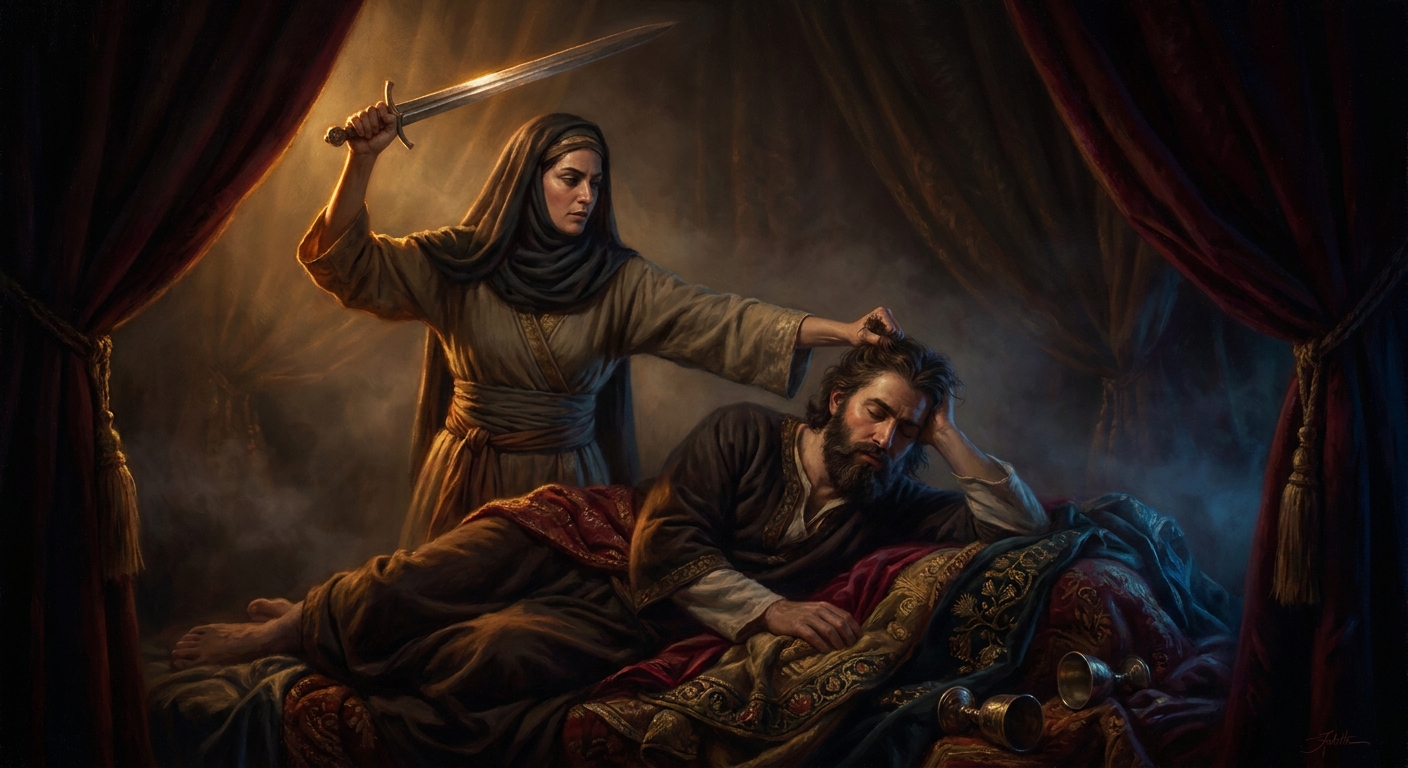
A beautiful widow walks into an enemy camp, drinks with the general, and cuts off his head. One of the most dramatic stories in the biblical tradition — and one of the most controversial, because it may be deliberate fiction.
| Aspect | Detail |
|---|---|
| Written | ~150 BC (possibly 2nd century BC during the Maccabean period) |
| Language | Possibly Hebrew originally; survived in Greek (Septuagint). No Hebrew manuscripts have been found |
| Genre | Historical novella / theological fiction. The geography and history are deliberately wrong — most scholars believe this is intentional |
| Canon status | Canonical in Catholic, Eastern Orthodox, and Ethiopian Orthodox churches. Rejected by Protestants. Not in the Jewish Tanakh |
| Named after | Judith (Yehudit) — from the Hebrew for “Jewish woman.” She may represent the Jewish nation itself |
The Assyrian general Holofernes, commanding the armies of Nebuchadnezzar (anachronistically called “king of the Assyrians”), besieges the Israelite town of Bethulia. The elders prepare to surrender after 34 days without water.
Judith, a beautiful, wealthy, and devout widow, rebukes the elders for their lack of faith. She puts on fine clothes, takes food and wine, and walks into the enemy camp with her maid. She tells Holofernes that she has defected and will reveal how to conquer Israel.
Over three days, she dines with Holofernes. On the final night, he drinks himself into a stupor, intending to seduce her. When they are alone:
“She went to the bedpost near Holofernes’ head, and took down his sword that hung there. She came close to his bed, took hold of the hair of his head, and said, ‘Give me strength today, O Lord God of Israel!’ Then she struck his neck twice with all her might, and cut off his head.” (Judith 13:6-8)
She carries his head back to Bethulia in a food bag. The Israelites display it on the wall. The Assyrian army panics and flees.
Judith 8:11-17 — Judith rebukes the elders:
“Who are you to put God to the test today, and to set yourselves up in the place of God in human affairs? You are putting the Lord Almighty to the test, but you will never learn anything!”
Judith 9:10 — Her prayer before the mission:
“By the deceit of my lips strike down the slave with the prince and the prince with his servant; crush their arrogance by the hand of a woman.”
Judith 16:7 — The victory hymn:
“The Almighty Lord has foiled them by the hand of a woman. For their champion did not fall by the hands of young men, nor did the sons of the Titans strike him down… but Judith daughter of Merari with the beauty of her countenance undid him.”
The book contains deliberate anachronisms: Nebuchadnezzar was king of Babylon, not Assyria. Bethulia cannot be located on any map. The historical details contradict each other. Most scholars believe the author intentionally scrambled the history to signal that this is a theological parable, not a historical report — much like Jesus’ parables use fictional scenarios to make true points.
- Historical inaccuracies — The deliberate anachronisms troubled reformers who valued historical accuracy
- Not in the Hebrew canon — No Hebrew original was known (still has not been found)
- Moral ambiguity — Judith uses deception and seduction in service of God. Some Protestant commentators found her methods morally troubling
- Jerome’s note — He included it in the Vulgate reluctantly, noting the Hebrews did not receive it among canonical scripture
| Tradition | Significance |
|---|---|
| Christian (Protestant) | Rejected from the canon but admired as literature. Luther called it “a fine, good, holy, useful book.” The story influenced Western art for centuries (Artemisia Gentileschi, Caravaggio, Klimt) |
| Catholic | Fully canonical. Judith is a type of the Virgin Mary (woman who defeats evil). Read in the liturgy. Her canticle (Judith 16) parallels the Magnificat (Luke 1:46-55) |
| Jewish | Not canonical but connected to Hanukkah traditions. Medieval Jewish midrashim retell the story. Judith embodies the theme of God delivering Israel through unlikely agents |
| Masonic | Not directly referenced, but the theme of a single courageous individual saving a community through wisdom and daring resonates with Masonic ideals of virtue and moral courage |
| Esoteric | Judith as the “divine feminine” agent of destruction — the woman who unmakes the warrior. Connected in some interpretations to the archetype of the sacred feminine as both beautiful and lethal |
| Ethiopian Orthodox | Fully canonical. Part of the Old Testament |