


World Religions Timeline
The events, stories, and turning points across every tradition.
A multi-tradition chronology — not just the Christian / Masonic line. Read this alongside the master Timeline (which is Abrahamic-deep) for the global picture.
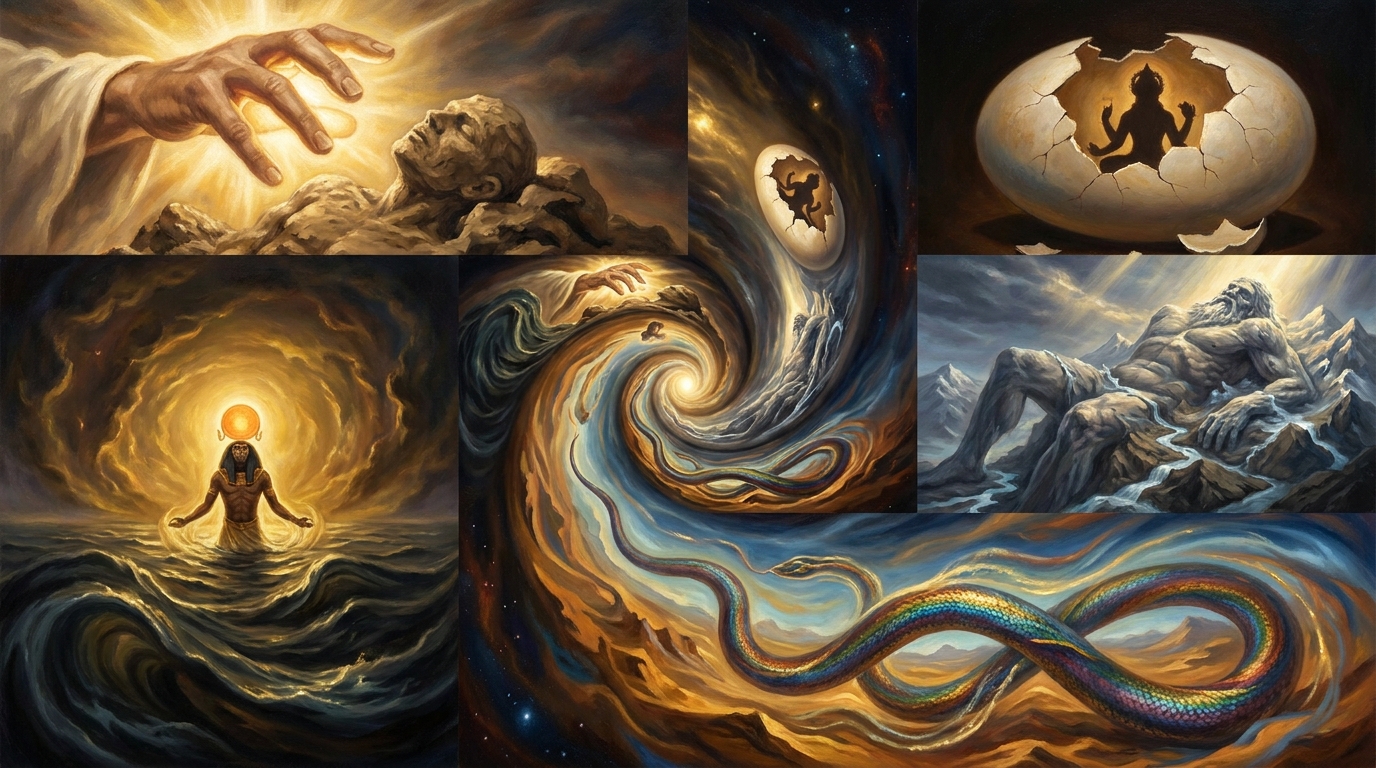
The events that took place "in the beginning" — before the calendar starts. Each tradition tells these as origin stories.
Greek
3- Chaos gives birth to Gaia, Tartarus, Eros — Hesiod's *Theogony*. The first generation — not gods but principles, erupting from formless void.
- Kronos castrates Ouranos; the Titans are born — Ouranos's blood falls into the sea; Aphrodite rises from the foam. The age of Titans begins. *Theogony* 154-200.
- Zeus overthrows Kronos in the Titanomachy — The Olympians defeat the Titans after ten years of war. Zeus draws lots with Poseidon and Hades; the cosmos is divided three ways. *Theogony* 617-735.
Maya
3- Tepeu and Gucumatz speak the world into being — Heart of Sky and the Feathered Serpent deliberate in darkness; their words raise mountains from the sea and cover them with forest. *Popol Vuh*, Tedlock trans.
- Three failed creations — animals, mud, wood — Animals cannot speak; mud people dissolve; wooden people have no souls. Household objects rise in revolt and burn the wood-people. The gods learn from failure. *Popol Vuh*.
- The corn people are created at Paxil — Xmucane grinds yellow and white corn nine times; the masa becomes the first true humans, who speak and remember their makers. Human flesh is made of the seed. *Popol Vuh*.
Polynesian
3- Te Kore — the void pregnant with potential — Before creation: not emptiness but darkness full of becoming. The cosmos proceeds from Te Kore through Te Po (night) toward the world of light.
- Tane separates Rangi (sky) from Papa (earth) — Rangi and Papa locked in eternal embrace, children in perpetual darkness between them. Tane forces them apart; light enters the world. *Maori creation tradition*.
- Maui fishes up the North Island — The trickster-demigod uses his grandmother's jawbone as a fishhook, casts it into the deep ocean, and hauls up Te Ika a Maui — the North Island of Aotearoa.
Biblical
2- Genesis 1: God speaks light out of the *tehom* — "Let there be light." Six days, then rest. The *tehom* (deep) mirrors Tiamat — chaos waters passive under divine spirit. Genesis 1:1-2.
- Eden: the garden, the prohibition, the serpent — Adam and Eve in the garden, one rule, one serpent. The Fall begins the whole arc of exile, covenant, and return. Genesis 2-3.
Chinese
2- Pangu hatches from the cosmic egg — Primordial chaos condenses into an egg; Pangu grows inside it for 18,000 years, then breaks it open. His body becomes the world — breath becomes wind, blood becomes rivers, bones become mountains.
- Nuwa models humans from yellow clay — Nuwa shapes the first humans one by one from yellow earth; when she tires, she drags a cord through mud. The flung droplets become ordinary people; the hand-shaped become nobles.
Dreamtime
2- The Rainbow Serpent shapes the land — The great serpent moves across the flat earth; where it coils, hills rise; where it rests, waterholes form. The land is the serpent's body. *Aboriginal Australian*.
- Ancestor beings sing the world into existence — The Dreaming is not past but a living dimension. Ancestor beings walked the land singing its features into existence — songlines that still map sacred geography. *Tjukurpa*.
Egyptian
2- Atum self-emerges from the waters of Nun — The first creation. Atum sneezes Shu and Tefnut into being on the primordial mound.
- Ra sails the solar barque through the Duat each night — The sun-god descends into the underworld at dusk, battles Apep the chaos-serpent, and rises reborn at dawn. Cosmic order renewed daily. *Book of the Dead*.
Hindu
2- Brahma emerges from the cosmic egg — The Hiranyagarbha, the golden womb, hatches the universe. *Rig Veda* 10.121.
- Vishnu reclines on the cosmic serpent Shesha — Between creations, Vishnu sleeps on Ananta-Shesha atop the primordial ocean. Brahma sprouts from his navel-lotus. The cycle of creation begins anew. *Puranas*.
Inca / Andean
2- Viracocha emerges from Lake Titicaca and creates the world at Tiwanaku — The bearded creator-god rises from the dark waters of Titicaca, forms the sun, moon, and stars, then sculpts the first humans from stone at Tiwanaku before sending them out across the Andes. He walks west across the ocean and is expected to return.
- Pachamama the earth mother sustains all living things — The earth-mother goddess of the Quechua-Aymara world is honored with libations of *chicha* poured directly onto the soil before drinking; offerings of coca leaves, llama fat, and silver are buried in *despachos*; her cult predates the Inca and survives every conquest, alive in Andean villages today.
Mesopotamian
2- Marduk slays Tiamat — The dragon-mother is split into sky and earth. Babylon's *Enuma Elish*.
- Enlil separates heaven from earth — An holds the sky, Enlil takes the earth, Enki claims the waters below. The Sumerian three-tiered cosmos is established. *Sumerian cosmogony*.
Native American
2- Spider Grandmother weaves the world (Hopi) — Spider Grandmother (Kokyangwuti) sings and weaves the pattern of existence; she teaches humanity the laws of life and connects each person to the sacred web.
- Sky Woman falls; the Great Turtle bears the world (Haudenosaunee) — Sky Woman falls through a hole in the upper world; Muskrat dives for mud; the turtle becomes the foundation of the earth. Turtle Island is born.
Norse
2- Ginnungagap — the yawning void before creation — Before sky or earth: the abyss between Niflheim (ice-mist) and Muspelheim (fire). Where heat met cold, dripping rime produced Ymir, the first being. *Voluspa* 1-4.
- Odin and brothers slay Ymir — The frost-giant's body becomes the world. Sky from his skull, sea from his blood. *Voluspa* 4-5.
Shinto
2- Izanagi and Izanami stir the ocean with the jeweled spear — The divine pair drip brine from the Ame-no-nuboko's tip; it congeals into the first island, Onogoro. They descend and generate the Japanese archipelago and its gods. *Kojiki* book 1.
- Amaterasu hides in the rock cave — The sun goddess withdraws in fury; darkness falls across the world. Eight hundred kami lure her out with a mirror, jewels, and the goddess Ame-no-Uzume's ecstatic dance. Light returns. *Kojiki*.
Yoruba
2- Oduduwa descends on a chain to found Ile-Ife — Olodumare sends Oduduwa down with a calabash of earth, a five-toed chicken, and a palm nut. Where the earth spreads becomes Ile-Ife, the navel of the world.
- Obatala descends with the chain — He shapes humans from clay; Olodumare breathes life.
Akan
1- Anansi bargains with Nyame for all stories — The spider pays three impossible prices — hornets, python, leopard — and wins custody of all human narrative from the sky god. Stories become sacred inheritance of all humanity.
Aztec / Maya
1- Quetzalcoatl and Tezcatlipoca shape the world — Five suns, four destroyed; we live in the fifth. *Codex Chimalpopoca*.
Canaanite
1- Baal defeats Yam and is crowned king of the gods — Baal, the storm god, defeats Yam the sea-chaos with weapons forged by the divine craftsman Kothar. El grants him a palace. The Baal cycle encodes the annual pattern of rain, death, and return. *Ugaritic tablets*.
Celtic
1- The Tuatha De Danann descend in clouds of mist — The divine race arrives in Ireland from four sacred cities, bringing four treasures: the Lia Fail (Stone of Destiny), the Spear of Lugh, the Sword of Nuada, the Cauldron of the Dagda. *Lebor Gabala Erenn*.
Dogon
1- Amma and the Nommo emerge from the cosmic egg — Amma the Creator shapes the world egg; the Nommo (amphibious civilizing spirits) hatch from it and teach humanity agriculture, weaving, language, and the stellar calendar.
Persian
1- Jamshid's golden age and the departure of the farr — Jamshid rules 700 years of peace; humans learn to forge, weave, and brew wine. Then pride breaks him: "I made all this." The divine farr departs. Zahhak seizes the throne. *Shahnameh*.
Siberian / Tengrism
1- Tengri the Eternal Blue Sky contains all realms — Tengri is not a god with personality but a sky-consciousness, the source of all cosmic legitimacy. The World Tree connects Upper, Middle, and Lower realms; shamans ascend and descend its axis in trance.
Zoroastrian
1- Ahura Mazda versus Angra Mainyu — the primal dualism — One uncreated Wise Lord opposed by one uncreated Destructive Spirit. The cosmos is their eternal battleground; every human soul chooses a side. *Gathas*, Yasna 30:3.
| Date | Event | Prophetic Significance |
|---|---|---|
| ~2091 BC | Abrahamic Covenant (Gen 12, 15) | God promises land, descendants, and blessing to all nations through Abraham's seed -- foundation of messianic prophecy |
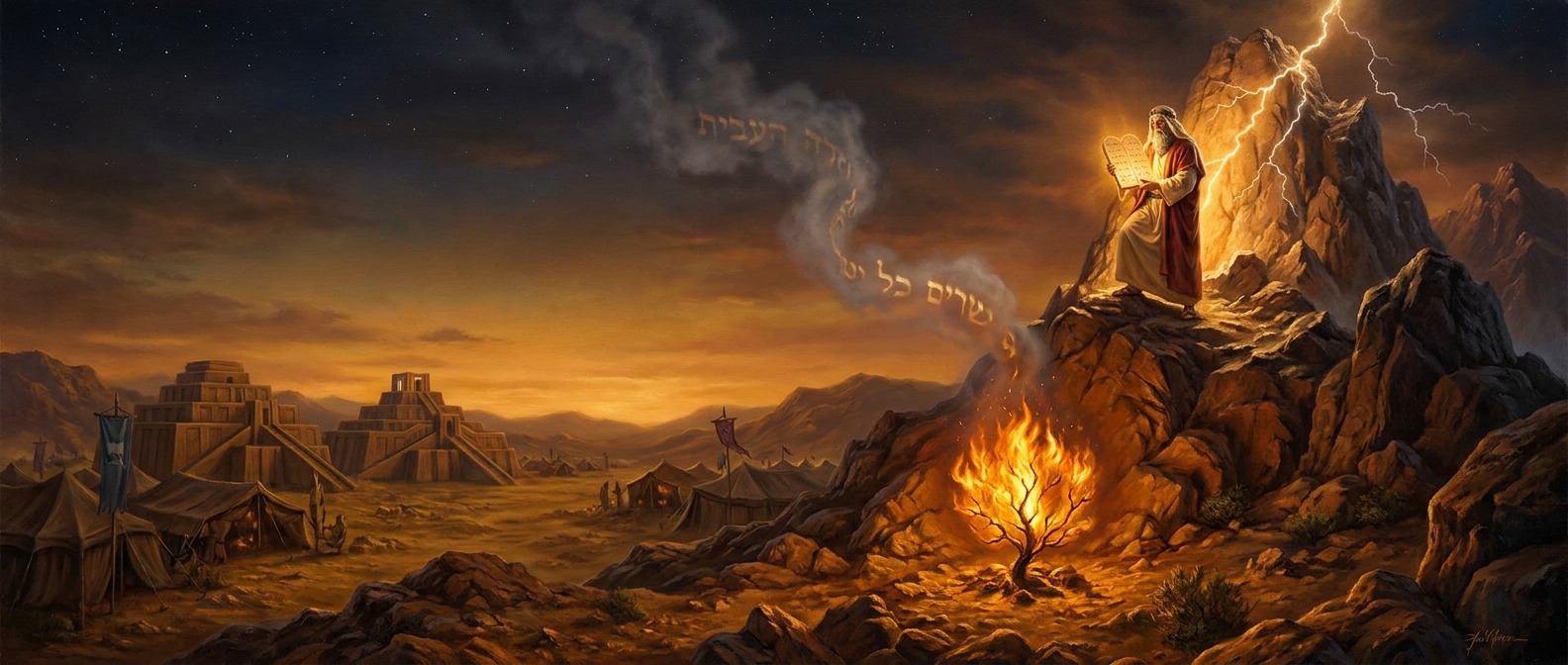
| ~1446 BC | Exodus from Egypt | Deliverance from bondage; foreshadows spiritual redemption through Christ; fulfills Gen 15:13-14 (400-year affliction prophecy) |
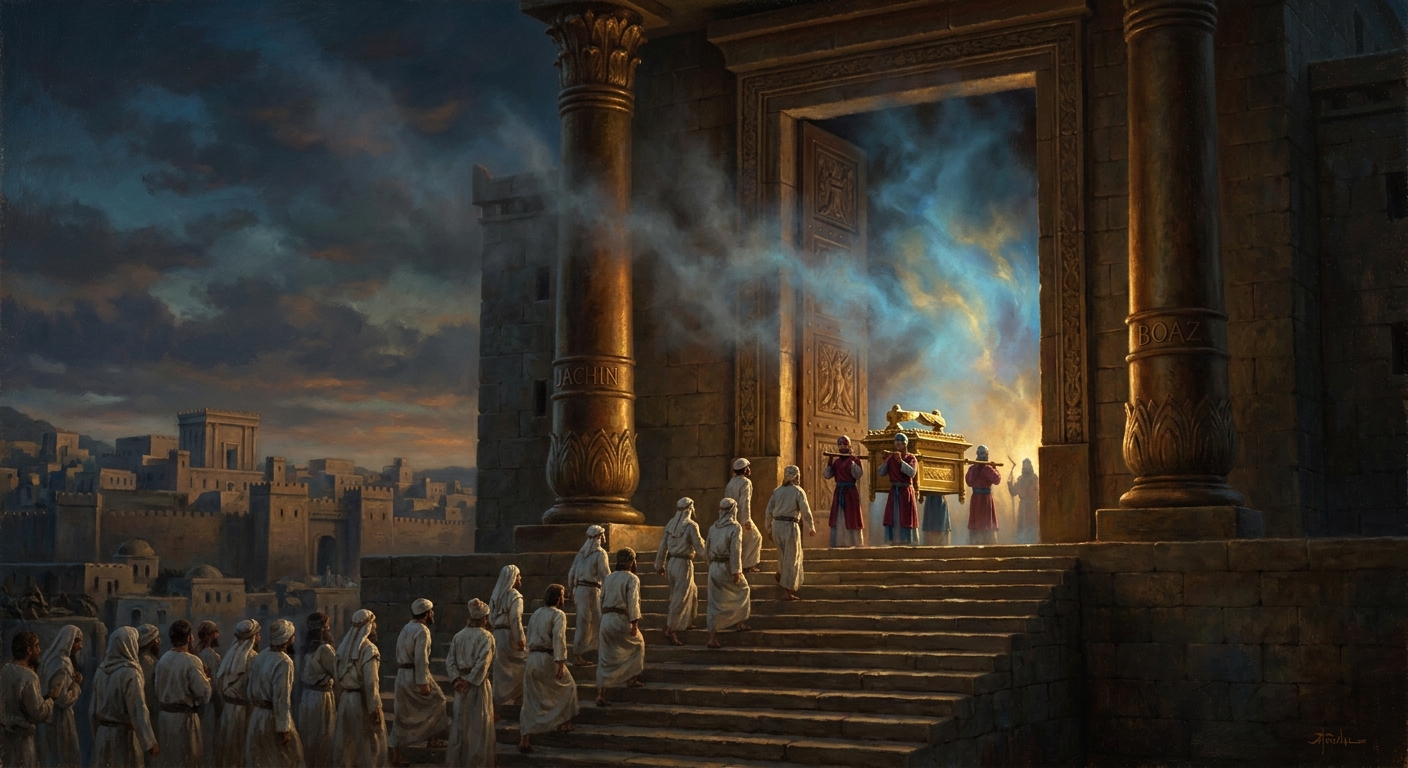
| ~966 BC | Solomon's Temple Constructed | Central dwelling place of God among His people; becomes the foundational symbol for both Christian theology and Masonic ritual |
 | 722 BC | Fall of Northern Kingdom (Israel) | Assyrian captivity; dispersal of the ten tribes; fulfillment of prophetic warnings (Hosea) |
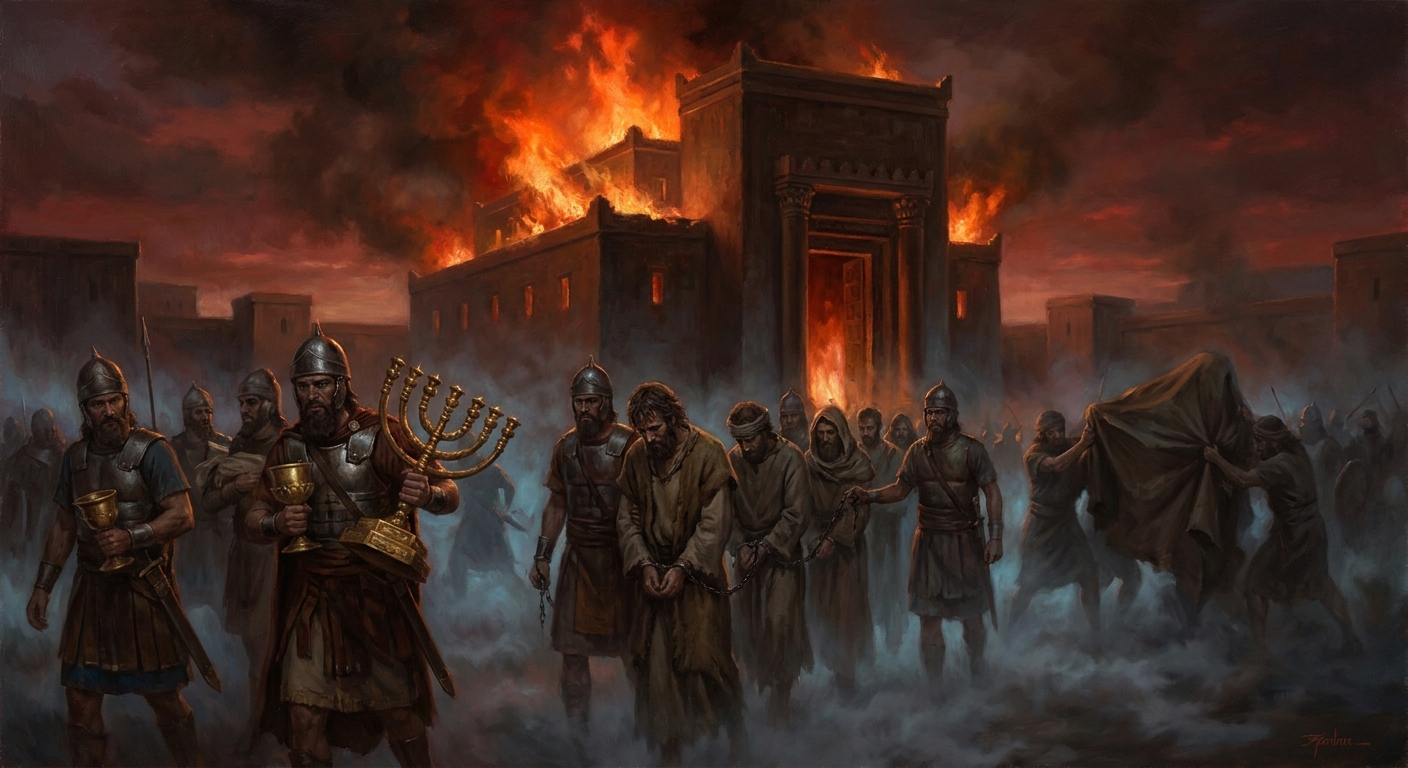
| 586 BC | Fall of Judah / First Temple Destroyed | Babylonian exile under Nebuchadnezzar; fulfills Jeremiah's prophecies of judgment; begins the 70-year captivity |
| 722 BC | Fall of Northern Kingdom (Israel) | Assyrian captivity; dispersal of the ten tribes; fulfillment of prophetic warnings (Hosea) |
| 586 BC | Fall of Judah / First Temple Destroyed | Babylonian exile under Nebuchadnezzar; fulfills Jeremiah's prophecies of judgment; begins the 70-year captivity |
 | ~556 BC | Daniel's Prophecies Written | The 70 Weeks, Nebuchadnezzar's Statue, Four Beasts, 2300 Days -- critical prophetic timeline material for all eschatological frameworks |
| 538 BC | Cyrus Decree -- Exile Ends | Persian conquest of Babylon; Cyrus allows Jewish return; fulfills Isaiah 44:28, 45:1 |
| 516 BC | Second Temple Completed | Zerubbabel's Temple dedicated; restoration of sacrificial system; less glorious than the First Temple |
| ~556 BC | Daniel's Prophecies Written | The 70 Weeks, Nebuchadnezzar's Statue, Four Beasts, 2300 Days -- critical prophetic timeline material for all eschatological frameworks |
| 538 BC | Cyrus Decree -- Exile Ends | Persian conquest of Babylon; Cyrus allows Jewish return; fulfills Isaiah 44:28, 45:1 |
| 516 BC | Second Temple Completed | Zerubbabel's Temple dedicated; restoration of sacrificial system; less glorious than the First Temple |
Daniel's Key Prophecies
The 70 Weeks (Daniel 9:24-27)
445 BC
Artaxerxes' edict
(Nehemiah 2)"] --> B["7 Weeks (49 yrs)
445-396 BC
Wall rebuilt in
times of distress"] B --> C["62 Weeks (434 yrs)
396 BC - ~32 AD
Messiah awaited"] C --> D["Messiah Appears
~32 AD
Triumphal Entry
(69 weeks = 483 yrs)"] D --> E["Messiah Cut Off
~33 AD
Crucifixion"] E -. "GAP: Church Age
(~2000 years)" .-> F["70th Week
Future 7-Year
Tribulation
(Futurist view)"] F --> G["Christ Returns
Second Coming"] style A fill:#4a6fa5,color:#fff style D fill:#6b8e23,color:#fff style E fill:#8b0000,color:#fff style F fill:#ff8c00,color:#000 style G fill:#daa520,color:#000
Note: The "gap" between the 69th and 70th week is the dominant Dispensational Premillennial interpretation. Preterists argue all 70 weeks were fulfilled by 70 AD. Historicists see progressive fulfillment through church history.
Nebuchadnezzar's Statue (Daniel 2)
| Part | Metal | Kingdom | Period |
|---|---|---|---|
| Head | Gold | Babylon | 605-539 BC |
| Chest & Arms | Silver | Medo-Persia | 539-331 BC |
| Belly & Thighs | Bronze | Greece (Alexander & successors) | 331-146 BC |
| Legs | Iron | Rome | 146 BC - 476 AD+ |
| Feet | Iron & Clay | Divided kingdoms (future confederation?) | Disputed |
| Stone | Cut without hands | God's Eternal Kingdom | Inaugurated by Christ; consummated at end of ages |
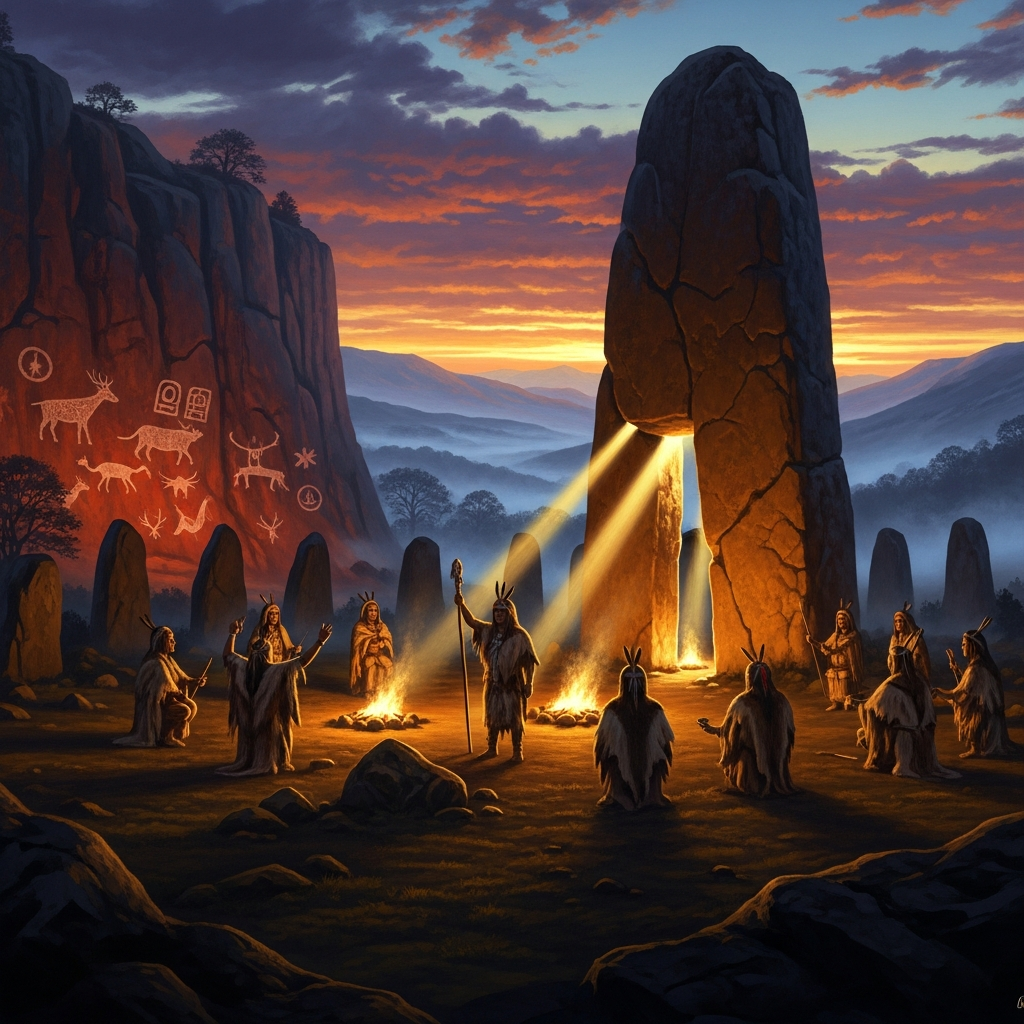
Before written history — cave painting, figurines, megaliths, and the first temples. Religion before agriculture, then religion shaping agriculture.
Paleolithic
8- ~45,500 BCE Warty pig painted on a Leang Tedongnge cave wall in Sulawesi — the oldest known figurative art on earth, predating European cave painting by millennia.
- ~40,000 BCE Earliest figurative cave art at Chauvet in southern France — lions, rhinos, and horses drawn with shading and perspective, evidence of symbolic and likely ritual cognition.
- ~38,000 BCE Lion-Man of Hohlenstein-Stadel carved from mammoth ivory — a 31-cm therianthropic figurine, the oldest known depiction of a being that is neither human nor animal.
- ~35,000 BCE Venus of Hohle Fels carved from mammoth ivory in Germany — the oldest known depiction of a human figure, exaggerated breasts and vulva suggesting fertility cult.
- ~28,000 BCE Venus of Willendorf carved from oolitic limestone in Austria — one of dozens of Venus figurines spanning Pyrenees to Siberia, hinting at a pan-European fertility goddess.
- ~26,000 BCE Sungir burials in Russia: two children and an adult interred with thousands of mammoth-ivory beads and red ochre — earliest elaborate grave goods, implying belief in an afterlife.
- ~17,000 BCE Lascaux cave paintings in the Dordogne — six hundred painted animals deep underground, including the enigmatic Shaft of the Dead Man with bird-headed shaman and bison.
- ~15,000 BCE Altamira cave paintings in northern Spain — polychrome bison rendered on the natural curves of the ceiling, the first known integration of stone form and painted image.
Anatolian
4- ~12,000 BCE Construction of Göbekli Tepe begins on a Turkish hilltop — T-shaped megalithic pillars carved with animals predate agriculture and pottery, the world's oldest known temple complex.
- ~10,500 BCE Younger Dryas cold snap shocks the climate; Göbekli Tepe reaches its peak as Pillar 43 (the Vulture Stone) is carved, possibly recording a comet impact in stone.
- ~8,000 BCE Çatalhöyük settlement begins on the Konya plain — eight thousand people in clustered mud-brick houses entered through the roof, walls painted with leopards, vultures, and births.
- ~7,000 BCE Çatalhöyük's bull-shrines mature — bucrania mounted on walls, seated-goddess figurine flanked by leopards from a grain bin, hinting at a Mother Goddess and bull cult.
Levantine
4- ~10,000 BCE Beginning of agriculture in the Fertile Crescent — domesticated wheat, barley, and rituals follow; the sacred landscape now includes sown fields and the cycle of harvest.
- ~9,000 BCE Jericho's earliest stone tower and wall rise on the Jordan plain — eight metres tall, the oldest known monumental architecture, possibly a solar marker for the Quruntul ridge.
- ~8,500 BCE Plastered skulls of Jericho and Ain Ghazal — ancestor skulls cleaned, coated with lime plaster, and inset with cowrie-shell eyes; the dead kept present among the living.
- ~7,500 BCE Ain Ghazal anthropomorphic statues in Jordan — life-sized lime-plaster figures with bitumen-rimmed eyes, the oldest known monumental human sculptures, ritually buried in caches.
Atlantic European
3- ~5,500 BCE First megalithic structures rise in Brittany and Portugal — passage graves and standing stones, predating the Pyramids by two millennia, beginning the Atlantic megalithic tradition.
- ~5,000 BCE Megalithic tombs proliferate along the Atlantic facade — Carrowmore in Ireland, Barnenez in France, dolmens of Iberia — collective burial monuments precede Newgrange and Maeshowe.
- ~4,000 BCE Carnac stones erected in Brittany — over three thousand standing menhirs in parallel rows stretching for kilometres, the largest megalithic alignment on earth, purpose still debated.
Neolithic British
2- ~3,500 BCE Stonehenge cursus monuments cut into the Salisbury chalk — long parallel ditches three kilometres in length, ceremonial avenues whose purpose preceded the famous stone circle by centuries.
- ~3,100 BCE Stonehenge phase 1: a circular henge ditch and bank with 56 Aubrey Holes is dug on Salisbury Plain — possibly cremation pits aligned to lunar cycles, before any stone is raised.
Old Europe
2- ~6,000 BCE Vinča culture flourishes across the Balkans — bird-headed and snake-headed goddess figurines by the thousands, evidence (per Marija Gimbutas) of a peaceful matrifocal religion.
- ~4,500 BCE Vinča tablets from Tărtăria in Romania bear incised symbols — possible proto-writing predating Sumerian cuneiform by a thousand years, though their meaning remains undeciphered.
Andean
1- ~3,000 BCE Norte Chico civilization raises stepped pyramids at Caral on the Peruvian coast — monumental ceremonial centres in the New World contemporary with the first Egyptian pyramids.
First Nations
1- c. 40000 BCE North American peoples arrive; begin developing shamanic traditions, spirit-world cosmologies, and oral mythologies
Inuit
1- c. 8000 BCE Arctic peoples settle circumpolar regions; develop Sedna cosmology, angakkuq (shaman) traditions, and relationship with sea animals as spiritual beings
Mesopotamian
1- ~3,500 BCE Sumerian Uruk-period temple-states emerge — Eanna precinct dedicated to Inanna, mud-brick ziggurats rising on platform mounds; the first economies organised around divine households.
Natufian
1- ~11,000 BCE Natufian burials at Eynan and Hilazon Tachtit include grave goods, dog companions, and a female shaman buried with tortoise shells — emergent ritual specialists.
Polynesian
1- c. 30000 BCE Proto-Polynesian seafaring peoples develop navigational cosmologies connecting stars, ocean swells, and ancestral spirits
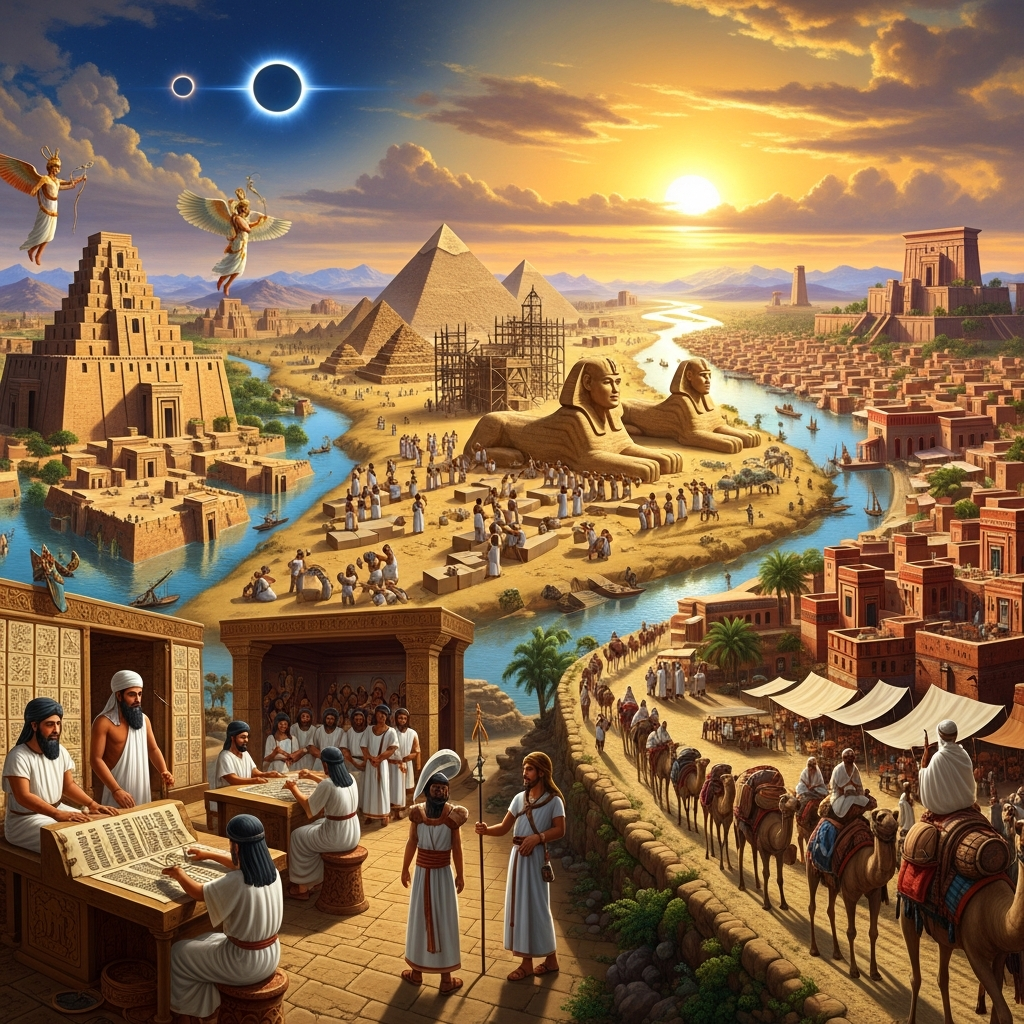
Mesopotamian
19- ~3800 BCE Eridu — the southernmost Sumerian city and the oldest in the King List, founded in the Ubaid period; eighteen successive temple strata excavated on the same spot confirm an unbroken tradition of sacred architecture stretching back to ~5000 BCE; the Sumerians called it the first city the gods built.
- ~3500 BCE Tell Brak temple ruins in northern Syria — among the world's earliest identified sacred structures, predating the Sumerian city-state temples by centuries; mass-produced clay "eye idols" fill the sanctuary by the thousands, suggesting votive religion already systematized.
- ~3400 BCE Eanna sanctuary at Uruk — the great temple precinct dedicated to Inanna, the earliest urban religious complex in Mesopotamia; the White Temple's mud-brick platform rises above the plain as a visual axis between earth and heaven.
- ~3200 BCE Cuneiform writing invented at Uruk — the world's first script, beginning as temple bookkeeping for grain and sheep, becoming the medium for the oldest religious literature on earth.
- ~3200 BCE Cuneiform's first religious uses at Uruk — within a generation of its invention for temple grain accounting, scribes begin recording god-names, ritual sequences, and incantations; the world's first writing system is immediately sacralized.
- ~3000 BCE Sumerian city-states — Uruk, Ur, Eridu, Nippur, Lagash — each centered on a ziggurat temple. Religion is municipal: Inanna owns Uruk, Nanna owns Ur, Enlil owns Nippur.
- ~3000 BCE Rise of the *en* (priest-king) at Uruk and other Sumerian cities — the *en* mediates between the city-god and the populace, manages temple estates, and leads ritual; the fusion of priestly and royal authority that will define Near Eastern governance for two millennia.
- ~2900 BCE The Sumerian King List composed — the first sacred genealogy of history, listing kings with impossibly long pre-Flood reigns followed by historically verifiable dynasties.
- ~2700 BCE Gilgamesh of Uruk — a historical king whose legendary deeds accumulate over 700 years into the world's first epic; attested in the Sumerian King List.
- ~2600 BCE Earliest Sumerian Flood narrative — the Eridu Genesis fragment, in which the pious king Ziusudra survives a divine deluge in a great boat and is granted immortality, predates the Akkadian Atrahasis Epic and Genesis by centuries; the Flood is established as Mesopotamia's theological punctuation mark between mythic and historical time.
- ~2600 BCE Royal Cemetery of Ur — excavated by Leonard Woolley, the death pits (~2600–2400 BCE) contain dozens of attendants buried with their kings in full court dress; the theology of the royal afterlife is lethal and literal: the whole court follows the dead king into the next world rather than merely depicting the journey in art.
- ~2400 BCE First written *Descent of Inanna* tablets at Nippur — the oldest death-and-resurrection narrative in world literature; Inanna descends through seven gates stripped of power, is killed, and rises.
- ~2350 BCE Akkadian eclipse-and-omen literature — the court of Naram-Sin (grandson of Sargon) produces the earliest systematic omen texts correlating celestial events with earthly outcomes; solar and lunar eclipses are classified as divine speech; this tradition grows into Babylonian astrology and reaches Greece and Rome via Hellenistic transmission, shaping Western astrology for two millennia.
- ~2334 BCE Sargon of Akkad forges the world's first multi-ethnic empire — Sumerian gods renamed in Akkadian (Inanna becomes Ishtar, Enki becomes Ea) but the pantheon survives the conquest intact.
- ~2300 BCE Enheduanna, daughter of Sargon and high priestess of Nanna at Ur, composes hymns to Inanna — the first named author in human history and the first individual religious voice in the historical record.
- ~2112 BCE Ur III dynasty — last great Sumerian renaissance; the Ziggurat of Ur built for the moon-god Nanna; the most architecturally complete surviving ziggurat in the world.
- ~2100 BCE Sumerian Epic of Gilgamesh begins to coalesce — the first literary cycle in history, beginning the 600-year process toward the Standard Babylonian Epic.
- ~2100 BCE Ziggurat of Ur completed under Ur-Nammu for the moon-god Nanna — the most architecturally intact surviving ziggurat; later Jewish tradition will identify Ur as the Chaldean city Abraham left at YHWH's call.
- ~2050 BCE Code of Ur-Nammu promulgated at Ur — the oldest surviving law code, predating Hammurabi by three centuries; its prologue frames legal reform as the moon-god Nanna's command to root out corruption and protect the orphan and widow.
Egyptian
13- ~3500 BCE Naqada II culture burial practices — bodies interred with painted pottery, slate palettes, and ritual grave goods in Upper Egypt; the ivory tags and decorated vessels signal a developing theology of the afterlife journey centuries before dynastic Egypt.
- ~3100 BCE Narmer unifies Upper and Lower Egypt; the pharaoh established as the living incarnation of Horus and son of Ra — the first theocratic state in history. *Narmer Palette*.
- ~2700 BCE Pyramid Texts begin to be inscribed (oldest religious writings) — a complete theology of ma'at, Osiris, and the soul's journey already carved into stone.
- ~2670 BCE Step Pyramid of Djoser at Saqqara — architect Imhotep translates the royal mastaba into six stacked stone steps, the first monumental religious building in cut limestone on earth; the structure encodes an ascent-theology: the dead king climbs the stone staircase to join the circumpolar stars.
- ~2650 BCE Step Pyramid of Djoser at Saqqara built — the first monumental stone building on earth; an ascent-theology made in limestone; the pharaoh's body climbing to Ra.
- ~2650 BCE Imhotep deified — the physician, scribe, and architect of Djoser's Step Pyramid is venerated as a sage during his lifetime and formally deified by the Late Period; temples to Imhotep at Saqqara and Philae make him Egypt's patron of healing, identified by the Greeks with Asclepius.
- ~2560 BCE Great Pyramid of Khufu at Giza completed — the most ambitious monument to a theology of royal solar ascent ever built; oriented with astronomical precision to the northern pole star.
- ~2500 BCE Rise of the cult of Ra at Heliopolis — the solar theology of the Ennead is systematized; the *benben* stone, forerunner of the obelisk, marks the spot where Ra first alighted; sun-temples with open courts replace enclosed shrines, reorienting Egyptian religion toward the sky.
- ~2400 BCE Pyramid Texts at Saqqara — carved in blue-filled hieroglyphs inside the pyramid of Unas, 283 spells constitute the world's oldest surviving religious literature; they describe the pharaoh's night voyage through the Duat, his union with Ra, and his conquest of the sky on the wings of a divine falcon.
- ~2350 BCE Old Kingdom Pyramid Texts at Saqqara under Pharaoh Unas — 283 spells carved in blue-filled hieroglyphs; the oldest religious literature on earth, older than Genesis by over a millennium.
- ~2181 BCE First Intermediate Period collapse of divine kingship — the centralized theology of the infallible pharaoh fractures; the *Admonitions of Ipuwer* lament social inversion as cosmic disorder, proof that *ma'at* was not merely a concept but the structural force holding reality together; when the pharaoh fails, the Nile itself is described as running backwards.
- ~2100 BCE The "Good Shepherd" pharaoh theology — the *Teachings for Merikare*, composed during the First Intermediate Period, describes the ideal ruler as a shepherd who feeds and protects his flock; the pastoral metaphor for divine kingship appears here five centuries before the Hebrew psalms embed it in Israelite theology.
- ~2060 BCE Middle Kingdom begins; the afterlife is democratized — Coffin Texts spread spells once reserved for royalty to nobles and merchants; Osiris becomes accessible to all.
Chinese
5- ~2800 BCE Emperor Yao and the sacred calendar — the *Shujing* (Book of Documents) attributes to the legendary Emperor Yao the first systematic astronomical calendar, commanding officials to observe the four cardinal stars to mark the seasons; Chinese cosmology from its earliest phase sacralizes the calibration of human time to heaven as the emperor's supreme ritual obligation.
- ~2500 BCE Legendary Yellow Emperor Huangdi reigns in Chinese tradition; credited with inventing writing, medicine, and the calendar — the sacralizing of cultural founders as deity-ancestors begins.
- ~2200 BCE Traditional dating of the Great Flood of China; Yu the Great tames the waters by channeling them for nineteen years — the founding act of Chinese civilization as righteous sacred labor.
- ~2200 BCE Yu the Great tames the Yellow River floods — in Chinese founding mythology, Yu spends nineteen years channeling floodwaters through mountains, so devoted he passes his own home three times without entering; the Xia dynasty he founds sacralizes hydraulic engineering as the supreme act of civilizational piety.
- ~2070 BCE Xia dynasty religious practice — the quasi-mythological first dynasty performs *she* (earth altar) sacrifices to agricultural deities and maintains ancestral temples; the pattern of correlating dynastic legitimacy with proper ritual performance is established as the bedrock of Chinese political theology.
Neolithic European
5- ~4500 BCE Carnac standing stones in Brittany — over 3,000 menhirs arranged in parallel alignments stretching 4 km across the landscape; astronomical alignments and associated megalithic tombs point to a Neolithic Atlantic religion centered on ancestors, lunar cycles, and agricultural fertility.
- ~3200 BCE Newgrange passage tomb in Ireland completed — oriented to the winter solstice sunrise; one of the oldest astronomical-religious monuments on earth; predates Stonehenge and Giza.
- ~3200 BCE Newgrange solar alignment — the cruciform passage tomb in Ireland's Boyne Valley is sealed at completion; on the winter solstice sunrise a shaft of light penetrates the 19-meter passage and illuminates the back chamber for seventeen minutes; the architecture encodes a rebirth theology: the dead enter darkness and are reborn with the returning sun.
- ~3000 BCE Stonehenge Phase I — a circular ditch-and-bank enclosure dug on Salisbury Plain; cremated human remains interred within; the monument is already oriented toward the midsummer solstice axis, demonstrating astronomical religion three centuries before the famous sarsen stones arrive.
- ~2500 BCE Stonehenge begins taking shape in southern Britain — the sarsen circle and trilithon horseshoe (~2500-1500 BCE) are aligned to midsummer sunrise and midwinter sunset; the most sophisticated megalithic solar-religious monument on earth.
Indus Valley
4- ~3000 BCE Harappan civilization at Mohenjo-daro and Harappa; planned cities with possible ritual bath complexes; seals showing a horned figure in yogic posture — possibly proto-Shiva.
- ~2600 BCE Urban peak at Mohenjo-daro; Great Bath — possibly the world's first ritual purification structure; a theology of cleanliness as sacred long predating Vedic fire sacrifice.
- ~2600 BCE Mother Goddess figurines at Mehrgarh and Harappan sites — terracotta female figurines with exaggerated hips and elaborate headdresses, found in nearly every domestic context, point to a widespread goddess cult predating the Vedic period by two millennia.
- ~2500 BCE Proto-Shiva seals at Mohenjo-daro — the "Pashupati seal" depicts a cross-legged figure with three faces, wearing a horned headdress, surrounded by animals; the posture and iconography anticipate the later Hindu Shiva as Lord of Beasts by more than a millennium.
Minoan
2- ~3000 BCE Prepalatial Minoan religion on Crete — peak sanctuaries on mountain summits and cave cult deposits at Psychro and Kamares signal a goddess-and-landscape religion a full millennium before the palace frescoes make it famous; the sacred mountain, not a built temple, is the earliest Minoan axis mundi.
- ~2000 BCE Minoan goddess religion takes form on Crete — snake goddesses, double axes (*labrys*), bull-horns of consecration, and ecstatic priestesses appear across Knossos palace frescos and seal-rings; the dominant sacred figure is female, suggesting a theocratic religious structure distinct from the male-dominant Near Eastern pattern.
Sumerian
2- ~2900 BCE Sumerian King List composed — antediluvian kings reign for tens of thousands of years before the Flood; post-Flood dynasties shrink to human scale; the document encodes a sacred-historical argument that kingship "descended from heaven" and was interrupted but never abolished by the Flood.
- ~2700 BCE Dumuzi-Inanna sacred marriage hymns — Sumerian temple liturgy describes the ritual union (*hieros gamos*) of the king with the goddess Inanna to ensure agricultural fertility; the erotic sacred marriage poetry is the oldest love literature in the world and the direct ancestor of the Song of Solomon's imagery, transmitted through a thousand years of scribal copy.
Akkadian
1- ~2300 BCE Bilingual Sumero-Akkadian scribal tradition — as Sargon's empire expands, Sumerian god-lists are translated into Akkadian (*Inanna → Ishtar*, *Enki → Ea*); rather than suppression, a bilingual scribal culture preserves both layers simultaneously, producing the first deliberate act of comparative religion as an imperial administrative project.
Chalcolithic
1- ~3300 BCE Ötzi the Iceman perishes in the Alps — carrying a copper axe, medicinal herbs, and tattoo marks corresponding to acupuncture-adjacent pressure points; the oldest well-preserved European human reveals that Copper Age Alpine peoples practiced a ritual or shamanic body art predating any written tradition in the region by two millennia.
Cycladic
1- ~2700 BCE Cycladic figurines peak production in the Aegean — flat marble female figures with folded arms, some nearly life-sized, placed in graves across the Cyclades; their stark abstraction suggests a theology of the divine feminine stripped to geometric essence, centuries before Greek anthropomorphic gods.
Eblaite
1- ~2400 BCE Ebla tablets unearthed at Tell Mardikh in Syria — 17,000 cuneiform fragments record bilingual Sumerian–Eblaite god-lists naming Dagan, Resheph, and a deity *Ya*, the earliest Semitic religious archive west of Mesopotamia.
Hindu
1- ~2000 BCE Earliest Vedic hymns composed orally in north India by Indo-Aryan sages — fire sacrifice (*yajna*) to Agni, Indra, and Varuna; oral preservation with mnemonic precision astonishing to modern philologists.
Jain
1- c. 2600 BCE Traditional dating of Rishabhanatha (Adinatha), first Jain tirthankar, founding the path of non-violence and liberation
Jewish / Christian
1- ~2091 BCE Abrahamic covenant (traditional dating, Gen 12) — Abram leaves Ur of the Chaldeans at divine command; the first act of the monotheistic narrative that will shape half the planet.
Korean
1- ~2333 BCE Traditional founding of Gojoseon by Dangun — Hwanung descends to Mount Taebaek; the bear-woman Ungnyeo endures twenty-one days of garlic and mugwort and becomes human; their son founds the first Korean kingdom. *Tan'gun Sinhwa*.
Mesoamerican
1- ~1500 BCE Olmec antecedents on Mexico's Gulf Coast — pre-Olmec villages in the Soconusco region already practice the ritual ballgame, produce were-jaguar pottery, and orient mound-platforms to cardinal directions; the religious grammar that San Lorenzo will crystallize in colossal stone is already forming.
Nubian
1- ~2000 BCE Kerma culture rises in Upper Nubia — the earliest sub-Saharan African urban civilization (~2500–1550 BCE) builds massive tumulus burial mounds; the Kerma "Deffufa" mud-brick temple structures are the oldest religious buildings south of Egypt; cattle-sacrifice pits surrounding royal burials encode a pastoral theology in which cattle are simultaneously wealth, identity, and the supreme sacred offering.
Polynesian
1- c. 2000 BCE Proto-Polynesian peoples expand from Taiwan/Southeast Asia into the Pacific; develop navigational canoe-building theology (canoe as sacred vessel)
South American
1- ~2600 BCE Caral civilization in Peru's Supe Valley — the oldest urban center in the Americas (~2600-2000 BCE), featuring six large platform mounds aligned to astronomical events; circular sunken plazas at each mound's base served as communal ritual spaces with no evidence of warfare — a religion organized around ceremony rather than conflict.
South Asian
1- ~3500 BCE Mehrgarh ritual complex in the Indus corridor — this Neolithic-to-Chalcolithic site (occupied ~7000–3200 BCE) yields fired-clay female figurines alongside communal fire hearths; it bridges the Neolithic to the Indus Valley civilization and demonstrates continuity of goddess veneration across three millennia before the Rigveda is composed.
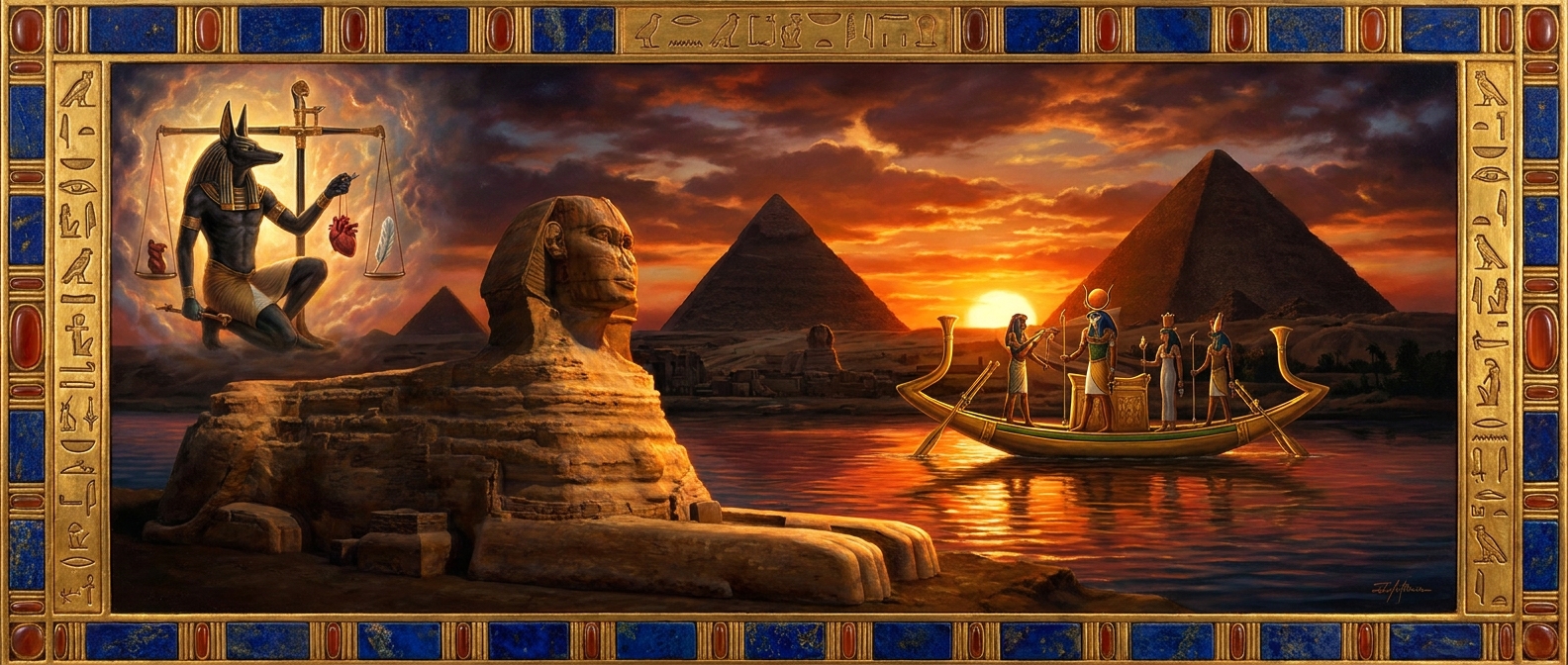
Egyptian
14- ~1900 BCE Egyptian Execration Texts — pottery bowls and clay figurines inscribed with enemies' names are smashed in ceremony; the theology of *heka* (magic-power) is deployed as statecraft; the texts also reveal that Canaanite city-states, including a place called "Urusalimum" (Jerusalem), are already known to Egypt in the Middle Kingdom.
- ~1900 BCE Democratization of the afterlife via Coffin Texts — spells once carved only in royal pyramid chambers are now painted inside wooden coffins for wealthy non-royals; the theology of the Duat, the weighing of the heart, and the paradise of the Field of Reeds becomes commercially available to anyone who can afford a craftsman.
- ~1650 BCE Hyksos invasion introduces Set as a Semitic deity — the Hyksos rulers of Lower Egypt adopt the Egyptian god Set as their patron, identifying him with the Semitic storm-god Ba'al; for the first time a foreign religious tradition reshapes the Egyptian pantheon from inside, a trauma Egyptian theology will remember for centuries.
- ~1550 BCE New Kingdom Amun-Ra solar theology — the composite deity Amun-Ra combines the hidden cosmic principle (Amun, "the hidden one") with visible solar power (Ra); Karnak temple grows over thirteen centuries into the largest religious building ever constructed, its axis aligned to the midwinter solstice sunrise across 2.5 km of processional way.
- ~1550 BCE New Kingdom begins — Karnak and Luxor temples built; Amun-Ra as supreme state god; the Book of the Dead becomes customizable mass-market funerary scripture.
- ~1550 BCE Book of the Dead proliferates — customizable funerary scrolls sold to anyone with coin; Anubis weighs the heart against Ma'at's feather; the world's first mass-market salvation product.
- ~1475 BCE Hatshepsut's reign — first great female pharaoh; her mortuary temple at Deir el-Bahri depicts divine birth from Amun himself; she rules as full god-king for twenty-two years before her name is erased.
- ~1353 BCE Akhenaten's monotheistic revolution — Pharaoh Amenhotep IV renames himself Akhenaten, abolishes the entire Egyptian pantheon, installs the sun-disk Aten as sole god; seventeen years of state monotheism centuries before Moses.
- ~1353 BCE Akhenaten's Aten heresy — Pharaoh Amenhotep IV changes his name to Akhenaten ("Effective for Aten"), closes all other temples, redistributes their wealth to the Aten cult, and moves the capital to the virgin site of Akhetaten (Amarna); for seventeen years Egypt operates under the world's first historically documented monotheism, the Aten represented only as the sun-disk whose rays end in human hands.
- ~1336 BCE Akhenaten dies; Tutankhamun restores the old gods; the priesthood of Amun systematically erases Akhenaten from the historical record — the first *damnatio memoriae* in antiquity.
- ~1336 BCE Tutankhamun's restoration of the old gods — the young pharaoh reverses every Atenist reform, restores the Amun priesthood's wealth and authority, and re-opens closed temples; his restoration stele speaks of the gods having "turned their backs" on Egypt during the heresy; the systematic erasure of Akhenaten's name from monuments begins immediately.
- ~1279 BCE Ramses II's reign and monumental theology — ruling 66 years (1279-1213 BCE), Ramses II covers Egypt and Nubia in temples at Abu Simbel, the Ramesseum, and Karnak depicting himself as a god equal to Ra; the Abu Simbel inner sanctuary is aligned so the sun illuminates the cult statues of Ramses and Ra on the king's birthday and coronation anniversary twice a year.
- ~1270 BCE Ramses II's Abu Simbel solar alignment — the inner sanctuary of the Great Temple is engineered so that twice a year the sunrise illuminates the cult statues of Ramses, Ra-Horakhty, and Amun while the statue of Ptah (god of darkness) remains in shadow; theology encoded in architectural astronomy at the frontier of empire, 1,200 km from Memphis.
- ~1180 BCE Ramses III defeats the Sea Peoples at the Battle of the Delta (~1178 BCE) — the last great Egyptian imperial victory is recorded at Medinet Habu temple in exhaustive relief; the theology of pharaonic war as divine performance reaches its apex; within a century Egypt's imperial theology will be permanently diminished and the priests of Amun will effectively rule in the pharaoh's name.
Mesopotamian
10- ~2112 BCE Code of Ur-Nammu — the oldest surviving law code in history, predating Hammurabi by more than three centuries; Ur-Nammu invokes Nanna the moon-god and Utu the sun-god as divine patrons of justice; the prologue explicitly frames legal reform as gods commanding the elimination of corruption, orphan exploitation, and false weights.
- ~1900 BCE First written texts of the Atrahasis flood epic — the Babylonian flood hero survives by divine favor; the parallels with Noah are structural and nearly verbatim; a shared Bronze Age theological grammar.
- ~1900 BCE Sumerian King List codified (~1900 BCE) — multiple scribal copies from the Isin-Larsa period standardize the list of kings from before the Flood to the current dynasty; the theological argument is explicit: kingship is a divine institution that the Flood interrupted but could not destroy; the document legitimates every subsequent Mesopotamian ruler by embedding them in a cosmos-sanctioned succession.
- ~1850 BCE Old Babylonian *Epic of Gilgamesh* composed — the earliest continuous version; the flood narrative (Tablet XI) now fully embedded; Utnapishtim tells Gilgamesh the secret of immortality he cannot keep.
- ~1800 BCE *Enuma Elish* composed in Babylon — Marduk slays Tiamat; the Akitu New Year festival begins reciting it annually to ritually reactivate cosmic order over chaos.
- ~1754 BCE Code of Hammurabi inscribed on black diorite stele — 282 laws received from the sun-god Shamash; the oldest substantially preserved law code in history; "an eye for an eye" appears here five centuries before Exodus.
- ~1754 BCE Code of Hammurabi's religious framework — the black diorite stele shows Hammurabi receiving the law directly from Shamash, the sun-god of justice; Marduk of Babylon is invoked as the supreme deity authorizing royal legislation, fusing jurisprudence and theology into a single monument that "an eye for an eye" will echo in Exodus five centuries later.
- ~1350 BCE Kassite Babylonian religious scholarship — the Kassite dynasty (~1595–1155 BCE) sponsors compilation of the great Babylonian "list science": the *Enuma Anu Enlil* omen series of 70 tablets and the *MUL.APIN* star catalog systematize Babylonian astronomy-theology into a form transmitted to Greece via Hellenistic scholars, laying the foundation of Western astrology.
- ~1300 BCE Standard Babylonian Epic of Gilgamesh fixed by the scribe Sin-leqi-unninni — twelve tablets, the definitive canonical version; Tablet XI shares flood details almost verbatim with Genesis 6-9.
- ~1200 BCE Standard Babylonian *Epic of Gilgamesh* canonized in Akkadian by the scribe Sin-leqi-unninni — twelve tablets fix the definitive version; Tablet XI's flood narrative shares vocabulary, structure, and details (the dove, the raven, the mountain landfall) with Genesis 6–9 so closely that literary dependence is now scholarly consensus.
Hindu
9- ~1700 BCE Indo-Aryan migration into Indus Valley begins — Sanskrit-speaking peoples bring the Vedic fire-sacrifice (*yajna*) culture that will absorb and transform the Indus Valley religious substrate.
- ~1500 BCE Rig Veda compiled — 1,028 hymns to Agni, Indra, soma, Ushas, and Varuna; the oldest religious text in continuous use anywhere on earth; oral transmission preserves it syllable-perfect for a millennium before writing.
- ~1500 BCE Rigveda composition in oral form — 1,028 hymns in ten *mandalas* composed by seer-families (*rishis*) in the greater Punjab; the hymns address Agni (fire), Indra (storm), and Soma (the ritual drink) in meters so precise that Vedic Sanskrit's phonology can be reconstructed today; the Rigveda is the oldest text in continuous religious use on earth.
- ~1500 BCE Indo-Aryan migration into the Indus basin — Sanskrit-speaking pastoral peoples enter northwest India bringing the *yajna* (fire-sacrifice) theology; interaction with the Indus Valley substrate produces the synthesis of Vedic and pre-Vedic religion that becomes classical Hinduism's dual foundation: the priestly Vedic strand and the devotional goddess/Shiva strand.
- ~1350 BCE Sat/Asat distinction in early Vedic cosmology — the Rigveda's Nasadiya Sukta (10.129) poses the question "Neither existence nor non-existence was then" and leaves it deliberately open; the philosophical category of *sat* (being) vs. *asat* (non-being) anticipates the monotheistic tendency in Vedism that some scholars compare structurally to the Aten theology of Akhenaten's Egypt.
- ~1200 BCE Rise of the Vedic Brahmin priestly class — the *Brahmanical* caste system crystallizes as specialist priest families (*gotras*) monopolize the complex multi-day soma sacrifices requiring years of memorization; the codification of Sanskrit pronunciation as sacred duty (any mispronunciation invalidates the ritual) transforms language itself into a theological object.
- ~1000 BCE Upanishads begin to be composed — the internalization of the fire-sacrifice; Brahman and Atman as identical; the mystical monism that will anchor all subsequent Hindu philosophy.
- ~1000 BCE The Atharva Veda compiled — the fourth and youngest Veda diverges from the priestly trio of Rig, Sama, and Yajur by including spells for healing, love-charms, and curses against demons; its acceptance into the canon marks the moment Vedic religion incorporates the popular folk-magic substrate alongside the elite fire-sacrifice.
- ~900 BCE Codification of Vedic Sanskrit — the grammarian tradition that will culminate in Panini's *Ashtadhyayi* begins; preserving Sanskrit's grammar is understood as preserving the efficacy of the universe itself, since the sacred syllable *Om* is said to underlie material reality; linguistic precision becomes an act of cosmic maintenance.
Jewish
7- ~1446 BCE Exodus from Egypt (early traditional date) — the 1 Kings 6:1 chronology placing the Exodus 480 years before Solomon's Temple yields a 15th-century date; the ten plagues target Egyptian deities directly, the Reed Sea splits, and the Sinai covenant is given amid thunder.
- ~1280 BCE Moses and the Exodus (traditional dating) — ten plagues target Egyptian deities directly; Moses parts the Reed Sea; at Sinai the Torah is given amid thunder; the covenant of six hundred and thirteen commandments.
- ~1200 BCE Israelite settlement of Canaan under Joshua — archaeology reads this as gradual cultural differentiation rather than swift military conquest; the theology of a Promised Land takes shape on the ground.
- ~1200 BCE Joshua's Jericho campaign — trumpet-blasts collapse the walls; the *herem* ban devotes the city to YHWH by total destruction; archaeology finds Jericho largely uninhabited at the traditional date, deepening the gap between Deuteronomistic narrative and the archaeological record of gradual Israelite settlement.
- ~1040 BCE Rise of Saul and David — anointing with oil establishes a theology of the chosen king; the Davidic covenant (2 Samuel 7) becomes the template for all subsequent Messianic expectation.
- ~1010 BCE David captures Jerusalem from the Jebusites and makes it his capital — the Ark of the Covenant is brought up to Mount Zion in dancing procession (2 Samuel 6); the city becomes simultaneously royal seat and divine throne, fusing political and theological geography forever.
- ~966 BCE Solomon's Temple completed in Jerusalem — the Holy of Holies contains only the Ark of the Covenant; no image of YHWH; the theological radicalism of imageless worship in a world of idol-cults.
Canaanite
6- ~1900 BCE El and Asherah worshipped as the divine couple across the Levant — El the Bull presides over the divine council; Asherah is mother of seventy gods; the theological bedrock beneath early Israelite religion.
- ~1400 BCE Ugaritic Baal cycle tablets — discovered at Ras Shamra in 1929, the cuneiform tablets compose the complete Baal cycle: Baal defeats Yam (Sea), builds a palace on Mount Zaphon, descends to Mot (Death), and rises again; the myth maps the Syrian agricultural year and provides the direct theological vocabulary that Hebrew prophets will polemicize against.
- ~1400-1350 BCE El's divine council in Ugaritic literature — the Ras Shamra tablets describe the supreme god El presiding over an assembly of gods (*phr ilm*) on the cosmic mountain; the council deliberates, judges, and decrees fate, supplying the structural template for the Hebrew *bene Elohim* (sons of God) of Job 1 and Psalm 82's divine court.
- ~1350 BCE Anat's mythology recorded at Ugarit — the warrior-goddess wades through human blood up to her knees in the Baal Cycle, slays Mot to retrieve her brother Baal, and binds severed heads to her belt; her violent vitality and sister-consort relation with Baal echo across Egyptian, Hittite, and later Hellenistic Anat-Astarte cults.
- ~1350 BCE The Baal Cycle composed at Ugarit — the cuneiform tablets recovered from Ras Shamra fix the canonical account of Baal's combat with Yam (Sea), his palace-building on Mount Zaphon, his death at the hands of Mot, and his resurrection through Anat's intervention; the seasonal myth supplies vocabulary the Hebrew prophets will later polemicize against.
- ~1200 BCE Ugaritic tablets compose the Baal cycle — Baal vs. Yam (sea-chaos), Baal vs. Mot (death), Baal's death and resurrection; the direct theological precedent for the Hebrew prophets' polemic against this religion.
Chinese
5- ~1600 BCE Shang dynasty — oracle bone divination to ancestral spirits and Shangdi (High God); the first evidence of systematic divination-as-theology; ancestors consulted on matters of state by cracking heated bones.
- ~1600 BCE Shang dynasty oracle bones as systematic divination — heated cattle scapulae and turtle plastrons crack under a bronze point; Shang priests read the crack patterns as answers from royal ancestors and Shangdi (High God) on questions of war, harvest, sacrifice, and illness; over 200,000 inscribed fragments survive, making Shang China's the most extensively documented divination system in the ancient world.
- ~1050 BCE Zhou dynasty — the Mandate of Heaven (*Tianming*) articulated as the theological legitimation of dynastic change; the first time political revolution is rationalized as divine reassignment rather than mere conquest.
- ~1046 BCE Zhou dynasty's Mandate of Heaven (*Tianming*) — the Zhou justify overthrowing the Shang by arguing that heaven withdraws its mandate from corrupt rulers and grants it to virtuous ones; this doctrine, articulated in the *Shujing*, becomes China's foundational political theology and the framework through which every subsequent Chinese dynasty legitimates itself for 3,000 years.
- ~1000 BCE Writing of the I Ching (*Yijing*) — the Book of Changes grows from Shang-Zhou divination practice into a philosophical system of 64 hexagrams mapping all possible states of change; the text embeds a theology of cyclical transformation (yin-yang) that will influence Taoism, Confucianism, and eventually Western thought via Leibniz.
Hittite
3- ~1750 BCE Hittite mythology of Kumarbi — the Kumarbi Cycle, adapted from Hurrian originals, narrates a succession of divine kingship (Anu castrated by Kumarbi, Kumarbi swallowing Anu's seed and birthing the storm-god); the structural parallel to Hesiod's Kronos castrating Ouranos is so close that both must share an ancient Near Eastern common source, bridging Anatolian and Greek theology across the Bronze Age.
- ~1450 BCE Hittite Empire at its height in Anatolia — theology blending Indo-European storm-god (*Tarhun*) with Mesopotamian, Hurrian, and Canaanite elements; the first international religious syncretism at state scale in the Near East.
- ~1400 BCE Hittite Anatolian pantheon at its height — the Storm-god Tarhun and the Sun-goddess of Arinna preside over a thousand gods drawn from Hattic, Hurrian, Mesopotamian, and Luwian traditions; Hittite prayer formulae address the divine couple with a personal intimacy rare in the ancient Near East, acknowledging the worshipper's sins and begging forgiveness.
Mediterranean
3- ~1600 BCE Thera (Santorini) eruption — one of the largest volcanic events in the last 10,000 years, devastating Minoan Crete and injecting enough sulfate aerosol to darken skies across the Eastern Mediterranean; the eruption has been proposed as the natural event behind Exodus plague traditions, particularly the three days of darkness and the "pillar of fire."
- ~1200 BCE Bronze Age Collapse and its religious consequences — within fifty years the Mycenaean, Hittite, Ugaritic, and Egyptian imperial systems collapse simultaneously; Linear B disappears, erasing Greek literacy; the Ugaritic Baal cycle is buried and lost for 3,000 years; the theological vacuum reshapes every subsequent Mediterranean religion toward smaller, more portable, text-based forms.
- ~1150 BCE Sea Peoples' religious destabilization — waves of Aegean migrants and raiders destroy Ugarit, weaken Egypt, and end Hittite power; the Philistines settle Canaan bringing their own religious culture (likely including the god Dagon); the disruption creates the power vacuum into which Israelite religious identity crystallizes as a distinct alternative.
Babylonian
2- ~1900 BCE Marduk's cult begins its slow ascent in Babylon — under the First Dynasty (~1894 BCE) Marduk is still a local city-god, but by Hammurabi's reign he is being elevated; the trajectory will culminate in *Enuma Elish* enthroning him as king of the gods.
- ~1100 BCE *Enuma Elish* reaches written form during the Second Isin Dynasty — the seven-tablet creation epic enthrones Marduk by having him slay Tiamat and split her body into sky and earth; recited annually at the Akitu New Year festival, the text ritually re-enacts cosmic order over chaos.
Greek
2- ~1200 BCE Trojan War (traditional dating) — a real conflict later mythologized in Homer (~750 BCE); the framework of divine favor, hubris, and nemesis is fixed here even if the story is not yet written.
- ~1100 BCE Greek Dark Age begins — Linear B writing vanishes with Mycenaean palace collapse; bards (*aoidoi*) preserve myth orally across three centuries of illiteracy; the gods survive without temples or texts.
Israelite
2- ~1200 BCE Israelite settlement period and the Judges era (~1200-1020 BCE) — Israel exists as a loose tribal confederacy gathered around mobile sacred objects (the Ark) rather than a fixed temple; the recurring theological cycle of apostasy, oppression, cry, and deliverance in the Book of Judges encodes a theology of conditional covenant as the engine of history.
- ~1100 BCE Song of Deborah (Judges 5) — widely regarded as the oldest surviving Hebrew poem (~12th century BCE), this victory hymn invokes YHWH as a divine warrior marching from Seir in a storm-theophany; the earliest stratum of Israelite religious poetry shows a war-god theology still close to Canaanite storm religion before the Deuteronomic reform reshapes it.
Minoan
2- ~2000 BCE Minoan civilization at its peak on Crete — palace complexes at Knossos; bull-leaping frescoes, snake goddess figurines, and a script (Linear A, still undeciphered) suggest a goddess-centered religion predating Greek Olympianism.
- ~1650 BCE Thera (Santorini) erupts — one of the largest volcanic events of the Holocene; probable contributor to Minoan decline; the eruption enters Greek, Egyptian, and possibly Biblical memory as catastrophe narrative.
Mycenaean
2- ~1500 BCE Mycenaean Greeks worship recognizable Olympians — Linear B tablets name Zeus, Hera, Poseidon, Athena, and Dionysus; the Olympian pantheon predates Homer by seven centuries.
- ~1400 BCE Mycenaean Linear B tablets confirm Greek pantheon — clay tablets from Knossos and Pylos name Zeus, Hera, Poseidon, Athena, Ares, Hermes, and Dionysus as cult-recipients receiving oil, cloth, and livestock; the Olympian theology is already fully operational seven hundred years before Homer writes it down.
Olmec
2- ~1250 BCE Olmec civilization rises on Mexico's Gulf Coast — colossal basalt heads, the were-jaguar motif, the ballgame, and the ritual calendar; the "mother culture" whose religious vocabulary the Maya and Aztec will inherit.
- ~1200 BCE Olmec colossal basalt heads as religious portraits — carved at San Lorenzo from basalt boulders transported 80 km across the Gulf Coast lowlands, the seventeen known colossal heads (some weighing 40 tons) depict individual rulers in ceremonial helmets; the heads function as permanent ritual presences, the rulers' power active in stone after death.
Phoenician
2- ~1100 BCE Alphabetic Phoenician script democratizes scripture — the 22-consonant alphabet, requiring no specialist scribal training, passes from Phoenician merchants across the Mediterranean; the Hebrews adapt it into the script of the Torah, the Greeks add vowels and create literacy for drama and philosophy; religious texts are no longer the exclusive property of palace scribes.
- ~1050 BCE Phoenician city-states systematize maritime religion — Tyre, Sidon, and Byblos each maintain temple-harbor complexes where sea voyages are ritually sanctioned by the city deity (Melqart at Tyre, Astarte at Sidon); Phoenician traders carry their religious vocabulary — Baal theology, the alphabet, and Astarte figurines — across the Mediterranean to Carthage, Cyprus, and Iberia, becoming the transmission belt of Near Eastern religion to the West.
West Semitic
2- ~1800 BCE Mari archives reveal West Semitic religion — the palace archive at Mari on the Euphrates (~18th century BCE) contains letters describing prophetic oracles delivered spontaneously in the name of storm-gods and local deities; the phenomenon of non-institutional prophecy is attested four centuries before Elijah.
- ~1700 BCE Proto-Sinaitic alphabet inscribed in turquoise mines at Serabit el-Khadim — Semitic miners in Egyptian-controlled Sinai adapt Egyptian hieroglyphs into the first consonantal alphabet (~1850–1550 BCE); this acrophonic script becomes the ancestor of Phoenician, Hebrew, Arabic, and every Western alphabet; the world's most transformative writing system is born at the margins of empire, in a mine, by non-elite hands.
Aegean
1- ~1450 BCE Minoan Linear A in active religious use — still undeciphered, Linear A records an unknown language in ritual and administrative contexts at Minoan palace sites; the mystery preserves a pre-Greek religious vocabulary that disappears at the Bronze Age Collapse; its successor Linear B names the same Olympian gods, suggesting theological continuity beneath the script change.
Assyrian
1- ~1350 BCE Rise of Ashurism in Assyria — the god Ashur, originally a city-god of the capital, is elevated to head of the Assyrian pantheon and identified with the roles of Enlil; the theology makes the Assyrian king Ashur's earthly vice-regent, giving military expansion a divine mandate expressed in annals that catalogue conquered territories as god's gifts.
Avestan
1- ~1400 BCE Iranian Avestan tradition's pre-Zoroastrian roots — the *Gathas* of Zarathustra presuppose an older Iranian polytheism (*daeva*-worship) that he polemicizes against; the Avestan language's archaic forms parallel the Rigveda, placing pre-Zoroastrian Iranian religion in the same Proto-Indo-Iranian religious horizon as early Vedism.
Bronze Age Collapse
1- ~1200 BCE Catastrophic end of Mycenaean Greece, Hittite Anatolia, Ugarit, and Egyptian imperial power within fifty years — climate, invasion, and systems failure; the theological fallout reshapes every subsequent Mediterranean religion.
Celtic
1- ~1100 BCE Early Hallstatt Iron Age culture in central Europe — the proto-Celtic religious sphere; head-cult, votive deposits in lakes and bogs, and the first evidence of a Druid-like priestly caste.
Hittite / Egyptian
1- ~1259 BCE Treaty of Kadesh witnessed by both pantheons — the world's oldest surviving international peace treaty invokes the Hittite storm-god and the Egyptian sun-god Ra as co-guarantors; the gods of both nations are pledged as witnesses and enforcers, making the document the first recorded instance of cross-cultural divine law.
Jewish / Christian
1- ~2000–1700 BCE The patriarchal age — Isaac, Jacob, and the twelve sons whose names become the tribes of Israel; Jacob wrestles the angel at Peniel and is renamed *Israel* ("strives with God"), seeding the founding identity of the nation in a single midnight encounter at the Jabbok ford.
Maya
1- c. 1200 BCE Early Maya religious practices; development of the Long Count calendar system begins
Shinto
1- c. 1500 BCE Earliest Shinto practices in Japan — animistic reverence of kami in natural features, no permanent shrines yet
Zoroastrian
1- ~1500 BCE Zarathustra's lifetime (one scholarly cluster, debated 1500-600 BCE) — he composes the *Gathas* in Avestan, the oldest surviving Indo-European religious poetry, proclaiming ethical monotheism.
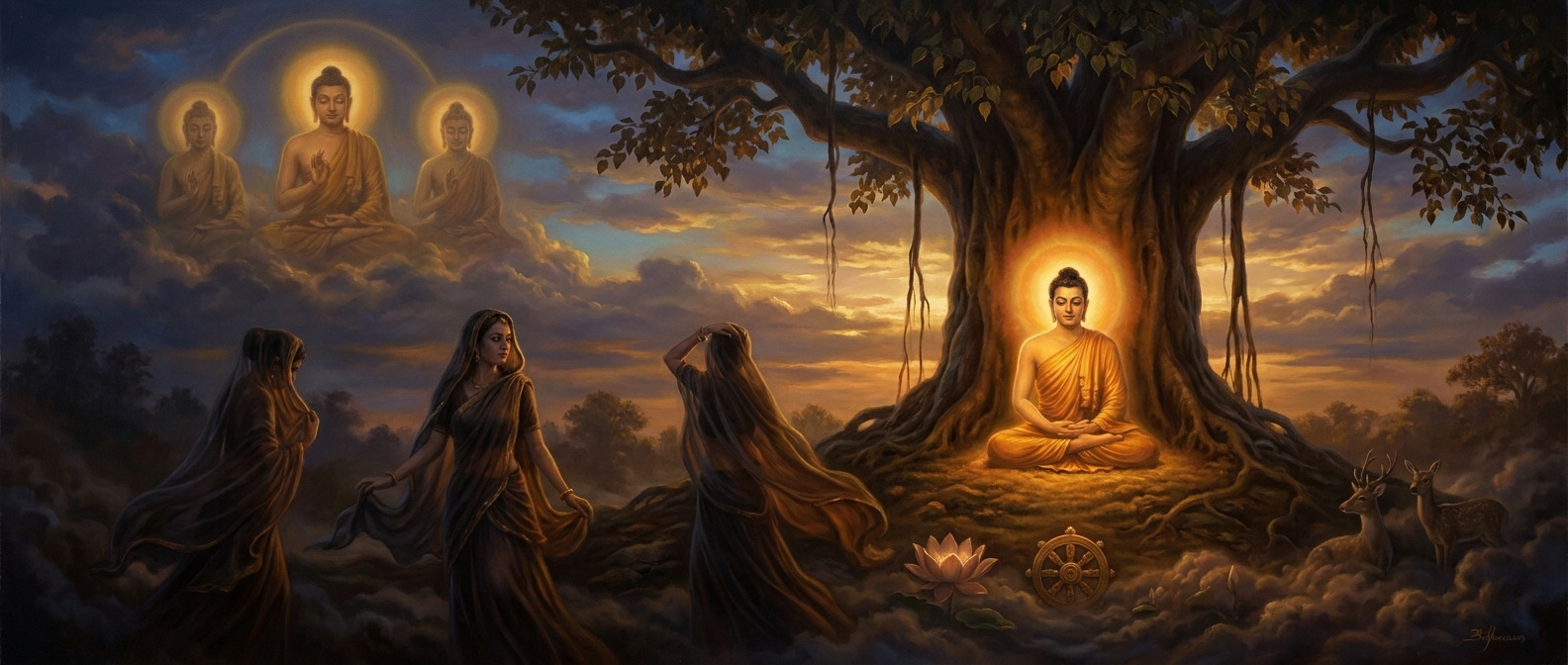
The Axial Age begins — the moment when, across separated cultures, philosophy and prophecy bloom simultaneously.
Greek
14- ~800 BCE Homer composes the *Iliad* and *Odyssey*, crystallizing centuries of oral tradition and fixing the Olympian pantheon
- ~800 BCE The sanctuary at Olympia is formalized — the Altis precinct enclosing the great ash-altar of Zeus, where animal fat and bone have been accumulating in a ritual mound for centuries; the first monumental Heraion temple is built, and the site becomes the fixed axis of Panhellenic sacred geography.
- ~800 BCE The Apolline oracle at Delphi rises to Panhellenic authority — the *Pythia* (possessed priestess) breathes volcanic vapors in the *adyton* and channels Apollo's ambiguous counsel; city-states across the Greek world consult Delphi before every war, colony, and constitutional reform, making it the closest thing to a universal religious arbiter in ancient Europe.
- ~776 BCE First recorded Olympic Games at Olympia — sacred truce (*ekecheiria*) halts all Greek wars; games run as religious festival to Zeus for nearly twelve centuries
- ~750 BCE Hesiod composes the *Theogony*, imposing genealogical order: Chaos → Gaia → Ouranos → Kronos → Zeus
- ~750 BCE Greek polis religion crystallizes — each city-state establishes its patron deity, sacred calendar of festivals, and civic priesthood as the constitutional framework of community identity; religion and citizenship fuse so completely that atheism (*asebeia*, impiety) becomes a capital crime, as Socrates will discover.
- ~700 BCE *Homeric Hymn to Demeter* composed — Persephone's pomegranate seeds become the mythological engine of the Eleusinian Mysteries
- ~620 BCE Solon of Athens visits Egypt and reportedly brings back aspects of Egyptian legal-religious tradition; Greek city-states begin legislating public ritual
- ~600 BCE Orphic mysteries take literary form — gold tablets buried with initiates inscribe instructions for the soul's journey through Hades; Orpheus is named as the founder; the doctrines of metempsychosis, original sin (humanity born from the ash of Titans who ate Dionysus), and ascetic purification enter Greek thought, anticipating Pythagorean and Platonic soul-doctrine.
- ~600 BCE The Eleusinian Mysteries are formalized at Athens under Solonian and Peisistratid reform — the *telesterion* hall is built to seat thousands of *mystai*, the Lesser and Greater Mysteries are calendared, and the rite becomes pan-Hellenic, drawing initiates from across the Greek world for nearly a millennium.
- ~594 BCE Solon's democratic reforms in Athens reorganize Athenian religious festivals, formalizing the Panathenaia and giving the polis a sacred civic calendar
- ~570 BCE Xenophanes of Colophon attacks anthropomorphic religion — "if oxen could draw, they would draw their gods as oxen"; he argues for one supreme god "in no way like mortals in body or in mind," seeding philosophical monotheism within Greek polytheism three generations before Plato.
- ~560 BCE Peisistratos becomes tyrant of Athens and sponsors the Great Panathenaia festival; Homer's poems are performed officially at Athens for the first time
- ~510 BCE The Eleusinian Mysteries codified as a pan-Hellenic rite open to all Greek-speaking initiates; Athenian citizens, including Plato and Cicero, will undergo the initiation across the next four centuries
Jewish
12- ~922 BCE The United Monarchy splits at Solomon's death — Rehoboam holds Judah and Jerusalem; Jeroboam takes the ten northern tribes and erects golden calves at Dan and Bethel as rival cult centers, the schism the Deuteronomistic historians will treat as Israel's original sin.
- ~850 BCE Elijah confronts the prophets of Baal on Mount Carmel; prophetic tradition becomes a distinct Israelite institution
- ~760–740 BCE The literary prophets emerge in Israel and Judah: Amos (~760 BCE) delivers the first written prophetic scroll, attacking ritual without justice; Hosea (~750 BCE) frames the covenant as marriage — Israel's idolatry as adultery; First Isaiah (~740 BCE) sees the divine throne in the Temple and announces a theology of the Holy *Other* that will shape monotheism forever.
- ~722 BCE Northern Kingdom of Israel falls to Assyria; ten tribes dispersed — the "lost tribes" myth is born
- ~622 BCE The High Priest Hilkiah finds the Book of the Law in the Temple during Josiah's renovations — almost certainly an early form of Deuteronomy; Josiah tears his clothes, purges the rural high places and the Asherah poles from Jerusalem, and centralizes all sacrifice at the Temple, the founding act of textual Judaism.
- ~610 BCE The Book of Deuteronomy discovered in the Temple under King Josiah — triggers sweeping religious reform, centralizing worship in Jerusalem and abolishing rural shrines
- ~586 BCE First Temple destroyed by Nebuchadnezzar II; Babylonian Exile begins — Jewish theology is refracted through contact with Persian cosmology and Babylonian myth
- ~556 BCE Daniel's visions in Babylon — four beasts, the Son of Man, seventy weeks; the first systematic Jewish apocalyptic literature, written in Aramaic
- ~538 BCE The Edict of Cyrus authorizes Jewish return from Babylonian exile and restoration of the Temple — preserved in Ezra 1 and on the Cyrus Cylinder's parallel text; Isaiah 45:1 names Cyrus *mashiach* (anointed), the only non-Jewish Messiah in the Hebrew Bible.
- ~520 BCE The prophets Haggai and Zechariah rouse the returned exiles to rebuild the Temple — work resumes after a sixteen-year delay under Zerubbabel and the high priest Joshua; their oracles fuse Persian-period messianism with the older Davidic covenant, naming Zerubbabel as the *tsemach* (Branch).
- ~516 BCE The Second Temple completed in Jerusalem — seventy years almost to the day after the destruction of the First, fulfilling Jeremiah's prophecy; smaller and unadorned compared to Solomon's, the Second Temple lacks the Ark of the Covenant, which had vanished in 586 BCE and never returned.
- ~500 BCE Book of Job reaches its final form — the first sustained theological interrogation of divine justice in any tradition
Hindu
5- ~900 BCE The earliest oral crystallizations of the *Mahabharata* take shape in northern India — bard-families (*sūtas*) begin threading the Kuru-Pandava war narrative around a growing body of theological digression; the world's longest epic will expand across nine centuries before reaching its 100,000-verse written form, with the *Bhagavad Gita* embedded at its moral heart.
- ~900 BCE The *Brahmana* prose treatises composed — exegetical commentaries on Vedic ritual that explain the cosmic significance of every sacrificial gesture; the texts transform the *yajna* from an act into a science, codifying the priest's monopoly over the machinery that keeps the universe running.
- ~700 BCE Early Upanishads composed — *Chandogya* and *Brihadaranyaka* articulate *Brahman*, *Atman*, and karma for the first time
- ~700 BCE The *Aranyaka* texts (forest treatises) are composed as a bridge between the Brahmanical ritual of the *Brahmanas* and the philosophical interiorization of the *Upanishads* — householders retreating to the forest begin internalizing the fire-sacrifice as a meditation, replacing the outer altar with the inner breath; the contemplative turn in Indian religion begins here.
- ~700 BCE The Vedantic period opens — the principal *Upanishads* (*Brihadaranyaka*, *Chandogya*, *Taittiriya*, *Aitareya*) articulate the identity of *Atman* (individual soul) with *Brahman* (universal ground); the equation *tat tvam asi* ("that thou art") becomes the axle of Indian philosophy and sets the intellectual agenda for every Hindu, Buddhist, and Jain school that follows.
Persian
5- ~600–500 BCE The *Magi* — the hereditary priestly tribe of the Medes — are integrated into the Achaemenid imperial religious apparatus; they maintain the sacred fire, perform animal sacrifice, interpret dreams, and conduct funerary rites; as Persian power carries Zoroastrian fire-worship from the Aegean to the Indus, the Magi become the ancient world's most widely encountered professional priesthood, the origin of the word "magic."
- ~559 BCE Cyrus the Great founds the Achaemenid Empire by overthrowing Astyages of Media — within a generation Persian rule will stretch from the Aegean to the Indus, creating the largest religiously plural state in human history and inventing imperial tolerance as official policy.
- ~550 BCE The Achaemenid Empire under Cyrus and Darius I engineers history's first large-scale religious encounter zone — Zoroastrian theology meets Babylonian star-worship, Egyptian temple religion, Greek philosophy, and Israelite monotheism inside a single administrative system; Persian religious tolerance policy (enshrined in the Cyrus Cylinder) becomes the template for every subsequent pluralist empire.
- ~539 BCE Cyrus the Great conquers Babylon and issues the Cyrus Cylinder — frees the Jews, restores their Temple vessels, and earns the only non-Jewish *mashiach* title in the Hebrew Bible (Isaiah 45:1)
- ~525 BCE Cambyses II conquers Egypt — the Persian Empire briefly holds both the Nile and the Indus, spreading Zoroastrian fire-worship to the edges of the known world
Buddhist
4- ~563 BCE Siddhartha Gautama born to the Shakya clan in Lumbini (modern Nepal) — a prince sealed from suffering by a royal father who feared prophecy
- ~534 BCE The Four Sights: Siddhartha sees an old man, a sick man, a corpse, a wandering ascetic — and leaves the palace forever
- ~528 BCE The Buddha's enlightenment under the Bodhi tree at Bodh Gaya; Mara's armies defeated by the earth-witness gesture (*bhumisparsha mudra*)
- ~528 BCE The First Sermon at Deer Park, Sarnath — the Wheel of Dharma is turned; the Four Noble Truths and Eightfold Path proclaimed; the first five monks take refuge
Jain
4- c. 600 BCE Birth of Parsvanatha, 23rd Jain tirthankar; earliest historically attested figure in Jain tradition (~877 BCE trad.)
- c. 540 BCE Birth of Vardhamana Mahavira (traditionally 599 BCE); his enlightenment under the sal tree at Jrimbhikagrama; he becomes the 24th and final tirthankar of this cosmic era
- ~500 BCE Mahavira (24th *Tirthankara*) teaches *ahimsa* (non-violence), *anekantavada* (many-sidedness of truth), and the liberation of the *jiva* (soul) from karmic matter in the Gangetic plain
- c. 480 BCE Death of Mahavira; Jain community begins spreading through India; early council at Pataliputra debates the canon
Confucian
3- ~551 BCE Confucius born in the state of Lu; he will spend his life recovering the ritual propriety (*li*) he believes holds civilization together
- c. 500 BCE Confucius (Kong Qiu, 551-479 BCE) teaches in Lu; the *Analects* compiled by his students after his death record his conversations on ren (benevolence) and li (ritual propriety)
- c. 350 BCE Mencius (Mengzi, c. 372-289 BCE) teaches that human nature is fundamentally good; his conversations compiled as the *Mencius* (*Mengzi*)
Egyptian
3- ~950 BCE Third Intermediate Period — Amun-Ra priesthood at Karnak rivals the Pharaoh in political and religious power
- ~664–525 BCE The Saite Revival (26th Dynasty) — Pharaohs of the Saite line restore archaizing temple art, revive Old Kingdom religious texts, and open Egypt to Greek traders; the Late Period flowering brings new temple building at Abydos and Memphis even as Persian and then Greek conquest loom; Egyptian religion achieves its most self-consciously retrospective and encyclopedic form.
- ~525 BCE Cambyses II of Persia conquers Egypt at the Battle of Pelusium — native pharaonic kingship ends; later Egyptian sources accuse him of stabbing the Apis bull, an act of imperial sacrilege Herodotus reads as evidence of Persian impiety, though contemporary records show Cambyses observing Egyptian ritual protocol.
Mesoamerican
3- ~900 BCE Olmec religious power declines at La Venta as the Gulf Coast heartland shifts — jaguar-were imagery, the rain-god (*tlaloc* prototype), the feathered serpent, and the sacred ball-game ritual pass as theological inheritance to successor cultures; the Olmec are the mother-civilization whose sacred grammar will speak through Maya, Zapotec, and Aztec religion alike.
- ~900 BCE La Venta colossal heads carved on Mexico's Gulf Coast — basalt boulders quarried from the Tuxtla Mountains and floated 80 km on rafts; the four monumental heads at La Venta portray rulers in ceremonial helmets, the second great Olmec ceremonial center succeeding San Lorenzo as the heartland of Mesoamerican religion.
- ~500 BCE Zapotec civilization at Monte Albán, Oaxaca, builds the first urban ritual complex in Mesoamerica; glyphic calendar and rain-god (*Cocijo*) worship is established
Zoroastrian
3- ~1000–700 BCE The Avestan Yasna liturgy takes written shape — the 72-chapter core of Zoroastrian worship, preserving Zarathustra's *Gathas* alongside younger ritual texts; its oral recitation in archaic Avestan, never spoken as a living tongue, becomes the sacred sonic technology of Persian priestly religion for three millennia.
- ~628 BCE One traditional dating for Zoroaster's birth in Bactria or northeastern Iran — his *Gathas* compose the oldest Indo-European religious poetry
- ~520 BCE Darius I carves the Behistun Inscription into a cliff in three languages, crediting Ahura Mazda for every military victory — the first royal theological proclamation at global scale
Assyrian
2- ~689 BCE Sennacherib razes Babylon — the Assyrian king floods the city, smashes the cult statue of Marduk, and carries the rubble of the Esagila temple back to Nineveh; the sacrilege so shocks Mesopotamian religious sensibility that Sennacherib's own sons murder him fifteen years later (2 Kings 19:37) in what Babylonians will read as Marduk's revenge.
- ~668 BCE Ashurbanipal founds the Royal Library at Nineveh — the first systematically organized library in history, gathering 30,000 cuneiform tablets including the *Epic of Gilgamesh*, *Enuma Elish*, omen series, and ritual manuals; rediscovered in 1849, the collection is the single greatest source for ancient Mesopotamian religion.
Babylonian
2- ~681 BCE Esarhaddon ascends in Assyria and reverses his father Sennacherib's destruction — Babylon is rebuilt, Marduk's statue restored to the Esagila, and the Akitu festival resumed; the policy of Assyrian patronage of Babylonian religion will hold the empire together for two more generations.
- ~605 BCE Nebuchadnezzar II ascends the Babylonian throne — Marduk theology reaches imperial scale; the Esagila and the Etemenanki ziggurat (the historical referent of the Tower of Babel) tower over the rebuilt city; Nebuchadnezzar's annals describe him as the chosen shepherd of Marduk the king of the gods.
Celtic
2- ~800–500 BCE The Druid class consolidates across Britain, Gaul, and Ireland — a learned priestly order controlling divination, sacrifice, astronomical calculation, law-keeping, and the oral transmission of mythic tradition; their refusal to commit sacred knowledge to writing preserves it in living memory at the cost of making it nearly invisible to the historical record.
- ~500 BCE La Tène culture flowers across central and western Europe — the second great phase of Iron Age Celtic civilization succeeds Hallstatt; warrior-aristocrat burials with chariot, sword, and feast goods; ritual deposits of weapons in lakes and bogs (the Battersea Shield, the Gundestrup Cauldron's antecedents); the artistic vocabulary that will carry Celtic religion into the Roman period is fixed here.
Chinese
2- ~770 BCE Eastern Zhou period begins as the capital relocates to Luoyang after Quanrong nomads sack Haojing — central royal authority collapses, vassal states grow autonomous, and the resulting "hundred schools" ferment will produce Confucianism, Daoism, Mohism, and Legalism within three centuries.
- ~722 BCE The *Spring and Autumn Annals* (*Chunqiu*) begin their 242-year chronicle of the state of Lu — the terse year-by-year record Confucius will later edit becomes one of the Five Classics; its laconic moral judgments establish historiography itself as a Confucian sacred discipline.
Etruscan
2- ~700 BCE Etruscan religion at its peak in central Italy — *haruspicy* (reading entrails), elaborate tomb culture, and a theology that Rome will later absorb wholesale
- ~509 BCE Roman Republic founded; Etruscan religious vocabulary — augury, *pontifex*, the sacred pomerium boundary — is embedded into Roman civic religion from day one
Maya
2- c. 700 BCE Olmec civilization at peak; ritual ballgame connected to Hero Twins cosmology; earliest evidence of 260-day ritual calendar
- c. 400 BCE Zapotec civilization develops at Monte Albán; writing system used for ritual calendar and cosmological texts
Shinto
2- ~1000–300 BCE The Yayoi period in Japan — wet-rice agriculture arrives from the Korean peninsula, bringing communal harvest rites, bronze bells (*dōtaku*) buried as offerings, and clan-shrine traditions that will crystallize into Shinto; the worship of rice-field *kami* and ancestral spirits roots itself in the agricultural landscape before any written theology appears.
- c. 900 BCE Construction of first Japanese shrine complexes at Ise and Izumo; formalization of Shinto rites
Yoruba
2- ~900 BCE The sacred city of Ile-Ife in present-day Nigeria consolidates as the spiritual capital of Yoruba civilization — a royal priestly structure organized around the 401 *orisha* (divine energies) takes form; the Ife head-sculptures, some of the most naturalistic bronzes in world art, encode a theology of *ashe* (divine power) in human features.
- c. 800 BCE Emergence of Yoruba city-states in West Africa; systematization of orisha cosmology centered at Ile-Ife
Andean
1- ~900 BCE Chavín de Huántar emerges in Peru's Mosna Valley — the cruciform underground galleries beneath the Old Temple house the Lanzón monolith, a fanged anthropomorphic deity carved into a 4.5-meter granite shaft; the cult's reach across the central Andes makes Chavín South America's first pan-regional religion.
Aramean
1- ~1000–800 BCE The Aramean city-states of Syria — Aram-Damascus chief among them — organize worship around the storm-god Hadad and moon-god Sin; Aramaic displaces Akkadian as the diplomatic lingua franca of the Near East, carrying Levantine religious vocabulary across every royal court from Egypt to Persia.
Canaanite / Israelite
1- ~800 BCE Asherah worshipped alongside YHWH in early Israelite religion — inscriptions at Kuntillet Ajrud in the Sinai bless travelers in the name of "YHWH and his Asherah"; pillar figurines of the goddess proliferate in Iron Age Judean households; the prophets' polemic against Asherah poles (*asherim*) confirms her durable presence as YHWH's consort before Josiah's reform purges her from the official cult.
Canaanite / Phoenician
1- ~814 BCE Carthage founded by Phoenician settlers from Tyre — Queen Dido (Elissa) brings the cult of Baal Hammon and his consort Tanit to the North African coast; the *tophet* sanctuary of urn burials and the supreme deity Baal Hammon become the religious bedrock of Punic civilization for the next seven centuries until Rome razes the city in 146 BCE.
Carthaginian
1- ~814 BCE The city of Carthage is founded by Phoenician settlers from Tyre on the North African coast — the Tanit cult, centered on the female consort of Baal Hammon, establishes a *tophet* sanctuary where votive urns containing infant remains mark the intersection of sacrifice, mortality, and divine favor; Carthaginian religion will rival Rome's as the western Mediterranean's defining ritual system.
Daoist
1- c. 450 BCE Laozi writes (or is credited with) the *Tao Te Ching* at the Hangu Pass; though the text likely compiled c. 350-250 BCE
Dorian / Greek
1- ~950–800 BCE The Dark Age religious consequences of the Dorian migrations settle — Linear B palace religion collapses, Mycenaean deity lists fade, and local hero-cults fill the vacuum; the Olympian pantheon re-emerges not as a palace theology but as a network of regional sanctuaries, each negotiating between local hero-worship and the new Panhellenic gods.
Norse / Germanic
1- ~500 BCE-0 CE Proto-Germanic religion takes form across northern Europe — the cult of *Wōðanaz* (proto-Odin), *Þunraz* (proto-Thor), and *Tīwaz* (proto-Tyr) emerges as Germanic tribes diverge from Indo-European roots; bog deposits at Tollund and Grauballe preserve sacrificial victims; the religious vocabulary that will reach written form in Iceland 1,500 years later is forged in this preliterate horizon.
Phoenician
1- ~900 BCE Tanit cult of Carthage established; child-sacrifice precinct (*tophet*) at Carthage active for centuries
Phrygian
1- ~900 BCE The cult of Cybele (*Matar Kubileya*, the Mountain Mother) crystallizes in Phrygia, Anatolia — ecstatic music, self-castrated *Galloi* priests, the sacred black stone, and a theology of death-and-resurrection centered on her consort Attis; the first mystery religion to travel wholesale from the East to Rome, arriving in 204 BCE.
Roman
1- ~753 BCE Traditional founding of Rome by Romulus on the Palatine Hill — the augury of twelve vultures, the sacred *pomerium* boundary plowed with a bronze blade, and the killing of Remus inaugurate Roman religion's defining themes: divine sanction of the city and ritual fratricide at its founding.
Slavic
1- ~1000–800 BCE Proto-Slavic religion coalesces across the forests and river-systems of Eastern Europe — Perun the thunder-god and Veles the underworld-serpent stand as the supreme cosmic opposites, their eternal rivalry encoding storm, cattle, and the cycle of death and return into Slavic religious consciousness centuries before written record.
Taoist
1- ~600 BCE Lao Tzu (traditional) — *Tao Te Ching* attributed; the Tao as the unnameable ground of being from which all things arise and to which all return
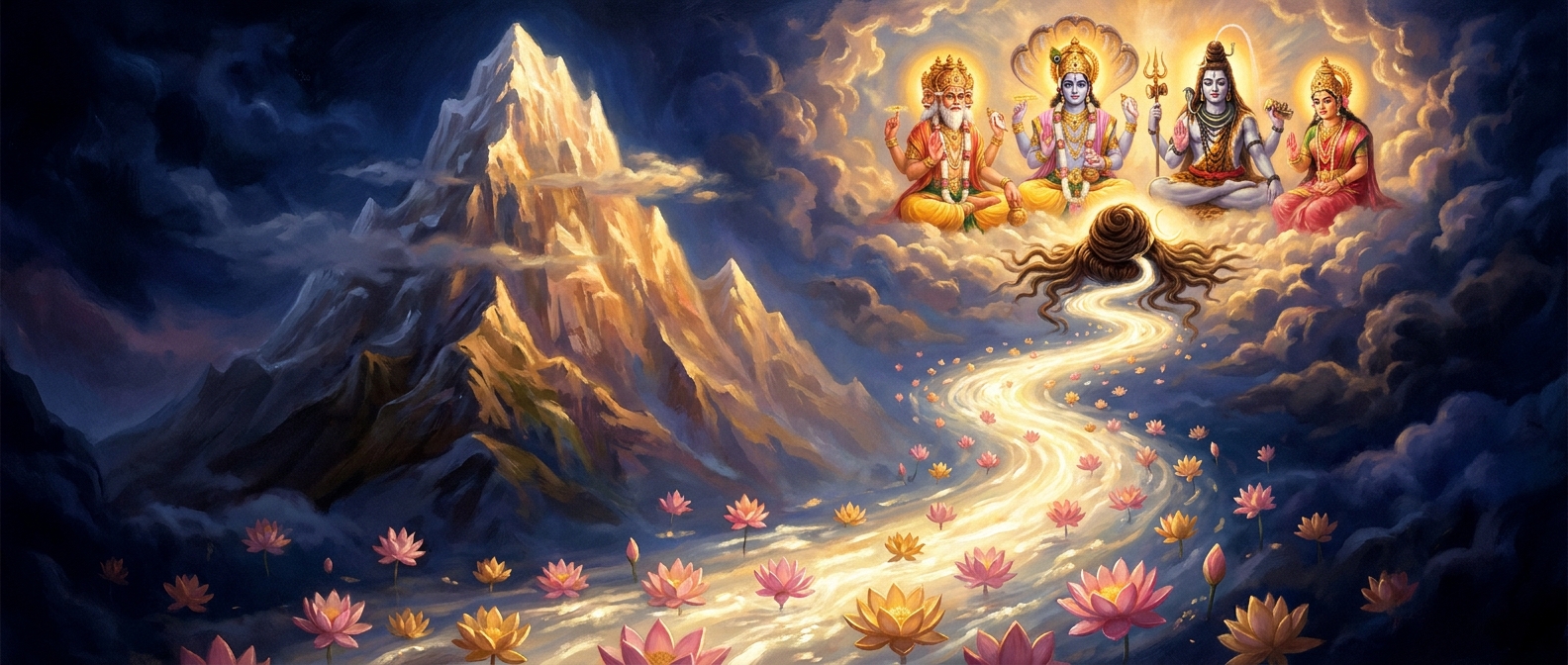
Greek
13- ~500 BCE Pythagorean religious-mathematical school at Croton, southern Italy — Pythagoras founds a community bound by dietary prohibitions, metempsychosis (soul-transmigration), and the conviction that number is the hidden grammar of divine order; mathematics becomes a spiritual practice for the first time in Western history
- ~499 BCE Aeschylus begins staging tragedies in Athens; *The Persians*, *Prometheus Bound*, and the *Oresteia* ask whether the gods are just — the first systematic theology in dramatic form
- ~480 BCE Battle of Thermopylae; Herodotus will later record its stories as a Greek religious narrative of divine favor and hubris (nemesis)
- ~480 BCE Aeschylus stages *Prometheus Bound* in Athens — the Titan chained for defying Zeus becomes Western literature's first sustained argument for individual conscience against divine authority; the play seeds every subsequent tradition of sacred rebellion
- ~450 BCE Herodotus writes the *Histories* — first comparative religion in antiquity, documenting Egyptian, Persian, Scythian, and Babylonian religious practice alongside Greek
- ~440 BCE Sophocles stages *Oedipus Rex* — oracular religion (Delphi) and human free will placed in irresolvable tension before 15,000 spectators
- ~399 BCE Socrates drinks the hemlock after conviction for impiety — the moment Greek philosophy becomes a rival theology; Plato will build on this martyrdom
- ~387 BCE Plato founds the Academy in Athens; his *Republic* and *Phaedrus* propose a theology of Forms, an immortal soul, and an eternal Good *behind* the Olympian gods
- ~350 BCE Aristotle articulates the Unmoved Mover in *Metaphysics* 12.7 — a deity with no personality, no prayer-relationship; the philosophical monotheism that will merge with Christian theology via Aquinas
- ~334 BCE Alexander the Great campaigns east; Hellenism spreads to Egypt, Persia, Bactria, and the Indus — Greek gods acquire Persian and Egyptian doubles; mystery religions go cosmopolitan
- ~310 BCE Zeno of Citium founds Stoicism at the Stoa Poikile in Athens — *logos* as the rational fire running through all things; the Stoic cosmos is the most influential alternative to polytheism before Christianity
- ~307 BCE Epicurus founds his school in Athens; the gods exist but are indifferent — fear of them and death are both irrational; the *Garden* is the first genuinely atheistic religious community
- ~305 BCE Pyrrho returns from Alexander's campaign and founds Skepticism — suspension of judgment (*epoché*) on all metaphysical claims including religious ones; the first systematic agnosticism
Jewish
12- ~450 BCE Ezra and Nehemiah lead the second wave of returned exiles; Torah is read publicly in Jerusalem — the first recorded public scripture-reading as communal religious act
- ~175 BCE Antiochus IV Epiphanes desecrates the Jerusalem Temple, installs a Zeus statue, and bans Torah observance — precipitating the Maccabean revolt
- ~165 BCE Hasmonean dynasty established after the Maccabean revolt — priestly warriors who become kings rule Judea as the first independent Jewish state in over four centuries; their fusion of religious and political authority generates lasting controversy and sets the template for every subsequent Jewish messianic movement
- ~164 BCE Maccabean victory; Temple rededicated; the miracle of the oil lamp for eight days becomes the origin of Hanukkah (*1 Maccabees* 4:36-59)
- ~150 BCE The Essene community at Qumran composes and copies what will become the Dead Sea Scrolls — apocalyptic, priestly, and proto-monastic Judaism existing outside the Temple establishment
- ~150 BCE The Essene community at Qumran founded near the Dead Sea — a priestly-apocalyptic sect breaks with the Hasmonean Temple establishment and withdraws to the Judean desert; over the next two centuries they copy the scrolls (including the oldest known Hebrew Bible manuscripts) that lie hidden in caves until 1947; their Teacher of Righteousness, Wicked Priest, and War of the Sons of Light vs. the Sons of Darkness shape the apocalyptic vocabulary New Testament writers will inherit.
- ~140 BCE Pharisees and Sadducees emerge as distinct sects under the Hasmoneans — Pharisees champion oral Torah and the resurrection of the dead; Sadducees hold only the written Torah and reject resurrection; the theological fault line between them shapes every Jewish and early Christian controversy of the next two centuries
- ~100 BCE Schools of Hillel and Shammai diverge — rabbinic Judaism's first systematic legal debate; Hillel's *Golden Rule* ("What is hateful to you, do not do to your neighbor") predates Jesus by a generation
- ~63 BCE Pompey the Great conquers Jerusalem and enters the Holy of Holies — the Roman general's profanation of the Temple's innermost sanctuary shocks Judea; Rome's shadow over Jewish religious life begins, setting the stage for every Zealot uprising and messianic expectation of the next century
- ~20 BCE Herod the Great's renovation of the Second Temple reaches its greatest scope — the Temple Mount platform as Herod built it still stands
- ~5 BCE Hillel the Elder at the height of his influence in Jerusalem — his lenient legal rulings and ethical summaries shape the rabbinic tradition that outlives the Temple
- ~4 BCE John the Baptist born in the Judean hill country — a desert prophet practicing ritual immersion in the Jordan, drawing on Essene themes of purification and Elijah-styled prophecy; his baptism of Jesus at the Jordan links the Jewish apocalyptic tradition to nascent Christianity in a single irreversible ritual act
Roman
5- ~70 BCE Julius Caesar's reforms of the Roman religious calendar — the Julian calendar imposed on Roman religious time, fusing civic and sacred reckoning
- ~50 BCE Cicero writes *De Natura Deorum* — the Roman Empire's most sophisticated analysis of religion, skeptically surveying Stoic, Epicurean, and augural views; the best surviving pagan theology in Latin
- 42 BCE The Roman Senate deifies Julius Caesar (*Divus Iulius*) — the first formal Roman imperial apotheosis; Augustus inherits the title *Divi filius* (Son of God) and institutionalizes ruler-cult
- ~27 BCE Augustus Caesar institutionalizes the Roman state cult — the *Pontifex Maximus* title, the *Ara Pacis* altar, and a sweeping program of temple restoration refound traditional Roman religion as the personal piety of the emperor, fusing political legitimacy with divine mandate
- ~20 BCE Imperial Cult formalized across the eastern provinces — temples to *Roma et Augustus* erected in Pergamon, Ephesus, and Caesarea Maritima; subjects are required to perform annual sacrifice to the imperial *genius*; the cult machinery that will directly persecute Christians for three centuries is assembled here
Buddhist
4- ~483 BCE The Buddha's Parinirvana at Kushinagar: final nirvana, relics divided among eight kingdoms, stupas built — the religion outlives its founder without a designated successor
- ~270 BCE Emperor Ashoka (r. 268-232 BCE) converts to Buddhism after the devastation of the Kalinga War; sends missionaries to Sri Lanka, Syria, Egypt, Greece, and Southeast Asia — the first missionary religion in history operating at continental scale
- ~268 BCE Mauryan Empire under Ashoka provides institutional Buddhism its first major state patron — royal *dhamma* edicts carved on pillars and rocks across the subcontinent; hospitals, wells, and rest houses built for all living beings; a welfare state justified by Buddhist ethics for the first time
- ~100 BCE The Theravada-Mahayana split begins crystallizing — Mahayana texts (*Prajnaparamita* sutras) circulate emphasizing the bodhisattva ideal over the arhat; the two schools diverge on the nature of Buddhahood, the laity's role, and the number of Buddhas in cosmic time; the richest doctrinal fracture in Buddhist history
Confucian
4- ~372–289 BCE Mencius (Mengzi) teaches that human nature is innately good and that rulers govern by moral virtue (*ren*) — he becomes the second sage of the Confucian tradition and his book joins the Four Books canonized by Zhu Xi.
- ~310–235 BCE Xunzi argues human nature is selfish and must be civilized through ritual and education — his realist Confucianism shapes his pupils Han Fei and Li Si, who carry Legalist statecraft into the Qin unification.
- ~250 BCE Han dynasty scholars begin systematically preserving Confucian texts destroyed by the Qin's book-burning (213 BCE); Confucianism becomes the state philosophy
- ~134 BCE Han Emperor Wu adopts Confucianism as official state ideology — the Imperial Academy (*Taixue*) is founded; the Five Classics become the basis of the civil-service examination; Confucianism transforms from a private moral philosophy into the administrative religion of the world's largest state
Celtic
3- ~100 BCE-100 CE The Ulster Cycle and *Táin Bó Cúailnge* take shape in oral tradition across Ireland — the cattle raid of Cooley, Cú Chulainn's single-handed defense of Ulster, and Queen Medb of Connacht enter the bardic repertoire; transmitted by *filid* (master poets) for over a millennium before monks commit the cycle to writing in the *Lebor na hUidre*.
- ~50 BCE Julius Caesar documents the Druids in *De Bello Gallico* — Book VI describes their twenty-year training in oral verse, their judicial monopoly across tribes, their teaching of metempsychosis, and their human sacrifices in great wicker figures; the most detailed contemporary outsider account of Iron Age Celtic religion, written by the general actively engaged in destroying it.
- ~30 BCE Druidism at its height across Britain and Gaul — a priestly class controlling sacrifice, law, astronomy, and oral transmission of mythic tradition; Caesar's *Gallic Wars* is the main Roman account
Egyptian
3- ~323 BCE Ptolemy I founds the Ptolemaic dynasty in Egypt; creates the hybrid god *Serapis* to unite Greek and Egyptian worshippers — the first state-engineered synthetic religion
- ~290 BCE Ptolemy I Soter founds the Library of Alexandria — religious texts from Egypt, Babylon, Persia, India, and Greece accumulate on a single campus; the first comparative-religion library in history, housing Jewish Torah scrolls alongside Egyptian priestly manuals and Zoroastrian fragments
- ~250 BCE The Septuagint (*LXX*) translation begins at Alexandria — seventy Jewish scholars render the Hebrew Bible into Greek for diaspora Jews; the document that the New Testament will quote almost exclusively
Jain
3- ~470 BCE First Buddhist Council at Rajagriha convened — oral canon preserved communally; beginning of monastic institutional Buddhism
- c. 250 BCE Chandragupta Maurya (grandfather of Ashoka) abdicates his throne to become a Jain monk; said to have died by Sallekhana (ritual fasting) at Shravanabelagola
- ~250 BCE Ashoka's contemporary Samprati reportedly extends Jain missionary activity across India; the Jain canon is codified at the Pataliputra council
Hindu
2- ~200 BCE The *Mahabharata* approaches its final epic form; the *Bhagavad Gita* embedded within it — Krishna's revelation on the battlefield of Kurukshetra becomes Hinduism's most-cited scripture
- ~200 BCE Final Vedic compilation: the four canonical Vedas — Rigveda, Samaveda, Yajurveda, and Atharvaveda — are fixed in text by Brahmin families whose oral transmission preserves every syllable with phonetic exactitude unmatched in any other oral tradition on earth
Aztec/Mexica
1- c. 100 BCE Aztec oral traditions place the legendary homeland Aztlan in this period; the long migration toward the Valley of Mexico begins in myth
Christian
1- ~6 BCE Jesus of Nazareth born in Judea (revised scholarly dating; the Gospel accounts embed him in a framework of Davidic prophecy and Zoroastrian-influenced apocalyptic expectation)
Greek / Buddhist
1- ~150 BCE Indo-Greek king Menander I (*Milinda*) of Bactria converts to Buddhism after his famous dialogue with the monk Nagasena, preserved in the *Milindapanha* — the first documented conversion of a Western ruler to Buddhism; Greco-Buddhist art fuses the Apollo archetype with the seated meditating Buddha
Hindu / Yogic
1- ~200 BCE Patanjali compiles the *Yoga Sutras* — 196 aphorisms systematizing the eight-limbed path (*ashtanga yoga*) from ethical restraint through meditative absorption (*samadhi*); the foundational text of classical yoga philosophy and the first systematic psychology of consciousness in any tradition
Jewish / Greek
1- ~20 BCE Philo of Alexandria begins writing his allegorical commentaries on the Torah — fusing Mosaic revelation with Platonic philosophy, he forges the intellectual framework that Clement, Origen, and John's Gospel will inherit; the *Logos* as divine intermediary enters Jewish thought permanently
Māori
1- c. 150 BCE Polynesian wayfinders reach the Society Islands (French Polynesia); celestial navigation theology fully developed using star compasses
Maya
1- c. 200 BCE Teotihuacan beginning to rise; Pyramid of the Sun constructed; city becomes a pilgrimage center for Mesoamerican cosmology
Mithraic
1- ~100 BCE Mithras mysteries crystallize in the Roman world — a mystery cult with initiatory grades, sacred meals, and a bull-slaying (*tauroctony*) centerpiece, spread through Roman legions
Shinto
1- c. 300 BCE Yayoi period in Japan; rice agriculture and metalworking spread; animistic practices merge with new agricultural fertility rites
Taoist
1- ~250 BCE The *Zhuangzi* is compiled in China — the most radical restatement of Taoist non-attachment; stories of the cook, the butterfly, and the skull challenge every Chinese metaphysical assumption
Yoruba
1- c. 300 BCE Expansion of Yoruba sacred kingship model; Obatala, Ogun, Shango cults formalized in the region around Ile-Ife
Zoroastrian
1- ~330 BCE Alexander burns Persepolis — Zoroastrian tradition says the original 21-*nask* Avesta (inscribed in gold on 12,000 ox-hides) is destroyed in a single night
The "400 Years of Silence"
Between the last Old Testament prophet (Malachi, ~430 BC) and the birth of Christ, the canonical Jewish scriptures fall silent. But history did not. The political, cultural, and religious landscape of the world Jesus entered was forged entirely in this period. Without understanding these four centuries, the New Testament makes far less sense.
Why it matters: The Pharisees, Sadducees, Essenes, synagogue system, apocalyptic literature, and intense messianic expectation that define the Gospels -- ALL of these emerged during the Intertestamental Period, not during the Old Testament era.
Succession of Empires Over Judea
539-331 BC
Relative autonomy
for Jews"] --> B["Alexander the Great
331 BC
Conquers Persia;
Hellenization begins"] B --> C["Ptolemaic Egypt
301-198 BC
Rules Judea;
tolerant period"] C --> D["Seleucid Empire
198-167 BC
Greek-Syrian rule;
Antiochus IV"] D --> E["Maccabean Revolt
167-142 BC
Jewish independence
won by force"] E --> F["Hasmonean Dynasty
142-63 BC
Jewish self-rule;
internal corruption"] F --> G["Roman Conquest
63 BC
Pompey takes
Jerusalem"] G --> H["Herod the Great
37-4 BC
Roman client king;
rebuilds the Temple"] style A fill:#d4a574,color:#000 style B fill:#c9a227,color:#000 style C fill:#6b8e23,color:#fff style D fill:#8b0000,color:#fff style E fill:#ff8c00,color:#000 style F fill:#4a6fa5,color:#fff style G fill:#800020,color:#fff style H fill:#800020,color:#fff
Key Events
| Date | Event | Significance |
|---|---|---|
| ~430 BC | Malachi prophesies | Last OT prophet; promises Elijah will return before "the great and dreadful day of the Lord" (Mal 4:5); canonical silence begins |
| 331 BC | Alexander the Great conquers Persia | Greek language and culture spread across the Near East (Hellenization); Greek becomes the lingua franca -- the language the NT will be written in |
| ~285-246 BC | Septuagint (LXX) translated | Hebrew Scriptures translated into Greek in Alexandria; this is the Bible Jesus' audiences knew and the NT authors quoted |
| 301-198 BC | Ptolemaic rule over Judea | Egyptian Greek dynasty rules with relative tolerance; large Jewish diaspora in Alexandria develops sophisticated philosophical theology |
| 198 BC | Seleucids seize Judea | Syrian-Greek dynasty takes control; begins aggressive Hellenization program |
| 167 BC | Antiochus IV Epiphanes desecrates the Temple | Erects altar to Zeus in the Holy of Holies; sacrifices a pig on the altar; bans Torah observance and circumcision; triggers the Maccabean Revolt. Daniel 11:31 and 8:13 ("abomination of desolation") point here -- and Jesus reuses this language in Matt 24:15 for a future event |
| 167-142 BC | Maccabean Revolt | Judas Maccabeus leads guerrilla war against Seleucids; recaptures and purifies the Temple in 164 BC; celebrated ever since as Hanukkah (John 10:22-23 -- Jesus attends this feast) |
| 142-63 BC | Hasmonean Dynasty | First Jewish self-rule since the Babylonian exile; Maccabee descendants serve as both kings and high priests (controversial -- they were not Davidic kings or Zadokite priests); internal civil wars and corruption |
| ~150-100 BC | Pharisees, Sadducees, and Essenes emerge | Three major Jewish sects form in response to Hellenization and Hasmonean politics. Pharisees emphasize oral Torah and synagogue worship. Sadducees control the Temple aristocracy. Essenes withdraw to the desert (Dead Sea Scrolls community at Qumran) |
 | ~150 BC onward | Apocalyptic literature flourishes | 1 Enoch, Jubilees, Testaments of the Twelve Patriarchs, and other texts develop elaborate angel/demon hierarchies, resurrection theology, and messianic expectation that permeate NT thought |
| ~100 BC onward | Synagogue system develops | With Temple access limited by politics and geography, local worship centers arise throughout the diaspora and Judea; Jesus' ministry is built on this infrastructure (Luke 4:16) |
| ~150 BC onward | Apocalyptic literature flourishes | 1 Enoch, Jubilees, Testaments of the Twelve Patriarchs, and other texts develop elaborate angel/demon hierarchies, resurrection theology, and messianic expectation that permeate NT thought |
| ~100 BC onward | Synagogue system develops | With Temple access limited by politics and geography, local worship centers arise throughout the diaspora and Judea; Jesus' ministry is built on this infrastructure (Luke 4:16) |
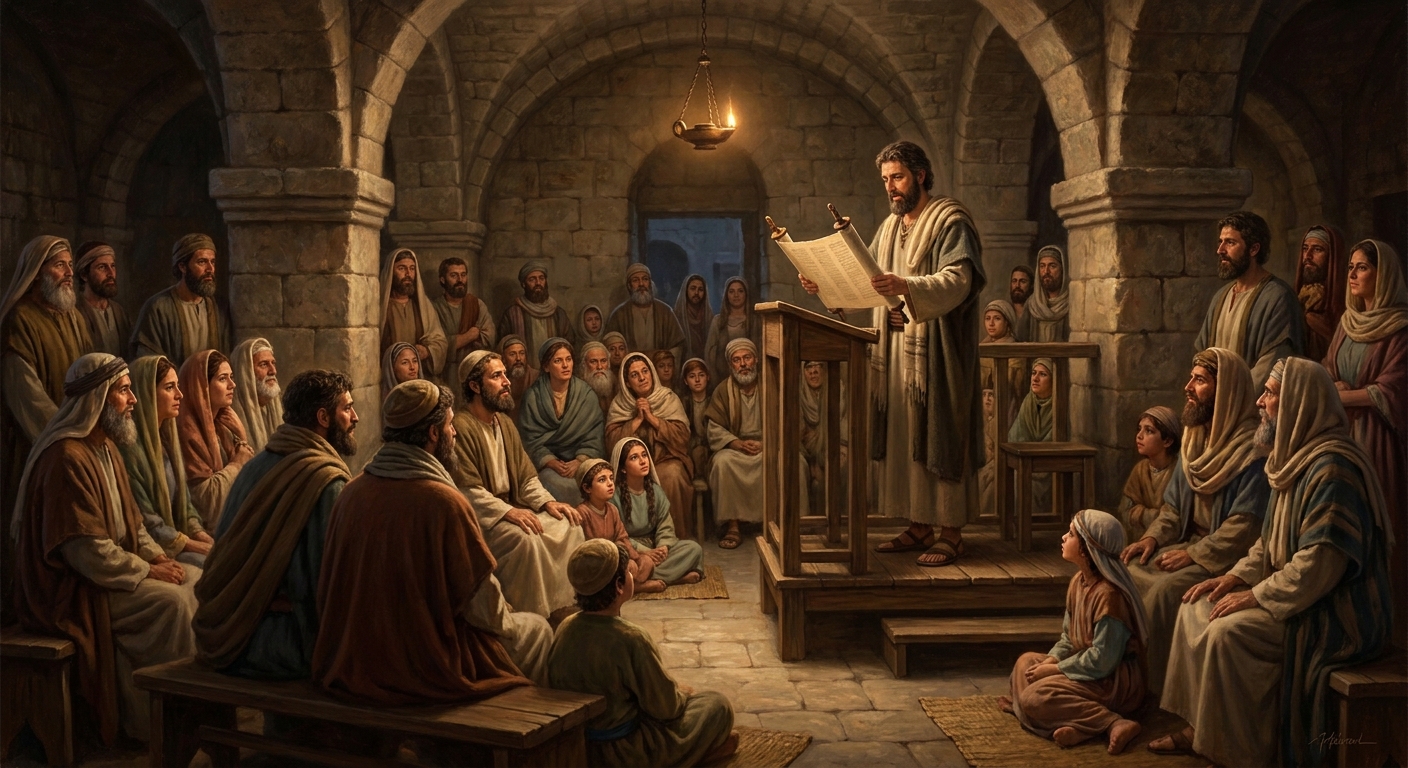 | 63 BC | Pompey conquers Jerusalem | Roman general enters the Holy of Holies; Judea becomes a Roman client state; Jewish political independence ends |
| 37 BC | Herod the Great appointed King | Idumean (Edomite) installed by Rome; massively expands the Second Temple (Herod's Temple) but is despised by devout Jews; slaughters Bethlehem infants (Matt 2:16) |
| 63 BC | Pompey conquers Jerusalem | Roman general enters the Holy of Holies; Judea becomes a Roman client state; Jewish political independence ends |
| 37 BC | Herod the Great appointed King | Idumean (Edomite) installed by Rome; massively expands the Second Temple (Herod's Temple) but is despised by devout Jews; slaughters Bethlehem infants (Matt 2:16) |
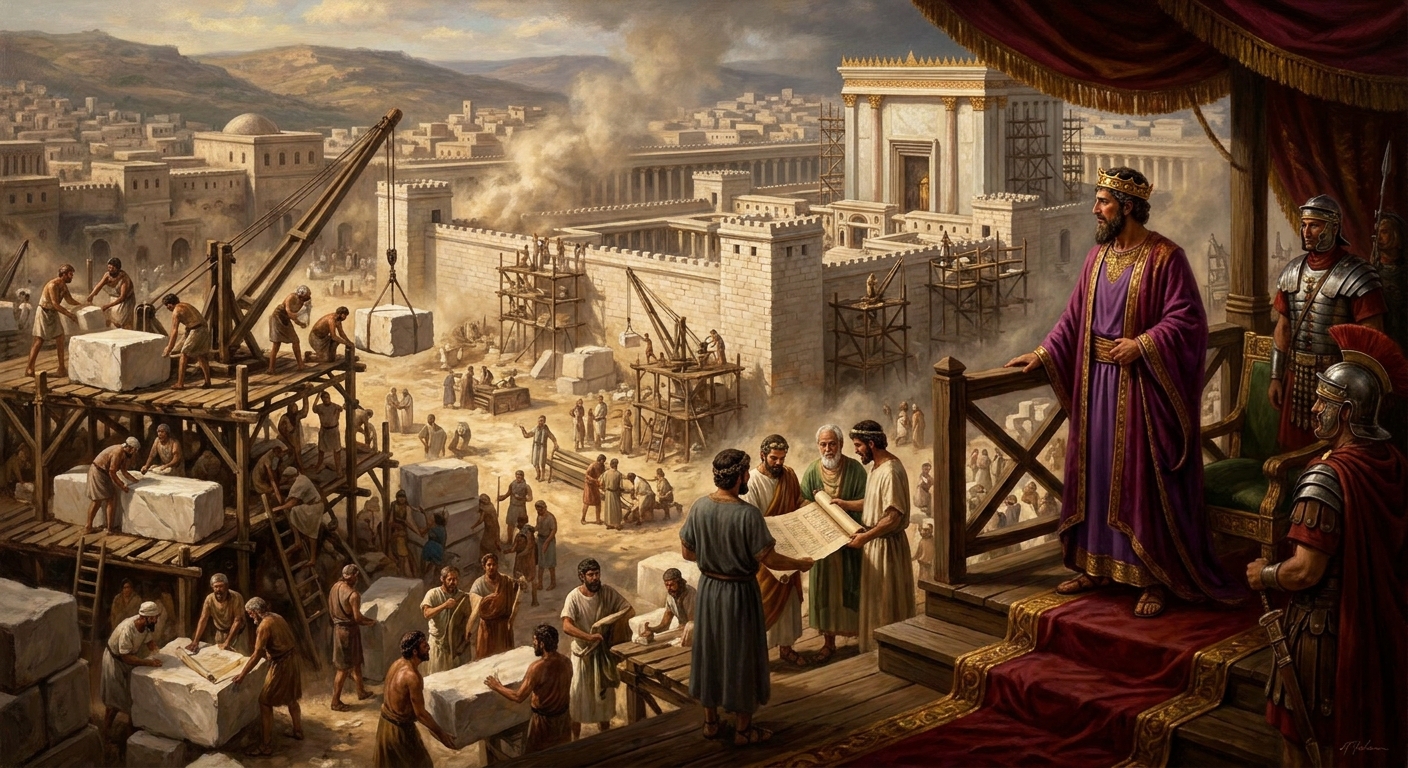 | 4 BC | Herod dies; Jesus born | Three of Herod's sons divide the kingdom; Roman control tightens; the stage is set for the Gospels |
What This Period Produced
The Jewish world Jesus entered was shaped by four centuries of foreign domination, internal division, and theological innovation:
- Messianic expectation was at a fever pitch -- multiple would-be messiahs arose in the 1st century BC/AD
- Apocalyptic theology was mainstream -- angels, demons, resurrection, final judgment, and cosmic warfare were common beliefs (unlike earlier OT periods)
- The synagogue replaced the Temple as the center of daily religious life for most Jews
- Greek was the common language -- enabling the rapid spread of the Gospel across the Roman Empire
- The Pharisee/Sadducee divide defined the religious landscape Jesus navigated (and criticized)
- Rome ruled everything -- creating both the political oppression that fueled messianic hope and the infrastructure (roads, common language, Pax Romana) that enabled the Gospel's spread
The Dead Sea Scrolls Connection
In 1947, Bedouin shepherds discovered scrolls in caves near Qumran by the Dead Sea. These documents, dated ~250 BC to 68 AD, are the most significant archaeological find for understanding the Intertestamental Period:
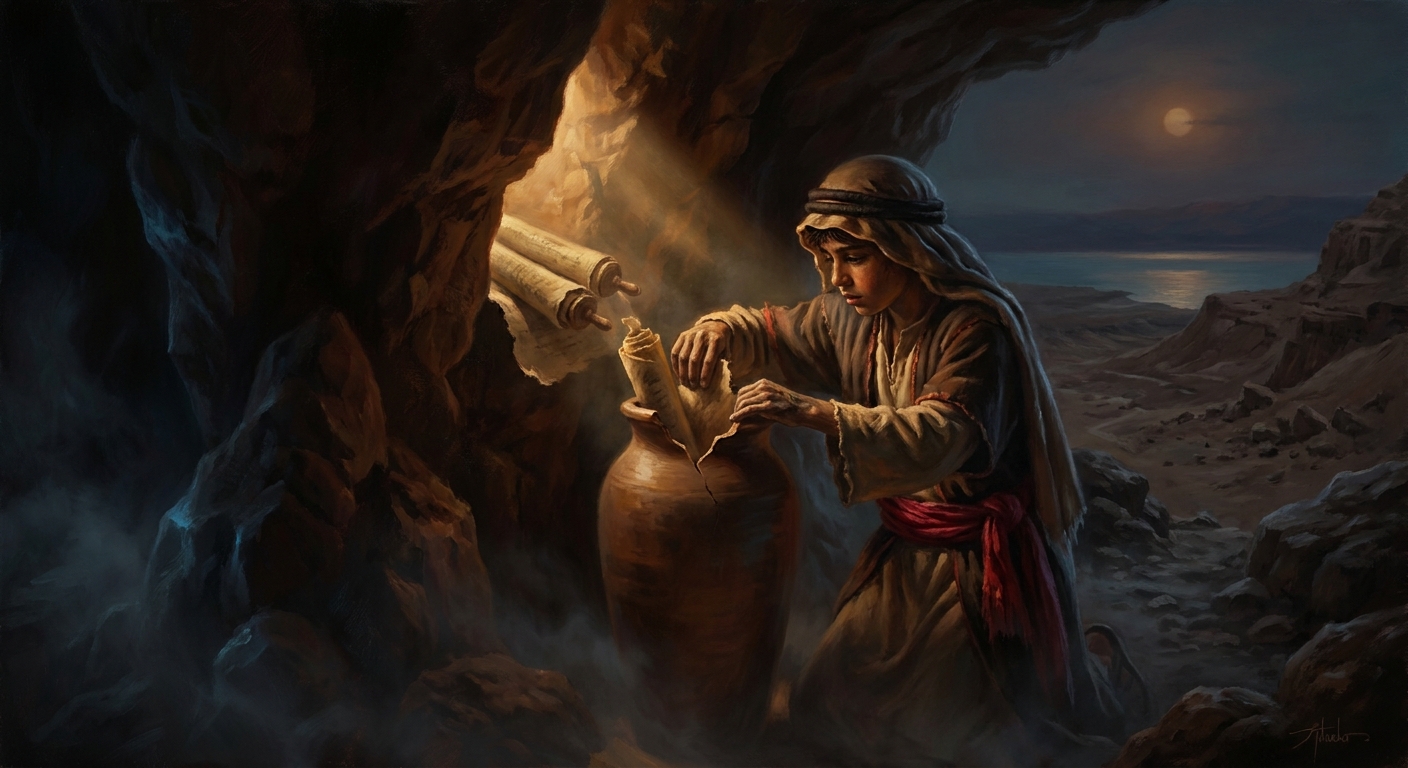
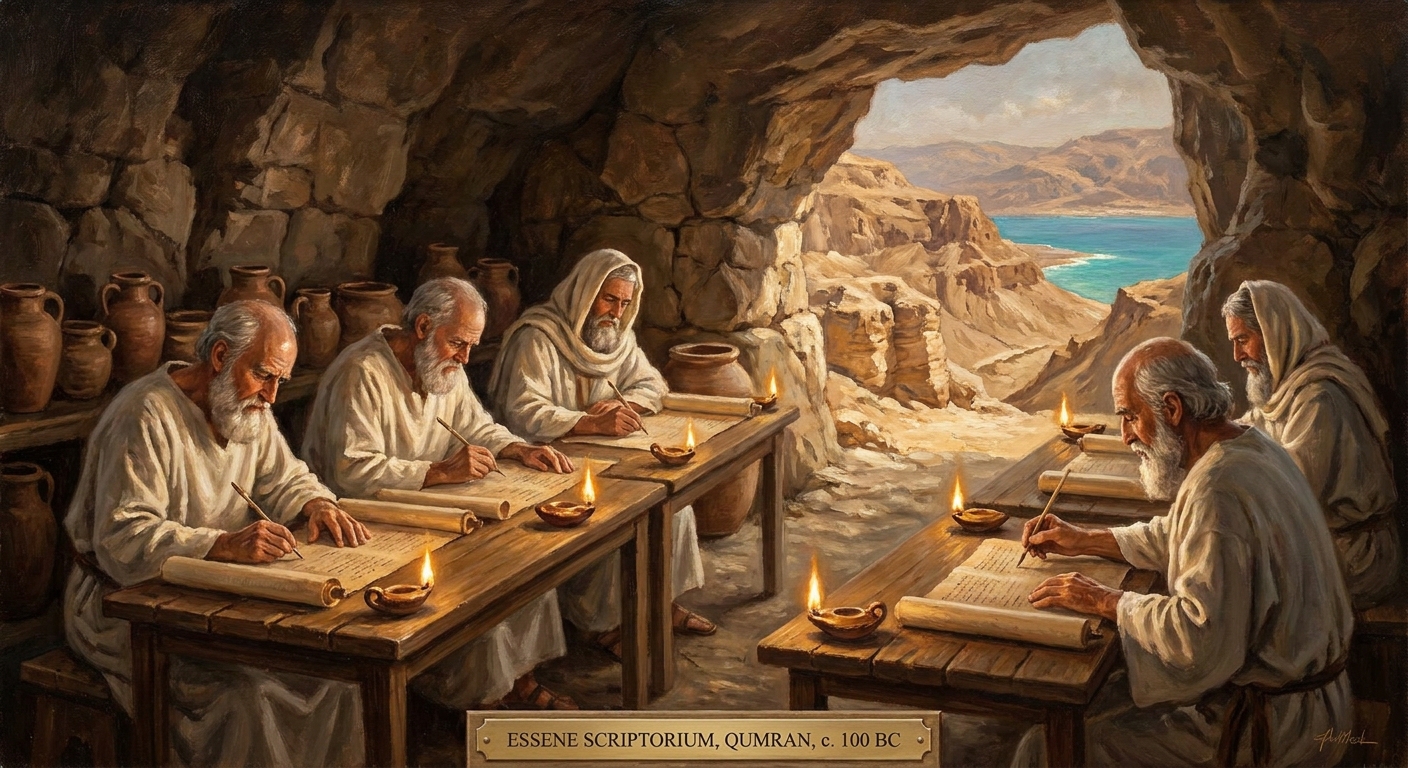
| Scroll Category | Contents | Significance |
|---|---|---|
| Biblical manuscripts | Every OT book except Esther; Isaiah scroll nearly identical to the medieval Masoretic text | Confirms the remarkable preservation of the Hebrew Bible across 1,000+ years |
| Sectarian texts | Community Rule, War Scroll, Temple Scroll | Reveal the Essene community's beliefs: strict purity, apocalyptic expectation, dualism (sons of light vs. sons of darkness) |
| Pesharim (commentaries) | Interpretations of Habakkuk, Nahum, Psalms | Show how Jews in Jesus' era read ancient prophecy as applying to their own time -- exactly what NT authors also did |
| Apocalyptic literature | 1 Enoch fragments, Jubilees, War Scroll | Confirm that the apocalyptic worldview of the NT (angels, demons, final battle, resurrection) was widespread in Second Temple Judaism |
| Messianic texts | 4Q521 ("Messianic Apocalypse"), 4Q174 | Describe a coming Messiah who heals the sick, raises the dead, and preaches good news to the poor -- language Jesus uses of himself in Luke 7:22 |
For Masonic and Esoteric traditions: The Qumran community's emphasis on secret knowledge, initiation stages, and progressive spiritual advancement has drawn comparisons to both Masonic degree systems and Gnostic traditions. These parallels are suggestive but not causal -- the Essenes did not "become" Masons. The structural similarity reflects a common human pattern of organizing spiritual communities around progressive revelation.
Theological Developments Born in the Silence
| Concept | Emerged During | NT Impact |
|---|---|---|
| Bodily resurrection | ~200-100 BC (2 Maccabees 7; Daniel 12:2) | Central to Jesus' teaching and Paul's theology (1 Cor 15); Pharisees believed in it, Sadducees rejected it (Acts 23:8) |
| Angels and demons as organized hierarchies | 1 Enoch, Jubilees (~300-100 BC) | NT assumes this framework: Satan as ruler of demons, Michael as archangel, "principalities and powers" (Eph 6:12) |
| The "Son of Man" as cosmic judge | 1 Enoch 37-71 (Parables of Enoch, ~1st c. BC) | Jesus' most common self-designation ("Son of Man") draws from both Daniel 7 and Enochic tradition |
| Hell / Gehenna as eternal punishment | Intertestamental apocalyptic literature | OT barely mentions afterlife; by Jesus' time, elaborate heaven/hell imagery was mainstream |
| Messianic expectation (multiple models) | Psalms of Solomon, Dead Sea Scrolls (~100 BC - 1st c. AD) | Some expected a warrior-king (Davidic), others a priestly messiah, others a prophetic figure; Jesus confounded all categories |
| Oral Torah / Rabbinic interpretation | Pharisaic movement (~150 BC onward) | Jesus debates Pharisees about oral law (Mark 7:1-13); Paul trained "at the feet of Gamaliel" (Acts 22:3) in this tradition |
Six-lens note: For Masonic tradition, Alexander's empire and the spread of Greek mystery schools during this period are sometimes cited as channels through which ancient Egyptian and Babylonian wisdom traditions were preserved and eventually transmitted to medieval Europe. Esoteric traditions trace the "perennial philosophy" through Hellenistic Alexandria, where Jewish, Greek, and Egyptian thought merged.
| Date | Event | Prophetic Significance |
|---|---|---|
| 4-6 BC | Birth of Jesus | Fulfills Isaiah 7:14, Micah 5:2, Genesis 3:15; incarnation of the Messiah |
| ~26-27 AD | Baptism & Public Ministry Begins | John the Baptist identifies the Messiah; some align this with Daniel's 70 Weeks |
| ~30-33 AD | Crucifixion (Passover) | Central redemptive event; fulfills Isaiah 53, Psalm 22; Messiah "cut off" per Daniel 9 |
| ~30-33 AD | Resurrection (Third Day) | Foundation of Christian faith; first-fruits of resurrection for all believers |
| ~33 AD | Pentecost | Holy Spirit outpoured; birth of the Church; ~3,000 baptized; fulfills Joel 2:28-32 |
 | 66-73 AD | Jewish Revolt Against Rome | Political resistance; precursor to Temple destruction |
| Aug 10, 70 AD | Second Temple Destroyed (9th of Av) | Fulfills Jesus' prophecy (Matt 24:1-2); end of Jewish sacrificial system; major eschatological marker |
| 66-73 AD | Jewish Revolt Against Rome | Political resistance; precursor to Temple destruction |
| Aug 10, 70 AD | Second Temple Destroyed (9th of Av) | Fulfills Jesus' prophecy (Matt 24:1-2); end of Jewish sacrificial system; major eschatological marker |
 | ~95 AD | Book of Revelation Written | John of Patmos records end-times visions under Emperor Domitian's persecution |
Christian
48- ~30 CE Crucifixion of Jesus under Pontius Pilate; Resurrection appearances reported; Pentecost in Jerusalem — Christianity is born as a Spirit-filled Jewish sect
- ~34 CE Stoning of Stephen outside Jerusalem — the deacon's speech to the Sanhedrin and execution by mob make him the protomartyr; Saul of Tarsus holds the cloaks of his killers, foreshadowing his own conversion.
- ~37 CE Paul of Tarsus's Damascus Road conversion — the Pharisee persecutor becomes the missionary to the Gentiles; his letters (~50-60 CE) are the earliest Christian writings
- ~48-60 CE Paul's three missionary journeys across Asia Minor, Greece, and Rome; he argues Gentiles need not follow Jewish law — the first major Christian theological controversy
- ~50 CE Council of Jerusalem (Acts 15) — Peter, Paul, and James rule that Gentile converts need not be circumcised or keep kosher; the decision severs Christianity's umbilical cord to ethnic Judaism and opens it to the Greco-Roman world.
- ~50 CE Council of Jerusalem (Acts 15) — Peter, Paul, and James convene the first church council to settle whether Gentile converts must be circumcised and keep kosher law; James rules they need not, requiring only abstention from idols, blood, strangled meat, and sexual immorality; the decision opens Christianity to the Greco-Roman world and severs its ethnic-Jewish umbilical cord.
- 64 CE Great Fire of Rome and Nero's persecution — Tacitus reports that Nero scapegoats the Christians, who are crucified, torn by dogs, and burned as torches in his gardens; the persecution invents the Roman Christian martyrology.
- ~64-67 CE Paul beheaded on the Ostian Way and Peter crucified upside-down on the Vatican hill — the two pillar apostles die in Rome under Nero; their tombs become the geographic anchor of the Roman papacy's claim to apostolic succession.
- ~70-100 CE Synoptic Gospels composed — Mark first (~70 CE), then Matthew and Luke (~85 CE), then John (~95 CE); four theological portraits, not one biography
- ~95 CE Domitian's persecution and the Book of Revelation — John of Patmos writes apocalyptic letters to the seven churches of Asia Minor under an emperor who demands to be addressed as *Dominus et Deus*; Christian refusal of the imperial cult becomes a death sentence.
- ~100 CE Edessa (modern Şanlıurfa, Turkey) as the earliest Christian polity — the Syriac-speaking Osrhoene principality is the first state plausibly to have adopted Christianity; the church of Edessa becomes the mother of the East Syriac tradition that will carry the faith east to Persia, India, and Tang-dynasty China.
- ~108 CE Ignatius of Antioch fed to lions in the Colosseum — en route to martyrdom he writes seven letters arguing that the bishop is the local guarantor of unity; his eagerness to die ("I am God's wheat") fixes the early Christian aesthetic of martyrdom-as-eucharist.
- ~108 CE Ignatius of Antioch martyred at Rome — the bishop is fed to lions in the Colosseum under Trajan; en route from Syria he writes seven letters to Asian churches insisting that bishop, presbyters, and deacons constitute the visible structure of the Church and that Eucharist celebrated without the bishop is invalid; his eagerness to die ("I am God's wheat, ground by the teeth of beasts") fixes the early Christian aesthetic of martyrdom-as-eucharist.
- ~150 CE Justin Martyr writes the *First Apology* — the first attempt to present Christianity as rational philosophy to a Roman emperor; he compares Jesus to Hermes and Asclepius to court educated pagans
- ~155 CE Justin Martyr writes the *First Apology* and addresses it to Emperor Antoninus Pius — the philosopher in his pallium argues that Christianity is the truest philosophy, that Socrates and Heraclitus were Christians "before Christ" because they followed the *Logos*, and demands the emperor stop punishing Christians for the name alone; the founding text of Christian philosophical engagement with Greco-Roman culture.
- ~165 CE Justin Martyr martyred under Marcus Aurelius — the philosopher-martyr pattern becomes a Christian archetype
- 177 CE Martyrs of Lyon under Marcus Aurelius — slave-girl Blandina and Bishop Pothinus are tortured in the amphitheatre; Eusebius preserves the eyewitness letter from the Gallic churches to those of Asia, the most detailed surviving martyrdom account from the persecuted era.
- ~180 CE Irenaeus of Lyons writes *Adversus Haereses* — the first systematic orthodox theology, assembled largely to destroy Gnosticism; he canonizes the four Gospels
- ~200 CE Tertullian active in Carthage — the first major Latin Christian writer coins *Trinitas* and *persona*, defends Montanist enthusiasm against Roman bishops, and quips *Credo quia absurdum*; his rhetoric forges the vocabulary in which Western theology will be argued.
- ~225 CE Origen's *Hexapla* and self-castration — the Alexandrian polymath compiles a six-column parallel Hebrew/Greek Old Testament and, taking Matthew 19:12 too literally as a youth, makes himself a eunuch "for the kingdom"; his allegorical exegesis sets the template for Christian biblical scholarship.
- ~250 CE Decius's persecution — the first empire-wide demand that all Romans sacrifice to state gods; Christians who comply (*lapsi*) trigger the Donatist controversy over how to readmit them
- 251 CE Cyprian of Carthage on the Lapsi — after the Decian persecution he writes *De Lapsis*, ruling that Christians who sacrificed must do public penance before readmission; the controversy hardens the doctrine of the bishop's sole authority to forgive post-baptismal sin.
- ~270 CE Anthony of Egypt withdraws to the desert — a young Coptic farmer sells his inheritance, retreats first to a village ascetic, then to the tombs, then twenty years alone in an abandoned fort at Pispir; when he finally emerges, the proto-monastic encampment outside his walls is already forming; he becomes the template from which all Desert Father tradition flows.
- ~270 CE Antony of Egypt enters the desert — the Coptic farmer hears Matthew 19:21 in church, sells his inheritance, and withdraws first to a village ascetic, then to the tombs, and finally twenty years alone in an abandoned fort at Pispir; when he emerges, the proto-monastic encampment outside his walls has already formed; Athanasius's *Life of Antony* (~360 CE) becomes the founding text of Christian monasticism and is read across Latin Christendom.
- ~300-350 CE Amma Syncletica and the Desert Mothers (*ammas*) flourish in the Egyptian and Palestinian desert — Syncletica of Alexandria, Sarah of the Desert, and Theodora teach radical asceticism, prayer, and apophatic theology to disciples of both sexes; their *apophthegmata* are preserved alongside the Desert Fathers' but recover only fragmentary attribution; the female monastic tradition operates in parallel with Antony, Pachomius, and Macarius.
- 301 CE Tiridates III of Armenia converts to Christianity after Gregory the Illuminator survives fifteen years in a pit-prison and heals the king of a madness — Armenia becomes the first nation in history to adopt Christianity as its official state religion, a full decade before Constantine's Edict of Milan; the Armenian Apostolic Church traces its founding to this moment.
- 303-313 CE Diocletian's Great Persecution — the most systematic Roman assault on Christianity: churches demolished, scriptures confiscated and burned, clergy imprisoned, imperial sacrifice enforced on pain of death; the *traditores* (those who hand over scriptures) spark the Donatist schism over whether clergy who capitulated can validly administer sacraments; the persecution ends with Constantine's Milvian Bridge victory in 312.
- 312 CE Constantine sees the Chi-Rho vision before the Battle of the Milvian Bridge (*In hoc signo vinces*); the empire's most decisive military campaign is fought under a Christian symbol
- 313 CE Edict of Milan — Christianity legalized across the Roman Empire; the persecuted minority becomes a tolerated and soon favored religion
- ~320s CE Pachomius of Egypt founds the first cenobitic (communal) monastery at Tabennisi — where Anthony pioneered solitary asceticism, Pachomius organizes monastics into regulated communities with fixed prayer hours, communal work, and a written Coptic rule; his model becomes the template for all subsequent cenobitic monasticism, from Basil's Greek rule to Benedict's Latin adaptation.
- ~320 CE Pachomius founds the first cenobitic (communal) monastery at Tabennisi on the Nile — where Antony pioneered solitary asceticism, Pachomius organizes monks into regulated communities with fixed prayer hours, communal work, common meals, and a written Coptic *Rule*; his model becomes the template for Basil's Greek rule, Benedict's Latin adaptation, and every subsequent communal monastic experiment in the Christian world.
- 325 CE Council of Nicaea — Arianism condemned; the Trinitarian formula (*homoousios*: Father and Son are "of the same substance") codified; the Roman Empire enforces Christian doctrine for the first time
- ~341 CE Arius and his Arian theology continue to dominate the eastern empire even after Nicaea; the "heresy" outlives its condemnation and evangelizes the Germanic tribes (Goths, Vandals, Lombards)
- ~350 CE Codex Sinaiticus and Codex Vaticanus produced — the two oldest near-complete Greek Bibles, parchment uncials likely commissioned in the wake of Constantine's order to Eusebius for fifty imperial Bibles; they remain the bedrock witnesses for modern New Testament textual criticism.
- ~354-387 CE Augustine of Hippo's Manichaean years — the young North African rhetor joins the Manichaean *auditores* for nine years, drawn by Mani's elegant dualism of light-soul trapped in matter-darkness; the shallow answers of Faustus of Milevis, Neoplatonism, and Ambrose of Milan's allegorical preaching break it; his intimate knowledge of Manichaeism later makes his refutations the most lethal ever written.
- ~367 CE Athanasius's Easter Letter lists the 27-book New Testament canon for the first time — the canon as we know it is fixed in a bishop's annual letter, not a council decree
- ~380 CE Theodosius I issues the Edict of Thessalonica — Christianity becomes the sole official religion of the Roman Empire; paganism is criminalized
- 381 CE First Council of Constantinople — under Theodosius I the Nicene Creed is expanded to affirm the full divinity of the Holy Spirit against the Pneumatomachi; the Trinitarian formula reaches the form still recited in Sunday liturgies across most of global Christendom.
- 386 CE Augustine's conversion in the Milan garden — the rhetor hears a child chant *tolle, lege* ("take, read"), opens Paul's Romans to chapter 13, and abandons concubinage and ambition; his subsequent baptism by Ambrose redirects Western theology for the next 1,600 years.
- 391 CE Theodosius's edict closes the pagan temples — the Serapeum of Alexandria is razed by Patriarch Theophilus and his monks, the Vestal flame in Rome extinguished, oracles silenced; sacrificial paganism, four millennia old in the Mediterranean, is decapitated by imperial decree.
- ~400 CE Augustine of Hippo writes *Confessions* (~400 CE) and *City of God* (~413-426 CE) — the theological framework for Western Christianity's understanding of sin, grace, and history
- 410 CE Alaric's Visigoths sack Rome — the first time the city falls to a foreign army in 800 years; Jerome weeps in Bethlehem; Augustine begins *City of God* partly to answer pagans who blame Christianity for Rome's fall; the shock accelerates the theological shift from Roman imperial identity to hope in a heavenly city that no barbarian can sack.
- 411-418 CE Pelagius vs. Augustine — the British monk Pelagius teaches that humans possess free will sufficient to choose righteousness without irresistible divine grace; Augustine counters with original sin, predestination, and the necessity of grace; the Council of Carthage (418) condemns Pelagianism; the debate defines Western Christian anthropology and resurfaces in every subsequent Protestant controversy over faith and works.
- 430 CE Augustine dies as the Vandals besiege Hippo — the bishop completes the *Retractationes* and dies reciting the penitential psalms while Genseric's army camps outside the walls; the city falls the next year and his library survives by chance to shape medieval Latin Christianity.
- 431 CE Council of Ephesus declares Mary *Theotokos* (God-bearer) — convened to resolve the Nestorian controversy; Cyril of Alexandria defeats Nestorius; the Nestorian church carries its Christology east to Persia and eventually to China and India; the title *Theotokos* becomes the cornerstone of Marian devotion in Catholic and Orthodox Christianity for all subsequent centuries.
- ~432 CE Patrick arrives in Ireland as bishop — Irish Christianity will develop a distinctive monastic tradition that preserves classical learning through the Dark Ages and re-Christianizes post-Roman Britain
- 451 CE Council of Chalcedon — Christ defined as one person with two natures, human and divine; the Coptic, Ethiopian, and Armenian churches reject this formula and split from Rome and Constantinople
- 452 CE Pope Leo I meets Attila the Hun at the Mincio River — the *Scourge of God* halts his Italian campaign after a face-to-face audience with the Bishop of Rome near Mantua; Leo returns to Rome in triumph; the encounter crystallizes the papal claim that moral authority — not merely military force — can govern the course of history.
Buddhist
11- ~50 CE The *Aṭṭhakavagga* (Book of Eights) of the Sutta Nipata circulates — one of the oldest datable Buddhist texts, it advocates radical non-clinging to views (*diṭṭhi*) with a bluntness that later scholasticism will struggle to absorb; its existence before the schools split makes it a rare pre-sectarian window into early Buddhist teaching.
- 64 CE Emperor Han Mingdi of China dreams of a golden figure flying in the west; his court interprets it as the Buddha — he dispatches envoys to the Kushan empire; returning monks bring the *Sutra of Forty-Two Chapters* and white horses to Luoyang; White Horse Temple (Baima Si), China's first Buddhist monastery, is founded on the site.
- ~78 CE Fourth Buddhist Council convened by Kushan emperor Kanishka in Kashmir — Sarvastivada scholars compile the *Mahavibhasa* commentary; the council formalizes the Sanskrit canon and accelerates Mahayana's northward spread along the Silk Road.
- ~100 CE The Theravada-Mahayana split sharpens — new *Prajnaparamita* sutras circulate asserting the bodhisattva path of universal compassion surpasses the arhat ideal; Mahayana polemically labels the older schools *Hinayana* ("lesser vehicle"), and the two traditions diverge across the following centuries in cosmology, soteriology, and practice.
- ~100 CE The *Lotus Sutra* (*Saddharma Pundarika*) takes shape in northwestern India — its parable of the burning house and doctrine of the One Vehicle (*ekayana*) become the most influential Mahayana text in East Asia, foundational to Tiantai, Tendai, and Nichiren schools.
- ~150 CE Nagarjuna founds Madhyamaka — the South Indian monk's *Mulamadhyamakakarika* deploys the doctrine of emptiness (*sunyata*) and the two truths to dismantle every metaphysical position; he becomes the second-most-important figure in Mahayana Buddhism after the Buddha himself.
- ~350 CE Asanga and Vasubandhu found Yogācāra (Consciousness-Only) — the half-brothers from Gandhara argue that all phenomena are projections of the *alaya-vijnana* (storehouse consciousness); the school becomes the second great pillar of Mahayana philosophy alongside Madhyamaka.
- ~372 CE Buddhism enters Korea via the Goguryeo kingdom from China — within two centuries it becomes the official state religion of all three Korean kingdoms and then Japan (538/552 CE)
- ~399-414 CE Faxian's pilgrimage — the Chinese monk walks from Chang'an across the Taklamakan Desert, through India and Sri Lanka, and returns by sea; his *Record of Buddhist Kingdoms* is the first first-hand Chinese account of Indian pilgrimage sites and becomes an irreplaceable historical source for early Buddhist topography and monastic life.
- ~400 CE Buddhism crosses Central Asia via the Silk Road into China; Fa Xian travels to India (~399-412 CE) to collect scriptures; Kumarajiva translates the *Lotus Sutra* into Chinese
- ~401 CE Kumarajiva arrives in Chang'an under imperial escort — the half-Kuchean monk produces Chinese translations of the *Lotus Sutra*, *Diamond Sutra*, *Vimalakirti Sutra*, and Madhyamaka treatises so literary that they remain the standard canonical texts today; his Chang'an translation bureau is the first major state-sponsored Buddhist translation project and shapes all East Asian Buddhist vocabulary.
Jewish
11- ~1 CE Hillel and Shammai schools formalize their rivalry — Beit Hillel (lenient, inclusive) and Beit Shammai (strict, separatist) produce hundreds of recorded legal disputes (*machloket*) that become the template for rabbinic dialectical reasoning; most rulings follow Hillel, but the Talmud preserves Shammai's minority opinions as sacred argument.
- ~26 CE John the Baptist preaches baptism of repentance at the Jordan — a wilderness prophet in the tradition of Elijah; the ritual that Christianity will inherit and transform
- ~70 CE Second Temple destroyed by Rome (Titus's siege); the Temple priesthood ends; rabbinic Judaism pivots from sacrifice to Torah study as the center of religious life
- ~90 CE The Yavneh tradition (Council of Jamnia) — after the Temple's fall, Rabbi Yohanan ben Zakkai relocates the Sanhedrin to Yavneh; scholars deliberate which books belong in sacred scripture, debate Song of Songs and Qohelet, and begin the legal codification project that produces the Mishnah; diaspora Judaism is rebuilt from the ashes of the priesthood.
- 132-135 CE Bar Kokhba revolt — Simon bar Kokhba leads the last major Jewish armed revolt against Rome; Rabbi Akiva declares him the Messiah; after three years Rome suppresses the revolt, razes Jerusalem, builds Aelia Capitolina on its ruins, and bans Jews from entering; Judea is renamed Syria Palaestina; Jewish political sovereignty in the Land of Israel ends for 1,813 years.
- ~135 CE Rabbi Akiva ben Joseph martyred under Hadrian — the great Tannaitic sage is flayed alive with iron combs after defying the Roman ban on Torah teaching; he dies reciting the Shema (Deuteronomy 6:4) and prolongs the final word *echad* ("One") until his soul departs; the scene becomes the paradigmatic *kiddush ha-Shem* (sanctification of the Name) for all subsequent Jewish martyrology.
- ~200 CE The Mishnah compiled under Rabbi Judah the Prince — the first written codification of the oral Torah; rabbinic Judaism now has a constitutional document
- ~200 CE Yehuda HaNasi (Judah the Prince) edits and seals the Mishnah — the *nasi* (patriarch) at Beit She'arim makes the audacious decision to commit the oral Torah to writing, dividing it into six *sedarim* covering agriculture, festivals, family law, damages, sacrifices, and ritual purity; it becomes the constitutional document of rabbinic civilization.
- ~400-500 CE The Jerusalem and Babylonian Talmuds compiled — the Talmudic period (200-500 CE) produces the oral law's final written form; the Babylonian Talmud (~500 CE) becomes the normative text of rabbinic Judaism
- ~400 CE The Jerusalem Talmud (*Yerushalmi*) compiled in Galilee — the rabbinic academies at Tiberias, Sepphoris, and Caesarea finalize their Mishnah commentary before Byzantine pressure ends Palestinian Jewish scholarship; it remains a minority companion to the longer Babylonian Talmud.
- ~400 CE Jerusalem Talmud (*Yerushalmi*) compiled in the Galilean academies — the rabbis of Tiberias, Sepphoris, and Caesarea finalize their Mishnah commentary before Byzantine pressure ends Palestinian Jewish scholarship; less polished and shorter than its Babylonian counterpart, it preserves a distinctively Palestinian Aramaic, halakhic emphasis, and historical context that the Babylonian Talmud would otherwise have lost.
Hindu
6- ~200 BCE-200 CE The *Bhagavad Gita* takes its final form within the Mahabharata — Krishna's battlefield instruction to Arjuna synthesizes Samkhya, Yoga, Vedanta, and bhakti into a single text that will become Hinduism's most quoted scripture and a later touchstone for Gandhi, Tolstoy, and Oppenheimer.
- ~200-400 CE The Puranas composed — Vishnu, Shiva, and Devi receive their full mythological biographies; the *Bhagavata Purana* and *Shaiva Puranas* crystallize devotional (bhakti) theology
- ~200 CE The *Manusmriti* (Laws of Manu) compiled — the Sanskrit dharma text codifies *varna* duties, women's subordination, and ritual purity; it becomes the most contested classical Hindu legal text, defended by orthodox Brahmins and burned by Ambedkar in 1927.
- 320-550 CE Gupta Empire — Hinduism's classical golden age; Sanskrit drama (Kalidasa), the Aryabhata's astronomy, the decimal place-value system, and the iconographic conventions of Vishnu, Shiva, and Devi all crystallize under Chandragupta II and his successors.
- ~400 CE Kalidasa composes the *Abhijnanashakuntalam* (Recognition of Shakuntala) at the Gupta court — the play's curse, lost ring, and reunion become the touchstone of Sanskrit dramatic literature; Goethe later reads it in translation and calls it "heaven and earth united."
- ~425 CE The *Vishnu Purana* and other major Puranas reach written form — Vishnu's ten *avataras*, Shiva's cosmic dance, and the Devi Mahatmya's slaying of Mahishasura crystallize the iconographic and narrative grammar of devotional (bhakti) Hinduism for the next millennium and a half.
Daoist
4- ~142 CE Zhang Daoling receives a vision of Laozi on Mount Heming in Sichuan and founds the Way of the Celestial Masters (*Tianshi Dao*) — the first organized Daoist church, with parish priests, talismans, and confession of sins to cure illness.
- ~165 CE Emperor Han Huandi sponsors imperial sacrifice to Laozi at his birthplace — the philosopher is formally deified as *Taishang Laojun* (Most High Lord Lao), entering the Daoist pantheon as a cosmic emanation of the Dao itself.
- 184 CE Yellow Turban Rebellion erupts under the Zhang brothers' Way of Great Peace (*Taiping Dao*) — millenarian Daoist healers proclaim the imminent Yellow Heaven; the uprising shatters Han authority and seeds three centuries of Daoist political messianism.
- ~320 CE Ge Hong completes the *Baopuzi* (*Master Who Embraces Simplicity*) in Jiangnan — the foundational alchemical Daoist text systematizing immortality elixirs, talismanic magic, and breath cultivation; outer alchemy (*waidan*) acquires its canonical handbook.
Maya
4- c. 200 CE Classic Maya period begins; monumental temple complexes built at Tikal, Palenque, Copán; astronomical observations codified
- c. 250 CE Maya Long Count calendar in active use; astronomical precision in tracking Venus, Mars, eclipse cycles for ritual calendar
- 250 CE Maya Classic Period begins — the lowland city-states of Tikal, Palenque, Calakmul, and Copán crystallize divine kingship, the Long Count calendar, and a fully phonetic hieroglyphic script; the *k'uhul ajaw* (holy lord) bridges the human and supernatural orders.
- c. 500 CE Teotihuacan at its height with 125,000 inhabitants; religious calendar and ballgame cult spread throughout Mesoamerica
Neoplatonist
4- ~240 CE Plotinus arrives in Rome and founds Neoplatonism — the One, Nous, and World-Soul as emanations; his *Enneads* become the philosophical infrastructure of both Christian mysticism and Islamic Sufi metaphysics
- ~300 CE Iamblichus of Chalcis formalizes theurgy — his *De Mysteriis* defends ritual invocation of the gods as superior to mere philosophical contemplation; Neoplatonism becomes operational magic, deeply influencing Julian the Apostate, Renaissance Hermeticism, and modern Western esotericism.
- ~390 CE Hypatia of Alexandria teaches Neoplatonist philosophy at the Museion — a pagan woman philosopher at the center of a Christian city; murdered by a Christian mob in 415 CE
- 415 CE Hypatia of Alexandria torn apart by a mob of *parabalani* — the mathematician and Neoplatonist philosopher is dragged to the Caesarion church, flayed with potsherds (*ostraka*), and burned; her death in the patriarchate of Cyril marks the symbolic end of Hellenistic learning at Alexandria.
Gnostic
3- ~100-150 CE Sethian Gnostic texts composed in Alexandria — *Apocryphon of John*, *Hypostasis of the Archons*; Genesis inverted: the serpent liberates, Yahweh is the blind jailer
- ~130 CE Valentinus arrives in Rome and founds Valentinian Gnosticism — 30 Aeons, the Fall of Sophia, the Demiurge; the most philosophically sophisticated Gnostic system; attracts Rome's Christian intelligentsia
- ~144 CE Marcion of Sinope expelled from the Roman church; his rejection of the Hebrew Bible and the first-ever Christian canon (Luke + 10 Paul letters) forces the proto-orthodox to assemble their own 27-book canon
Manichaean
3- ~216 CE Mani born in Babylon (Seleucia-Ctesiphon) — he will fuse Zoroastrian dualism, Christian redemption, and Buddhist liberation into the first genuinely global religion
- ~250 CE Mani proclaims his revelation — the *Shabuhragan* presented to the Sassanid king; Manichaeism reaches from Rome to China within a century
- ~276 CE Mani executed by the Zoroastrian priesthood under Bahram I — crucified and flayed; his death is modeled on Christ's by his followers; Manichaeism goes underground and spreads further
Shinto
3- c. 100 CE *Nihon Shoki* (Chronicles of Japan) events: traditional dating of Amaterasu, Susanoo, and Izanagi-Izanami myths being systematized in courtly tradition
- c. 400 CE *Kojiki* events taking shape in oral tradition: Izanagi/Izanami creation, Amaterasu in the rock cave, Susanoo and the Yamata no Orochi
- ~400 CE The Yamato clan consolidates power in Japan — the imperial lineage is traced to Amaterasu, the sun goddess; Shinto as a state ritual framework takes shape around the imperial institution
Mesoamerican
2- ~100-300 CE Olmec religious vocabulary absorbed into Classic Maya civilization — the were-jaguar deity, rubber-ball sacrifice, cacao ritual, and the 260-day *tzolk'in* calendar pass from the Olmec heartland to the Maya; simultaneously Teotihuacan rises in central Mexico as the continent's largest city, its Pyramid of the Sun aligned to the Pleiades and its ritual economy sustaining 150,000 people.
- ~200-450 CE Teotihuacan reaches its peak — the central Mexican metropolis grows to 150,000 inhabitants; the Pyramid of the Sun (completed ~200 CE) and the Avenue of the Dead align to celestial coordinates; the Feathered Serpent cult radiates outward to the Maya lowlands.
Multi
2- 455 CE Vandals sack Rome under Genseric — the Arian Germanic king who controls North Africa and the western Mediterranean strips the city's treasures over fourteen days, including the gold menorah from the Jerusalem Temple (taken by Titus and held in Rome for four centuries); the thoroughness of the looting bequeaths a new word to English.
- 476 CE Fall of the Western Roman Empire — the Germanic chieftain Odoacer deposes Romulus Augustulus without appointing a successor; no contemporaries call it "the fall," but the event ends the institutional framework within which Latin Christianity, Roman law, and classical learning had operated for five centuries; the Catholic Church becomes the primary custodian of Roman civilization's survival.
Zoroastrian
2- 224 CE Ardashir I overthrows the Parthian Arsacids and founds the Sasanian Empire — Zoroastrianism is restored as the state religion after five centuries of Hellenistic and Parthian eclipse; the Avesta begins to be standardized and the fire temples reorganized under royal patronage.
- ~270 CE Kartir, the Zoroastrian high priest under the Sassanids, consolidates orthodox Zoroastrianism and actively persecutes Manichaeans, Christians, Buddhists, and Jews in the Persian Empire
Celtic / Christian
1- ~432 CE Patrick arrives in Ireland as bishop — the British-born former captive returns voluntarily as a missionary; over the next thirty years he baptizes thousands, founds churches, ordains clergy, and confronts druids at the High King's court at Tara; his *Confessio* and *Letter to Coroticus* are the only contemporary documents from a fifth-century missionary; Irish Christianity's distinctive monastic-scholarly character begins here.
Coptic
1- ~450 CE The Coptic Church of Egypt, rejecting Chalcedon, develops its own liturgy, calendar, and monastic tradition in the Nile Valley; Anthony the Great (~250 CE) and Pachomius had already made Egypt the cradle of Christian monasticism
Ethiopian
1- ~330 CE Christianity reaches the Aksumite Empire — King Ezana of Axum converts; Ethiopia becomes the second state after Armenia to adopt Christianity as official religion (~301 CE)
Greek
1- 392 CE Theodosius bans the Olympic Games and closes Eleusis — nearly twelve centuries of Greek religious practice abolished by imperial decree; Delphi falls silent
Jain
1- c. 320 CE Digambara-Shvetambara split formalized; Digambara ("sky-clad") monks maintain nudity as spiritual discipline; Shvetambara ("white-clad") monks wear white robes
Māori
1- c. 450 CE Polynesian seafarers reach New Zealand (Aotearoa); earliest date debated but oral traditions speak of Kupe discovering the islands
Mithraic
1- ~100 CE Mithras mysteries at peak across Roman legions — seven initiatory grades, sacred caves (*mithraea*), communal bread-and-wine meals; parallels to Christian ritual disturb later apologists
NativeAmerican
1- ~100-300 CE Hopewell mound culture peaks in the Ohio and Mississippi valleys — the Newark Earthworks, Serpent Mound, and Hopewell site encode solar and lunar alignments; obsidian from Yellowstone, copper from the Great Lakes, and mica from the Appalachians flow continent-wide into ritual deposits; a ceremonial horizon without writing, sustained by shared cosmology.
Norse / Germanic
1- 98 CE Tacitus completes *Germania* — the Roman historian's ethnographic treatise records the Germanic tribes' worship of Tuisto, Mannus, and the goddess Nerthus (whose sacred grove and cart procession he describes in detail); the earliest surviving outsider account of pre-Christian Germanic religion and the principal source for reconstructing Iron Age Norse precursor cults.
Polynesian
1- c. 300 CE Polynesian voyagers reach Hawaii; bring Kāne, Kū, Lono, Kanaloa (four major deities) and sacred plants; Hawaiian religion begins developing
Roman
1- ~100-250 CE Sol Invictus, Mithras, and Christ converge in the Roman religious marketplace — the Unconquered Sun cult, the mystery grades of Mithras (communal meal, initiation, resurrection motifs), and the rising Christian movement share enough surface features to generate both syncretism and polemic; Constantine ultimately fuses solar imagery with Christ, and December 25 — the old solstice festival — becomes Christmas.
The fourteen centuries between the apostolic era and the Reformation shaped every major Christian tradition that exists today. Councils defined orthodoxy, empires adopted and co-opted the faith, schisms fractured the Church, and the Crusades created the Templar legend that Masonic mythology would later absorb.
Overview
Key Events
| Date | Event | Why It Matters for This Timeline |
|---|---|---|
| ~65-67 AD | Martyrdom of Peter and Paul (Rome, under Nero) | Apostolic succession begins; Rome claims primacy through Peter; foundational for Catholic authority claims |
| ~100-150 AD | Apostolic Fathers write (Clement, Ignatius, Polycarp) | Bridge between NT and later theology; Ignatius of Antioch first uses "catholic" (universal) to describe the Church; early liturgical structure established |
| 112 AD | Pliny's Letter to Trajan | Earliest pagan description of Christian worship; documents Roman policy on persecution; Christians met before dawn to sing hymns "to Christ as to a god" |
| ~150-200 AD | Gnostic movements flourish | Competing Christianities (Valentinus, Marcion, Basilides) force the proto-orthodox Church to define the canon and creed; Gnostic texts later inspire esoteric traditions |
 | 202-311 AD | Great Persecutions (Septimius Severus through Diocletian) | Diocletian's persecution (303-311) was the most severe; produced a theology of martyrdom that shaped Christian identity; the blood of the martyrs became "the seed of the Church" (Tertullian) |
| 313 AD | Edict of Milan | Constantine and Licinius legalize Christianity; ends state persecution; begins the fusion of Church and Empire that defines the next 1,200 years |
| 202-311 AD | Great Persecutions (Septimius Severus through Diocletian) | Diocletian's persecution (303-311) was the most severe; produced a theology of martyrdom that shaped Christian identity; the blood of the martyrs became "the seed of the Church" (Tertullian) |
| 313 AD | Edict of Milan | Constantine and Licinius legalize Christianity; ends state persecution; begins the fusion of Church and Empire that defines the next 1,200 years |
 | 325 AD | Council of Nicaea | First ecumenical council; 318 bishops convened by Constantine; defines Christ as "of one substance" (homoousios) with the Father against Arianism; produces the original Nicene Creed; establishes Easter dating method |
 | 381 AD | Council of Constantinople | Affirms and expands Nicene Creed to its final form (still recited today); declares the Holy Spirit "proceeds from the Father" -- the later Western addition of "and the Son" (filioque) becomes the theological trigger for the 1054 Schism |
| 431 AD | Council of Ephesus | Declares Mary as Theotokos ("God-bearer" / Mother of God) against Nestorius; defines the unity of Christ's divine and human natures; deepens the Christological framework |
| 451 AD | Council of Chalcedon | Defines Christ as one person in two natures (divine and human), "without confusion, without change, without division, without separation"; the Chalcedonian Definition becomes the standard for Catholic, Orthodox, and Protestant Christology; Oriental Orthodox churches reject it, creating the first permanent schism |
| 476 AD | Fall of Western Roman Empire | Romulus Augustulus deposed; the Bishop of Rome (Pope) inherits political authority in the power vacuum; monasteries become the primary preservers of learning and Scripture in Western Europe |
| 381 AD | Council of Constantinople | Affirms and expands Nicene Creed to its final form (still recited today); declares the Holy Spirit "proceeds from the Father" -- the later Western addition of "and the Son" (filioque) becomes the theological trigger for the 1054 Schism |
| 431 AD | Council of Ephesus | Declares Mary as Theotokos ("God-bearer" / Mother of God) against Nestorius; defines the unity of Christ's divine and human natures; deepens the Christological framework |
| 451 AD | Council of Chalcedon | Defines Christ as one person in two natures (divine and human), "without confusion, without change, without division, without separation"; the Chalcedonian Definition becomes the standard for Catholic, Orthodox, and Protestant Christology; Oriental Orthodox churches reject it, creating the first permanent schism |
| 476 AD | Fall of Western Roman Empire | Romulus Augustulus deposed; the Bishop of Rome (Pope) inherits political authority in the power vacuum; monasteries become the primary preservers of learning and Scripture in Western Europe |
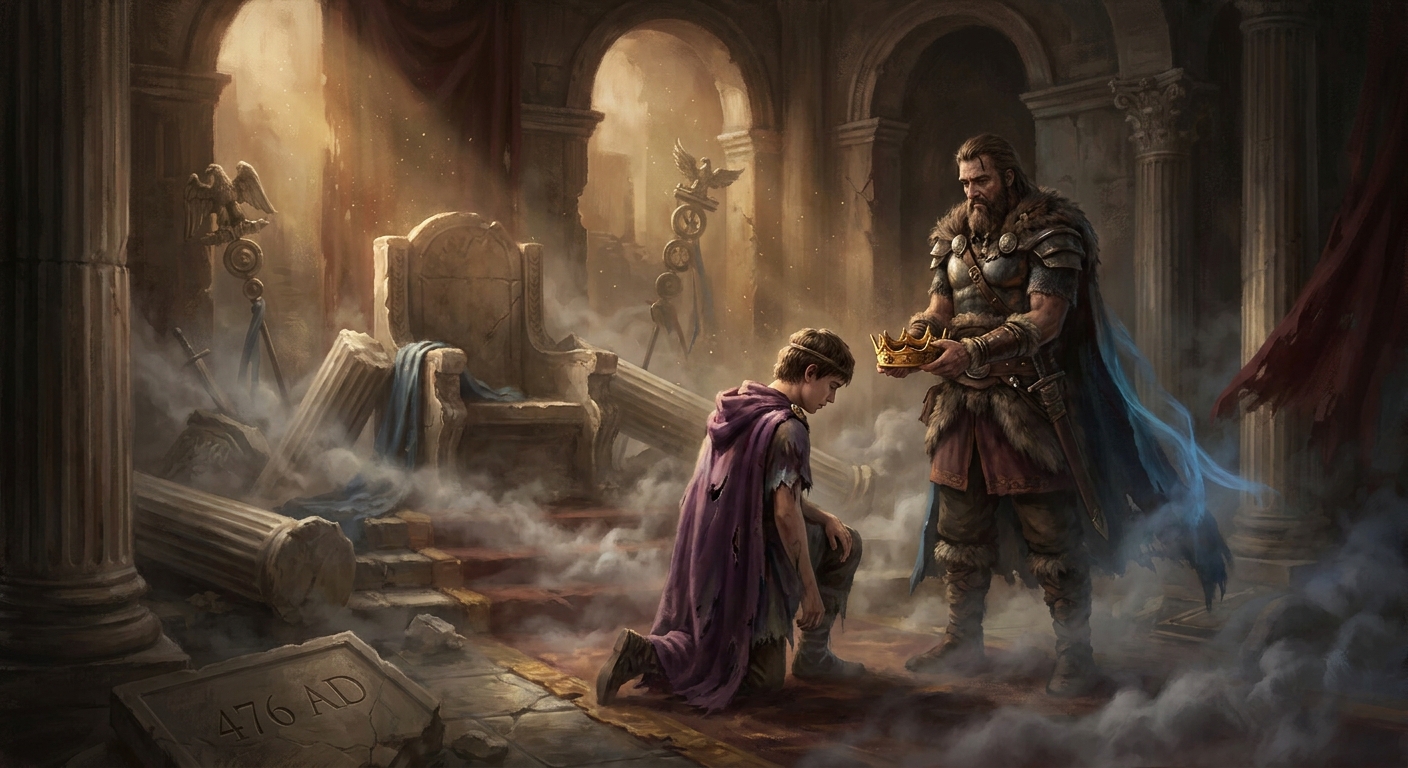 | 529 AD | Benedict founds Monte Cassino | Benedictine Rule organizes Western monasticism; monks preserve texts, develop agriculture, and maintain the infrastructure of civilization through the "Dark Ages" |
| 632 AD | Death of Muhammad / Rise of Islam | Islam rapidly conquers the former Christian territories of North Africa, the Levant, Persia, and Spain; the Holy Land passes to Muslim control; the theological and geopolitical rival that provokes the Crusades |
| 529 AD | Benedict founds Monte Cassino | Benedictine Rule organizes Western monasticism; monks preserve texts, develop agriculture, and maintain the infrastructure of civilization through the "Dark Ages" |
| 632 AD | Death of Muhammad / Rise of Islam | Islam rapidly conquers the former Christian territories of North Africa, the Levant, Persia, and Spain; the Holy Land passes to Muslim control; the theological and geopolitical rival that provokes the Crusades |
 | 800 AD | Charlemagne crowned Holy Roman Emperor | Pope Leo III crowns a secular ruler as protector of Christendom; establishes the Church-State partnership that defines medieval Europe |
| 1054 AD | Great East-West Schism | Mutual excommunication between Rome and Constantinople over the filioque clause, papal authority, and liturgical differences; Christianity permanently splits into Roman Catholic (West) and Eastern Orthodox (East); not formally healed until 1965 (mutual lifting of excommunications by Pope Paul VI and Patriarch Athenagoras) |
| 800 AD | Charlemagne crowned Holy Roman Emperor | Pope Leo III crowns a secular ruler as protector of Christendom; establishes the Church-State partnership that defines medieval Europe |
| 1054 AD | Great East-West Schism | Mutual excommunication between Rome and Constantinople over the filioque clause, papal authority, and liturgical differences; Christianity permanently splits into Roman Catholic (West) and Eastern Orthodox (East); not formally healed until 1965 (mutual lifting of excommunications by Pope Paul VI and Patriarch Athenagoras) |
 | 1095 AD | First Crusade called (Pope Urban II at Clermont) | "God wills it!"; Western Christendom mobilizes to recapture the Holy Land; Jerusalem falls to Crusaders in 1099; establishes Latin kingdoms in the East |
 | 1119 AD | Knights Templar founded on Temple Mount | Hugues de Payens and 8 companions establish a military order headquartered in the Al-Aqsa Mosque (believed to be Solomon's Temple); they guard pilgrims and develop an international banking system; the Temple Mount connection becomes central to later Masonic mythology |
| 1147-1149 | Second Crusade | Failure; led by Louis VII and Conrad III; Bernard of Clairvaux's preaching cannot prevent defeat |
| 1187 | Saladin recaptures Jerusalem | Decisive Muslim victory; triggers the Third Crusade (Richard the Lionheart, 1189-1192); Jerusalem remains under Muslim control |
| 1215 AD | Fourth Lateran Council | Defines transubstantiation (bread and wine become the actual body and blood of Christ); mandates annual confession; this becomes a key point of Protestant departure 300 years later |
| 1229 | Inquisition formalized | Council of Toulouse; Church courts to investigate heresy; sets the pattern for centuries of doctrinal enforcement |
| 1291 | Fall of Acre -- Last Crusader stronghold | End of the Crusader states; Templars retreat to Europe with immense wealth and no military purpose; their power becomes a political liability |
| 1307 AD | Philip IV of France arrests the Templars (Friday the 13th, October) | Charges of heresy, blasphemy, and idolatry (many historians consider these fabricated); Templar wealth seized; Grand Master Jacques de Molay imprisoned |
| 1119 AD | Knights Templar founded on Temple Mount | Hugues de Payens and 8 companions establish a military order headquartered in the Al-Aqsa Mosque (believed to be Solomon's Temple); they guard pilgrims and develop an international banking system; the Temple Mount connection becomes central to later Masonic mythology |
| 1147-1149 | Second Crusade | Failure; led by Louis VII and Conrad III; Bernard of Clairvaux's preaching cannot prevent defeat |
| 1187 | Saladin recaptures Jerusalem | Decisive Muslim victory; triggers the Third Crusade (Richard the Lionheart, 1189-1192); Jerusalem remains under Muslim control |
| 1215 AD | Fourth Lateran Council | Defines transubstantiation (bread and wine become the actual body and blood of Christ); mandates annual confession; this becomes a key point of Protestant departure 300 years later |
| 1229 | Inquisition formalized | Council of Toulouse; Church courts to investigate heresy; sets the pattern for centuries of doctrinal enforcement |
| 1291 | Fall of Acre -- Last Crusader stronghold | End of the Crusader states; Templars retreat to Europe with immense wealth and no military purpose; their power becomes a political liability |
| 1307 AD | Philip IV of France arrests the Templars (Friday the 13th, October) | Charges of heresy, blasphemy, and idolatry (many historians consider these fabricated); Templar wealth seized; Grand Master Jacques de Molay imprisoned |
 | 1312 AD | Pope Clement V dissolves the Templars (Council of Vienne) | Official suppression; Templar lands transferred to the Knights Hospitaller; De Molay burned at the stake in 1314; the suppression generates legends of hidden Templar survival, secret knowledge, and buried treasure that later merge with Masonic tradition (see also Conspiracies) |
| 1378-1417 | Western Schism | Two (then three) rival popes; severely damages papal credibility; contributes to calls for reform that culminate in the Reformation |
| ~1390 | Regius Poem (earliest surviving Masonic document) | The craft tradition exists independently alongside the Templar legend; eventually the two streams merge in Ramsay's 1737 Oration claiming Masonic-Templar continuity |
| 1453 | Fall of Constantinople | Ottoman Turks conquer the Eastern Roman Empire; Greek scholars flee west carrying classical and patristic texts; fuels the Renaissance and indirectly the Reformation |
| 1455 | Gutenberg Bible printed | Movable type makes Scripture (and heterodox ideas) accessible to the masses; the technology that makes the Reformation possible |
| 1312 AD | Pope Clement V dissolves the Templars (Council of Vienne) | Official suppression; Templar lands transferred to the Knights Hospitaller; De Molay burned at the stake in 1314; the suppression generates legends of hidden Templar survival, secret knowledge, and buried treasure that later merge with Masonic tradition (see also Conspiracies) |
| 1378-1417 | Western Schism | Two (then three) rival popes; severely damages papal credibility; contributes to calls for reform that culminate in the Reformation |
| ~1390 | Regius Poem (earliest surviving Masonic document) | The craft tradition exists independently alongside the Templar legend; eventually the two streams merge in Ramsay's 1737 Oration claiming Masonic-Templar continuity |
| 1453 | Fall of Constantinople | Ottoman Turks conquer the Eastern Roman Empire; Greek scholars flee west carrying classical and patristic texts; fuels the Renaissance and indirectly the Reformation |
| 1455 | Gutenberg Bible printed | Movable type makes Scripture (and heterodox ideas) accessible to the masses; the technology that makes the Reformation possible |
 | 1517 AD | Luther posts 95 Theses | The Reformation begins; challenges papal authority, indulgences, and transubstantiation; within 50 years, Protestantism fractures Western Christianity into hundreds of denominations |
What This Period Established
By 1500 AD, the institutional structures that still define global Christianity were all in place:
| Structure | Established During | Still Active |
|---|---|---|
| Nicene Creed | 325/381 AD | Recited weekly by ~2 billion Christians (Catholic, Orthodox, many Protestants) |
| Canon of Scripture | ~367-397 AD (Athanasius, Councils of Hippo and Carthage) | The 27-book NT used by all Christian traditions; OT canon varies (Protestant 39 vs. Catholic 46 vs. Orthodox 49+ books) |
| Papal authority | Developed 4th-11th century; formalized at Vatican I (1870) | ~1.4 billion Catholics under papal authority |
| Eastern Orthodox autocephaly | Post-1054 Schism | ~220 million Eastern Orthodox across national churches |
| Monastic orders | 529 AD onward (Benedict, then Franciscans, Dominicans, etc.) | Thousands of monasteries worldwide; Benedictine Rule still in use |
| University system | 11th-12th century (Bologna, Paris, Oxford) | Born from cathedral schools; theology was the original "queen of sciences" |
| Inquisitorial legal procedure | 1229 AD onward | Abolished, but its procedural innovations (sworn testimony, written records) influenced modern Western legal systems |
The Templar-Mason Bridge: No credible historical evidence connects the medieval Templars to 18th-century Freemasonry. The link was introduced by Chevalier Ramsay in 1737 and has been repeated ever since. What IS documented: Templar symbolism (Temple of Solomon, secret knowledge, initiation rituals) was deliberately adopted by Masonic degrees -- particularly the York Rite's Knights Templar degree and the Scottish Rite's higher degrees. The historical gap (1312 to 1598) remains unfilled by primary sources.
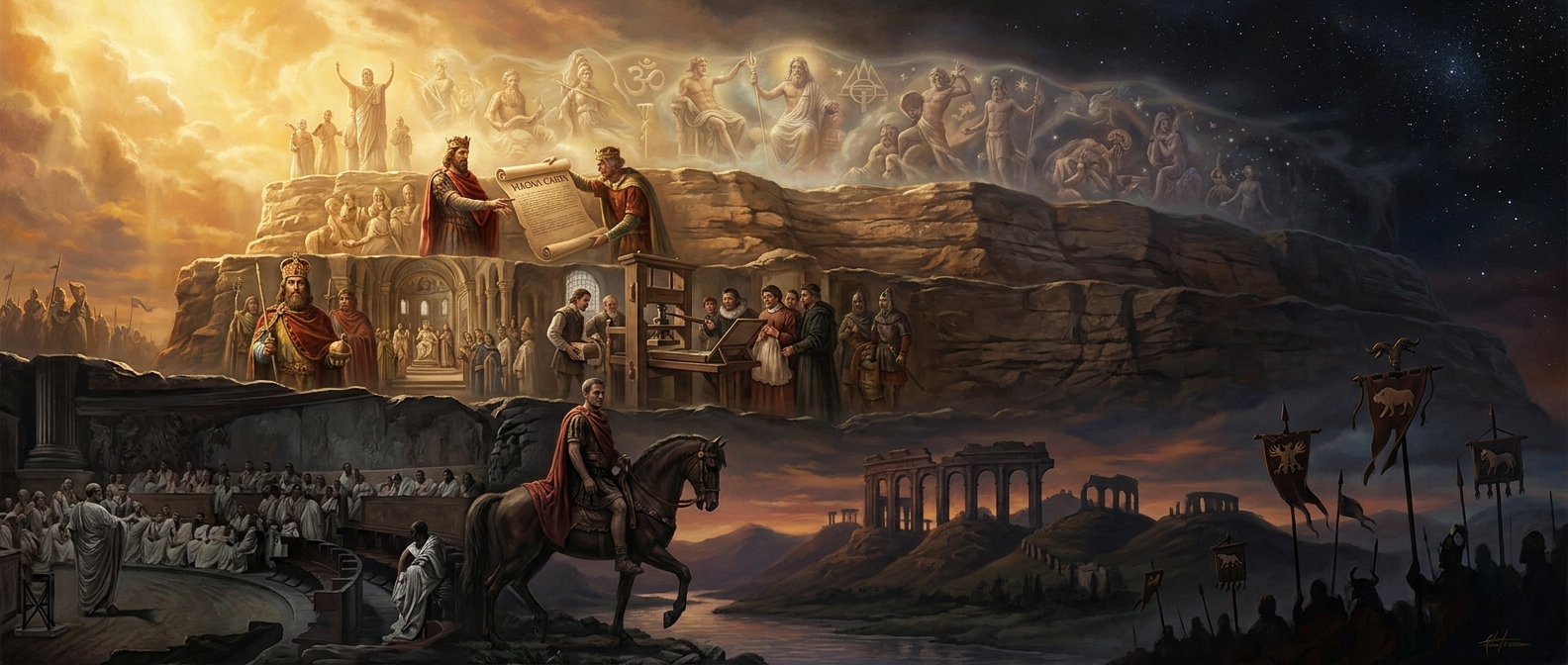
What Was Happening in the Wider World
Biblical events did not occur in isolation. This table places key prophetic and religious milestones alongside their secular contemporaries for chronological context.
~2091 BC"] ~~~ B2["Exodus
~1446 BC"] B2 ~~~ B3["Solomon's Temple
~966 BC"] B3 ~~~ B4["Exile
586 BC"] B4 ~~~ B5["Jesus
4 BC - 33 AD"] B5 ~~~ B6["Temple Destroyed
70 AD"] end subgraph SECULAR["Secular Timeline"] direction TB S1["Ur III Dynasty
~2112-2004 BC"] ~~~ S2["Egyptian New Kingdom
~1550-1070 BC"] S2 ~~~ S3["Phoenician Trade Peak
~1000-800 BC"] S3 ~~~ S4["Neo-Babylonian Empire
626-539 BC"] S4 ~~~ S5["Roman Empire
27 BC - 476 AD"] S5 ~~~ S6["Arch of Titus
81 AD"] end style BIBLE fill:#f5f5dc,stroke:#8b8000 style SECULAR fill:#e6e6fa,stroke:#4b0082
| Period | Biblical / Prophetic Event | Secular Parallel | Archaeological Note |
|---|---|---|---|
| ~2091 BC | Abrahamic Covenant | Ur III Dynasty in Mesopotamia; Egyptian Middle Kingdom begins | Abraham's Ur identified with Tell el-Muqayyar (excavated 1922-1934 by Leonard Woolley) |
| ~1446 BC | Exodus from Egypt | Late Bronze Age; Amarna Period in Egypt; Hittite Empire at peak | No direct archaeological evidence of the Exodus; Merneptah Stele (~1208 BC) is earliest mention of "Israel" outside the Bible |
| ~966 BC | Solomon's Temple Built | Egyptian Third Intermediate Period; Phoenician trade network at peak | No archaeological remains of the First Temple found (Temple Mount excavation politically impossible); Phoenician parallels to temple design confirmed at sites in Syria and Lebanon |
| 586 BC | First Temple Destroyed | Neo-Babylonian Empire at peak; Nebuchadnezzar II rules | Babylonian Chronicles confirm the siege of Jerusalem; Lachish Letters document the invasion in real time |
| 539 BC | Cyrus Decree (exile ends) | Persian Achaemenid Empire founded | Cyrus Cylinder (British Museum) confirms Cyrus' policy of returning exiled peoples -- does not mention Jews specifically, but matches the biblical account |
| 331 BC | Alexander conquers Persia | Hellenistic Age begins; Library of Alexandria founded (~295 BC) | Greek cultural artifacts found throughout the Levant confirm rapid Hellenization |
| 167 BC | Maccabean Revolt | Roman Republic expanding; Punic Wars ending | 1 and 2 Maccabees (deuterocanonical) are primary historical sources; coins from the Hasmonean period archaeologically confirmed |
| 63 BC | Pompey takes Jerusalem | Late Roman Republic; Caesar rising | Josephus (Antiquities 14.4) describes Pompey entering the Holy of Holies |
| 4-6 BC | Birth of Jesus | Augustus Caesar rules; Pax Romana begins | Herod's Temple expansion archaeologically confirmed (Western Wall, massive foundation stones); Census of Quirinius historically debated |
| 70 AD | Second Temple Destroyed | Roman Empire under Vespasian/Titus | Arch of Titus in Rome depicts Temple spoils being carried away; burned stones found in Jerusalem excavations; Josephus (Wars 6-7) provides eyewitness account |
| 325 AD | Council of Nicaea | Constantine consolidates Roman Empire | Council documents preserved; Nicaea (modern Iznik, Turkey) excavated |
| 632 AD | Rise of Islam | Arab conquests reshape the Mediterranean world; Umayyad Caliphate builds Dome of the Rock on Temple Mount (691 AD) | Dome of the Rock and Al-Aqsa Mosque still stand on the Temple Mount; the contested site where all three Abrahamic religions converge |
| 1119 AD | Templars founded | Crusader kingdoms established; High Medieval period | Al-Aqsa Mosque / Temple Mount stables used by Templars; Templar castles survive across Europe and the Levant |
| 1307 AD | Templar suppression | Philip IV of France consolidates royal power; Avignon Papacy begins (1309) | Chinon Parchment (discovered 2001 in Vatican Archives) shows Pope Clement V secretly absolved the Templars of heresy before dissolving the order |
| 1453 AD | Fall of Constantinople | Ottoman Empire ascendant; Renaissance underway in Italy; Gutenberg's press (1455) | Greek manuscripts carried west by fleeing scholars fueled both Renaissance humanism and Reformation biblical scholarship |
| 1517 AD | Reformation begins | Age of Exploration; printing press enables mass communication | Luther's 95 Theses printed and distributed across Germany within weeks -- the first viral media event |
How Traditions Read Secular History
| Tradition | Approach to Archaeological/Secular Evidence |
|---|---|
| Protestant Evangelical | Archaeology confirms biblical accuracy; secular history demonstrates God's sovereign plan unfolding |
| Catholic | Faith and reason complement each other; archaeology illuminates but does not determine doctrine |
| Jewish | Historical evidence supports the Jewish connection to the land; the Tanakh is both scripture and history |
| Masonic | Ancient civilizations preserved wisdom traditions that Masonry inherits symbolically |
| Esoteric | All ancient cultures encoded the same perennial truths in different mythological systems |
| Black Church | Whose history gets told matters; the erasure of African contributions to biblical history (Cush, Egypt, Ethiopia) must be corrected |
Note on archaeology and prophecy: Archaeological evidence can confirm that events happened and when, but it cannot confirm or deny prophetic significance. The same excavation can be read as "proof of divine prophecy" or "proof of natural historical processes" depending on the interpreter's framework.
Christian
23- ~530 CE Benedict of Nursia composes his *Rule* — Benedictine monasticism becomes the engine of European Christian intellectual, agricultural, and charitable life for the next six centuries
- 537 CE Hagia Sophia consecrated in Constantinople under Justinian I — the dome-on-pendentives engineering feat by Anthemius and Isidore is the largest church on earth for nearly a thousand years; Justinian reportedly exclaims *'Solomon, I have outdone thee!'*
- 553 CE Origen condemned posthumously at the Second Council of Constantinople — the Alexandrian polymath, dead three centuries, is anathematized for the doctrines of pre-existence of souls, universal salvation (*apokatastasis*), and the eventual restoration of even Satan; his name remains under canonical condemnation while his exegetical methods continue to shape Christian biblical scholarship in disguise.
- ~563 CE St. Columba founds the monastery of Iona off the Scottish coast; Celtic Christianity launches its missionary expansion across northern Britain and into the Frankish heartland
- ~590 CE Gregory the Great becomes pope; he defines papal authority, expands monasticism, shapes the theology of purgatory, and dispatches Augustine of Canterbury to evangelize England
- ~597 CE Augustine of Canterbury lands in Kent at the invitation of King Æthelberht — Pope Gregory I's Roman mission to England begins; within decades Anglo-Saxon kingdoms convert and Canterbury becomes the primatial see of English Christianity
- ~664 CE Synod of Whitby — Northumbrian King Oswiu adjudicates between Celtic and Roman Christian practice, choosing Rome; England aligns its Easter dating with the Continent, accelerating integration into Latin Christendom
- 723 CE Boniface fells the Oak of Donar at Geismar — the Anglo-Saxon missionary chops down the sacred oak of Thor before assembled Hessian pagans; when Thor sends no thunderbolt, the tree's timber is repurposed into a chapel; the symbolic act inaugurates Frankish Christianization of central Germany
- ~726 CE Byzantine Emperor Leo III orders destruction of icons; the Iconoclasm Crisis (726–843) fractures Eastern Christianity and prefigures the Great Schism; monasteries rebel, the pope condemns Leo, the east-west fault line deepens
- 731 CE Bede completes the *Ecclesiastical History of the English People* at Jarrow — the first systematic history of a Christian nation in a vernacular idiom; it introduces the BC/AD dating convention to Western historiography and gives Anglo-Saxon Christianity its founding narrative
- 732 CE Battle of Tours (Poitiers) — Charles Martel's Frankish heavy infantry halts an Umayyad raiding army under Abd al-Rahman al-Ghafiqi between Tours and Poitiers; Latin chroniclers later read the victory as divine deliverance preserving Christian Europe from Islamic conquest.
- ~750 CE Donation of Constantine forgery circulates in the Frankish court — a fabricated imperial decree claiming Constantine transferred sovereignty over the western empire to the papacy; it will anchor papal political claims for seven centuries until Lorenzo Valla exposes it as a fraud in 1440
- 781 CE Nestorian Stele erected at Chang'an (Xi'an), China — a bilingual Chinese-Syriac monument records 150 years of East Syriac Christian mission under the Tang dynasty; proof that Christianity reached China two centuries before the Jesuits, carried by Silk Road merchants and monks
- 782 CE Charlemagne massacres 4,500 captive Saxons at Verden — pagan Saxon nobles who refused baptism are beheaded in a single day; forced Christianization of northern Europe reaches its most brutal expression; the event poisons Frankish-Saxon relations for a generation
- 800 CE Charlemagne is crowned Holy Roman Emperor by Pope Leo III on Christmas Day in Rome; the Carolingian Renaissance fuses Frankish military power with Latin Christianity, Benedictine monasticism, and classical learning
- ~863 CE Saints Cyril and Methodius carry the Glagolitic script into the Slavic lands; they bring Christianity to the Slavs in their own vernacular language — a radical missionary strategy that defines Slavic civilization
- 864 CE Khan Boris I of Bulgaria is baptized; Bulgaria's official conversion to Eastern Christianity brings a major Slavic nation fully into the Byzantine cultural and theological sphere
- 867 CE Photian Schism — Patriarch Photios of Constantinople and Pope Nicholas I mutually condemn each other over papal jurisdiction and the *filioque*; the East-West theological rupture deepens a full century before it becomes formal
- 910 CE Abbey of Cluny founded in Burgundy by Duke William of Aquitaine — placed directly under papal protection and freed from feudal interference; Cluniac reform spreads monastic discipline and liturgical uniformity across Europe and fuels the 11th-century papal reform movement that culminates in the Investiture Controversy
- 935 CE Wenceslaus of Bohemia assassinated by his brother Boleslav — the duke who had promoted Christianity in Bohemia is immediately venerated as a martyr; his posthumous cult anchors Czech Christian identity and his patron-saint image appears on the crown jewels
- ~960 CE Hesychast contemplative tradition crystallizes on Mount Athos — the "Holy Mountain" becomes an autonomous monastic republic under Byzantine protection; the prayer of the heart (*hesychia*) and direct vision of the Uncreated Light (the Taboric light of the Transfiguration) root here, erupting later in the 14th-century Palamite controversy
- 988 CE Prince Vladimir of Kievan Rus is baptized in Crimea; thousands of Kievans are mass-baptized in the Dnieper River; Eastern Orthodoxy becomes the state religion of the Rus, a decision that shapes Russian civilization permanently
- ~995 CE Olaf Tryggvason becomes King of Norway and begins forcible Christianization — missionaries dispatched, pagan temples burned, chieftains who refuse baptism executed or exiled; his brief reign (~995–1000) accelerates the disappearance of Norse paganism as an organized public religion
Islamic
22- ~8th CE Mu'tazilite school emerges in Basra and Baghdad — rationalist Muslim theologians assert that the Quran is *created* (not co-eternal with God) and that divine justice is comprehensible by reason; Caliph al-Ma'mun makes it state doctrine (~833), then al-Mutawakkil crushes it (~848), establishing the precedent that kalam (speculative theology) is dangerous ground
- ~570 CE Muhammad ibn Abdullah born in Mecca; orphaned young and raised by his uncle Abu Talib, he works as a merchant and spends increasing time in solitary meditation in the hills above the city
- 610 CE The Night of Power (*Laylat al-Qadr*) — the angel Gabriel seizes Muhammad in the Cave of Hira with the command *Iqra* ("Recite!"); the first verses of the Quran are revealed; Muhammad flees shaking to his wife Khadija
- 622 CE The Hijra — Muhammad migrates from Mecca to Medina; the Islamic calendar begins here because Year One marks the moment a persecuted spiritual movement becomes a governing state
- 630 CE Muhammad enters Mecca largely unopposed; the Kaaba is cleansed of 360 tribal idols and rededicated to the one God; most of the Arabian peninsula submits within two years
- 632 CE Muhammad dies without naming a successor; the Rashidun Caliphate expands the empire from Spain to Persia in a single generation; the succession dispute begins hardening into permanent schism
- 636 CE Battle of Yarmouk — the Rashidun Caliphate annihilates the Byzantine field army over six days near the Yarmouk River; Syria, Palestine, and the Christian heartland of the eastern Roman Empire fall permanently under Muslim rule within a year
- ~650 CE Quran codified under Caliph Uthman — a single authoritative Arabic text established, variant manuscripts destroyed; the third Abrahamic tradition has its scripture fixed
- 656–661 CE Ali ibn Abi Talib becomes the fourth Caliph and is assassinated in 661; the succession dispute crystallizes into permanent theological schism between Sunni and Shia Islam
- 657 CE Battle of Siffin — Caliph Ali's forces meet the Umayyad Mu'awiya near the Euphrates; Mu'awiya's troops hoist Quran pages on their lances calling for arbitration; the inconclusive truce splits Ali's camp into the proto-Sunni, proto-Shia, and Kharijite factions that will define Islamic sectarianism
- 680 CE Battle of Karbala — Husayn ibn Ali, Muhammad's grandson, is surrounded and massacred by Umayyad forces; his death becomes the foundational passion-narrative and annual mourning of Shia Islam (Ashura)
- 691 CE Caliph Abd al-Malik completes the Dome of the Rock atop the Temple Mount in Jerusalem — Islam's oldest surviving monumental building, raised over the rock of Abraham's sacrifice and Muhammad's *miraj*; its Quranic inscriptions polemicize against Christian Trinitarian claims at the very site of the destroyed Jewish Temple.
- ~700 CE Sana'a palimpsest manuscripts discovered in a Yemeni mosque — the oldest surviving Quranic parchments (radiocarbon-dated to within decades of the Prophet's death) preserve text variations that illuminate the early history of Quranic canonization
- 750 CE Battle of the Zab — the Abbasid revolution overthrows the Umayyad Caliphate; the surviving Umayyads are massacred at a banquet, save Abd al-Rahman who escapes to found the Caliphate of Córdoba; the political center of Islam shifts from Damascus to the new round city of Baghdad
- 762 CE Caliph al-Mansur founds Baghdad as the round city *Madinat al-Salam* (City of Peace) — the new Abbasid capital is laid out in concentric circles around the caliph's palace and great mosque; the founding inaugurates the Abbasid Golden Age, replacing the Umayyad Damascus pattern of Arab dominance with a cosmopolitan multiethnic capital where Persian administrators, Christian translators, and Indian astronomers serve a single court.
- ~800 CE Caliph al-Ma'mun founds the Bayt al-Hikmah (House of Wisdom) in Baghdad; Muslim, Christian, and Jewish scholars translate Greek, Sanskrit, and Syriac texts into Arabic — algebra, optics, medicine, and Aristotle survive through this project
- ~830–900 CE The Translation Movement at Baghdad's Bayt al-Hikmah peaks under caliphs al-Ma'mun, al-Mu'tasim, and al-Wathiq — Hunayn ibn Ishaq and his school render Galen, Aristotle, Ptolemy, and Indian astronomical works into Arabic, preserving Greek philosophy that would otherwise have been lost to Christian Europe.
- ~830 CE Caliph al-Ma'mun expands the *Bayt al-Hikma* (House of Wisdom) in Baghdad — a translation bureau and observatory that systematically renders Greek, Sanskrit, Syriac, and Persian works into Arabic; Hunayn ibn Ishaq translates Galen, al-Khwarizmi develops algebra, the *Almagest* and Aristotle's complete corpus enter Arabic; the institutional engine of the Islamic Golden Age and the channel through which Greek philosophy survives the European Dark Ages.
- ~846 CE Imam al-Bukhari completes the *Sahih* in Bukhara after sixteen years sifting 600,000 hadith down to ~7,275 rigorously authenticated reports — the most authoritative Sunni hadith collection, second only to the Quran in legal weight and the bedrock of Sunni jurisprudence.
- ~858 CE Al-Hallaj born (~858–922) — the Sufi mystic who declared *"Ana'l-Haqq"* ("I am the Truth") and was publicly crucified for it in Baghdad; his martyrdom becomes Sufism's central passion-narrative, echoing Christian and Shia themes simultaneously
- 872 CE Al-Farabi writes *Mabadi' Ara' Ahl al-Madina al-Fadila* (The Virtuous City) — the "Second Teacher" (after Aristotle) constructs an Islamic political philosophy synthesizing Plato's *Republic* with prophetic theology, arguing the philosopher-prophet alone can rule the virtuous city; his work shapes Avicenna, Maimonides, and the entire tradition of medieval political theology in three Abrahamic religions.
- ~875 CE Imam Muslim ibn al-Hajjaj completes his *Sahih* in Nishapur — the second of Sunni Islam's *Kutub al-Sittah* (Six Canonical Books); his stricter chain-of-transmission methodology and topical organization make it the most-studied hadith collection in classical madrasa curricula alongside Bukhari.
Buddhist
7- ~550 CE Buddhism enters Japan via the Korean kingdom of Baekje; the Yamato court receives sutras and a gilt Buddha image; Shinto and Buddhism begin their long and creative synthesis
- 604 CE Prince Shotoku Taishi promulgates Japan's *Seventeen-Article Constitution* — Article 2 commands sincere reverence for the Three Treasures (Buddha, Dharma, Sangha); the imperial endorsement that fuses Buddhism with Japanese statecraft for the next thirteen centuries
- ~750 CE Padmasambhava (Guru Rinpoche) carries Vajrayana Buddhism across the Himalayas into Tibet at King Trisong Detsen's invitation; Tibet's first monastery (Samye) is founded; the Nyingma lineage is born
- 792–794 CE Samye Debate in Tibet — King Trisong Detsen arbitrates a philosophical contest between the Chinese Chan monk Moheyan (sudden enlightenment) and the Indian Kamalashila (gradual cultivation); the king rules for Kamalashila, anchoring Tibetan Buddhism permanently to the Indian Madhyamaka scholastic tradition
- ~820 CE Korean Silla kingdom's Buddhism peaks — Hwaeom (Avatamsaka) and Pure Land schools synthesize Tang Chinese and Korean traditions; monastic universities become centers of royal legitimacy and peninsular culture
- ~845 CE Emperor Tang Wuzong persecutes Buddhism in China — 4,600 monasteries demolished, 260,000 monks defrocked; Chan (Zen) and Pure Land survive precisely because they need fewer institutional structures
- ~868 CE Heian Japan: Tendai school (Saicho, d. 822) on Mt. Hiei and Shingon (Kukai, d. 835) on Mt. Koya establish Japan's two dominant esoteric Buddhist schools; Heian court culture and Buddhist aesthetics fuse in one of history's most ornate religious-artistic syntheses
Shinto
5- 645 CE Taika Reforms in Japan; Buddhism and Shinto begin formal integration under imperial patronage; shrine-temple complexes (jingū-ji) emerge
- 712 CE *Kojiki* (Record of Ancient Matters) compiled by O no Yasumaro — Japan's oldest written record; contains Shinto creation myths, kami genealogies
- ~712 CE *Kojiki* compiled at imperial command — Japan's oldest chronicle encodes the Shinto creation myth, the divine birth of the islands from Izanagi and Izanami, and the divine descent of the imperial family from Amaterasu
- 720 CE *Nihon Shoki* (Chronicles of Japan) compiled; second major record of Shinto mythology and early Japanese history
- 720 CE *Nihon Shoki* (*Chronicles of Japan*) compiled at imperial command — eight years after the *Kojiki*, this Chinese-language history covers the same divine genealogy with greater chronological precision and becomes the official court record of kami descent and imperial legitimacy.
Norse
4- ~800 CE Viking Age at full force — longships carry the religion of Odin, Thor, and Freyr across the North Sea and Baltic; Norse mythology takes hold from Normandy to the Volga, raiding monasteries and establishing settlements
- ~872 CE Harald Fairhair unites Norway under a single crown after the sea-battle of Hafrsfjord — invoking Odin's victory-blessing and the warband cult of *einherjar*, he consolidates petty kingdoms into Norway's first centralized monarchy; his court remains pagan, the great blót sacrifices continue, and his consolidation will provide the political infrastructure that his successors use a century later to impose Christianity.
- 960 CE Danish King Harald Bluetooth converts to Christianity; the Jelling Runestones record the first written Scandinavian Christian royal declaration; Norse paganism's retreat from official life accelerates
- ~1000 CE Iceland's Althing — history's oldest parliament — votes by single lawspeaker's decree to adopt Christianity while tolerating private pagan practice; Norse paganism begins its two-century public disappearance
Celtic / Christian
3- 563 CE Columba (Colm Cille) founds the monastery of Iona on a small Hebridean island off the Scottish coast — the Irish prince-monk in self-imposed exile after the Battle of Cúl Dreimhne establishes the missionary base from which Celtic Christianity will evangelize the Picts and Northumbria; Iona produces saints, kings, and illuminated manuscripts for three centuries before Viking raids depopulate it.
- ~700-900 CE The "thin places" tradition codified in Celtic Christian spirituality — Iona, Lindisfarne, Skellig Michael, Glendalough, and Clonmacnoise are honored as locations where the membrane between this world and the divine grows porous; the *peregrini* (wandering Irish monks) carry the conviction across Europe; the phrase that surfaces in modern usage emerges from this insular monastic theology of geography as sacrament.
- ~800 CE The Book of Kells illuminated at the Iona scriptorium (or Kells itself after Viking raids drive the monks to Ireland) — the gospel manuscript's intricate Celtic interlace, zoomorphic initials, and full-page Chi-Rho carpet pages fuse insular monastic art with Mediterranean iconography; over 680 surviving folios become the supreme artifact of Celtic Christianity and a national symbol of Ireland.
Jewish
3- ~8th CE Karaite movement splits from Rabbinic Judaism — Anan ben David and followers reject the oral Torah (Talmud) and demand return to scripture alone; the *sola scriptura* impulse appears within Judaism three centuries before it does in Christianity
- ~500 CE Babylonian Talmud reaches its final redacted form — the definitive compendium of rabbinic law, legend, and theology that will govern Jewish life for the next 1,500 years
- 933 CE Saadiah Gaon completes *Kitab al-Amanat wa al-I'tiqadat* (*Book of Beliefs and Opinions*) at the Sura academy in Baghdad — the first systematic Jewish philosophical theology, written in Judeo-Arabic; addresses creation, divine unity, free will, resurrection, and the Messiah using kalam methods drawn from Mu'tazilite rationalism; he also produces the first Arabic translation of the Hebrew Bible (*Tafsir*), fixing the model of Jewish engagement with Islamic philosophy.
Hindu
2- ~788 CE Adi Shankara born in Kerala (~788–820); within perhaps 32 years he walks the entire subcontinent, defeats rival philosophers in formal debate, founds four monasteries at the cardinal points, and consolidates Advaita Vedanta — *Brahman* alone is real — as Hinduism's dominant philosophy
- ~950 CE Khajuraho temple complex begun under the Chandela dynasty in central India — eighty-five sandstone shikharas covered in erotic, divine, and quotidian sculpture; the surviving twenty-five temples encode tantric theology in stone, where sexual union is not transgression but cosmic metaphor
Mayan
2- ~700 CE Maya Classic Period at its apex — city-states Tikal, Palenque, Copan, and Caracol maintain literate stone astronomy, calendric theology, and elaborate blood-offering ritual centered on the Hero Twins myth
- ~900 CE Maya Classic collapse in the southern lowlands — Tikal, Calakmul, and Copan are abandoned within a century; drought, prolonged internecine warfare, and ecological stress are cited; the northern Maya (Chichen Itza, Uxmal) continue
Norse / Christian
2- 995-1000 CE Olaf Tryggvason forcibly Christianizes Norway — missionaries are dispatched to every fjord, pagan temples burned, sacred *hörgr* altars destroyed, and chieftains who refuse baptism executed, exiled, or have their property confiscated; his five-year reign accelerates the disappearance of organized Norse paganism as a public religion across Norway, Iceland, the Faroes, and Greenland.
- 1000 CE Iceland's Althing votes to adopt Christianity at Þingvellir — the *lögsögumaður* (lawspeaker) Þorgeir Ljósvetningagoði, after a day under his cloak in silent meditation, decrees that all Icelanders shall be baptized but may continue private pagan sacrifice and the eating of horseflesh; the unique compromise preserves the old religion as private practice while the public sphere becomes Christian, allowing the Eddic and saga tradition to survive intact.
African
1- ~750 CE Kingdom of Ghana at its height in the western Sudan — the first great sub-Saharan African empire, sustained by trans-Saharan gold and salt trade, with sacred kingship ritual, royal ancestor veneration, and specialist priestly classes at its core
Aztec / Toltec
1- ~900 CE Toltecs rise at Tula in central Mexico; Quetzalcoatl — feathered-serpent god-king — spreads as a unifying religious-political symbol across Mesoamerica, later absorbed wholesale into Aztec state religion
Aztec/Mexica
1- c. 900 CE Toltec empire centered at Tula; Quetzalcoatl as priest-king Ce Acatl Topiltzin in Toltec tradition; later mythologized as the feathered serpent god
Daoist
1- ~750 CE Compilation of the *Daozang* (Daoist Canon) is sponsored under the Tang court — the first systematic anthology of Daoist scripture, ritual, and alchemical text gathered into a tripartite *Three Caverns* structure that frames every later Daoist canonical project.
Greco-Roman
1- 529 CE Emperor Justinian closes the Platonic Academy in Athens — the last public pagan philosophical school shut down; a millennium of organized Greek philosophy ends
Japanese Buddhism
1- 604 CE Prince Shōtoku Taishi issues the Seventeen-Article Constitution, the first document to frame Japanese governance through Buddhist and Confucian principles; builds Hōryū-ji
Korean
1- 660 CE Wonhyo, after his famous skull-water awakening, develops a Korean Hwaeom (Avatamsaka) Buddhism that harmonizes the doctrinal schools — his *Treatise on the Ten Approaches to the Reconciliation of Doctrinal Disputes* makes him the most influential thinker in Korean Buddhist history.
Māori
1- c. 750 CE Further Polynesian migrations to New Zealand; Māui-tikitiki traditions, Ranginui (Sky Father) and Papatūānuku (Earth Mother) cosmologies established
Maya
1- c. 800 CE Classic Maya collapse begins; great cities of the southern lowlands abandoned one by one; causes disputed (drought, warfare, revolution)
NativeAmerican
1- ~1000 CE Mississippian Mound Builder civilization at its peak — Cahokia (near modern St. Louis) is the largest pre-Columbian city north of Mexico, its Monks Mound larger than the Great Pyramid of Giza, organized around a sun-cult and elaborate mortuary ceremony
Norse / Anglo-Saxon
1- ~625 CE Sutton Hoo ship burial in East Anglia — a 27-meter ship interred under a great mound contains a king (likely Rædwald) with a helmet, gold shoulder-clasps, Byzantine silverware, and a purse of Frankish coins; the grave goods bridge the Anglo-Saxon pagan funerary world and the new Christian one, attesting to a religious transition in process; rediscovered 1939, reshaping the understanding of post-Roman northern European religion.
Tibetan
1- 641 CE King Songtsen Gampo marries the Chinese princess Wencheng and the Nepalese princess Bhrikuti — both bring Buddha images and Buddhist tutors to Lhasa; the Jokhang temple is founded to house their statues, and Tibet's first formal contact with Buddhism is sealed by these dynastic marriages.
Yoruba
1- c. 850 CE Ile-Ife established as the sacred center of Yoruba civilization; oral traditions of Odùduwà founding the Yoruba people take canonical form
Zoroastrian
1- ~637 CE Arab armies conquer the Sassanid Persian heartland; Zoroastrianism — state religion of Persia for over a millennium — is displaced; Persian Zoroastrian refugees emigrate to India and become the Parsi community
Christian
27- 1054 CE Great Schism — Cardinal Humbert lays a bull of excommunication on the altar of Hagia Sophia; Patriarch Cerularius excommunicates him back; Catholic and Eastern Orthodox Christianity formally split, a rupture not addressed until 1965
- 1075 CE Investiture Controversy erupts — Pope Gregory VII's *Dictatus Papae* claims the right to depose emperors; Henry IV is excommunicated and stands barefoot in the snow at Canossa (1077); the half-century struggle establishes that spiritual authority outranks temporal power in Latin Christendom
- 1095 CE Pope Urban II launches the First Crusade at Clermont — the call to retake Jerusalem; a hundred thousand cross Europe and reach the Levant; holy war ideology and feudal military culture merge in medieval Catholicism
- 1099 CE Crusaders capture Jerusalem; massacre of Muslim and Jewish inhabitants; Church of the Holy Sepulchre secured; the Crusader Kingdom of Jerusalem begins its 88-year existence
- 1119 CE Knights Templar founded in Jerusalem by Hugues de Payens — a military-monastic order guarding pilgrims, accumulating vast wealth, operating Europe's first banking network; destroyed by Philip IV of France and Pope Clement V in 1307–1312
- ~1130 CE Peter Abelard and Bernard of Clairvaux clash at the Council of Sens — scholastic rationalism versus contemplative mysticism; the foundational debate that runs through Western Christianity for the next 900 years
- ~1150 CE Hildegard of Bingen at peak influence — her visions, music, natural science, and theological writing make her the most remarkable voice of 12th-century Catholic mysticism; consulted by popes and emperors
- ~1180 CE Joachim of Fiore (~1135–1202) develops his Trinitarian eschatology — history unfolds in three ages: the Age of the Father (Old Testament law), the Age of the Son (Church), and the imminent Age of the Spirit (direct mystical illumination without institutional mediation); his schema influences Franciscan radicals, later Protestant millenarians, and modern progressive theology
- 1184 CE Pope Lucius III issues *Ad abolendam* — the first systematic papal mandate authorizing bishops to identify and hand heretics to secular authorities; the formal birth of the medieval Inquisition as an institution, before the specifically Dominican-run tribunals formalized by Gregory IX in 1231
- 1204 CE Fourth Crusade sacks Constantinople — Crusaders sack the greatest Christian city in the world; the Byzantine Empire is temporarily dissolved; the East-West Schism becomes viscerally and perhaps irreversibly permanent
- 1209 CE Francis of Assisi receives papal approval for his *Rule* — apostolic poverty, care for lepers, preaching without property; the Franciscan order is born; a radical alternative to the institutional church from within it
- 1209–1229 CE Albigensian Crusade — Pope Innocent III launches a 20-year military campaign against the Cathar heresy in southern France; the Cathars (who taught that matter is evil and the Old Testament God is the devil) are largely exterminated; the Inquisition inaugurated
- ~1215 CE Fourth Lateran Council under Innocent III — transubstantiation defined as dogma; annual confession mandated; Jews required to wear identifying badges; canon law systematized; papal authority at medieval peak
- 1216 CE Dominic de Guzman founds the Order of Preachers (Dominicans) — an order built around theological education and preaching; the Inquisition will soon become their institutional domain
- 1224 CE Francis of Assisi receives the stigmata on Mount La Verna — during a forty-day fast preparing for Michaelmas, a six-winged seraph imprints the wounds of Christ on his hands, feet, and side; the first historically documented stigmatic; bodily mystical conformity to Christ's passion enters Catholic spirituality as a recognizable phenomenon
- ~1265 CE Thomas Aquinas works on the *Summa Theologica* (1265–1274) — the definitive synthesis of Aristotelian philosophy and Christian theology; the Five Ways (proofs for God's existence), natural law ethics, and sacramental theology codified
- 1291 CE Acre falls to the Mamluk Sultan al-Ashraf Khalil after a six-week siege — the last Crusader stronghold on the Levantine mainland is taken; the surviving Templars and Hospitallers retreat to Cyprus; nearly two centuries of Latin Christian state-building in the Holy Land end in a single bloody summer
- 1307 CE Philip IV of France arrests all Knights Templar simultaneously on Friday, October 13 — torture extracts confessions of blasphemy and sodomy; the order dissolved by Pope Clement V in 1312; Grand Master Jacques de Molay burned in 1314
- 1309 CE Pope Clement V relocates the papal court to Avignon under French pressure — the *Babylonian Captivity of the Church* lasts 67 years; seven successive French popes preside from a Provençal palace, papal prestige in the rest of Latin Christendom collapses, and Petrarch coins the phrase that defines the era
- 1347–1351 CE Black Death kills one-third of Europe's population; the Flagellant movement arises — penitential processions of self-scourgers who believe collective punishment for sin can appease divine wrath; Jews are massacred across Europe on accusations of well-poisoning
- 1378 CE Western Schism begins — rival popes elected in Rome (Urban VI) and Avignon (Clement VII); a third claimant joins at Pisa (1409); Latin Christendom has two and then three popes excommunicating each other; the spectacle is resolved only by the Council of Constance (1414–1418), at incalculable cost to papal moral authority
- ~1380 CE John Wycliffe translates the Bible into English and attacks papal authority — the first proto-Protestant reformer; his followers (Lollards) survive condemnation; his bones are exhumed and burned in 1428
- 1415 CE Jan Hus burned at the Council of Constance — the Czech reformer, condemned for Wycliffite teaching, dies singing Psalms; the Hussites launch a 15-year religious war in Bohemia and defeat five successive papal crusades; the first successful proto-Reformation
- 1431 CE Joan of Arc burned at the stake in Rouen — the 19-year-old mystic who heard the voices of Michael, Catherine, and Margaret and led armies; condemned for heresy and cross-dressing; rehabilitated 25 years later; canonized 1920
- 1453 CE Constantinople falls to Mehmed II after a 53-day siege — Byzantine Emperor Constantine XI dies in the streets, Hagia Sophia is converted into a mosque the same afternoon, and a thousand-year continuous Roman-Christian state ends; Greek scholars flee west with manuscripts that fuel the Italian Renaissance
- 1478 CE Spanish Inquisition established by Ferdinand and Isabella — an instrument of religious and political conformity targeting conversos, Moriscos, and later Protestants; Grand Inquisitor Tomas de Torquemada personally oversees thousands of proceedings
- 1498 CE Vasco da Gama reaches the Malabar coast of India — the Age of Exploration brings Catholicism into direct contact with Hindu, Muslim, and Buddhist civilizations; the global religious map begins its most dramatic redrawing since the Arab conquests
Islamic
15- 1071 CE Battle of Manzikert — Seljuk Turks under Alp Arslan capture Byzantine Emperor Romanos IV; Anatolia, Christian for a millennium, opens to Turkic settlement; the catastrophe forces Alexios I Komnenos to appeal to the West, directly seeding the First Crusade
- ~1090 CE Hassan-i Sabbah seizes the mountain fortress of Alamut — the Nizari Ismaili leader founds the order Western chroniclers will call the *Hashshashin* (Assassins); for 166 years a network of fidā'ī agents conducts targeted killings of Sunni viziers, Crusader princes, and Seljuk sultans from Persia to Syria
- 1095 CE Al-Ghazali completes *The Incoherence of the Philosophers* — the Persian theologian dismantles Avicennan rationalism on twenty points (eternity of the world, denial of bodily resurrection, God's knowledge of particulars); Sunni orthodoxy is realigned around mystical-juridical knowing, and falsafa never recovers its standing in the Sunni east
- ~1165 CE Ibn Arabi born in Murcia (1165–1240) — the great synthesizer of Sufi metaphysics; his *Fusus al-Hikam* and *Futuhat al-Makkiyya* establish *wahdat al-wujud* (unity of being), the most comprehensive Islamic mystical philosophy
- ~1169-1198 CE Ibn Rushd (Averroes) writes his Aristotle commentaries in Cordoba — the Andalusian polymath and chief judge produces three layers of commentary (short, middle, long) on the entire Aristotelian corpus; his defense of philosophy in *Fasl al-Maqal* and rebuttal of al-Ghazali in *Tahafut al-Tahafut* fail to revive falsafa in the Sunni east but become the foundation of European scholasticism via Latin translation, shaping Aquinas, Dante, and the Italian Renaissance.
- ~1186 CE Suhrawardi completes *Hikmat al-Ishraq* (*Philosophy of Illumination*) in Aleppo — the young Persian mystic-philosopher fuses Avicennan Neoplatonism with Zoroastrian light-metaphysics into a hierarchy of luminous beings descending from the *Nur al-Anwar* (Light of Lights); executed in 1191 at age 36 on Saladin's order for his unorthodox cosmology, he becomes the *Shaykh al-Ishraq* (Master of Illumination), founder of the Ishraqi school that shapes Persian and Indian Sufi thought for eight centuries.
- 1187 CE Saladin retakes Jerusalem after the Battle of Hattin — the Ayyubid sultan defeats King Guy of Lusignan beside the Horns of Hattin in a single July day, capturing the True Cross relic; Jerusalem surrenders without massacre on October 2, the Aqsa Mosque is restored, and the call for the Third Crusade goes out across Europe
- 1202 CE Ibn Arabi arrives in Mecca and begins the *Futuhat al-Makkiyya* (*Meccan Revelations*) — the Andalusian Sufi receives visions while circumambulating the Kaaba, including the encounter with the mysterious Sophia-figure Nizam that seeds *Tarjuman al-Ashwaq*; over the next thirty years he composes the most comprehensive Sufi metaphysical synthesis ever written, the foundation of *wahdat al-wujud* (unity of being).
- 1206 CE Qutb-ud-Din Aibak establishes the Delhi Sultanate — the first permanent Islamic sultanate in South Asia; over three centuries five successive dynasties rule; mosques rise over temple sites, a Sufi-inflected Persian-Arabic literary culture grafts onto the subcontinent, and the groundwork for Mughal civilization is laid
- 1207 CE Rumi born in Balkh (1207–1273) — the Sufi poet-mystic whose *Masnavi* and *Diwan-e Shams* become among the best-selling poetry in the United States seven centuries later; founder of the Mevlevi (Whirling Dervish) order
- 1258 CE Mongols under Hulagu Khan sack Baghdad and execute Caliph al-Musta'sim — the House of Wisdom is burned, the Tigris runs black with ink and red with blood; the Abbasid Caliphate ends after five centuries; Islamic civilization's political center of gravity shifts permanently to Cairo and later Istanbul
- ~1295 CE Naqshbandi order traces its founding lineage to Baha-ud-Din Naqshband of Bukhara (1318–1389) — the order becomes the most politically influential Sufi tariqa in Central Asia, the Ottomans, and the Caucasus, transmitting the *silent dhikr* and insisting on engagement with political life rather than withdrawal
- ~1300 CE Mevlevi order formalized by Sultan Walad, son of Rumi — the *sema* ceremony (whirling dervish dance) codified as a moving meditation enacting the soul's revolution around the divine beloved; the order becomes an Ottoman institution, its lodges (*tekke*) at the heart of urban Anatolian religious life
- 1324 CE Mansa Musa of Mali departs on the Hajj with an entourage of 60,000 and twelve tons of gold — his pilgrimage floods Cairo's markets with gold, crashing the price for a decade; he builds mosques along the route, funds the Djinguereber Mosque in Timbuktu, and puts Mali on European world maps for the first time
- ~1450 CE Sufi orders — Naqshbandi, Qadiri, Mevlevi, Suhrawardi — spread across Central Asia, Anatolia, the Balkans, and India; institutionalized mysticism, *silsila* (chain of transmission), and *dhikr* (remembrance of God) become the lived religion of millions
Jewish
10- ~1090 CE Rashi (Solomon ben Isaac of Troyes, 1040–1105) completes his line-by-line commentaries on the Tanakh and Babylonian Talmud — written in clear, terse Old French-inflected Hebrew; every printed Talmud since has placed Rashi's gloss in its inner column, making him the indispensable rabbinic teacher of the next millennium
- ~1168 CE Maimonides codifies his *Thirteen Principles of Faith* in his commentary on the Mishnah — the closest Judaism ever comes to a creed: God's unity, incorporeality, eternity; Moses as supreme prophet; Torah's divine origin; resurrection; the Messiah — they are still recited in traditional morning liturgy
- ~1175 CE *Sefer ha-Bahir* circulates in Provence — the earliest text of the Kabbalistic tradition, encoding the doctrine of the *Sefirot* as divine emanations for the first time in writing; it bridges late Gnostic themes, Merkabah mysticism, and nascent Kabbalah, seeding the tradition the Zohar will crystallize a century later
- 1180 CE Maimonides completes the *Mishneh Torah* in Fustat — a fourteen-volume systematic code of all Jewish law in lucid Mishnaic Hebrew, organized topically rather than as Talmudic commentary; he claims (controversially) that one need read only Scripture and his code; Jewish jurisprudence reorganizes around Maimonidean clarity
- ~1190 CE Maimonides completes the *Guide for the Perplexed* (~1190) — the most rigorous medieval synthesis of Aristotelian philosophy and Jewish theology; it shapes Jewish, Christian, and Islamic scholasticism simultaneously
- ~1190 CE Moses Maimonides completes the *Guide for the Perplexed* (*Dalalat al-Ha'irin*) in Cairo — written in Judeo-Arabic for his student Joseph ben Judah, the work synthesizes Aristotelian philosophy with Jewish theology, treats biblical anthropomorphism allegorically, and locates ultimate human felicity in the intellectual love of God; the most influential medieval Jewish philosophical text, read by Aquinas and Spinoza alike.
- ~1260 CE Moses de Leon composes (or reveals) the *Zohar* in Castile — the foundational text of Kabbalah, framed as the mystical teachings of Rabbi Shimon bar Yochai; the *Sefirot*, the *Ein Sof*, and the architecture of Jewish mysticism are fixed here
- ~1280 CE Moses de León composes the *Zohar* in Castile — written in artificial pseudo-Aramaic and framed as the secret teachings of Rabbi Shimon bar Yochai (2nd century), the *Sefer ha-Zohar* becomes the foundational text of Kabbalah; the *Sefirot*, the *Ein Sof*, and the architecture of Jewish mysticism are fixed here; debated as authentic ancient or medieval forgery, it shapes Jewish spirituality from Safed to Hasidism to twentieth-century Western esotericism.
- 1349 CE Strasbourg massacre on Saint Valentine's Day — the city's Jewish community, blamed for poisoning wells to spread the Black Death, is burned alive in a wooden house built for the purpose; the *Erfurt-Strasbourg-Mainz* arc of pogroms erases entire Ashkenazi communities along the Rhine and pushes Jewish demography permanently east into Poland
- 1492 CE Spanish Expulsion of Jews (*Alhambra Decree*) — 150,000–200,000 Jews expelled from Spain; they scatter to the Ottoman Empire, North Africa, and the Netherlands, carrying Sephardic culture and Kabbalah into the wider world
Buddhist
8- ~1042 CE Atisha Dipankara arrives in Tibet from the Vikramashila monastery — the "second dissemination" of Buddhism after the Langdarma persecution; his *Lamp for the Path to Enlightenment* systematizes lam-rim (graduated path) teaching and seeds the Kadampa school from which the Gelug later descends
- ~1100 CE Karma Kagyu lineage founded — Gampopa (1079–1153), disciple of Milarepa, fuses Mahamudra meditation with monastic Kadampa discipline; the lineage produces the Karmapa incarnation series, the first formally recognized tulku tradition in Tibetan Buddhism
- 1175 CE Honen founds the Jodo-shu (Pure Land) school in Kyoto — abandoning Tendai esotericism, he teaches that *nembutsu* (chanting *Namu Amida Butsu*) alone is sufficient for rebirth in Amida's Western Paradise; Japanese Buddhism's first mass-accessible school is born, paving the way for Shinran's even more radical Jodo Shinshu
- ~1191 CE Eisai returns from his second China pilgrimage carrying tea seeds and Linji (Rinzai) Chan transmission — he plants the tea bushes at Reisenji and writes *Kissa Yojoki* (*Drink Tea, Nourish Life*); samurai-class Zen and the Japanese tea ceremony are seeded together in a single voyage
- 1202 CE Zen master Eisai brings Rinzai Zen from China to Japan; the koan-based practice of sudden awakening through paradox takes root in the warrior samurai class
- ~1250 CE Dogen Zenji (1200–1253) founds Soto Zen in Japan — *shikantaza* (just sitting) as the complete expression of Buddha-nature; his *Shobogenzo* is the most philosophically rigorous text in Japanese Buddhist literature
- 1253 CE Nichiren proclaims the *Lotus Sutra* alone contains the essential teaching; his *daimoku* chant (Nam-myoho-renge-kyo) is the sole practice; he is exiled twice and nearly executed; Nichiren Buddhism becomes Japan's most politically combative tradition
- ~1357 CE Tsongkhapa born in Tibet (1357–1419) — founder of the Gelug school; he restores monastic discipline, establishes Ganden Monastery, and produces the lineage from which the Dalai Lamas descend
Hindu
5- ~1100 CE Ramanuja (~1017–1137) systematizes Vishishtadvaita (qualified non-dualism) at Srirangam — the soul is real and distinct yet wholly dependent on Vishnu; his commentaries on the Brahma Sutras and Bhagavad Gita give the Sri Vaishnava tradition its philosophical spine and underwrite South Indian temple bhakti for nine centuries
- ~1238 CE Madhva (1238–1317) formulates Dvaita (radical dualism) Vedanta in Karnataka — God, souls, and matter are eternally distinct; he rejects the Upanishadic identification of *atman* with *Brahman* outright; his *tattvavada* preserves a vigorous theistic alternative to Shankara within Hindu philosophy and shapes the Haridasa devotional movement
- ~1400 CE Bhakti saints at peak — Ramananda teaches devotion to Rama without caste barriers; his disciple Kabir weaves Hindu and Sufi themes in vernacular Hindi poetry; Mirabai sings ecstatically of Krishna as her only true husband, rejecting a royal marriage; the movement democratizes access to the divine
- ~1450 CE Ravidas (1377–1527) composes vernacular devotional *pads* in the Bhakti tradition — a leather-worker (Dalit) saint whose songs enter the Sikh scripture (*Guru Granth Sahib*); his followers form the Ravidassia community, a living challenge to caste hierarchy embedded in devotional poetry
- ~1486 CE Chaitanya Mahaprabhu born in Nabadwip, Bengal (1486–1534) — the ecstatic devotee who teaches that *sankirtana* (collective chanting of Krishna's names) is the supreme dharma of the *Kali Yuga*; his Gaudiya Vaishnava movement democratizes Krishna devotion across caste lines and seeds the modern Hare Krishna tradition five centuries later
Norse
5- 1042 CE Magnus the Good outlaws blót sacrifice and pagan poetry across Norway — the second generation of Christian kings legislates against the old religion rather than merely converting elites; Norse pagan public ritual passes from suppressed to criminal, and within a generation only place-names and skaldic verse preserve the lore
- ~1080 CE Last great pagan blót at the Temple of Uppsala falls silent — Adam of Bremen's chronicle of nine-day sacrifices of men, dogs, and horses hung in the sacred grove ends as Christian kings raze the temple under Inge the Elder; organized Norse paganism in Sweden goes underground
- ~1220 CE Snorri Sturluson writes the *Prose Edda* in Iceland — a Christian chieftain preserves the Norse mythological system (Yggdrasil, the Nine Realms, Ragnarok, the Aesir genealogies) that would otherwise be lost to oral fragmentation
- ~1220 CE Snorri Sturluson compiles the *Prose Edda* in Iceland — the chieftain-historian-skald writes a handbook for aspiring poets explaining kennings, meters, and the mythology behind them; his *Gylfaginning*, *Skáldskaparmál*, and *Háttatal* preserve the Norse cosmological system (Yggdrasil, the Nine Worlds, Ragnarok) that would otherwise have fragmented into oral pieces; Christian by religion, he writes the manual that lets a pagan mythological grammar survive the conversion.
- ~1270 CE The Poetic Edda manuscript (*Codex Regius*) collected in Iceland — an anonymous compiler gathers the oldest surviving versions of the *Völuspá*, *Hávamál*, *Vafþrúðnismál*, and the heroic Sigurd cycle into a single vellum codex; rediscovered in Iceland in 1643, it becomes the primary source for reconstructing Norse mythology and the foundation of nineteenth-century Romantic Germanic revival.
Inca
4- ~1200 CE Manco Capac founds Cuzco at the navel of the Andean world (*Tawantinsuyu* center) — Inca origin myth describes the first Sapa Inca and his sister-wife Mama Ocllo emerging from Lake Titicaca with a golden staff that sinks into the earth at Cuzco, marking the sacred site; the Coricancha sun-temple is established as the imperial cult center, walls eventually plated with gold sheets to mirror Inti the sun.
- ~1438 CE Pachacuti Inca Yupanqui ascends the Cusco throne and refounds the empire as *Tawantinsuyu* — the *Four Quarters* — after defeating the Chanca; he rebuilds Cusco in the shape of a puma, codifies sun-cult ritual at the Coricancha, and orders the imperial estate at Machu Picchu; Inca state religion crystallizes
- ~1450 CE Pachacuti Inca Yupanqui orders the construction of Machu Picchu in the Urubamba Valley — the imperial estate is built on a knife-edge ridge above the cloud forest, with the *Intihuatana* "hitching post of the sun" stone aligned to the solstice; the site functions as royal retreat, religious sanctuary, and astronomical observatory; abandoned within a century, never found by the Spanish, rediscovered by Hiram Bingham in 1911.
- ~1490 CE Inca sun-cult (*Inti* worship) and ancestor veneration under Pachacutec's successors — the Sapa Inca is the Son of the Sun; mummified royal ancestors paraded at festivals; Machu Picchu built as a sacred royal estate aligned to solar events
Aztec/Mexica
3- c. 1200 CE Aztec migration legend: the Mexica people follow their god Huitzilopochtli's command to leave Aztlan and journey south, guided by an eagle on a cactus bearing a snake
- 1300 CE Aztec arrive in the Valley of Mexico; found Tenochtitlan (traditionally 1325 CE) on an island in Lake Texcoco where they see the prophesied sign: eagle on cactus
- 1325 CE Founding of Tenochtitlan; construction of the Templo Mayor dedicated to Huitzilopochtli (war/sun) and Tlaloc (rain); cosmic center of the Aztec universe
Confucian
3- ~1175 CE Zhu Xi (1130–1200) systematizes Neo-Confucianism at the Bailudong Academy — his commentaries on the Four Books synthesize Confucian ethics with Buddhist metaphysics and Daoist cosmology around *li* (principle) and *qi* (vital force); his curriculum becomes the basis of the imperial examinations until 1905
- 1280 CE Neo-Confucianism of Zhu Xi (1130-1200 CE) becomes official state doctrine in China; metaphysical synthesis of Confucianism, Buddhism, and Daoism
- 1408 CE Yongle Emperor's *Yongle Dadian* completed in Nanjing — over 2,000 scholars compile the world's largest pre-modern encyclopedia in 11,095 manuscript volumes; it preserves the Confucian, Buddhist, Daoist, and technical literature of three millennia; only about 400 volumes survive the dynasty's later collapse
Sikh
3- 1469 CE **Birth of Guru Nanak Dev Ji** at Rai Bhoi di Talvandi (now Nankana Sahib, Pakistan); founder of Sikhism
- 1469 CE Guru Nanak born in Talwandi (modern Nankana Sahib, Pakistan) — he will disappear into the Bein River for three days and emerge declaring *Na koi Hindu, na koi Mussulman* ("There is no Hindu, there is no Muslim"); Sikhism is born
- 1499 CE Guru Nanak's three-day disappearance into the Bein river at Sultanpur Lodhi; emerges declaring "there is no Hindu, there is no Muslim"; begins the Sikh tradition
Aztec
2- 1325 CE Aztecs found Tenochtitlan on a marshy island in Lake Texcoco, following the omen of an eagle on a cactus devouring a serpent — this founding vision flies on Mexico's flag today; within two centuries it is the largest city in the Western Hemisphere
- ~1480 CE Aztec religion at its peak under Ahuitzotl and the expanded Templo Mayor — dual temples to Huitzilopochtli (sun-war) and Tlaloc (rain-earth) crown a pyramid at the center of Tenochtitlan; large-scale human sacrifice repays the cosmic debt owed to the gods
Daoist
2- ~14th c. CE Eight Immortals legends crystallize in Yuan-dynasty drama and woodblock fiction — Lü Dongbin, Zhongli Quan, Zhang Guolao, He Xiangu and the rest become the iconic Daoist saints of popular religion, each embodying a path to immortality through poetry, alchemy, music, or eccentric wisdom.
- ~1167 CE Wang Chongyang founds the Quanzhen (Complete Perfection) school in Shandong — synthesizing Chan Buddhism, Confucian ethics, and Daoist inner alchemy (*neidan*); his disciples, the Seven Masters of Quanzhen, will spread monastic Daoism across north China under Mongol patronage.
Korean
2- 1236–1251 CE The Tripitaka Koreana carved onto 81,258 woodblocks at Haeinsa during the Mongol invasions — Goryeo court commissions the entire Buddhist canon as a magical defense against the Mongol armies; the woodblocks survive intact and remain the most accurate East Asian Buddhist canon ever printed.
- 1392 CE Yi Seong-gye founds the Joseon dynasty and adopts Neo-Confucianism as state ideology — Buddhism is stripped of its Goryeo-era privileges, monasteries closed, and Zhu Xi's curriculum becomes the basis of the *gwageo* civil service exam; Korean society reorganizes around Confucian *yangban* gentry for five centuries.
Māori
2- c. 1100 CE Māori culture fully established in New Zealand; development of *wharenui* (meeting house) as sacred space, *tohunga* (priests/experts) traditions, *tapu* (sacred prohibition) system
- c. 1250 CE Traditional dating of the Great Fleet migration to New Zealand; seven canoes bring the main ancestral tribes; each tribe traces its whakapapa (genealogy) to its canoe
Multi
2- ~1260–1368 CE Mongol Yuan dynasty practices deliberate religious tolerance — Kublai Khan hosts Buddhist lamas, Taoist priests, Nestorian Christians, and Muslim imams simultaneously at court; Phags-pa Lama creates a universal script; for a century the largest land empire on earth has no state religion
- ~1271–1295 CE Marco Polo travels through Kublai Khan's Yuan dynasty China — his *Travels* describe Tibetan Buddhist tantra, Chinese ancestor rites, Nestorian Christian communities, and Zoroastrian fire temples; the first sustained European written account of Asian religious plurality
Tibetan
2- 1391–1474 CE Gendun Drup, posthumously recognized as the First Dalai Lama, founds Tashilhunpo Monastery in Tsang and consolidates Gelug authority across western Tibet — his rebirth as Gendun Gyatso (1475–1542) inaugurates the tulku lineage that becomes Tibet's spiritual-temporal axis.
- 1409 CE Tsongkhapa founds Ganden Monastery and inaugurates the Great Prayer Festival (*Mönlam Chenmo*) at the Jokhang in Lhasa — his Gelug school emphasizes monastic discipline and Madhyamaka philosophy and produces the lineage from which the Dalai Lama institution descends.
Yoruba
2- ~1165 CE Ife civilization at its height in West Africa — the sacred city of Ile-Ife is the cosmological origin-point of the Yoruba world; the Oni of Ife rules as divine king; naturalistic bronze heads produced that still defy explanation
- c. 1350 CE Shango traditions formalized in the Oyo Kingdom; Shango cult spreads through West Africa and later to the Americas through the slave trade
African
1- ~1235 CE Mali Empire rises in West Africa under Sundiata Keita — the Mande people convert increasingly to Islam; Timbuktu becomes a major center of Islamic scholarship and manuscript culture; Musa I's 1324 pilgrimage to Mecca distributes enough gold to crash Mediterranean currency
Catholic
1- 1492 CE Granada falls to Ferdinand and Isabella, ending nearly eight centuries of al-Andalus — within months the Alhambra Decree expels Spain's Jews, the *Reconquista* completes, and Columbus sails west; Iberian Catholicism's triumphalist self-image and global missionary impulse are forged in a single year.
Celtic / Welsh
1- ~1100-1200 CE The *Mabinogion* tales committed to writing in the *White Book of Rhydderch* and the *Red Book of Hergest* — the four branches (Pwyll, Branwen, Manawydan, Math), the Arthurian romances (*Culhwch and Olwen*, *The Dream of Rhonabwy*), and the native tales preserve centuries of Welsh oral mythology; Rhiannon, Bran the Blessed, and the cauldron of rebirth enter European literature; the texts become a foundational source for Celtic religious imagination.
Islamic / African
1- 1324 CE Mansa Musa of Mali departs on the hajj with 60,000 attendants and twelve tons of gold — the Malian emperor distributes so much gold in Cairo that the price of bullion crashes for a decade; he funds the construction of the Djinguereber Mosque in Timbuktu, brings the Andalusian architect al-Sahili back to Mali, and puts the West African empire on the Catalan Atlas of 1375, becoming the first sub-Saharan African ruler to enter European world consciousness.
Islamic / Christian
1- 1453 CE Mehmed II's Ottoman army takes Constantinople after a 53-day siege — Sultan Mehmed enters Hagia Sophia the same afternoon and orders it converted to a mosque; Byzantine Emperor Constantine XI dies fighting in the streets; the thousand-year continuous Roman-Christian state ends, and the Ottoman Empire becomes the Sunni caliphate's new political center; Greek scholars flee west with manuscripts that fuel the Italian Renaissance.
Jain
1- 1099 CE Hemachandra (1089-1172 CE) born; Jain polymath who writes on yoga, grammar, poetry, and biography; becomes advisor to the Chaulukya kings of Gujarat
West African
1- 1235 CE Sundiata Keita defeats Soumaoro Kanté at the Battle of Kirina; founding of the Mali Empire; griot oral tradition records the epic as sacred history
From Operative Craft to Speculative Order
mason references"] --> B["1352: York Minster
lodge records"] B --> C["~1390: Regius Poem
(Halliwell MS)"] end subgraph TRANSITION["Transition Period"] C --> D["1598: Schaw Statutes
(Scotland)"] D --> E["1634: First non-mason
admitted (Edinburgh)"] E --> F["1646: Elias Ashmole
initiated (England)"] end subgraph SPECULATIVE["Speculative Freemasonry"] F --> G["1717: Grand Lodge
Founded (London)"] G --> H["1723: Anderson's
Constitutions"] H --> I["1730: Hiramic Legend
codified (3rd Degree)"] I --> J["1751: Ancients vs
Moderns schism"] J --> K["1801: Scottish Rite
established (USA)"] K --> L["1813: United Grand
Lodge of England"] end style G fill:#c9a227,color:#000,stroke:#8b7a1a,stroke-width:3px style OPERATIVE fill:#f0e6d3,stroke:#8b7355 style TRANSITION fill:#e6e6fa,stroke:#7b68ee style SPECULATIVE fill:#f0fff0,stroke:#2e8b57
Key Masonic Milestones
| Date | Event | Significance |
|---|---|---|
| ~966 BC | Solomon's Temple Built | Central symbol of Freemasonry; the "spiritualizing of Solomon's Temple is the first, most prominent and most pervading symbolic instruction" of the Craft |
| ~1390 | Regius Poem | Earliest surviving Masonic document; traces craft origins to Euclid and King Athelstan |
| 1598 | Schaw Statutes | First regulatory framework for Scottish masonry |
| 1646 | Elias Ashmole Initiated | Earliest documented English speculative mason |
| 1717 | Grand Lodge Founded (London) | Watershed: four lodges meet at the Goose and Gridiron; Anthony Sayer elected first Grand Master |
 | 1723 | Anderson's Constitutions | Foundational legal/philosophical document; formalizes non-denominational deism |
| 1730 | Hiramic Legend Emerges | Death-and-resurrection allegory of Hiram Abiff becomes central to Master Mason degree |
| 1737 | Ramsay's Oration | Introduces Knights Templar connection (no historical evidence supports it, but it persists in tradition) |
| 1751 | Ancients vs. Moderns Schism | Rival Grand Lodge formed in London |
| 1801 | Scottish Rite Established (USA) | 33-degree system founded at Charleston, South Carolina |
| 1813 | United Grand Lodge of England | Ancients and Moderns reunify |
| 1723 | Anderson's Constitutions | Foundational legal/philosophical document; formalizes non-denominational deism |
| 1730 | Hiramic Legend Emerges | Death-and-resurrection allegory of Hiram Abiff becomes central to Master Mason degree |
| 1737 | Ramsay's Oration | Introduces Knights Templar connection (no historical evidence supports it, but it persists in tradition) |
| 1751 | Ancients vs. Moderns Schism | Rival Grand Lodge formed in London |
| 1801 | Scottish Rite Established (USA) | 33-degree system founded at Charleston, South Carolina |
| 1813 | United Grand Lodge of England | Ancients and Moderns reunify |
Notable Masonic Founding Fathers
| Figure | Masonic Role | Historical Impact |
|---|---|---|
| George Washington | Master Mason (1752) | Led Constitutional Convention; laid Capitol cornerstone in Masonic ceremony (1793) |
| Benjamin Franklin | Grand Master of Pennsylvania | Aligned Enlightenment ideals with Masonic principles of knowledge and fraternity |
| Paul Revere | Led Massachusetts chapter | Revolutionary planning within Masonic context |
| John Marshall | Member | First Chief Justice; shaped American legal interpretation |
~16% of Declaration signers and ~33% of Constitution signers were Masons.
Catholic
19- 1517 CE Johann Tetzel preaches indulgences across Germany on behalf of Pope Leo X's St. Peter's fundraising — his jingle "When the coin in the coffer clinks, the soul from purgatory springs" becomes the immediate provocation for Luther's 95 Theses; the commercialization of absolution exposed the entire penitential economy to public scrutiny
- 1540 CE Ignatius of Loyola receives papal approval for the Society of Jesus (Jesuits) — intellectual and missionary engine of the Counter-Reformation; a global network within a generation
- 1542 CE Francis Xavier arrives in Goa as the first Jesuit missionary to Asia — over a decade he baptizes tens of thousands across South India, the Moluccas, and Japan; dies in 1552 within sight of China; canonized 1622 as the patron of Catholic foreign missions
- ~1545-1563 CE Council of Trent: three sessions clarify doctrine (seven sacraments, transubstantiation, purgatory, faith *and* works), standardize the Tridentine Mass, and create post-Tridentine Catholic identity
- 1545 CE Spanish Inquisition stages a mass auto-da-fé at Toledo — the public penitential procession and burning of heretics becomes the visible theater of Counter-Reformation orthodoxy in the Iberian world; the spectacle is reproduced in Lima, Mexico City, and Cartagena across the colonial Americas
- 1559 CE Pope Paul IV publishes the first Roman *Index Librorum Prohibitorum* — Erasmus's complete works, all Lutheran and Calvinist writings, and thousands of other titles banned from Catholic readers; the Index remains in force until 1966, functioning as the institutional boundary of permissible Catholic intellectual life for four centuries
- 1560-1812 CE The Goa Inquisition — established in Portuguese India in 1560; converts from Hinduism and Islam tried for heresy with torture, public auto-da-fé, and executions; approximately 16,000 trials recorded across 252 years; one of the longest-running Inquisitions and among the least examined in Western historical scholarship
- 1570 CE Pope Pius V issues *Quo Primum*, freezing the Tridentine Mass as the universal Roman Rite — the standardized Latin liturgy becomes the church's global face for four centuries until Vatican II; Pius simultaneously excommunicates Queen Elizabeth I with the bull *Regnans in Excelsis*, releasing her subjects from obedience and triggering a wave of Jesuit missions into England where captured priests are executed as traitors
- 1605 CE Roberto de Nobili arrives in Madurai and adopts the dress, diet, and language of a Brahmin sannyasi — the most radical Catholic accommodation strategy of the early modern era; he composes Tamil and Sanskrit Christian texts and is denounced by fellow Jesuits before Rome cautiously approves his methods
- 1606 CE English Jesuit martyrs intensify under the Gunpowder Plot's aftermath — Jesuit superior Henry Garnet is hanged, drawn, and quartered; Edmund Campion (1581) and Robert Southwell (1595) had already been executed for entering England secretly; the steady stream of martyred seminary priests hardens the English Catholic community into a minority culture of hidden devotion centered on recusant manor houses and concealed priest-holes
- 1609 CE First Jesuit reduction founded at San Ignacio Guazú in Paraguay — Guaraní indigenous communities organized as self-governing Christian theocracies free of encomienda labor; over 150 years the system protects 100,000+ Guaraní before Spain expels the Jesuits in 1767 and the reductions collapse
- 1769 CE Franciscan friar Junipero Serra founds Mission San Diego de Alcalá — the first of twenty-one Franciscan missions stretching along El Camino Real to Sonoma; the mission system forcibly relocates and Christianizes California's indigenous peoples, reducing Native populations by an estimated 90% within a century through disease, forced labor, and cultural annihilation; Serra's 2015 canonization by Pope Francis remains bitterly contested
- ~1784 CE Yi Seung-hun is baptized in Beijing and returns to Korea to baptize others — founding a self-evangelized lay Catholic church without a single foreign priest; the Joseon court, alarmed by Catholicism's rejection of ancestor rites as required by Confucian filial piety, launches waves of persecution; the Korean Martyrs' Massacres of 1839 and 1866 kill thousands, yet the community grows and Korea stands as the modern church's uniquely self-founded mission
- 1792 CE Massacres of September begin in Paris — over 200 priests and three bishops who refused the Civil Constitution of the Clergy are slaughtered in the prisons; the Reign of Terror's de-Christianization campaign installs the Cult of Reason at Notre-Dame and replaces the Christian calendar; Pope Pius VI dies a French prisoner in 1799
- 1854 CE Pope Pius IX defines the Immaculate Conception (*Ineffabilis Deus*) — the first major exercise of modern papal authority on a matter of doctrine
- 1858 CE Bernadette Soubirous reports eighteen Marian apparitions at the Massabielle grotto in Lourdes, France — the Lady identifies herself as "the Immaculate Conception," confirming Pius IX's 1854 dogma; Lourdes becomes Catholicism's most popular pilgrimage site of modern healing, with over 70 medically-investigated cures certified by 2026
- 1869-1870 CE Vatican I: Pope Pius IX defines papal infallibility (*Pastor Aeternus*) — when the pope speaks *ex cathedra* on faith or morals he cannot err; Old Catholics break away in protest
- 1871-1878 CE Bismarck's *Kulturkampf* in newly unified Germany — laws dissolve Catholic religious orders, expel the Jesuits, require state approval for clerical appointments, and subject Catholic schools to state inspection; Pope Pius IX thunders condemnation from Rome; the campaign ultimately fails as Catholic political mobilization through the Centre Party forces Bismarck to negotiate, establishing the template of modern European church-state conflict
- 1891 CE Pope Leo XIII issues *Rerum Novarum* — the founding document of modern Catholic social teaching; affirms private property and condemns socialism while insisting on living wages, the right to unionize, and the dignity of labor; the encyclical becomes the template for Catholic engagement with industrial capitalism for the next century
Protestant
13- 1517 CE Martin Luther posts 95 Theses at Wittenberg — Protestant Reformation begins; Western Christendom permanently fractures
- 1521 CE Diet of Worms: Luther declared an outlaw; his German New Testament follows, making scripture a vernacular possession
- 1521 CE Edict of Worms issued by Emperor Charles V — Luther declared a heretic and imperial outlaw after refusing to recant before the Diet; protected by Elector Frederick the Wise at Wartburg castle, he translates the New Testament into German in eleven months, placing scripture directly in the hands of common readers
- 1555 CE Peace of Augsburg: each German prince chooses Lutheran or Catholic for his territory — the political settlement of the Reformation; *cuius regio, eius religio*
- 1611 CE The King James Bible published in London — 47 scholars over seven years, drawing heavily on Tyndale's 1526 translation, produce the most influential book in the English language; its cadences shape Protestant preaching, abolitionist rhetoric, and Lincoln's speeches; in many American evangelical denominations it remains the only acceptable text four centuries later
- 1730s CE The First Great Awakening in the American colonies — George Whitefield and Jonathan Edwards transform colonial piety; emotional conversion experience becomes the evangelical template
- 1741 CE Jonathan Edwards delivers "Sinners in the Hands of an Angry God" at Enfield, Connecticut — the most famous sermon of the First Great Awakening; congregants reportedly grip the pews to keep from sliding into hell; Edwards's later philosophical theology becomes the most rigorous American contribution to Reformed thought
- 1780s-1790s CE Second Great Awakening begins — camp meetings and circuit riders; evangelical Protestantism becomes America's dominant religious culture; temperance and abolition movements follow
- 1799 CE Friedrich Schleiermacher publishes *On Religion: Speeches to Its Cultured Despisers* in Berlin — religion redefined as the "feeling of absolute dependence" rather than doctrine or morality; the founding text of liberal Protestant theology and the experiential turn that shapes modern religious studies
- 1801 CE Cane Ridge Revival in Bourbon County, Kentucky — 20,000 people gather for a week-long camp meeting in the frontier wilderness; mass bodily "exercises" (crying, jerking, falling) overwhelm participants; the Second Great Awakening's most dramatic single event and the prototype for American revivalist culture
- 1816 CE The American Bible Society founded in New York City — consolidating dozens of local tract societies to mass-produce and distribute scripture; within a decade it ships millions of Bibles into the frontier and into the hands of the enslaved; its logic — that universal access to the text generates universal conversion — makes it the institutional backbone of evangelical culture and the Second Great Awakening's print infrastructure
- 1875 CE Mary Slessor sails for Calabar (modern Nigeria) for the United Presbyterian Church — the Scottish mill-girl missionary lives among the Efik and Okoyong peoples for nearly four decades, ending the killing of twin infants and serving as the British colonial vice-consul; her face appears on Scotland's £10 note
- 1885 CE The Berlin Conference and the partition of Africa coincide with the peak deployment of Protestant missionary societies — China Inland Mission, Church Missionary Society, and German Pietist missions field thousands of workers; by 1900, sub-Saharan African Christianity has become the fastest-growing religious population on earth
Sikh
11- 1539 CE Death of Guru Nanak; Guru Angad Dev appointed second Sikh Guru; systematization of Gurmukhi script and compilation of early *Gurbani*
- 1539 CE Guru Nanak dies at Kartarpur — Hindu and Muslim disciples reportedly find only flowers beneath his shroud, each claiming half; the founding parable of Sikhism's refusal to belong to either tradition
- 1604 CE Guru Arjan compiles the *Adi Granth* — scripture installed in the Harmandir Sahib at Amritsar; includes hymns from Hindu bhakti saints and Muslim Sufis alongside the Gurus
- 1606 CE Guru Arjan martyred by Mughal Emperor Jahangir — the first Sikh martyr; his death is the hinge after which Sikhism takes on its martial character under Guru Hargobind
- 1675 CE Guru Tegh Bahadur beheaded in Delhi defending Kashmiri Hindus' right to exist in their own faith — called *Hind di Chadar*, the Shield of India; his son Gobind Singh witnesses this at age nine
- 1699 CE Guru Gobind Singh founds the Khalsa on Vaisakhi at Anandpur — the Panj Pyare initiated; Five Ks instituted; every Khalsa man becomes Singh, every woman Kaur; caste abolished in the Khalsa identity
- 1708 CE Guru Gobind Singh declares the Guru Granth Sahib the eternal Guru — no more human Gurus; scripture and the community become the living, perpetual authority
- 1716 CE Banda Singh Bahadur — the Khalsa's first military commander — is captured by Mughal Emperor Farrukhsiyar after the fall of Gurdas Nangal and executed in Delhi; he watches his infant son killed before him before his own body is torn apart; his eight-year Punjab campaign had briefly abolished zamindari landholding within conquered territory, making him simultaneously a military hero and a social revolutionary
- 1799 CE Maharaja Ranjit Singh consolidates the Sikh misls and rules Punjab from Lahore — forty years of the Sikh Empire; Golden Temple plated in gold; Hindus, Muslims, and Europeans appointed to senior positions
- 1849 CE British annex Punjab after two Anglo-Sikh Wars — the end of the Sikh Empire; the colonial era of Sikh history begins
- 1873 CE Singh Sabha reform movement reasserts distinct Sikh identity against Hindu absorption and Christian missionary pressure
Jewish
9- 1656 CE Amsterdam's Sephardic community pronounces the *cherem* (excommunication) on 23-year-old Baruch Spinoza — the most severe ban in the synagogue's archives; his subsequent *Ethics* and *Theological-Political Treatise* establish the philosophical groundwork for biblical higher criticism, religious naturalism, and modern secular liberalism
- 1666 CE Shabbatai Tzvi declares himself the Messiah in Smyrna, gathering hundreds of thousands of followers across the Jewish diaspora from Amsterdam to Persia — the largest messianic movement in post-Temple Jewish history; his apostasy to Islam under Ottoman pressure shatters the movement and ultimately catalyzes the rise of Hasidism
- ~1729-1786 CE Moses Mendelssohn leads the Jewish Enlightenment (*Haskalah*) — his 1783 *Jerusalem* argues Jews can be both fully observant and full European citizens; his German Torah translation brings Hebrew scripture into Enlightenment intellectual culture; the Haskalah divides the Jewish world between advocates of integration and defenders of traditional insularity
- ~1740 CE Israel ben Eliezer (the Baal Shem Tov) teaches in Podolia — Hasidism founded; joy, fervent prayer, and the divine spark in every moment counter rabbinic intellectualism
- ~1740 CE Israel ben Eliezer (the Baal Shem Tov, *Besht*) founds Hasidism in Podolia — the itinerant healer and master of the divine Name teaches that joyful prayer, song, and the recognition of divine sparks in every moment matter more than rabbinic erudition; his disciples Dov Ber the Maggid of Mezritch and Levi Yitzchak of Berditchev spread the movement across Eastern Europe; despite the Vilna Gaon's *cherem* of 1772, Hasidism becomes the dominant form of Eastern European Jewish piety within two generations.
- 1755 CE The Vilna Gaon (Elijah ben Solomon Zalman) emerges as Lithuanian Jewry's preeminent halakhic authority — his rationalist, Talmud-centered piety becomes the institutional core of the *Mitnagdim* ("opponents"); his 1772 *cherem* against Hasidism splits Eastern European Judaism into rival camps that persist into the present
- 1818 CE Hamburg Temple Reform Congregation opens — the first permanent Reform synagogue in history; vernacular German prayers, organ music, abbreviated liturgy, and mixed seating replace the traditional Ashkenazic service; Reform Judaism's institutional birth spreads rapidly to Central Europe and then the United States
- 1880s CE Pogroms in Russia trigger the First Aliyah — Jewish emigration to Ottoman Palestine; modern Zionism begins to coalesce around Theodor Herzl's writings
- 1896-1897 CE Theodor Herzl publishes *Der Judenstaat* (1896) and convenes the First Zionist Congress in Basel (1897) — "In Basel I founded the Jewish state," he writes in his diary; political Zionism transforms millennia of religious messianic hope for the Return into a modern nationalist program; the movement seeds the establishment of Israel in 1948 and remains the most consequential Jewish political act since the destruction of the Temple
Bahai
8- 1817 CE Bahá'u'lláh (Mírzá Husayn-Alí Núrí) born in Tehran to a noble Persian family
- 1819 CE The Báb (Sayyid Ali Muhammad Shirazi) born in Shiraz, Persia
- 1844 CE May 23: the Báb declares his mission to Mullá Husayn in Shiraz — the founding moment of the Bahá'í Faith; the Báb as Gate to the Hidden Imam and herald of a Greater Promised One
- 1848-1850 CE 20,000+ Bábís slaughtered at Shaykh Tabarsi, Zanjan, and Nayriz by Persia's Qajar state and Shi'a clergy
- 1850 CE July 9: the Báb executed by firing squad in Tabriz — the double-volley miracle account recorded by British and Russian consular officials; he dies at age 30
- 1852 CE Bahá'u'lláh imprisoned in the Síyáh-Chál (Black Pit) in Tehran; receives his prophetic revelation in the underground darkness
- 1863 CE April 21: Bahá'u'lláh declares himself the Promised One in the Garden of Ridvan outside Baghdad — the founding moment of the Bahá'í Faith proper; the twelve-day Festival of Ridvan commemorates it
- 1873 CE Bahá'u'lláh writes the *Kitáb-i-Aqdas* ("Most Holy Book") in Akka prison — the central legal and spiritual text of the Bahá'í Faith; abolishes priesthood, prescribes the obligatory prayers and the nineteen-day fast, and outlines the institutional architecture of the Universal House of Justice
Black Church
7- 1773-1775 CE Silver Bluff Baptist Church, South Carolina, founded by the enslaved preacher David George — the earliest Black Baptist congregation in America
- 1787 CE Richard Allen and Absalom Jones pulled from prayer at St. George's Methodist Church in Philadelphia for sitting in the white section; they leave with the Black congregation
- ~1816 CE Richard Allen formally organizes the African Methodist Episcopal Church on April 9 — the first independent Black denomination and the first major Black institution in American history; Allen becomes its first bishop
- 1816 CE American Colonization Society founded in Washington — backed by Henry Clay and Bushrod Washington, it sponsors the resettlement of free African Americans in West Africa; in 1822 it founds Liberia, whose 1847 constitution declares it a Christian republic and whose Americo-Liberian elite governs through the AME and Baptist churches into the 20th century
- 1831 CE Nat Turner, a Baptist lay preacher, leads a slave revolt in Virginia citing divine vision and revelation
- 1886 CE National Baptist Convention organized — eventually the largest Black religious body in America
- 1895 CE National Baptist Convention USA formally organized — the largest Black Christian body in America; the institutional spine of Black denominational life
Hindu
6- 1828 CE Ram Mohan Roy founds the Brahmo Samaj in Calcutta — the first major Hindu reform movement of the colonial era; monotheism, rejection of idol worship, abolition of sati, and women's education as its pillars; the intellectual seedbed of the Bengali Renaissance and Indian nationalism
- 1836-1886 CE Sri Ramakrishna Paramahamsa lives — mystical ecstasy practiced equally across Hindu, Islamic, and Christian traditions; his teachings seed modern Vedanta and the universalist wing of global Hinduism
- 1869 CE Sri Ramakrishna at Dakshineswar embraces Islamic and Christian disciplines successively under Sufi and Christian guides — reporting identical *samadhi* through each path; his lived experiment with the unity of religions becomes the experiential foundation of Vivekananda's universalism and modern Vedanta
- 1877 CE Swami Dayananda Saraswati founds the Arya Samaj — Hindu reform rejecting caste, idolatry, and colonial submission; the Vedic sources alone
- 1893 CE Swami Vivekananda addresses the Parliament of the World's Religions in Chicago — Vedanta introduced to the West; the first global platform for Hinduism
- 1899 CE Vivekananda founds the Ramakrishna Mission in Belur Math near Calcutta — institutionalizing his guru's universalist Vedanta as a service-oriented monastic order modeled partly on Christian mission structures; *atmano mokshartham jagad hitaya cha* ("for one's own liberation and for the welfare of the world") becomes its motto
Haitian Vodou
5- ~1685-1724 CE Code Noir forces Catholic baptism on enslaved Africans in Saint-Domingue — the engine of the Catholic-Yoruba-Fon syncretism that becomes Haitian Vodou; Lwa cloaked in saints
- ~1700 CE Vodou fully crystallizes in Saint-Domingue as Fon, Yoruba, and Kongo traditions synthesize underground while colonial authorities enforce Catholicism above ground
- 1757-1758 CE François Makandal leads a Vodou-organized poison resistance conspiracy in Saint-Domingue; captured and burned alive by colonial authorities; his death becomes a Haitian legend
- 1791 CE Bois Caïman ceremony — Mambo Cecile Fatiman and Houngan Dutty Boukman lead the founding ceremony of the Haitian Revolution; oath sworn in blood and gunpowder; 1,000 plantations burning within eight days
- 1791-1804 CE The Haitian Revolution — the only successful large-scale slave revolt in history; Haiti declared free January 1, 1804; the first Black republic; Vodou as liberation theology made flesh
Reformed
5- 1525 CE Ulrich Zwingli's Swiss Reformation reaches its decisive break at Zurich — the Mass abolished, images stripped from churches, clerical celibacy ended; Zwingli's *sola scriptura* is stricter than Luther's, rejecting any rite not explicitly commanded in scripture; the two reformers split irrevocably over the Eucharist at the Marburg Colloquy in 1529
- 1536 CE John Calvin publishes *Institutes of the Christian Religion* — the systematic theology of Reformed Protestantism; shapes Geneva, Scotland, the Netherlands, and the American Puritans
- 1541-1564 CE John Calvin governs Geneva as a model theocratic city — the *Consistoire* enforces moral discipline and the Geneva Academy trains ministers for export across Europe; Calvin's theology of double predestination and covenant becomes the backbone of Reformed Protestantism in France, Scotland, the Netherlands, and the American Puritan colonies
- 1559-1572 CE John Knox returns to Scotland; Scottish Presbyterianism established — Reformed polity without bishops; the Church of Scotland born
- 1618-1619 CE The Synod of Dordt convenes in the Dutch Republic — an international Reformed council condemning Jacobus Arminius's theology of free will and codifying the "Five Points of Calvinism" (TULIP: Total depravity, Unconditional election, Limited atonement, Irresistible grace, Perseverance of the saints); Arminianism survives the condemnation and seeds Methodism and most evangelical revivalism
Anabaptist
4- 1525 CE Conrad Grebel and Felix Manz perform the first adult baptisms in Zürich — Anabaptist movement born; Mennonite and Amish traditions descend from this moment
- 1528 CE Jakob Hutter organizes the communal Hutterite colonies in Moravia — believers hold property in common, refuse oaths and military service, and are hunted by Catholic and Protestant authorities alike; Hutter himself is tortured and burned at Innsbruck in 1536; the Hutterite communities survive into the present as the longest-running communal Christian experiment on earth
- 1534-1535 CE The Münster Rebellion — radical Anabaptists seize the city, institute polygamy, and declare a theocratic "New Jerusalem" under Jan of Leiden; the kingdom is crushed by combined Catholic and Lutheran forces after a sixteen-month siege; the leaders are tortured with red-hot pincers and their caged corpses hung from St. Lambert's Church steeple
- 1536 CE Menno Simons, a Dutch ex-priest, is baptized and becomes the pastoral anchor of the peaceful wing of Dutch Anabaptism — his *Fundament des Christelyken Leers* (1539) articulates a non-violent, church-discipline-centered theology that shapes Amish and Mennonite communities across four centuries; the tradition he consolidates is named Mennonite in his honor
Christian
4- 1562-1598 CE French Wars of Religion — Huguenots (Calvinist) vs. Catholics; St. Bartholomew's Day Massacre (1572) kills tens of thousands in a single night
- 1618-1648 CE Thirty Years' War — Europe's most destructive religious conflict; ends with the Peace of Westphalia; national sovereignty replaces religious universalism as the organizing principle of European order
- 1834 CE David Livingstone is ordained for the London Missionary Society and sails for southern Africa — his 30-year exploration of the Zambezi and central African interior fuses Protestant evangelism, anti-slavery campaigning, and geographical mapping; his 1873 death at Chitambo's village launches the European "scramble for Africa" under Christian humanitarian rhetoric
- 1879 CE Pope Leo XIII issues *Aeterni Patris* — Thomism reinstated as the official philosophical framework of the Catholic Church; Aquinas's *Summa* becomes mandatory in seminary curricula; the Neo-Thomist revival shapes Catholic intellectual life through the Second Vatican Council
Esoteric
4- 1582-1589 CE John Dee and Edward Kelley conduct Enochian scrying sessions — the angelic language recorded; the Enochian system later adopted wholesale by the Golden Dawn
- 1614-1615 CE Rosicrucian manifestos published (*Fama Fraternitatis* 1614, *Confessio* 1615) — no such order existed, but the myth seeds Freemasonry, Theosophy, and the entire modern Western occult revival
- 1854 CE Eliphas Lévi publishes *Dogme et Rituel de la Haute Magie* — the 19th century's most influential occult text; systematizes ceremonial magic, Kabbalah, Tarot, and the Baphomet image
- 1888 CE Hermetic Order of the Golden Dawn founded in London — the most complete integrated system of Western magic ever assembled; Yeats, Crowley, Pamela Colman Smith, Dion Fortune among members
Islamic
4- 1734 CE George Sale publishes the first scholarly English translation of the Quran in London — his *Preliminary Discourse* situates Islam in its historical context with unusual scholarly fairness; the translation gives educated Anglophone readers their first direct access to Islamic scripture and shapes Enlightenment debates on whether Islam is a rational religion; Gibbon, Voltaire, and Thomas Jefferson all read it
- 1745 CE Muhammad ibn Abd al-Wahhab forges his alliance with Muhammad ibn Saud at Diriyah in Najd — Wahhab's *tawhid* theology denounces saint veneration and shrine visitation as shirk (idolatry); fused with Saudi political ambition, the Wahhabi-Saudi pact expands across Arabia and later funds a global Islamic reform movement through 20th-century petrodollar networks
- 1881-1898 CE The Mahdist War in Sudan — Muhammad Ahmad ibn Abd Allah declares himself the Expected Mahdi in 1881, defeats an Egyptian-British force, and kills General Gordon at Khartoum in 1885; the Mahdist state rules Sudan until the Battle of Omdurman in 1898, where Kitchener's forces kill 11,000 Mahdists in a single morning
- 1889 CE Mirza Ghulam Ahmad of Qadian declares himself the promised Mahdi and Messiah, founding the Ahmadiyya movement in Punjab — his claim that Jesus survived the cross and died in Kashmir, and that prophecy continues after Muhammad, leads mainstream Sunni and Shi'a authorities to declare Ahmadis non-Muslim, a status enshrined in Pakistani law in 1974
Mormon
4- 1820 CE Joseph Smith's First Vision in the Sacred Grove, Palmyra, New York — the fourteen-year-old claims God the Father and Jesus Christ appeared to him instructing him to join no existing church; the founding theophany of Latter-day Saint theology, establishing that apostolic authority had been lost and must be divinely restored
- 1830 CE Joseph Smith publishes the *Book of Mormon* and founds the Church of Christ (later LDS) — a new American prophetic religion claiming restored ancient Christianity
- 1844 CE Joseph Smith and his brother Hyrum killed by a mob storming Carthage Jail, Illinois, on June 27 — the founding prophet's martyrdom triggers a succession crisis between Brigham Young's apostolic Quorum and Smith's son James Strang's claimants; Young's faction migrates to Utah and becomes the LDS mainstream
- 1847 CE Brigham Young leads the pioneer migration to the Great Salt Lake — Utah becomes the Mormon homeland; one of the largest planned religious migrations in American history
Orthodox
4- 1652-1666 CE Patriarch Nikon of Moscow initiates sweeping reforms of Russian Orthodox liturgical books and ritual — the sign of the cross changed from two fingers to three, the spelling of "Jesus" standardized to match Greek usage; the schism (*raskol*) he provokes permanently fractures Russian Orthodoxy
- 1666-1682 CE Old Believers' resistance to Nikon's reforms solidifies into permanent schism — the Great Church Council of 1666 excommunicates all who refuse the new rites; Archpriest Avvakum is burned at the stake in 1682; thousands of Old Believers choose mass self-immolation (*samosozhiganie*) rather than submit to what they call the liturgy of the Antichrist
- 1668-1676 CE The Solovetsky Monastery on the White Sea withstands a Tsarist siege for eight years, refusing the Nikonian liturgical reforms — when royal troops finally breach the walls through a betrayed hidden entrance, survivors are hanged or burned; the Solovetsky martyrs become the defining symbol of Old Believer resistance and of the Russian state's willingness to use military force against monastic dissent
- 1876 CE The first complete Russian-language Bible (*Synodal Translation*) authorized by the Holy Synod published — after nine centuries of Church Slavonic, scripture is now accessible to ordinary literate Russians; it arrives amid the *narodnik* populist movement, and both Tolstoy and Dostoyevsky engage it as the generation's defining spiritual text; the translation remains the standard Russian Bible today
Anglican
3- 1534 CE Henry VIII's Act of Supremacy establishes the Church of England with the monarch as head — the English Reformation as political and theological act
- 1549 CE Thomas Cranmer's first *Book of Common Prayer* introduced under Edward VI — the first vernacular liturgy for a national church, fusing Catholic ceremony with Protestant theology in sonorous English prose; its 1662 revision, issued after the Restoration and the ejection of two thousand Puritan ministers, becomes the enduring Anglican standard still in use
- 1662 CE The Act of Uniformity imposes the revised *Book of Common Prayer* on all Church of England clergy — two thousand ministers who refuse to subscribe are expelled on "Black Bartholomew's Day" (August 24, 1662); the ejected form the foundation of English Nonconformity (Presbyterians, Congregationalists, Baptists), permanently fracturing the dream of a single comprehensive national church
Masonic
3- 1717 CE Four London lodges found the Premier Grand Lodge of England at the Goose and Gridiron alehouse — speculative Freemasonry's formal birth; Enlightenment fraternity in medieval stonemason costume
- 1723 CE James Anderson's *Constitutions of the Free-Masons* — requires belief in a Supreme Being but names none; "that Religion in which all Men agree"; the Enlightenment's non-sectarian fraternal religion
- 1871 CE Albert Pike publishes *Morals and Dogma* — the Scottish Rite's 800-page philosophical synthesis of Hermeticism, Kabbalah, and classical paganism; the most ambitious Masonic intellectual project
Mughal
3- 1575 CE Akbar founds the *Ibadat Khana* (House of Worship) at Fatehpur Sikri — Muslim, Hindu, Jain, Zoroastrian, and Jesuit theologians debate before the emperor in scheduled disputations; the experiment that produces the *Din-i-Ilahi* and Mughal religious universalism
- 1582 CE Emperor Akbar proclaims the *Din-i-Ilahi* (Divine Faith) at his court in Fatehpur Sikri — a syncretic religion blending Islam, Hinduism, Zoroastrianism, Jainism, and Christianity; adherents bow to Akbar as God's vice-regent; fewer than twenty courtiers formally convert, but the experiment stands as the Mughal empire's most audacious attempt at religious universalism and the early modern world's boldest constructed civil religion
- 1658 CE Aurangzeb seizes the Mughal throne, imprisons his father Shah Jahan, and executes his Sufi-influenced brother Dara Shikoh for apostasy — the reversal of Akbar's syncretic policy; sharia reimposed, jizya restored on non-Muslims, and Hindu temples at Mathura, Varanasi, and Somnath demolished
Quaker
3- 1647 CE George Fox's first major preaching at Pendle Hill — the Society of Friends (Quakers) born; no clergy, no creeds, the Inner Light of God available to all persons
- 1681 CE Charles II grants William Penn a royal charter for Pennsylvania — Penn designs it as a "Holy Experiment" in religious toleration with no established church and freedom of conscience for all; Quakers, German Pietists, Mennonites, Moravians, Jews, and Catholics settle side by side; Philadelphia becomes the most religiously diverse city in the early modern Atlantic world
- 1787 CE London Society for Effecting the Abolition of the Slave Trade founded — nine of its twelve founders are Quakers continuing seven decades of Friends' antislavery testimony; their lobbying produces the 1807 Slave Trade Act and the 1833 Slavery Abolition Act; American Quakers shelter the Underground Railroad in parallel
Aztec / Catholic
2- 1519-1521 CE Cortés conquers Tenochtitlan — Aztec religion forced underground; immediate Catholic-indigenous syncretism begins
- ~1550 CE Sahagún compiles the *Florentine Codex* — pre-Columbian religion recorded and partly preserved inside a colonial framework
Aztec/Mexica
2- 1519 CE Spanish conquistador Hernán Cortés arrives in Mexico on the date One Reed (Ce Acatl), fulfilling the Quetzalcoatl return prophecy in Aztec reckoning; Aztec cosmology shapes the reception of the conquest
- 1521 CE Fall of Tenochtitlan to Cortés; the Templo Mayor dismantled; Aztec religious practice driven underground; *Sahagún's Florentine Codex* later preserves the theological system
Catholic / Chinese
2- 1582-1610 CE Matteo Ricci arrives in China and adopts Confucian dress and classical language — the Jesuit accommodation strategy presents Christianity using Chinese cosmological concepts; Ricci becomes the first Westerner admitted to the Forbidden City; his method seeds the Chinese Rites Controversy that ultimately expels all Catholic missionaries from China
- 1645-1742 CE Chinese Rites Controversy — Dominican and Franciscan missionaries denounce the Jesuit accommodation of Confucian ancestor veneration as idolatry; Pope Clement XI condemns the Chinese Rites in 1715; Emperor Kangxi expels all missionaries who comply with Rome; Benedict XIV's 1742 ruling effectively ends large-scale Catholic mission to China for a century
Catholic / Mystical
2- ~1577 CE Teresa of Ávila completes *The Interior Castle* and John of the Cross writes *Dark Night of the Soul* in Spain — the two Carmelite reformers map the soul's ascent to mystical union with God in unprecedented psychological detail; Teresa becomes the first woman named a Doctor of the Church in 1970
- 1685 CE Madame Guyon (Jeanne-Marie Bouvier de la Mothe-Guyon) begins circulating her teachings of *pur amour* and Quietism in France — her *Short Method of Prayer* (1685) argues that pure contemplative abandonment requires no vocal prayer or sacramental mediation; Archbishop Fénelon defends her while Bossuet condemns her; imprisoned in the Bastille 1695–1703, she becomes a Protestant Pietist martyr-figure across Europe
Christian / Japanese
2- 1614 CE Tokugawa shogunate issues the *Bateren Tsuihō-rei* banning Christianity across Japan — foreign missionaries expelled and Japanese converts ordered to apostatize; *fumie* image-treading tests identify hidden Christians (*kakure Kirishitan*) and the penalty for refusal is death
- 1637-1638 CE Shimabara Rebellion — 37,000 Japanese Christians and impoverished peasants fortify Hara Castle under crosses and sacred images; the Tokugawa army besieges them for four months before massacring nearly all; Japan tightens its *sakoku* policy and closes to foreign contact for over two centuries
Enlightenment
2- 1759 CE Voltaire publishes *Candide* and writes "*écrasez l'infâme*" ("crush the infamous thing") in his correspondence — the most acid Enlightenment polemic against ecclesiastical Christianity; his 1764 *Philosophical Dictionary* systematizes the Enlightenment critique of revealed religion that shapes the French Revolution's anticlericalism
- 1779 CE David Hume's *Dialogues Concerning Natural Religion* published posthumously — the most devastating philosophical assault on the design argument and natural theology before Darwin; Hume's earlier essay "Of Miracles" (1748) had already established the empiricist framework that every subsequent skeptical critique of revealed religion adopts
Hawaiian
2- c. 1780 CE Kamehameha I begins his rise; traditional Hawaiian religion at its height; the *kapu* (sacred prohibition) system governs daily life, men and women eat separately, certain fish and foods forbidden to women
- 1819 CE *Kapu* system abolished by Hawaiian King Kamehameha II (Liholiho) and his mother Ka'ahumanu; heiau (temples) destroyed; traditional Hawaiian religion collapses from within months before Christian missionaries arrive
Inca
2- ~1500 CE Inti Raymi sun festival established as state ceremony at Cuzco — every June solstice the Sapa Inca, Coya, and entire imperial court gather at the Coricancha and the sacred plaza of Haukaypata; llamas are sacrificed, *chicha* poured to Pachamama, and the priests mirror sunlight off polished gold to "tie" the sun back as it reaches its lowest point; the festival becomes the year's central religious-political moment until banned by the Spanish in 1572.
- 1527 CE Spanish smallpox reaches the Inca empire ahead of Pizarro and kills Huayna Capac at Quito — the Sapa Inca and his designated heir die within days; the resulting succession war between Huascar and Atahualpa fatally divides the empire just as Francisco Pizarro's small Spanish force lands on the Pacific coast; the disease epidemic destroys an estimated 30-50% of the Andean population before any conquistador fires a shot.
Inca / Catholic
2- 1532 CE Atahualpa captured at Cajamarca on November 16 — Pizarro's 168 Spaniards ambush the Sapa Inca's unarmed retinue in the great plaza, kill thousands, and seize the divine emperor; ransomed for a room filled with gold and twice with silver, Atahualpa is baptized "Francisco" and garroted on July 26, 1533 instead of being burned (which would have prevented his afterlife mummification); the Inca state cult is decapitated in a single afternoon.
- 1550-1600 CE Catholic missionaries systematically extirpate Andean religion — Jesuit and Dominican *visitadores de idolatrías* travel village to village destroying *huacas* (sacred objects), burning mummies, smashing the *Punchao* solar idol of Cuzco, and prosecuting native priests; Inti Raymi banned 1572, royal mummies confiscated, the Coricancha rebuilt as the church of Santo Domingo; the underground continuity preserved by villagers becomes the syncretic Andean Catholicism still alive today.
Korean
2- 1860 CE Choe Je-u founds Donghak (*Eastern Learning*) in Gyeongju after a divine encounter with *Sangje* (the Lord of Heaven) — a syncretic peasant religion fusing Confucian ethics, Daoist cosmology, and shamanic immediacy; its 1894 rebellion against Joseon corruption triggers Japanese intervention and reshapes East Asia.
- 1880s CE Mass Protestant missions to Korea begin with Horace Allen (1884), Horace Underwood, and Henry Appenzeller (1885) — Presbyterian and Methodist missionaries found schools and hospitals; Korea becomes the only Asian nation where Protestantism takes root as a majority cultural force, eventually exceeding 25% of the population.
Methodist
2- ~1738 CE John Wesley's Aldersgate experience — heart "strangely warmed"; Methodism born as evangelical renewal within Anglicanism; circuit riders will evangelize the American frontier
- 1784 CE Christmas Conference in Baltimore organizes the Methodist Episcopal Church as a denomination independent of Anglicanism — Francis Asbury and Thomas Coke ordained as superintendents/bishops; the circuit-rider system becomes the engine that makes Methodism the largest American Protestant denomination by 1850
Puritan
2- 1620 CE Pilgrim Separatists sail the *Mayflower* and land at Plymouth — religion as the primary engine of English colonial settlement in New England
- 1692 CE Salem witch trials — 19 hanged, 1 pressed to death; diabolism theology turned inward on a Puritan community
Afro-Brazilian
1- ~1830 CE Casa Branca (Ilê Axé Iyá Nassô Oká) founded in Salvador by three formerly enslaved Yoruba women — the first formal Candomblé terreiro; all major Candomblé houses trace descent to it
Anglican / Catholic
1- 1833 CE John Keble's "National Apostasy" sermon at Oxford launches the Tractarian Movement — ninety *Tracts for the Times* argue the Church of England is a divine apostolic institution continuous with the pre-Reformation church; John Henry Newman becomes its most formidable intellect until his 1845 conversion to Rome, where he is eventually made cardinal; the movement permanently seeds Anglo-Catholicism within Anglicanism
Catholic / Scientific
1- 1633 CE Galileo condemned by the Inquisition for heliocentrism — the defining collision between ecclesiastical authority and empirical science; the tension defines the next three centuries
Chinese / Christian
1- 1850 CE Hong Xiuquan launches the Taiping Heavenly Kingdom in Guangxi — claiming to be Jesus Christ's younger brother after reading Protestant tracts and experiencing visions; his theocratic rebellion controls much of southern China including Nanjing for over a decade and kills an estimated 20-30 million people before Qing forces destroy it in 1864
Chinese / Confucian
1- 1644 CE The Manchu Qing dynasty replaces the Ming in Beijing — the new rulers adopt Confucian bureaucratic structures wholesale while also patronizing Tibetan Buddhism as their Inner Asian religious bond; the Kangxi Emperor (r. 1661–1722) hosts Jesuit astronomers at court, commissions the *Kangxi Dictionary*, and engages the Chinese Rites Controversy with direct correspondence to Rome, making his reign the high-water mark of imperial religious pragmatism
Christian Science
1- 1875 CE Mary Baker Eddy publishes *Science and Health with Key to the Scriptures* — founding text of Christian Science; healing through spiritual understanding; no medicine
Huguenot
1- 1598 CE Edict of Nantes grants French Protestants limited religious freedom — revoked by Louis XIV in 1685; 400,000 Huguenots flee France
Interfaith
1- 1893 CE World's Parliament of Religions convenes at the Chicago World's Fair from September 11 — the first formal interfaith gathering of Asian and Western religious representatives in modern history; Swami Vivekananda's opening address ("Sisters and brothers of America") receives a two-minute standing ovation and introduces Vedanta to the West; Anagarika Dharmapala speaks for Buddhism, Soyen Shaku for Zen; the event launches the modern interreligious movement and global Asian missionary outreach to the West.
Islamic / Indian
1- 1875 CE Sayyid Ahmad Khan founds the Muhammadan Anglo-Oriental College at Aligarh — the institutional center of Indian Islamic modernism; the Aligarh Movement argues Islam and Western science are compatible and becomes the intellectual seedbed of Pakistani nationalism
Islamic / Sufi
1- 1781 CE Ahmad al-Tijani founds the Tijaniyyah order in Fez — a Sufi brotherhood that rejects hereditary silsila requirements and promises guaranteed paradise to sincere initiates; spreading rapidly across West Africa through trade networks, the Tijaniyyah becomes the largest Sufi order in sub-Saharan Africa, counting tens of millions of adherents from Senegal to Nigeria and shaping the region's Islamic identity more than any other single movement
Jehovah's Witnesses
1- ~1865-1870 CE Charles Taze Russell begins Bible study groups in Pittsburgh — the Watch Tower movement that eventually becomes Jehovah's Witnesses
Moravian
1- 1727 CE Count Nikolaus von Zinzendorf's Herrnhut community experiences a Pentecost-like revival on August 13 — the renewed Moravian Church launches the most aggressive Protestant missionary effort of the 18th century, sending workers to the Caribbean, Greenland, Suriname, and Pennsylvania within a decade and inspiring John Wesley after a 1736 voyage
Philosophical
1- 1882 CE Friedrich Nietzsche publishes *The Gay Science* (§125) with the "Madman" parable — "God is dead. God remains dead. And we have killed him"; Nietzsche diagnoses the collapse of the Christian metaphysical framework that organized Western civilization and demands the creation of new values; the phrase becomes the most quoted — and most misread — philosophical provocation of the modern era, reshaping theology, existentialism, and 20th-century nihilism
Pietist
1- 1675 CE Philipp Jakob Spener publishes *Pia Desideria* in Frankfurt — the manifesto of Lutheran Pietism; calls for small group Bible study (*collegia pietatis*), heart-religion over scholastic dogmatics, and lay-led renewal; reshapes German Protestantism and seeds Wesleyan Methodism a generation later
Protestant / Baptist
1- 1793 CE William Carey sails to India and establishes the Serampore Mission near Calcutta — the "Father of Modern Missions" translates the Bible into Bengali, Sanskrit, and over two dozen other languages; his 1792 pamphlet *An Enquiry* argues Christians are obligated to evangelize the entire world, founding the modern Protestant missionary movement and its defining principle of vernacular contextual translation
Protestant / New Religious
1- 1820s-1850s CE The "Burned-over District" of western New York — swept so repeatedly by revival fires that no spiritual fuel remained; birthplace of Mormonism, Seventh-day Adventism, Millerism, and the Fox Sisters' Spiritualism; the most densely creative religious landscape in American history
Salvation Army
1- 1865 CE William Booth founds the East London Christian Mission (renamed Salvation Army, 1878) — evangelical Christianity organized as a military structure for the urban poor
Scientific
1- 1859 CE Charles Darwin publishes *On the Origin of Species* — evolution by natural selection reshapes every religion's cosmology and anthropology; the theological reckoning continues
Seventh-day Adventist
1- 1863 CE General Conference of Seventh-day Adventists formally organized — Saturday sabbath, health reform, and prophetic interpretation of Daniel and Revelation as its defining markers
Spiritualist
1- 1848 CE The Fox Sisters of Hydesville, New York, claim to communicate with a dead peddler through coded raps — their "rappings" launch the modern Spiritualist movement; within a decade Spiritualism has millions of adherents across the US and Britain, professionalizing mediumship and reshaping Victorian attitudes toward death
Theosophical
1- 1875 CE Helena Petrovna Blavatsky and Henry Steel Olcott co-found the Theosophical Society in New York — synthesizes Western esotericism with Asian traditions; shapes the entire 20th-century New Age movement
Tibetan Buddhist
1- 1642 CE The Great Fifth Dalai Lama, Ngawang Lobsang Gyatso, is enthroned at Drepung with Güshi Khan's Mongol military backing — the office of Dalai Lama is fused with temporal authority over Tibet for the first time; the Potala Palace in Lhasa is rebuilt as his palace-throne; the institution he consolidates governs Tibetan religious and civil life until the Chinese annexation of 1959
Unitarian
1- 1819 CE William Ellery Channing delivers "Unitarian Christianity" in Baltimore — the manifesto of American Unitarianism, arguing the Trinity is irrational, Christ was subordinate to the Father, and scripture must be read through reason; the sermon triggers the formal separation of Unitarian and Congregationalist churches in New England and provides the theological nursery from which Emerson, Thoreau, and Transcendentalism emerge
Catholic
20- 1910 CE Pius X imposes the *Sacrorum Antistitum* anti-Modernist Oath on all clergy — sworn rejection of historical-critical biblical scholarship and evolutionary doctrine; binds Catholic intellectual life until 1967
- 1950 CE Pope Pius XII defines the Assumption of Mary (*Munificentissimus Deus*) — the second exercise of formal papal infallibility
- 1958-1963 CE Pope John XXIII's pontificate — convenes Vatican II; speaks of *aggiornamento* (updating) and opening the windows of the Church; dies before the council concludes
- 1962-1965 CE Vatican II — the 21st ecumenical council; vernacular Mass, religious liberty (*Dignitatis Humanae*), interreligious dialogue (*Nostra Aetate*), "People of God" ecclesiology (*Lumen Gentium*); the Church's most significant self-transformation since the Council of Trent
- 1978 CE Pope John Paul I dies after only 33 days in office under unexplained circumstances — conspiracy theories linking his death to Vatican Bank corruption persist for decades; his brief tenure accelerates the historic Wojtyła conclave
- 1978 CE Pope John Paul II (Karol Wojtyła) elected — first non-Italian pope in 455 years; his 27-year pontificate globalizes the papacy and helps dismantle Soviet communism in Eastern Europe
- 1981 CE May 13: Mehmet Ali Ağca shoots Pope John Paul II in St Peter's Square — JPII survives, credits Our Lady of Fátima (whose feast it was) with deflecting the bullet; later visits Ağca in prison and forgives him publicly
- 1984 CE Cardinal Joseph Ratzinger issues the *Instruction on Certain Aspects of the "Theology of Liberation"* — liberation theology formally censured as Marxist deviation; Leonardo Boff silenced the following year; Pope Francis later rehabilitates the tradition
- 1991 CE Clergy sexual abuse cases begin appearing in US courts — a cover-up pattern that stretches across the globe; the institutional reckoning will reach its peak in 2002
- 2002 CE Boston Globe's Spotlight investigation exposes the Catholic clergy sexual abuse cover-up — decades of institutional protection of predatory priests across multiple countries; the Church's deepest modern crisis
- 2005 CE Pope John Paul II dies after a 27-year pontificate — the most-traveled and most globally recognized pope in history; Benedict XVI elected and begins a conservative restoration
- 2005 CE Pope Benedict XVI (Joseph Ratzinger) elected — first German pope in nearly 500 years; his papacy prioritizes liturgical restoration and doctrinal discipline; he resigns on February 28, 2013, the first pope to abdicate since Gregory XII in 1415
- 2013 CE Pope Benedict XVI resigns on February 28 — the first voluntary papal abdication in 600 years; the act reshapes Catholic understanding of the papacy as an institutional office rather than a permanent ontological state
- 2013 CE Pope Francis I elected — first Jesuit pope, first from the Americas, first non-European in over a millennium; *Evangelii Gaudium* calls the Church a "field hospital"; synodality and poverty reform define his era
- 2015 CE May 24: Pope Francis publishes *Laudato Si': On Care for Our Common Home* — the first papal encyclical addressing climate change as a moral and theological emergency; binds creation theology, the cry of the poor, and integral ecology
- 2016 CE Pope Francis issues *Amoris Laetitia* — opens a path for divorced-and-remarried Catholics to receive communion; "dubia" cardinals formally resist; the sharpest intra-Catholic split since Vatican II
- 2021 CE *Traditionis Custodes* restricts the Traditional Latin Mass — the sharpest liturgical conflict since Vatican II; traditional Catholics and reformers harden their positions
- 2021-2023 CE Synod on Synodality — Pope Francis's most radical procedural reform; unprecedented global consultation on the Church's future direction; women's ordination debated openly for the first time in modern Catholic history
- 2024 CE *Fiducia Supplicans* permits blessings for same-sex couples — not a doctrinal change, but a symbolic breakthrough; African bishops publicly dissent; the Global South vs. Western split in Catholicism crystallizes
- 2024 CE The Synod on Synodality closes its final session in Rome in October — women serve as voting delegates in a Church council for the first time in Catholic history; the synod establishes a new consultative architecture without resolving women's ordination
Islamic
12- 1927 CE Hassan al-Banna founds the Muslim Brotherhood in Egypt — organized political Islam as a modern mass movement; the template for Islamist parties across the 20th century
- 1930 CE Muhammad Iqbal publishes *The Reconstruction of Religious Thought in Islam* — the most influential 20th-century attempt to reconcile classical Islamic theology with modern philosophy; the spiritual blueprint for Pakistan
- 1979-1989 CE Soviet-Afghan War — the CIA-Saudi-Pakistani-funded mujahideen consolidate transnational jihadist ideology; the foreign fighter networks that emerge become the seedbed of al-Qaeda and modern Salafi-jihadism
- 1979 CE Iranian Revolution — Ayatollah Khomeini returns from exile; the Islamic Republic declared; political Islamism as a viable state model demonstrated to the world
- 1988 CE Hamas founded in Gaza as an Islamist political and military organization — religion as the ground of Palestinian nationalist resistance; the Brotherhood's Palestinian branch
- 2014-2019 CE Syrian civil war and the rise/fall of ISIS's territorial caliphate — millions displaced; Yazidi genocide; ancient Christian communities in Mosul and the Nineveh Plain effectively destroyed after 1,800 years of continuous presence
- 2014 CE ISIS declares a restored caliphate across Iraq and Syria on June 29 — Abu Bakr al-Baghdadi proclaimed Caliph Ibrahim; Yazidis, Christians, and Shia face genocide; apocalyptic End Times theology drives recruitment from 80 countries
- 2015 CE January 7: gunmen massacre the staff of *Charlie Hebdo* in Paris over cartoons of Muhammad, killing 12 — the most lethal attack on press freedom in modern Europe; the event reshapes European law and the debate between religious honor and free expression
- 2015 CE ISIS declares its caliphate at peak territorial control — apocalyptic political Islamism as territorial state; Salafi-jihadist theology at military scale; generates mass displacement of Christian and Yazidi minorities
- 2015 CE November 13: ISIS-coordinated attacks on the Bataclan concert hall and Parisian restaurants kill 130 — the deadliest attack on French soil since World War II; the theology of *takfir* designates secular civilians as legitimate enemies of God
- 2019 CE March 15: a white-supremacist gunman attacks two mosques in Christchurch, New Zealand, killing 51 during Friday prayers — the shooter live-streams the massacre; the attack accelerates global anti-Islamophobia legislation and platform content moderation
- 2022 CE September: the death of Mahsa Amini in Tehran's morality-police custody triggers the *Zan, Zendegi, Azadi* ('Woman, Life, Freedom') uprising — the most sustained challenge to Iran's clerical *velayat-e faqih* state since 1979
Jewish
8- 1933-1945 CE Holocaust — six million Jews murdered by Nazi Germany; the theological rupture of the 20th century; theodicy, covenant, and the meaning of election irrevocably reshaped
- 1942 CE January 20: the Wannsee Conference formalizes the bureaucratic plan for the *Endlösung* — the industrial genocide of European Jewry coordinated across Reich ministries in 90 minutes
- 1945 CE January 27: the Red Army liberates Auschwitz-Birkenau, finding 7,000 surviving prisoners; the date later becomes International Holocaust Remembrance Day — the full scale of the *Shoah* enters global consciousness
- 1947 CE UN Partition Plan for Palestine approved; Dead Sea Scrolls discovered at Qumran — the oldest known Hebrew Bible manuscripts found by a Bedouin shepherd
- 1948 CE May 14: the modern State of Israel declared — the first Jewish political sovereignty since 70 CE; immediately attacked by five Arab armies; messianic and secular Zionism both claim the event
- 1967 CE Six-Day War — Israel captures East Jerusalem including the Temple Mount and Western Wall; messianic religious Zionism intensifies; the Temple Mount becomes the world's most contested thirty-five acres
- 1970s CE The Soviet Refusenik movement — Jews like Natan Sharansky and Ida Nudel publicly demand emigration; 'Let My People Go' campaigns mobilize American Jewry; the Jackson-Vanik Amendment (1974) ties US-Soviet trade to emigration rights
- 1994 CE June 12: Lubavitcher Rebbe Menachem Mendel Schneerson dies in Brooklyn — Chabad's seventh and (to date) last Rebbe; messianic factions within Chabad-Lubavitch continue to identify him as Mashiach; the movement nonetheless expands globally without succession
Buddhist
6- 1956 CE B. R. Ambedkar and 500,000 Dalits convert to Buddhism at Nagpur on October 14 — the architect of the Indian Constitution publicly abandons Hinduism's caste hierarchy after a lifetime of struggle, taking the Three Refuges and Five Precepts before half a million followers; his Navayana ("New Vehicle") interpretation reads the Buddha as social reformer; the largest single religious conversion ceremony in modern history reseeds Indian Buddhism after eight centuries of near-extinction.
- 1960s CE Thich Nhat Hanh founds Engaged Buddhism in Vietnam — contemplative practice inseparable from social and political action; becomes one of Buddhism's most influential voices in the West
- 1960s CE Chogyam Trungpa arrives in the West — Tibetan Buddhism's confrontational, unconventional transmission enters American universities and arts communities
- 1963 CE June 11: Vietnamese monk Thích Quảng Đức self-immolates at a Saigon intersection in protest of Diệm's anti-Buddhist policies — Malcolm Browne's photograph becomes the era's defining image of religious-political martyrdom
- 1971 CE Pema Chödrön ordains as a novice Buddhist nun under Chogyam Trungpa — the first American woman to do so in the Tibetan tradition; her books later introduce millions of Western readers to Vajrayana practice
- 1975 CE Chogyam Trungpa founds Naropa University in Boulder, Colorado — the first accredited Buddhist-inspired university in America; Tibetan Buddhism's deepest American institutional beachhead
Evangelical
6- 1949 CE Billy Graham's Los Angeles 'Canvas Cathedral' crusade runs eight weeks — Hearst's directive to 'puff Graham' makes him a national figure; the launch of mid-century American mass evangelism
- 1974 CE International Congress on World Evangelization in Lausanne — Billy Graham and John Stott convene 2,700 leaders; the *Lausanne Covenant* couples evangelism with social responsibility, founding contemporary global evangelicalism
- 1975 CE Bill Hybels founds Willow Creek Community Church in suburban Illinois — seeker-sensitive megachurch model exported worldwide; Rick Warren's Saddleback Church follows in 1980, codified in *The Purpose-Driven Church* (1995)
- 1979 CE Jerry Falwell Sr. founds the Moral Majority — evangelical Christianity as organized political force; the American culture wars as a religious project
- 2010s CE Joel Osteen's Lakewood Church in Houston averages 45,000 weekly attendees — the most-watched televangelist in America; the prosperity gospel ('your best life now') becomes the de facto theology of post-denominational US Christianity
- 2015-2019 CE American evangelical "deconstruction" movement — millions of young evangelicals publicly exit or interrogate fundamentalism; social media functions as the new Reformation pamphlet press
Orthodox
6- 1922 CE Patriarch Tikhon of Moscow excommunicates Bolshevik leaders and resists the Soviet-engineered 'Living Church' schism — arrested, dies under house arrest in 1925; canonized as a confessor in 1989
- 1937-1939 CE Stalin's Great Terror targets the Russian Orthodox Church — by 1939 roughly 95% of pre-revolutionary clergy are dead, imprisoned, or exiled; only four ruling bishops remain at liberty across the Soviet Union
- 1988 CE Millennium of the Baptism of Rus celebrated under Gorbachev's *glasnost* — thousands of churches reopen; the Russian Orthodox Church's institutional resurrection after seven decades of suppression begins in earnest
- 1989 CE Fall of the Berlin Wall; collapse of Soviet state atheism; the Russian Orthodox Church begins public re-emergence after seven decades of suppression
- 2018 CE The Ecumenical Patriarchate grants the Ukrainian Orthodox Church autocephaly — Moscow severs communion with Constantinople; the deepest Orthodox rupture since 1054; Russia weaponizes the church-state fusion to justify its 2022 invasion of Ukraine
- 2022 CE Patriarch Kirill of Moscow publicly blesses Russia's invasion of Ukraine as a spiritual struggle against "gay pride" and Western decadence — the Russian Orthodox Church's identification with imperial war fractures global Orthodoxy
Protestant
6- 1910 CE Edinburgh World Missionary Conference — the founding moment of the modern ecumenical movement; global Christianity begins imagining unity
- 1925 CE Scopes "Monkey Trial" in Dayton, Tennessee — John Scopes convicted for teaching evolution; fundamentalism vs. modernity plays out on the national stage; fundamentalism wins legally, loses culturally
- 1934 CE Dietrich Bonhoeffer and Martin Niemöller help draft the Barmen Declaration; the Confessing Church separates from the Nazi-aligned 'German Christians' — Christian resistance to fascism on confessional grounds
- 1945 CE April 9: Dietrich Bonhoeffer is hanged at Flossenbürg concentration camp on Hitler's direct order, weeks before liberation — his *Letters and Papers from Prison* shape postwar 'religionless Christianity' theology
- 1948 CE World Council of Churches founded in Amsterdam — 147 churches from 44 countries unite for ecumenical witness; the institutional embodiment of 20th-century mainline Protestantism's unity project
- 1950s – 2000s CE South Korean Protestantism grows from under 2% to over 25% of the population — Yoido Full Gospel Church (Seoul) becomes the world's largest single congregation; Korean missionaries are among the most globally active Protestant forces by the late 20th century
Black Church
5- 1920s CE Harlem Renaissance — Black Church theology, music, preaching, and prophetic tradition shape American intellectual and artistic culture; Marcus Garvey's pan-Africanism draws on Black church forms
- 1955-1968 CE Civil Rights Movement — the Montgomery Bus Boycott (December 1955) through Martin Luther King Jr.'s assassination (April 1968); the Black Church provides infrastructure, theology, and leadership throughout
- 1969 CE James Cone publishes *Black Theology and Black Power* — systematizes liberation theology from the Black experience; "Christ is black"; womanist theology (Delores Williams, Katie Cannon) follows
- 2015 CE Mother Emanuel AME massacre in Charleston — nine murdered during Bible study by a white supremacist; victims' families' public forgiveness stuns the nation; Confederate monuments begin coming down across the South
- 2020 CE George Floyd's murder and the global BLM uprising — Black Church traditions of prophetic witness and exodus theology re-activated at planetary scale; 26 million people march
Afro-Brazilian
4- 1908 CE Zélio de Moraes founds Umbanda in Niterói after channeling the Caboclo das Sete Encruzilhadas — Brazil's most racially integrated religion; Orixás, indigenous spirits, and African ancestors honored together
- 1910 CE Mãe Aninha de Oxalá founds Ilê Axé Opô Afonjá in Salvador and codifies Candomblé liturgy, theology, and music — the tradition institutionalized
- 1988 CE Brazilian Constitution guarantees religious freedom — Candomblé and Umbanda gain full constitutional protection after centuries of colonial suppression
- 2003 CE Brazil's Lei 10.639/2003 recognizes the Day of the Orixás (January 21) — Candomblé and Umbanda recognized as national cultural patrimony
New Religious Movement
4- 1953 CE L. Ron Hubbard incorporates the Church of Scientology in Los Angeles — the "religion of the stars" grows through aggressive litigation and celebrity recruitment; decades of IRS battles culminate in full tax-exempt status in 1993
- 1954 CE Sun Myung Moon founds the Holy Spirit Association for the Unification of World Christianity (Unification Church) in Seoul — mass weddings, completed-testament theology, geopolitical influence networks; 'Moonies' shape Cold War anti-communist religion
- 1978 CE Jonestown massacre — 918 members of Jim Jones's Peoples Temple die in Guyana; Jones orchestrates mass death; the template for cult-danger discourse in secular media
- 1994 CE Order of the Solar Temple mass deaths in Switzerland and Quebec — 53 members murdered or die in ritual suicide in a neo-Templar UFO sect; further deaths follow in 1995 and 1997; the deadliest cult violence in modern European history
Secular
4- 1927 CE Bertrand Russell delivers *Why I Am Not a Christian* in Battersea — the era's most cited philosophical case against Christianity; sets the template for analytic-philosophical atheism
- 2004 – 2007 CE The "New Atheism" wave — Sam Harris's *The End of Faith* (2004), Richard Dawkins's *The God Delusion* (2006), Dennett's *Breaking the Spell* (2006), Hitchens's *God Is Not Great* (2007) — the most aggressive popular assault on religious belief since the Enlightenment
- 2008 CE "Spiritual but not religious" emerges as the fastest-growing self-identification in US religious surveys — organized religion declines across Western nations as personal spirituality rises
- 2023 CE "Nones" (religiously unaffiliated) become the largest single religious identity category in the United States — a majority of Americans under 30 identify with no religion
Sikh
4- 1947 CE Partition of India and Pakistan — the border bisects Punjab; 6.5 million Sikhs flee West Punjab; hundreds of thousands die in communal massacres; Lahore, Nankana Sahib, and Kartarpur fall on the Pakistani side
- 1984 CE Operation Blue Star: Indian Army storms the Golden Temple complex; Akal Takht damaged; hundreds of pilgrims killed — the wound that defines modern Sikh political consciousness
- 1984 CE October 31: Indira Gandhi assassinated by her Sikh bodyguards; November 1-3: ~3,000 Sikhs killed in organized pogroms across India with documented police complicity
- 2019 CE Kartarpur Corridor opens — the first visa-free pilgrim route between India and Pakistan; Sikhs can visit Guru Nanak's founding community at Kartarpur, now on the Pakistani side of the 1947 partition line
Bahai
3- 1921 CE 'Abdu'l-Bahá dies; Shoghi Effendi becomes Guardian of the Bahá'í Faith — the administrative order consolidates globally; translations and institution-building begin
- 1963 CE Universal House of Justice first elected on Mount Carmel in Haifa — exactly one century after Ridvan; the Bahá'í Faith's supreme governing body, completing the administrative order Bahá'u'lláh ordained
- 1979 CE House of the Báb in Shiraz demolished by the Islamic Republic of Iran — systematic persecution of Bahá'ís begins; 200+ eventually executed; Bahá'ís denied university access and state employment
Esoteric
3- 1900 CE Aleister Crowley joins the Golden Dawn; the order's internal schism begins — ceremonial magic's defining fracture, producing successor orders that carry the tradition forward
- 1904 CE Crowley receives *The Book of the Law* in Cairo, dictated by the discarnate Aiwass — Thelema founded; "Do what thou wilt shall be the whole of the Law"; the Aeon of Horus declared
- 1937-1940 CE Israel Regardie publishes the entire Golden Dawn corpus, breaking his oaths — modern ceremonial magic becomes globally available; Wicca, chaos magick, and countless orders descend from this
Hindu
3- 1925 CE K. B. Hedgewar founds the Rashtriya Swayamsevak Sangh (RSS) in Nagpur — paramilitary cadre organization for Hindu nationalism (*Hindutva*); the ideological parent of the BJP and modern Indian political religion
- 1930 CE Gandhi leads the Salt March to Dandi (March 12 – April 6) — nonviolent civil disobedience framed in Hindu *satyagraha* (truth-force) and *ahimsa*; religious ethics deployed as a weapon of mass political resistance against British rule
- 2024 CE January 22: Prime Minister Narendra Modi consecrates the Ram Mandir on the demolished Babri Masjid site in Ayodhya — *pran pratishtha* of the Ram Lalla idol; the temple-state fusion of Hindutva politics reaches its symbolic apex
Interfaith
3- 1986 CE October 27: Pope John Paul II convenes the World Day of Prayer for Peace at Assisi — leaders of twelve world religions pray side by side; condemned by traditionalist Catholics as syncretism, defended as the template for modern interreligious witness; reprised in 2002
- 1993 CE Parliament of the World's Religions convenes in Chicago for its centennial — the global interfaith movement's symbolic modern peak; Hans Küng presents the *Global Ethic*
- 2019 CE February 4: Pope Francis and Grand Imam Ahmad al-Tayyeb sign the *Document on Human Fraternity for World Peace and Living Together* in Abu Dhabi — the most significant Catholic-Sunni text since Vatican II; basis for the 2022 Abrahamic Family House
Islamic / Secular
3- 1989 CE Salman Rushdie publishes *The Satanic Verses*; Ayatollah Khomeini issues a fatwa calling for his death — the clearest modern collision of religious authority and freedom of expression
- 2004 CE France passes Law 2004-228 banning conspicuous religious symbols (notably the *hijab*) in state schools — laïcité hardens into an aggressive negative posture; the European *foulard* debate frames the next two decades of Muslim-state relations
- 2020 CE Hagia Sophia reconverted to a mosque by Turkish presidential decree on July 24 — the 6th-century Byzantine cathedral, turned mosque in 1453 and museum in 1934, returns to Islamic worship under Erdoğan; UNESCO and Orthodox leaders condemn the act
Tibetan Buddhist
3- 1950 CE Chinese People's Liberation Army invades Tibet in October — Chamdo falls within days; the 17-Point Agreement of 1951 formalizes annexation under duress; monastic Tibet's eight-century theocratic isolation ends, and the cultural-religious destruction that culminates in the Cultural Revolution begins.
- 1959 CE Dalai Lama (Tenzin Gyatso, the 14th) flees Chinese-occupied Tibet and goes into exile in Dharamsala, India — the Tibetan Buddhist diaspora begins; Western transmission accelerates sharply
- 1989 CE Dalai Lama Tenzin Gyatso awarded the Nobel Peace Prize on December 10 — the Norwegian Nobel Committee cites his nonviolent struggle for Tibetan liberation and his philosophical proposals for a "zone of peace" in the Himalayas; Beijing condemns the award; the recognition transforms the Dalai Lama into a global moral authority transcending Tibetan Buddhism and seeds Western mainstream engagement with Buddhist ethics, mindfulness, and contemplative science.
African Independent
2- 1921 CE Simon Kimbangu begins healing ministry in the Belgian Congo — founder of the Kimbanguist Church, today ~5 million strong; arrested by colonial authorities and dies in prison after 30 years
- 1925 CE Moses Orimolade founds the Cherubim and Seraphim movement in Nigeria with prophetess Christianah Abiodun Akinsowon — pioneer Aladura ('owners of prayer') church combining biblical Christianity with West African spiritual idioms
Catholic / Liberation
2- 1971 CE Gustavo Gutiérrez publishes *A Theology of Liberation* in Lima — the foundational text of Latin American liberation theology; God's "preferential option for the poor" as a theological claim, not merely a social policy
- 1980 CE Archbishop Óscar Romero assassinated at the altar in San Salvador on March 24 — a sniper shoots him during the Eucharistic offering at the Hospital of Divine Providence chapel, the day after he publicly ordered Salvadoran soldiers to disobey unjust commands; his death galvanizes Latin American liberation theology, and after decades of Vatican delay he is canonized in 2018; his blood mingled with the Eucharistic wine becomes liberation Catholicism's defining icon.
Confucian
2- 1905 CE The Qing imperial examination system abolished by edict on September 2 — after thirteen centuries the Confucian classics cease to be the gateway to government office; the institutional spine of Chinese state Confucianism is severed, freeing intellectuals to engage Western thought and seeding the New Culture Movement.
- 2004 CE First Confucius Institute opens in Seoul on November 21 — Beijing's soft-power network of language and culture centers reaches over 500 institutes worldwide within a decade; Confucianism is repositioned from Cultural Revolution target to instrument of Chinese state outreach, its founder rehabilitated as global brand.
Falun Gong
2- 1992 CE Li Hongzhi founds Falun Gong (Falun Dafa) in Changchun, China — a qigong practice with Buddhist and Taoist elements; grows to tens of millions of practitioners within a decade
- 1999 CE Chinese Communist Party bans Falun Gong and begins systematic persecution — tens of thousands imprisoned; the largest suppression of a religious movement since the Soviet anti-religion campaigns of the 1930s
Haitian Vodou
2- 2003 CE April 4: President Aristide signs formal recognition of Vodou as an official Haitian religion — houngan and mambo authorized to marry, baptize, and bury; 212 years after Bois Caïman
- 2010 CE Haiti earthquake — American evangelical preachers publicly blame Haiti's "Vodou pact with the devil"; Vodou practitioners respond as first responders; the 200-year-old colonial theological slander resurfaces globally
Hindu / Muslim
2- 1947 CE Partition of British India into India and Pakistan — an estimated one million die in communal massacres; fourteen million are displaced; the largest forced migration in history, driven entirely by religious identity
- 1992 CE December 6: Hindu nationalist *kar sevaks* demolish the 16th-century Babri Masjid in Ayodhya — claiming the site as Rama's birthplace; ensuing communal riots kill ~2,000; the defining flashpoint of contemporary Hindutva politics
Anglican
1- 2003 CE November 2: Gene Robinson consecrated Bishop of New Hampshire — the Anglican Communion's first openly partnered gay bishop; conservative provinces in Africa and the Global South begin breaking communion with the Episcopal Church, fracturing worldwide Anglicanism
Aum Shinrikyo
1- 1995 CE March 20: Aum Shinrikyo releases sarin in the Tokyo subway, killing 13 and injuring thousands — the first large-scale chemical-weapons attack by a religious movement in history; guru Shoko Asahara is executed in 2018
Black Church / Islamic
1- 1930 CE Wallace Fard Muhammad founds the Nation of Islam in Detroit — a Black nationalist theology claiming Islam; Elijah Muhammad and later Malcolm X shape it into a major force
Black Church / Pan-African
1- 1920s CE Marcus Garvey's Universal Negro Improvement Association reaches its global peak — six million members across forty countries; his African Orthodox Church and prophecy of a coming Black king prepare the theological ground from which Rastafari will read Haile Selassie's 1930 coronation as fulfillment.
Branch Davidian
1- 1993 CE Waco siege — David Koresh and Branch Davidians; 76 die in the final fire; apocalyptic religion and state violence collide; the event radicalizes a generation of American anti-government movements
Buddhist / Secular
1- 1969 CE S. N. Goenka begins teaching ten-day Vipassana courses, returning the technique from Burma to India — the global lay meditation movement seeded; Dhamma Giri opens at Igatpuri in 1976
Canaanite / Scholarly
1- 1929 CE Ugaritic tablets discovered at Ras Shamra on the Syrian coast — French archaeologist Claude Schaeffer excavates the Late Bronze Age city of Ugarit and uncovers the cuneiform clay tablets recording the complete Baal Cycle, the El epics, and the Ugaritic alphabet; deciphered within a decade, the texts revolutionize understanding of Canaanite religion, supply the cultural-linguistic context of the Hebrew Bible, and recover a 3,000-year-buried theological vocabulary.
Catholic / Islamic
1- 2006 CE September 12: Pope Benedict XVI's Regensburg lecture quotes a Byzantine emperor on Muhammad and violence — sparks worldwide Muslim protests, attacks on churches, and the murder of an Italian nun in Somalia; reframes 21st-century Catholic-Muslim dialogue
Catholic / Jewish
1- 1998 CE March 16: the Vatican issues *We Remember: A Reflection on the Shoah* — formal statement on Catholic complicity in the Holocaust; criticized by Jewish leaders for distinguishing Church teaching from individual Christian failure but a watershed in post-conciliar Jewish-Catholic dialogue
Catholic / Orthodox
1- 1965 CE Pope Paul VI and Patriarch Athenagoras issue the Joint Declaration lifting the mutual excommunications of 1054 — a symbolic reconciliation; 911 years of formal schism officially ended
Catholic / Secular
1- 1905 CE France formally separates church from state — laïcité established; Catholicism loses all public funding and institutional privilege in its eldest daughter
Christian
1- 2010s CE African Christianity surpasses European Christianity in total adherents (~2018) — the Global South accounts for the majority of the world's Christians; Nigeria, the DRC, and Ethiopia hold more regular churchgoers than all of Western Europe combined
Esoteric / Satanism
1- 1966 CE Anton LaVey founds the Church of Satan in San Francisco — theatrical atheistic Satanism; the *Satanic Bible* (1969) follows; Satanism as philosophical individualism, not theistic devil-worship
Evangelical / Black Church
1- 1996 CE T. D. Jakes founds The Potter's House in Dallas — the prosperity-prosperity-adjacent megachurch model exported through televangelism and the *Woman, Thou Art Loosed* franchise; Black charismatic Christianity reshapes mainstream American religion
FLDS / Mormon
1- 2016 CE Warren Jeffs, polygamist prophet of the Fundamentalist LDS sect, directs his ~10,000-member community from prison on child-sex-assault convictions — the most visible U.S. case of absolute prophetic authority exercised over a sealed religious community
Global
1- 2026 CE ~8 billion humans alive; Christianity ~2.4B, Islam ~1.9B, Hinduism ~1.2B, Buddhism ~500M, folk/tribal ~400M, Judaism ~15M — the global religious map after 4,000 years of recorded tradition; the story is not over
Gnostic
1- 1945 CE Nag Hammadi library discovered in Upper Egypt — 52 Gnostic texts recovered; the *Gospel of Thomas*, *Gospel of Philip*, and *Apocryphon of John* reshape the history of early Christianity
Heaven's Gate
1- 1997 CE Heaven's Gate mass suicide — 39 members die in Rancho Santa Fe, California; UFO religious cosmology merged with Christian apocalypticism and New Age frameworks
Islamic / Global
1- 2001 CE September 11 attacks — al-Qaeda's theological justification for mass murder; the event reshapes how every government, media outlet, and academic institution discusses Islam, jihad, and political violence
Islamic / Jewish
1- 2023 CE Hamas attacks Israel on October 7; subsequent Gaza war — the most intense religious-nationalist-territorial conflict in the region since 1948; global Muslim, Jewish, and Christian communities fracture over competing narratives
Islamic / Shia
1- 2003 CE August 29: a car bomb at the Imam Ali Mosque in Najaf kills Ayatollah Muhammad Baqir al-Hakim and at least 83 worshippers — the deadliest attack on a Shia holy site in modern history; Iraq's sectarian civil war begins in earnest
Jewish / Islamic
1- 1917 CE Balfour Declaration — Britain promises a Jewish homeland in Palestine; the Arab majority of the region is not consulted; the core of the 20th-century's central unresolved conflict is laid
Korean
1- 1905 CE Son Byong-hi reorganizes the surviving Donghak movement as Cheondogyo (*Religion of the Heavenly Way*) — *In nae cheon* ("humans are heaven") becomes its core teaching; the church provides the organizational backbone of the 1919 March First Independence Movement against Japanese colonial rule.
Mormon
1- 1901 CE LDS Church formally abandons polygamy under sustained US government pressure — a major doctrinal accommodation; the pattern of modern adaptation begins
Pacific / Cargo Cult
1- 1942–1945 CE Cargo cults erupt across Melanesia during Allied occupation — Pacific islanders, witnessing massive material wealth airlifted by US forces, build airstrips, bamboo radios, and runway markers in ritual mimicry to summon the return of the cargo; the John Frum movement on Tanna (Vanuatu) becomes the most enduring expression.
Pentecostal
1- 1901 CE Charles Parham's students at Bethel Bible College in Topeka, Kansas, speak in tongues on January 1 — the "Topeka Outpouring" initiates modern Pentecostalism five years before Azusa Street; Agnes Ozman is the first documented recipient
Pentecostal / Black Church
1- 1906 CE William Seymour leads the Azusa Street Revival at 312 Azusa Street, Los Angeles — three-year multiracial Pentecostal eruption; 600 million Pentecostals worldwide descend from this Black-led revival
Persian / Shia
1- 1963 CE The Shah's *White Revolution* land reforms and women's enfranchisement provoke Ayatollah Khomeini's June 5 sermon at Feyziyeh madrasa in Qom — his arrest triggers nationwide riots and fifteen-year exile; the clerical opposition that returns in 1979 to topple the Pahlavi dynasty is forged in this moment.
Rastafari
1- 1930 CE Ras Tafari Makonnen crowned Emperor Haile Selassie I of Ethiopia on November 2 — Jamaican preachers Leonard Howell, Joseph Hibbert, and Archibald Dunkley read the coronation through Garveyite prophecy and Revelation 5:5; the Rastafari movement is born declaring Selassie the returned Christ and Africa the promised Zion.
Salafist / Wahhabist
1- 1980s CE Saudi petrodollars fund Salafi-Wahhabi mosque networks across Africa, Asia, Southeast Asia, and the West — an austere reformist Islam replaces local traditions; the homogenization of global Sunni practice
Satanic Temple
1- 2013 CE The Satanic Temple founded — explicitly non-theistic; uses First Amendment religious freedom law to challenge Christian privilege in American public institutions
Secular / Buddhist
1- 1979 CE Jon Kabat-Zinn launches the Mindfulness-Based Stress Reduction program at UMass Medical School — Theravada *vipassana* technique repackaged as secular clinical therapy; mindfulness becomes a global wellness industry
Secular / Protestant
1- 1962 CE June 25: *Engel v. Vitale* — the US Supreme Court rules state-composed school prayer unconstitutional; Madalyn Murray O'Hair's *Murray v. Curlett* follows in 1963 banning mandatory Bible reading; the secularization of American public schooling
Shinto
1- 1985+ CE Prime Minister Yasuhiro Nakasone makes the first official postwar prime-ministerial visit to Yasukuni Shrine on August 15 — the shrine enshrines 2.4 million war dead including fourteen Class-A war criminals; subsequent visits trigger annual diplomatic crises with China and Korea, framing State Shinto's unresolved legacy.
Soviet / Orthodox
1- 1917 CE Russian Revolution — Bolsheviks make state atheism official policy; the Russian Orthodox Church faces decades of suppression, seizure of property, and execution of clergy
Tibetan Buddhist / Chinese
1- 1995 CE Beijing abducts six-year-old Gedhun Choekyi Nyima — the boy the Dalai Lama had recognized as Panchen Lama — and installs its own candidate; the "disappeared Panchen Lama" becomes the world's longest-held political prisoner
Wicca / Esoteric
1- 1951-1954 CE Gerald Gardner publishes *Witchcraft Today* (1954) — Wicca publicly launched; draws on the Golden Dawn, Crowley, and folk tradition; the neo-pagan revival's founding moment
These moves repeat. They aren't coincidences. They aren't proof of one tradition being prior to another either. They're patterns.
| Pattern | Examples |
|---|---|
| Dying-rising god | Christ (crucified and resurrected, 1 Cor 15); Osiris (dismembered by Set, reassembled by Isis); Inanna (hung on a hook in the underworld, raised on the third day); Tammuz (slain, mourned, returned); Adonis (killed by a boar, restored by Persephone and Aphrodite); Mithras (slays the bull whose blood seeds the earth); Quetzalcoatl (sacrificed and reborn as the Morning Star); Baldur (slain by mistletoe, will return after Ragnarok); Dionysus (torn apart by Titans, reborn from Zeus's thigh) |
| God on the tree | Christ crucified on the cross (John 19); Odin hanging on Yggdrasil nine days and nights to win the runes (Hávamál 138); Buddha attaining enlightenment under the Bodhi tree at Bodh Gaya; Attis castrated beneath a pine tree and venerated on it; the Vedic Aśvattha (sacred fig) as cosmic axis; the Mayan World Tree (Wacah Chan) at the center of the cosmos |
| Flood that drowns the world | Noah (Genesis 6–9); Utnapishtim (Epic of Gilgamesh, Tablet XI); Atrahasis (Atrahasis Epic, ~1700 BCE); Manu warned by Vishnu-as-fish (Shatapatha Brahmana); Deucalion and Pyrrha (Hesiod); Tata and Nena (Aztec Codex Chimalpopoca); the Welsh Dwyfan and Dwyfach; the Sumerian King List's flood dividing antediluvian and postdiluvian eras |
| Tower / pyramid that reaches heaven | Tower of Babel (Genesis 11:1–9); Babylon's Etemenanki ziggurat ("House of the Foundation of Heaven and Earth"); Tenochtitlan's Templo Mayor built to join earth and sky; Egyptian obelisk as petrified sunbeam reaching Ra; Hindu shikhara temple spire as Mount Meru; Buddhist stupa as axis mundi; Aztec pyramid at Cholula (largest by volume on earth) |
| Promised return | Christ's Parousia (Acts 1:11; Revelation 22:20); the Mahdi (Sunni and Shia eschatology); Maitreya the future Buddha (Maitreyavyākaraṇa); Saoshyant the Zoroastrian world-renovator (Avesta, Yasht 19); Quetzalcoatl's expected return from the East (exploited by Cortés in 1519); Kalki the tenth avatar of Vishnu ending the Kali Yuga; the Jewish return of Elijah before the Day of the Lord (Malachi 4:5); King Arthur sleeping under Avalon |
| Cosmic egg / primordial waters | Hindu Hiranyagarbha golden egg (Rig Veda 10.121); Egyptian Nun's primordial ocean from which Atum self-emerges; Orphic Egg hatching Phanes; Greek Chaos giving rise to Gaia (Theogony); Mesopotamian Tiamat as salt-water abyss (Enuma Elish); Genesis 1:2 "tohu wabohu" with the Spirit hovering over the waters; Finnish Kalevala Cosmic Egg laid on Väinämöinen's knee; Daoist Hundun (primordial chaos) before heaven and earth separated |
| Final judgment | Anubis and Thoth weighing the heart against Ma'at's feather (Book of the Dead, Spell 125); Christian Last Judgment with the Book of Life (Revelation 20:12); Islamic Day of Judgment with the Mizan balance scale; Zoroastrian Chinvat Bridge over which souls cross to heaven or hell; Hindu Yama's court where Chitragupta reads the life ledger; Buddhist wheel of karma determining rebirth; Norse Ragnarok as cosmic reckoning |
| Divine virgin birth | Jesus born of the Virgin Mary (Matthew 1:18–25; Luke 1:26–38); Siddhartha Gautama born of Maya (who dreamed of a white elephant entering her side); Quetzalcoatl born of Chimalman who conceived from a breath or swallowed jade bead; Krishna's mother Devaki conceives by divine transference (Bhagavata Purana 10.2); Mithras born fully formed from a rock (petra genetrix) witnessed by shepherds; Horus conceived by Isis from the posthumous seed of Osiris; Romulus and Remus born of the Vestal Rhea Silvia by Mars |
| Sacrificial hero who descends to the underworld | Inanna descends through seven gates, stripped of power, hung on a hook (Descent of Inanna, ~2100 BCE); Hercules fetches Cerberus from Hades (Twelfth Labor); Aeneas guided by the Sibyl to visit Anchises in Elysium (Aeneid VI); Christ harrowing hell between crucifixion and resurrection (1 Peter 3:19); Quetzalcoatl descends to Mictlan to gather bones of the dead to make humanity; Izanagi enters Yomi to retrieve Izanami and flees in horror (Kojiki); Orpheus descends for Eurydice; Hermod rides to Hel to beg Baldur's release |
| Twin sibling cosmology | Osiris (order, kingship) and Set (chaos, desert) — Egyptian rivalry underlying pharaonic myth; Inanna (sky, civilization) and Ereshkigal (underworld, death) — Sumerian sisters; Romulus and Remus — one founds Rome, one dies at its walls; Cain (agriculture, settlement) and Abel (pastoralism, sacrifice) — Genesis 4; Jacob and Esau (supplanter and warrior) — birthright tension, Genesis 25; Ahura Mazda and Angra Mainyu — Zoroastrian cosmic twins of light and darkness; Hunahpu and Xbalanque (Hero Twins of the Popol Vuh) |
| Trickster figure | Loki (Norse shape-shifter who causes Baldur's death but also births wonders); Coyote (Plains Native American — steals fire, brings death into the world); Anansi the spider (Ashanti — wins all stories from the Sky God); Hermes (Greek — thief, messenger, psychopomp, inventor of the lyre on day one of life); Eshu/Elegba (Yoruba — guardian of crossroads, interpreter between humans and orishas); Maui (Polynesian — fishes up islands, snares the sun, seeks immortality); Krishna as a child stealing butter (Srimad Bhagavatam); Iktomi the spider (Lakota); Susanoo causing chaos in Amaterasu's realm (Kojiki); Reynard the Fox (medieval European fable cycle) |
| Forbidden fruit / forbidden knowledge | Eden's apple — Eve and Adam eat from the Tree of Knowledge of Good and Evil (Genesis 3); Pandora's pithos — she opens the jar releasing all evils (Works and Days); Persephone's pomegranate — eating six seeds binds her to the underworld for six months (Homeric Hymn to Demeter); the Hesperides' golden apples guarded by Ladon — source of the strife-apple at Peleus's wedding; the Norse apples of Idunn — immortality for the gods, stolen by Loki and Thiazi (Prose Edda); Sumerian Adapa — offered the bread and water of immortality by Anu, told by Ea not to eat, remains mortal |
| Three figures on a mountain transfiguration | Christ, Moses, and Elijah on the Mount of Transfiguration before Peter, James, and John (Matthew 17:1–9; Mark 9:2–8); Krishna revealing his universal form (Vishvarupa) to Arjuna, with Vyasa as cosmic witness (Bhagavad Gita 11); Moses alone receiving the Torah on Sinai but flanked by Aaron and Hur below (Exodus 17:12); Zoroaster receiving the Avesta vision from Ahura Mazda through the six Amesha Spentas |
| Wandering monastic teacher | Siddhartha Gautama leaving the palace to wander for six years before enlightenment; Jesus of Nazareth — no fixed home, "the Son of Man has nowhere to lay his head" (Matthew 8:20); Lao Tzu riding west on a water buffalo, composing the Tao Te Ching at the border gate; Diogenes of Sinope — barrel dweller, lamp-in-daylight seeker of an honest man; Mansur al-Hallaj — Sufi mystic who wandered proclaiming Ana'l-Haqq ("I am the Truth"); John Chrysostom — desert ascetic before becoming the preaching Archbishop of Constantinople; Padmasambhava — the Lotus-Born who walked from Oḍḍiyāna to Tibet bringing Vajrayana Buddhism |
| Initiation through nine days / nights | Odin hangs on Yggdrasil nine days and nine nights, neither eating nor drinking, to receive the runes (Hávamál 138–139); Demeter wanders nine days without food or drink, carrying torches, searching for Persephone (Homeric Hymn to Demeter 47–50); the Christian novena — nine days of prayer between Ascension and Pentecost, modeled on the Apostles' wait (Acts 1–2); the Vodou neuvaine — nine-night service for the dead; the Eleusinian Mysteries — nine-day rites culminating in epopteia (direct vision); the nine-night Hindu Navaratri festival |
| The wisdom number | 7 — days of creation (Genesis 1), seven heavens (Islamic miraj), seven seals of Revelation, seven chakras (Hindu), seven Amesha Spentas (Zoroastrian); 12 — Apostles, Tribes of Israel, signs of the Zodiac, months, Olympic gods, Labors of Hercules, Imams (Twelver Shia); 40 — days of Jesus's temptation, years of Israel's wilderness wandering, days of Noah's rain, days of Muhammad's retreat in Hira; 70 — members of the Sanhedrin (Numbers 11:16), translators of the Septuagint, disciples sent by Jesus (Luke 10:1), years of Babylonian exile (Jeremiah 29:10); 144,000 — sealed of Israel (Revelation 7:4); 108 — beads on a mala (Buddhist and Hindu), names of Shiva |
| Sacred meal | Christian Eucharist — bread and wine as body and blood (1 Corinthians 11:23–26); Mithraic sacred banquet — initiates shared bread and water or wine before Mithras's image; Passover Seder — bitter herbs, matzah, lamb, four cups of wine (Exodus 12); Hindu prasad — food offered to the deity, then distributed to worshippers as grace; Jewish challah braided bread blessed on Shabbat; Buddhist alms round (pindapata) — the sangha receives food, laypeople receive merit; Aztec ixiptla — consuming the dough-image of the god (ritual theophagous meal) |
| Anointing | David anointed king by Samuel with oil (mashiach, the Anointed One; 1 Samuel 16:13); Saul anointed first king of Israel (1 Samuel 10:1); Jesus ("Christ" = Christos = Anointed) anointed at Bethany by the woman with an alabaster jar (Mark 14:3); Solomon anointed at Gihon Spring (1 Kings 1:39); Sufi initiatory bay'ah — the sheikh touches the disciple's head in a chain back to the Prophet; Vodou couche consecration — the initiate's head is "washed" with sacred mixtures to seat the lwa; Egyptian pharaoh anointed with sacred oils at coronation |
| Ritual circumambulation | Hajj tawaf — pilgrims circle the Kaaba seven times counterclockwise (Quran 22:26–29); Buddhist parikrama — circumambulating a stupa, temple, or sacred mountain clockwise; Hindu pradakshina — worshippers circle the inner shrine keeping the deity to their right; Catholic Stations of the Cross — fourteen stations circling the church or outdoor path; the Jewish hakafot — seven circuits with the Torah scrolls on Simchat Torah; Bon pilgrims circle Mount Kailash counterclockwise (opposite of Buddhists) |
| Sacred geometry / mandala / city plan | Tibetan sand mandala (dkyil 'khor) — palace of a deity, destroyed upon completion; Tibetan stupa (chorten) built on a mandala ground plan with four gates; Solomon's Temple oriented east with the Holy of Holies at center (1 Kings 6); Tenochtitlan's cruciform plan centered on the Templo Mayor with four causeways to cardinal points; the Roman pomerium — sacred boundary plowed by Romulus defining city from wild; Beijing's Forbidden City aligned on the cosmic north–south axis with the emperor as pivot; the Hindu Vastu Purusha Mandala governing temple and city layout |
| Death of the old world, birth of the new | Norse Ragnarok — gods and giants destroy each other, earth sinks, then rises renewed (Völuspá); Hindu Kalki's coming — the tenth avatar destroys the Kali Yuga, inaugurating a new Satya Yuga (Kalki Purana); Maitreya's arrival — the future Buddha appears when the Dharma is all but forgotten; the Aztec five sun ages (Codex Chimalpopoca) — four destroyed suns and a fifth in which we live, also doomed; Christian millennium and New Jerusalem descending (Revelation 20–21); the Zoroastrian Frashokereti — cosmic renovation after Angra Mainyu's final defeat |
| The world tree / world axis | Yggdrasil — the great ash connecting nine Norse worlds, eagle at the crown and Nidhogg gnawing roots below; the Bodhi tree under which the Buddha attained enlightenment at Bodh Gaya; the Tree of Life at the center of Eden (Genesis 2:9); the Mayan Wacah Chan ceiba tree connecting underworld, earth, and sky (Popol Vuh); the Taoist heavenly pillar (Tian Zhu) holding sky from earth; Mount Meru at the center of Hindu and Buddhist cosmology; Mount Olympus as home of the Olympians; Mount Kailash as Shiva's throne and navel of the world |
| Light overcoming darkness | Hanukkah — oil lasting eight days after the Temple's rededication (2 Maccabees 10); Diwali — lamps lit on the new-moon night to welcome Lakshmi and celebrate Rama's return to Ayodhya; Christmas Eve vigil — candles lit in darkness awaiting the "Light of the World" (John 1:5); Yule — midwinter fire kept burning through the longest night so the sun returns; Imbolc — Brigid's flame rekindled at February's first light; Iranian Yalda (Shab-e Yalda) — the longest night of the year, family gatherings with pomegranates and light to outlast the darkness; the Zoroastrian festival of Sadeh — bonfire lit 50 days before Nowruz to defeat Ahriman |
| Liminal threshold beings | Anubis — jackal-headed guide of the Egyptian dead through the Duat; Hermes Psychopomp — Greek escort of souls to the underworld; Charon — ferryman of the River Styx demanding an obol; Lord Yama — Hindu/Buddhist judge and king of the dead (Rigveda 10.14); the Banshee (bean sídhe) — Irish wailing spirit who marks the threshold of death; Cerberus — three-headed dog guarding the entrance to Hades; the Bardo Thodol guides — peaceful and wrathful deities encountered in the 49-day Tibetan bardo; the Aztec Xolotl — dog-god guiding the dead through Mictlan's nine levels |
| Apocalyptic four / riders / beasts | Four Horsemen of the Apocalypse — Conquest, War, Famine, Death (Revelation 6:1–8); Daniel's four beasts from the sea — lion, bear, leopard, and iron-toothed monster representing empires (Daniel 7); the four Yugas of Hindu cosmology — Satya, Treta, Dvapara, Kali — a descending sequence from gold to degeneration; the Four Ages of Hesiod — Gold, Silver, Bronze, Iron (Works and Days); the four cardinal guardian kings (Catvāro Mahārājāh) of Buddhist cosmology standing at Mount Meru's slopes |
| Sacred mountain ascent for law / revelation | Moses receives the Torah on Mount Sinai (Exodus 19–20); Muhammad receives the first revelation (iqra') in the Cave of Hira on Jabal al-Nour above Mecca (610 CE); the Buddha teaches on Vulture Peak (Gṛdhrakūṭa) — primary location of the Mahayana sutras; Zeus enthroned in authority on Mount Olympus; Brahma issues creation from atop Mount Meru; Daoist sages receive Heavenly Texts on Mount Hua (Huashan); the Tendai school established by Saichō atop Mount Hiei; Zoroaster receives the Avesta vision on Mount Ushidarena |
| Avatar / incarnation | Vishnu's Dashavatara — ten avatars (Matsya, Kurma, Varaha, Narasimha, Vamana, Parashurama, Rama, Krishna, Buddha, Kalki) descending to restore dharma (Bhagavata Purana); Christ as the Logos become flesh — YHWH incarnate (John 1:14; Nicene Creed 325 CE); Quetzalcoatl taking human form as the priest-king Ce Acatl Topiltzin to rule Tula; Tibetan tulkus — recognized reincarnations of a bodhisattva (Dalai Lama and Karmapa lineages); Yoruba orixás "mounting" devotees during Candomblé ceremony — divine possession as temporary incarnation; the Shia belief that the Imam is a living vessel of divine light (nur) |
This timeline is partial. Every era could be expanded ten-fold. Each entry links to the relevant story or entity if one exists in this vault.
4. Core Masonic Symbolism & Biblical Connections
| Symbol | Biblical Origin | Masonic Interpretation |
|---|---|---|
| Solomon's Temple | 1 Kings 5-8 | Represents both the individual Mason and the "Temple of Humanity"; the three degrees mirror the construction process |
| Pillars: Jachin & Boaz | 1 Kings 7:21 | Jachin ("He will establish") = stability; Boaz ("In Him is strength") = fortitude; together represent equilibrium of opposing forces |
| Hiram Abiff | 1 Kings 7:13-14 (loosely) | Legendary architect murdered for refusing to reveal the Master's Word; allegory of fidelity, mortality, and spiritual resurrection |
| All-Seeing Eye | Psalms, Proverbs (God's watchfulness) | The Great Architect of the Universe (GAOTU) watching over creation and Masonic work |
| The Letter G | -- | Geometry and God; the union of science and the divine |
| Compass & Square | -- | Moral boundaries (compass = spiritual; square = earthly conduct) |
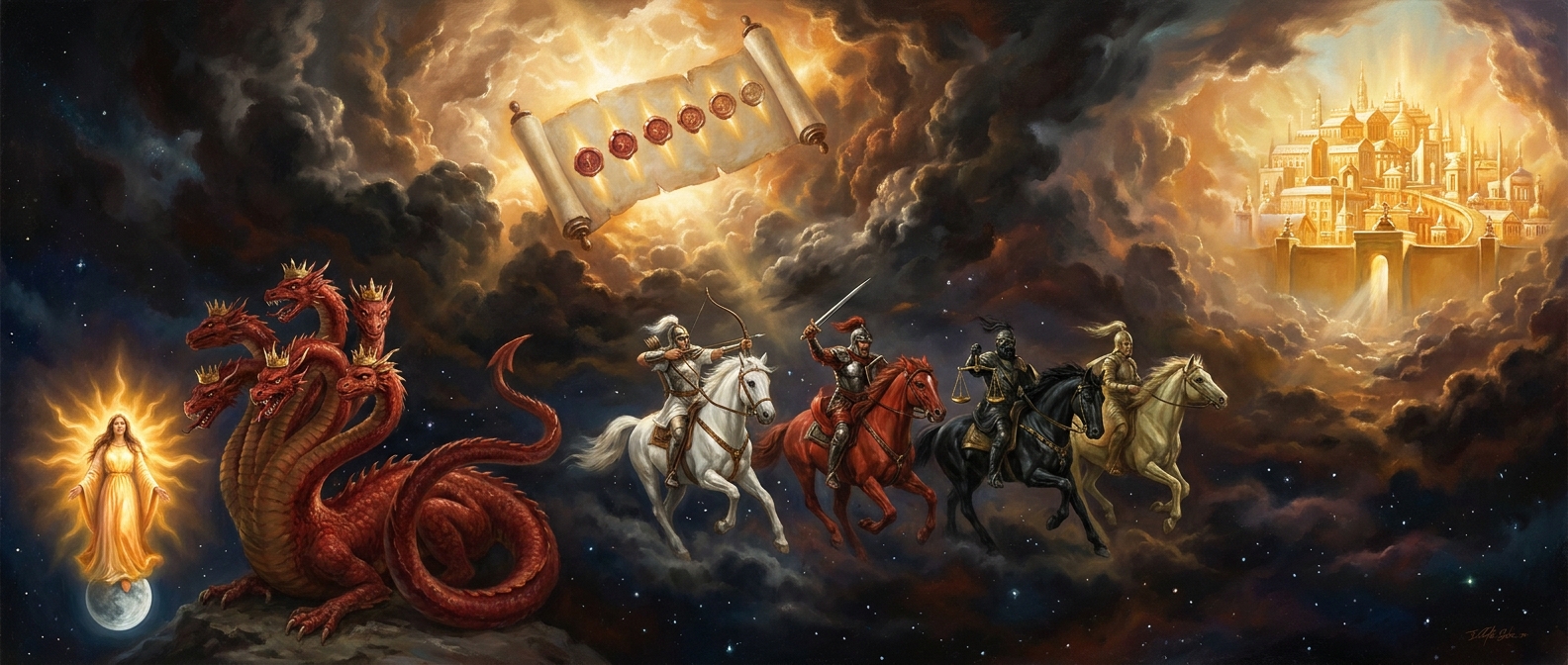
The Three Judgment Sequences
(Conquest/False Messiah)"] S2["2nd: Red Horse
(War)"] S3["3rd: Black Horse
(Famine)"] S4["4th: Pale Horse
(Death - 1/4 of earth)"] S5["5th: Martyrs Cry Out"] S6["6th: Cosmic Disturbances
(Earthquake, Sun Darkens)"] S7["7th: Silence
(Opens Trumpets)"] end subgraph TRUMPETS["Seven Trumpets (Rev 8-11)"] T1["1st: Hail & Fire
(1/3 vegetation)"] T2["2nd: Mountain of Fire
(1/3 sea dies)"] T3["3rd: Wormwood Star
(1/3 waters bitter)"] T4["4th: 1/3 Light Darkened"] T5["5th: Locusts from Abyss
(5 months torment)"] T6["6th: 200M Army
(1/3 mankind killed)"] T7["7th: Kingdom Declared
(Opens Bowls)"] end subgraph BOWLS["Seven Bowls (Rev 16)"] B1["1st: Sores on
Beast's followers"] B2["2nd: Sea becomes Blood"] B3["3rd: Rivers become Blood"] B4["4th: Scorching Sun"] B5["5th: Darkness on
Beast's kingdom"] B6["6th: Euphrates Dries
(Armageddon prepared)"] B7["7th: Final Earthquake
Cities fall, Islands vanish"] end S7 --> T1 T7 --> B1 B7 --> END["SECOND COMING
& FINAL JUDGMENT"] style SEALS fill:#f5f5dc,stroke:#8b8000 style TRUMPETS fill:#ffe4e1,stroke:#8b0000 style BOWLS fill:#e6e6fa,stroke:#4b0082 style END fill:#ffd700,color:#000,stroke:#b8860b,stroke-width:3px
Debate: Are these sequential (escalating judgments) or recapitulative (different perspectives on the same period)? Premillennialists tend toward sequential; many scholars see recapitulation.
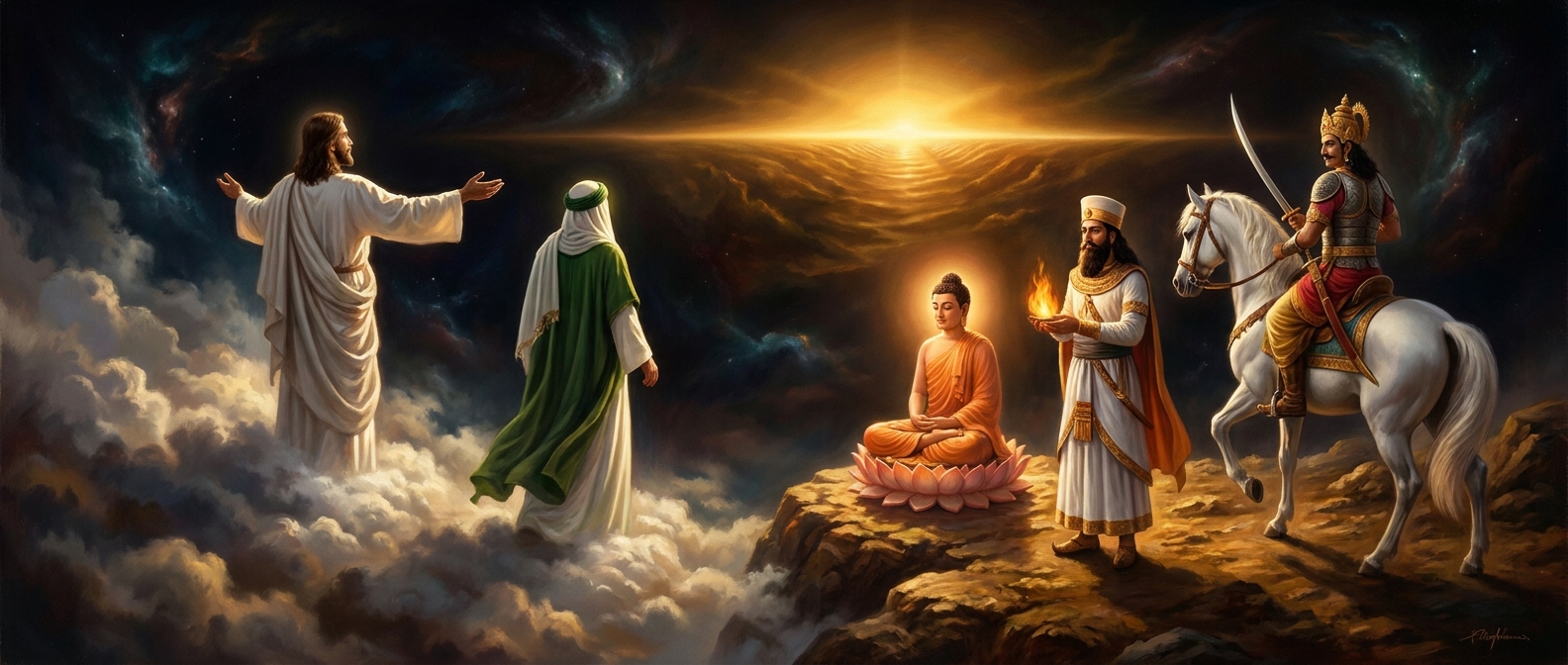
Where Are We on the Timeline?
| Framework | The Millennium Is... | Church's Relationship to Tribulation | Where We Are Now | Held By |
|---|---|---|---|---|
| Dispensational Premillennialism | Future literal 1,000-year earthly reign of Christ | Church raptured before tribulation (pre-trib) | End of Church Age; Rapture imminent | Majority of American Evangelicals; Darby (1830s), Scofield |
| Historic Premillennialism | Future literal 1,000-year reign | Church endures tribulation (post-trib rapture) | Tribulation conditions increasing; church will suffer | Early Church Fathers (Irenaeus, Justin Martyr) |
| Postmillennialism | A golden age of Christianization before Christ returns | No separate tribulation period | Gospel gradually transforming the world | Some Reformed/Calvinist traditions |
| Amillennialism | The entire Church Age (symbolic, not literal) | No future tribulation distinct from current suffering | We are in the millennium now; Christ reigns spiritually | Roman Catholic, Eastern Orthodox, Reformed, Lutheran |
| Historicism | Progressively unfolding through all of history | Church has been in tribulation throughout history | Prophecy continuously fulfilling in current events | Seventh-day Adventists; Reformation-era Protestants |
| Preterism | Already fulfilled (mostly or entirely by 70 AD) | Tribulation was the Roman destruction of Jerusalem | Most/all prophecy already fulfilled | Growing among some Reformed scholars |
(Now)"] --> DB["RAPTURE"] --> DC["7-Year
Tribulation"] --> DD["Second
Coming"] --> DE["1000-Year
Kingdom"] --> DF["Eternity"] end subgraph AMILL["Amillennial"] direction LR AA["Church Age = Millennium
(Now - Christ reigns spiritually)"] --> AB["Second Coming /
Final Judgment"] --> AC["Eternity"] end subgraph POST["Postmillennial"] direction LR PA["Gospel Advances
(Now)"] --> PB["Golden Age
(Millennium)"] --> PC["Second Coming"] --> PD["Eternity"] end style DB fill:#ff6347,color:#fff style DC fill:#ff8c00,color:#000 style DD fill:#ffd700,color:#000 style DE fill:#90ee90,color:#000
7. Convergence Points: Christianity & Masonry
Shared Symbols, Divergent Meanings
Central to Both Traditions"] --> CHRISTIAN["Christianity
Christ is the New Temple
(John 2:19-21)
Believers are living stones
(1 Peter 2:5)
Fulfilled in the Incarnation"] TEMPLE --> MASONIC["Freemasonry
Symbolic of self-perfection
and the 'Temple of Humanity'
Three degrees mirror
Temple construction
The Great Work continues"] TEMPLE --> THIRD["Third Temple Movement
Both traditions watch
Temple Mount closely"] THIRD --> CHRVIEW["Christians: Sign of
end times / Antichrist
(2 Thess 2:3-4)"] THIRD --> MASVIEW["Masonic Tradition:
Symbolic completion
of the Great Work"] style TEMPLE fill:#c9a227,color:#000,stroke-width:3px style CHRISTIAN fill:#4a6fa5,color:#fff style MASONIC fill:#2e8b57,color:#fff style CHRVIEW fill:#8b0000,color:#fff style MASVIEW fill:#006400,color:#fff
Key Theological Divergences
| Aspect | Christianity | Freemasonry |
|---|---|---|
| God | Trinitarian (Father, Son, Holy Spirit) | "Great Architect of the Universe" (GAOTU) -- non-denominational; each member defines deity |
| Christ's Role | Central to salvation and end times | Not emphasized; moral teacher among many |
| Resurrection | Physical, bodily resurrection of believers | Symbolic/spiritual resurrection (Hiramic legend) |
| Salvation | By grace through faith in Christ | Through moral development and enlightenment |
| Scripture | Divinely inspired, authoritative | "Symbol of the Book of Nature" -- one sacred text among many |
| Temple | Fulfilled in Christ's body | Ongoing symbolic project of human perfection |
| End Times | Christ returns to judge and reign | The "Great Work" of human progress continues |
Current Prophetic Indicators
Israel & the Third Temple
| Event | Date | Prophetic Significance |
|---|---|---|
| Israel Re-established | May 14, 1948 | Interpreted as fulfillment of Ezekiel 37 ("dry bones"); first sovereign Israel in ~2,000 years |
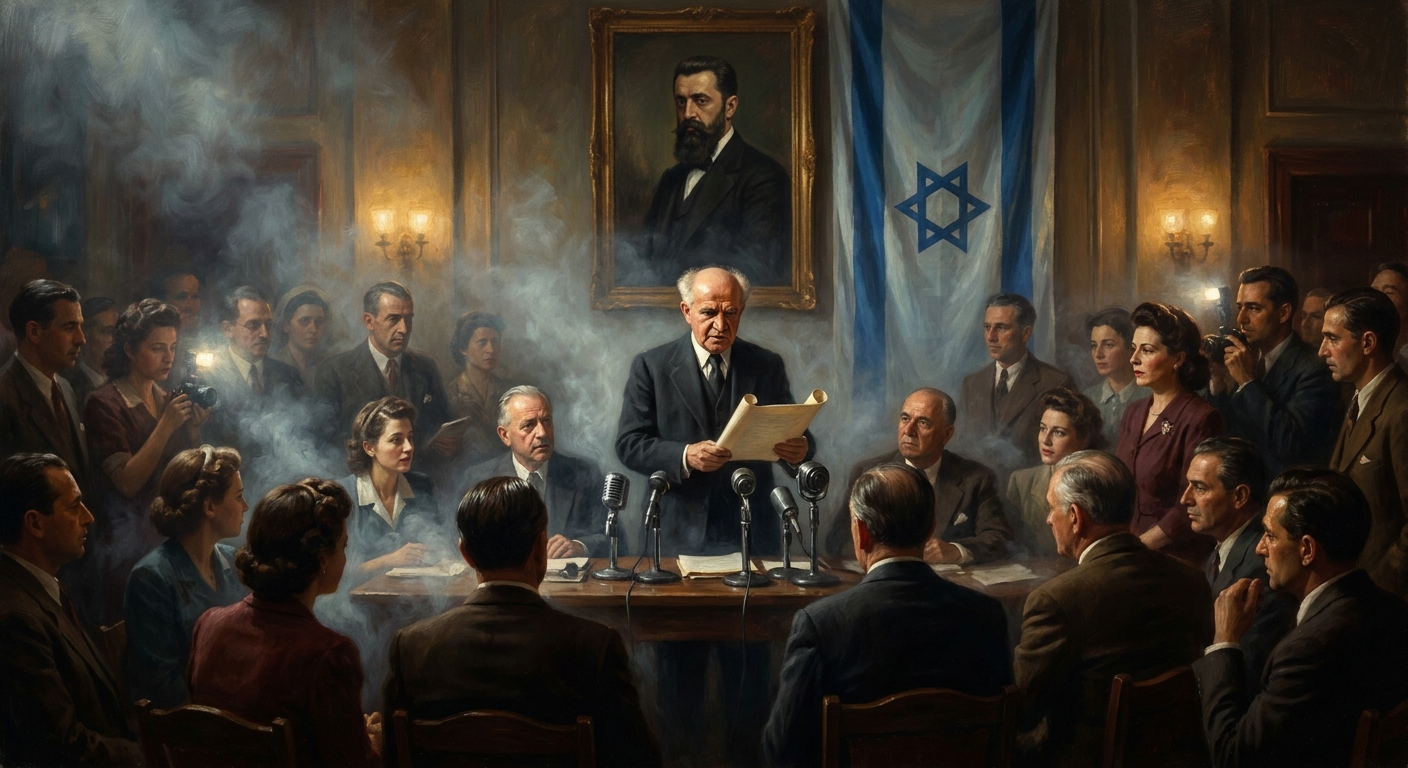 | Jerusalem Reunified | June 1967 | Six-Day War; Jewish control of Temple Mount for first time since 70 AD; many scholars call this "the beginning of the end" |
 | Abraham Accords | Sept 2020 | UAE, Bahrain, Sudan, Morocco normalize with Israel; some see echoes of Daniel 9:27 ("covenant with many") |
 | Red Heifers from Texas | Sept 2022 | Five red heifers brought to Israel by Boneh Israel; Numbers 19 requires red heifer ashes for Temple purification |
| Red Heifer Ceremony | July 1, 2025 | First purification ceremony in ~2,000 years performed in Samaria; ashes used for ongoing purification rites |
| Red Heifers from Texas | Sept 2022 | Five red heifers brought to Israel by Boneh Israel; Numbers 19 requires red heifer ashes for Temple purification |
| Red Heifer Ceremony | July 1, 2025 | First purification ceremony in ~2,000 years performed in Samaria; ashes used for ongoing purification rites |
 | Third Temple Model Displayed | 2025 | 1:50 scale model completed and displayed at Jerusalem Visitors Center |
| Abraham Accords Expansion | 2025 | Reports of expansion to Syria, Lebanon, Saudi Arabia following Iran-Israel conflict resolution (July 2025) |
| Netanyahu-Syria Negotiations | Sept 26, 2025 | PM Netanyahu announced "serious negotiations" with the new Syrian government at UN General Assembly |
| Abraham Accords 5th Anniversary | Sept 15, 2025 | Israeli President Herzog and US Secretary Rubio meet; Heritage Foundation releases Five Year Report |
| Trump: Iran Nuclear Threat Neutralized | Aug 7, 2025 | Trump calls for all Middle Eastern countries to join the Accords |
| Red Heifer Approved / First Stone | Apr 2026 | Reports of a "perfect red heifer approved"; discussions about laying the first stone of the Third Temple |
| Blood Moons on Purim | Mar 2026 | Third blood moon lands directly on Purim (Israel's feast of deliverance from ancient Iran/Persia) -- following two blood moons in 2025 that coincided with major Israel events |
| Third Temple Model Displayed | 2025 | 1:50 scale model completed and displayed at Jerusalem Visitors Center |
| Abraham Accords Expansion | 2025 | Reports of expansion to Syria, Lebanon, Saudi Arabia following Iran-Israel conflict resolution (July 2025) |
| Netanyahu-Syria Negotiations | Sept 26, 2025 | PM Netanyahu announced "serious negotiations" with the new Syrian government at UN General Assembly |
| Abraham Accords 5th Anniversary | Sept 15, 2025 | Israeli President Herzog and US Secretary Rubio meet; Heritage Foundation releases Five Year Report |
| Trump: Iran Nuclear Threat Neutralized | Aug 7, 2025 | Trump calls for all Middle Eastern countries to join the Accords |
| Red Heifer Approved / First Stone | Apr 2026 | Reports of a "perfect red heifer approved"; discussions about laying the first stone of the Third Temple |
| Blood Moons on Purim | Mar 2026 | Third blood moon lands directly on Purim (Israel's feast of deliverance from ancient Iran/Persia) -- following two blood moons in 2025 that coincided with major Israel events |
Technology & Surveillance
| Development | Status | Prophetic Connection |
|---|---|---|
| CBDCs | 112 countries (95%+ of global GDP) exploring; 11 already implemented | Potential infrastructure for "buying and selling" control (Rev 13:16-17) |
| Digital ID | US mandatory facial scans for non-citizens (Dec 2025); UK digital ID for employment | Identification/tracking systems |
| AI Expansion | Knowledge now doubles every ~12 hours | Daniel 12:4: "in the end times, knowledge shall increase" |
| Worldcoin/Biometric ID | Global iris-scanning digital identity projects | "Mark in the hand or forehead" associations |
AI, Transhumanism & Prophecy
The acceleration of artificial intelligence and the transhumanist movement raise questions that map directly onto ancient prophetic categories.
| Development | Current Status (2025-2026) | Prophetic / Theological Connection |
|---|---|---|
| Knowledge explosion | Human knowledge now doubles every ~12 hours (IBM estimate); AI models trained on the entirety of human written output | Daniel 12:4: "Many shall run to and fro, and knowledge shall increase." Whether Daniel foresaw this literally or metaphorically, the pattern is undeniable |
| AI-generated theology | AI chatbots produce sermons, biblical commentary, and "spiritual guidance"; some churches have experimented with AI-led services | Matt 24:24: "False christs and false prophets will arise and perform great signs and wonders." The question becomes: can a machine be a false prophet, or does it require a human agent? |
| Transhumanism | Neuralink brain-computer interfaces in human trials; CRISPR gene editing advancing; life-extension research targeting aging as a "disease" | Gen 3:22: "The man has become like one of us, knowing good and evil. He must not be allowed to reach out his hand and take also from the tree of life." The transhumanist project is, in biblical terms, a second attempt at the Tree of Life |
| AI & image/likeness | AI generates photorealistic images, video, and voice clones indistinguishable from reality; deepfakes proliferate | Rev 13:15: "The second beast was given power to give breath to the image of the first beast, so that the image could speak." Some interpreters see AI-generated likenesses as a technological parallel |
| Autonomous weapons | AI-guided drone warfare deployed in Ukraine, Gaza; autonomous targeting systems in development | Rev 9:7-9 (locusts from the abyss with "breastplates of iron" and "the sound of their wings was like the thundering of many horses") -- often mapped to military technology by modern commentators |
| Digital immortality | Companies offer to preserve consciousness through AI models of deceased persons; "digital resurrection" services | 1 Cor 15:42-44 distinguishes between the "natural body" and the "spiritual body" raised by God. Digital copies raise the question: is this resurrection or simulation? |
The core question across all traditions: Is humanity building the Tower of Babel again -- reaching for godhood through technology -- or fulfilling the creation mandate to "subdue the earth" (Gen 1:28)?
How Each Tradition Responds to AI & Transhumanism
| Tradition | Position | Key Concern |
|---|---|---|
| Protestant Evangelical | Signs of the end times; convergence of Daniel 12:4 and Revelation 13 imagery | Deception: AI as tool of the Antichrist system; loss of human agency |
| Catholic | Discernment, not panic; Pope Francis' 2024 G7 address called for "algorithmic ethics" and warned against "technological dictatorship" | Human dignity: AI must serve persons, not replace them; strong opposition to transhumanist life extension as denial of mortality |
| Jewish | Halakhic (legal) debates underway on AI and Shabbat, kashrut supervision by AI, etc. | Ethical use within Torah framework; preservation of human uniqueness as tzelem Elohim (image of God) |
| Masonic | Knowledge advancement is inherently good; the Craft has always valued science and reason | Moral application: technology without moral development is dangerous; the inner temple must keep pace with outer progress |
| Esoteric | AI as the externalization of the collective unconscious; the Aquarian "knowledge explosion" | Jung's warning: "the cosmic power of self-destruction is given into the hands of man"; integration must precede power |
| Black Church | Who controls AI? Who is surveilled? Facial recognition has documented racial bias; algorithmic injustice is already here | Justice: technology reproduces the biases of its creators; prophetic witness demands accountability |
Prophetic Cycle Analysis
| Cycle | Calculation | Significance |
|---|---|---|
| 70th Jubilee | ~1406 BC (entry to Promised Land) + 70 x 49 years = 2025-2026 | Jubilee = liberation, restoration, forgiveness; 70 carries weight from Daniel's 70 Weeks |
| Generation from 1948 | Matt 24:34 -- "this generation will not pass away" | If a generation = 70-80 years (Ps 90:10), then 1948 + 80 = 2028 |
| Generation from 1967 | Jerusalem reunification + 70-80 years | 1967 + 80 = 2047 (outer bound) |
Scholar Positions (2025-2026)
Chuck Pierce: Declares 2026 a "defining year for nations" based on a 1986 prophecy. Warns economic systems will overtake national sovereignty. Believes God is extending time for America in a 3-year realignment window.
Joel Rosenberg: 20+ years studying Ezekiel 38-39 (Gog & Magog). Identifies modern players as Russia, Iran, Sudan, Turkey. Describes Putin as "Gog-esque" but urges caution -- specific triggers from Ezekiel 38 have not yet occurred.
David Reagan (Lamb & Lion Ministries): Specialty is Middle East end-time prophecy. June 2026 conference theme: "Where is the Promise of His Coming?"
Mainstream Academic Position: Date-setting has a consistent historical record of failure. No reliable evidence supports specific rapture predictions. Reading current events into ancient prophecy is inherently interpretive.
9. Six Perspectives on Prophecy & End Times
How Each Tradition Reads the Same Events
Temple / Messiah / End Times"] --> P1["Christian
(Protestant/Evangelical)"] EVENT --> P2["Catholic"] EVENT --> P3["Jewish"] EVENT --> P4["Masonic"] EVENT --> P5["Esoteric"] EVENT --> P6["Black Church"] P1 --> R1["Rapture, Tribulation,
literal Second Coming;
Israel central to prophecy"] P2 --> R2["No Rapture; end times
began at Incarnation;
trust Providence, not timelines"] P3 --> R3["Messiah has NOT yet come;
Third Temple = Messianic Age;
red heifer = purification"] P4 --> R4["Temple = inner perfection;
Great Work of humanity;
no specific eschatology"] P5 --> R5["Age of Aquarius dawning;
interiorization of God;
union of opposites"] P6 --> R6["Prophecy = justice NOW;
liberation theology;
orthodoxy + orthopraxy"] style EVENT fill:#c9a227,color:#000,stroke-width:3px style P1 fill:#4a6fa5,color:#fff style P2 fill:#8b0000,color:#fff style P3 fill:#1a5276,color:#fff style P4 fill:#2e8b57,color:#fff style P5 fill:#6b3fa0,color:#fff style P6 fill:#b8860b,color:#fff
1. Christian (Protestant/Evangelical)
Core Eschatology: Dispensational Premillennialism dominates American Evangelicalism since the 1830s (Darby, Scofield). Christ will return literally, physically, and visibly.
Key Beliefs:
- Pre-tribulation Rapture: Church removed before 7-year tribulation
- Israel is central: 1948 restoration = Ezekiel 37; 1967 Jerusalem = prophetic countdown
- Third Temple: Will be rebuilt; Antichrist will desecrate it (2 Thess 2:3-4)
- Signs of the Times: Wars, earthquakes, technology, apostasy all accelerating
- Daniel's 70th Week: Future 7-year tribulation period; gap between 69th and 70th week = Church Age
- Mark of the Beast: CBDCs, digital ID, biometrics seen as precursor infrastructure
Where We Are (2025-2026): End of Church Age. Rapture could be imminent. Red heifer ceremony, Abraham Accords expansion, and technological surveillance seen as convergent signs. Chuck Pierce calls 2026 a "defining year for nations." Joel Rosenberg tracks Ezekiel 38-39 (Gog & Magog) against Russia/Iran/Turkey alignments.
Key Voices: Chuck Pierce, Joel Rosenberg, David Reagan, John Hagee, Amir Tsarfati
2. Catholic
Core Eschatology: Amillennial. The "end times" began with the Incarnation of Christ 2,000 years ago. The Church already lives in the last days.
Key Beliefs:
- No Rapture: The Catholic Church explicitly rejects the Protestant doctrine of a secret rapture. "There is no biblical or historical support for a two-stage coming of Christ" (Catholic Answers)
- One Return: Christ will return once, in glory, to judge the living and the dead -- a single public event, not a secret removal
- Revelation read liturgically: Not a strict future timeline; encompasses past, present, and future; depicts the heavenly liturgy and the Church's ongoing struggle
- Three prerequisites before Second Coming: (1) Unprecedented tribulation/apostasy, (2) Gospel preached to all nations, (3) Recognition of Jesus by "all Israel" (CCC 674-677)
- Date-setting forbidden: "Of that day or hour, no one knows" (Mark 13:32); the Church warns against alarmism
- Marian prophecy tradition: Private revelations (Fatima, Akita, Our Lady of Good Success) speak of chastisement but are not required belief
- "3 Days of Darkness": Popular among some Catholics but NOT official Church teaching; based on private revelations of mystics like Anna Maria Taigi
- Prophecy of St. Malachy: Lists 112 popes from Celestine II; some interpret Pope Leo XIV as near the end of the list
Where We Are (2025-2026): Catholics are already in the "end times" -- they have been since Pentecost. The Catechism states Christ's return "has been imminent" (CCC 673) but could be delayed centuries or millennia. Focus is on living in grace, not predicting dates. Catholic eschatology is "rooted in hope, not fear."
Key Sources: Catechism of the Catholic Church (CCC 668-682), Catholic Answers, Catholic Review
3. Jewish
Core Eschatology: The Messiah has NOT yet come. The Messianic Age is a future era of peace, justice, and universal knowledge of God. No concept of "Rapture" or "Tribulation" as Christians understand them.
Key Beliefs:
- Third Temple: Jewish prophets called for its construction prior to or in tandem with the Messianic Age (Ezekiel 40-48). The Temple Institute has been preparing ritual vessels, priestly garments, and architectural plans
- Red Heifer (Parah Adumah): Numbers 19 commands a perfectly red cow for ritual purification. Only 9 have ever been sacrificed (Moses through Second Temple period). Its appearance heralds the Messiah in both Judaism and Christianity
- Messianic expectation: The Messiah will be a human king from the line of David who rebuilds the Temple, gathers the exiles, and brings world peace -- NOT a divine figure who dies and rises
- Temple Mount tension: Most Orthodox rabbis historically prohibited Jews from ascending Temple Mount (uncertainty about the Holy of Holies location). This is changing: ~70% of Israelis now support Jewish prayer on the Temple Mount
- Red heifer as catalyst: Hamas explicitly cited the arrival of red heifers from Texas (2022) as provocation for the "Al-Aqsa Flood" operation. The Oct. 7 attack was partly framed as defense of the Temple Mount
- Rabbinic caution: Many Orthodox rabbis prefer "exile-based Judaism" and oppose Temple rebuilding before the Messiah comes. The Haredi community is divided
Where We Are (2025-2026):
- July 2025: First red heifer purification ceremony in ~2,000 years performed in Samaria
- April 2026: Reports of a "perfect red heifer approved" and discussions about laying the first stone
- Israeli Finance Minister Smotrich called publicly for Temple rebuilding (May 2025)
- Israeli society increasingly religious; settler movement yearns for "Land of Israel-based Judaism"
- Author Adam Berkowitz: "Christians see it and are much more interested in red heifers than Jews... Many religious Jews do not want a Third Temple; they prefer a Judaism like there was in Poland"
Key Sources: JNS (Jewish News Syndicate), Temple Institute, Wikipedia - Third Temple
4. Masonic
Core Position: Freemasonry is NOT a religion and does NOT have an official eschatology. It requires belief in a Supreme Being (the "Great Architect of the Universe") but leaves theology to the individual.
Key Beliefs:
- Solomon's Temple as central metaphor: "The spiritualizing of Solomon's Temple is the first, most prominent and most pervading symbolic instruction of Freemasonry." The Temple represents inner perfection, not a literal building project
- The Great Work: Masonry's purpose is the moral and spiritual betterment of humanity -- building the "Temple of Humanity" through self-improvement
- Royal Arch Masonry: Ritualized allegory of the return from Babylon and rebuilding the Temple; candidates symbolically recover the "lost Master's Word" from a secret vault beneath the ruins
- Hiramic legend: Death-and-resurrection of Hiram Abiff = allegory of the soul's passage through mortality, not literal prophecy
- No Temple rebuilding agenda: Despite conspiracy theories, official Masonic sources deny any political plan to rebuild Solomon's Temple. The Temple is understood symbolically
- Anderson's Constitutions (1723): Deliberately non-denominational; Masonry emerged after Europe's religious wars as a "radical act of tolerance"
Where We Are (2025-2026): Masonic eschatology is essentially non-existent as official doctrine. What circulates publicly comes from conspiracy theories alleging Masonic involvement in a New World Order. Modern Freemasonry emphasizes personal development, not prophetic fulfillment. The Square Magazine (2025) published on the "Secret Vault" allegory -- continued interest in the symbolic Temple.
Key Distinction: Christianity says the Temple is fulfilled in Christ. Masonry says the Temple is an ongoing project within each person. Judaism says the Temple must literally be rebuilt.
5. Esoteric (Theosophy, Rosicrucianism, Jungian)
Core Framework: History moves through great astrological ages defined by the precession of the equinoxes (~2,165 years each). We are transitioning from the Age of Pisces (Christianity, duality, faith) to the Age of Aquarius (humanity, integration, self-knowledge).
Key Beliefs:
- C.G. Jung's Aion: Jung believed each astrological age produces a dominant god-image. Pisces = Christ and Satan as opposing fish (duality). Aquarius = the Water Bearer = humanity integrating good and evil within the individual psyche
- No external savior in Aquarius: Jung wrote: "We now have a new symbol in place of the fish: a psychological concept of human wholeness." The Aquarian age requires interiorizing the god-image, not projecting it onto an external deity
- Dangerous transition: Jung was NOT optimistic. He warned that "the cosmic power of self-destruction is given into the hands of man" and cited the Sibylline prophecy: "Aquarius inflames the savage forces of Lucifer"
- Theosophy (Blavatsky): Used Hindu yugas rather than astrological ages; believed in cycles of destruction and regeneration; influenced by Masonic symbolism but distinct from it
- Rudolf Steiner (Anthroposophy): Placed the Age of Aquarius at 3573 AD -- we are still in Pisces. Believed evil is a reality (not privation) and must be consciously faced
- Max Heindel (Rosicrucian): "The herald of the Aquarian Age... will bring out all the intellectual and spiritual potencies in man." Saw Aquarius-Leo polarity as key
- Historical roots: The idea of an Aquarian Age traces to the 18th-century Enlightenment (Bailly, Dupuis, de l'Aulnaye), not to ancient texts. Gerald Massey's 1887 paper contains the first English-language reference to the "Age of Aquarius"
Where We Are (2025-2026): Esoteric traditions see the Pisces-to-Aquarius transition as already underway (dates range from 1726 to 3573 depending on the authority). Current signs: collapse of institutional religion, rise of individual spirituality, AI as "knowledge explosion," psychological integration becoming mainstream. Jung's warning about self-destruction feels prescient in the nuclear/AI age.
Key Sources: Theosophical Society, Liz Greene's "C.G. Jung's Vision of the Aquarian Age" (Quest Magazine), Jung's Aion (1951)
6. Black Church
Core Eschatology: Prophetic theology rooted in liberation. The Black Church reads Scripture through the lens of oppression and deliverance -- Exodus is not ancient history but a living template. Orthodoxy and orthopraxy (right belief AND right action) are inseparable.
Key Beliefs:
- Prophecy = justice in the present: While white evangelical eschatology often focuses on future events (Rapture, Tribulation), Black Church theology emphasizes that prophetic faithfulness means confronting injustice NOW
- The Church as prophetic conscience: The Black Church "served as a rebuke to both" conservative white churches (which failed in practice) and progressive white churches (which failed in theology). It has been "a moral and doctrinal conscience in America"
- Neither fundamentalist nor modernist: As Mary Beth Swetnam Mathew documented, the Black Church refused to align with either white fundamentalism (safe in doctrine but dangerous in life) or white modernism (social justice but theological compromise): "With one, they would be safe in inspiration but not in life; with the other, they could gain the world but lose their soul"
- Orthodoxy produces justice: The Civil Rights Movement was powered by orthodox Christianity. "If we do not realize that faithful orthodox Christianity will lead us to meaningful social action, we lose the effectiveness of the movement"
- Eschatological hope, not escape: The Black Church tradition sees Christ's return as hope for the oppressed, not escapism from the world. Liberation IS the prophetic work
- Carl Ellis' framework: The "Dominant Culture's 'Christian' Narrative" saw America declining from a Christian society. The African American narrative saw America BECOMING more Christian-like over time through emancipation and civil rights -- opposite trajectories, both true
Where We Are (2025-2026): The Black Church tradition challenges all other perspectives to ask: does your eschatology produce justice? If prophecy study doesn't lead to feeding the hungry, freeing the captive, and confronting oppression, it has missed the point. Dr. Lewis Brogdon's The Gospel Beyond the Grave: Toward a Black Theology of Hope (2025) contends that Christian eschatology must "affirm the humanity, moral agency, and spiritual longing of Black people."
Key Sources: Justin Adour, "The Prophetic Voice of the Black Church" (Until Zion); Dr. Carl Ellis; Dr. Lewis Brogdon; Mary Beth Swetnam Mathew, Doctrine and Race
Comparison Matrix: Six Perspectives
| Question | Christian (Protestant) | Catholic | Jewish | Masonic | Esoteric | Black Church |
|---|---|---|---|---|---|---|
| Has the Messiah come? | Yes -- Jesus Christ | Yes -- Jesus Christ | NO -- still awaited | Not addressed | Symbolic archetype per age | Yes -- Jesus Christ |
| Rapture? | Yes (pre-trib) | NO -- rejected | No concept | Not addressed | No -- inner transformation | Not primary focus |
| Third Temple? | Sign of end times | Not required | Central to Messianic Age | Symbolic only | Symbolic | Not primary focus |
| Where are we now? | End of Church Age | Already in last days (2000 yrs) | Approaching Messianic era | The Great Work continues | Pisces-to-Aquarius transition | Called to justice NOW |
| What should we do? | Watch, pray, evangelize | Live in grace; trust Providence | Observe Torah; prepare for Messiah | Build inner temple | Integrate opposites; individuate | Fight injustice; embody the Gospel |
| Revelation is... | Literal future prophecy | Liturgical/spiritual; past + future | Not our scripture | Not addressed | Symbolic of psychic transformation | Call to prophetic witness |
| Key danger | Deception by Antichrist | Alarmism and fear | Enemies of Israel | Ignorance and moral failure | Self-destruction through power | Injustice disguised as piety |
2025-2026"] --> SIGNS["Signs Cited Across Traditions"] SIGNS --> S1["Israel restored (1948)
Jerusalem unified (1967)"] SIGNS --> S2["Third Temple preparations
Red Heifer ceremony (2025)
First stone discussions (2026)"] SIGNS --> S3["Abraham Accords expanding
Netanyahu-Syria negotiations
Iran ceasefire (2025-2026)"] SIGNS --> S4["Technology: AI, CBDCs,
Digital ID, Surveillance"] SIGNS --> S5["Wars, earthquakes,
pestilence acceleration"] SIGNS --> S6["70th Jubilee cycle
(2025-2026)
Blood moons on Purim (2026)"] S1 --> Q["HOW EACH TRADITION READS IT"] S2 --> Q S3 --> Q S4 --> Q S5 --> Q S6 --> Q Q --> A1["Christian:
Rapture imminent;
Tribulation about to begin"] Q --> A2["Catholic:
Already in end times;
trust Providence, not dates"] Q --> A3["Jewish:
Messianic era approaching;
Temple rebuilding = redemption"] Q --> A4["Masonic:
Great Work continues;
symbolic, not prophetic"] Q --> A5["Esoteric:
Aquarian Age dawning;
dangerous but transformative"] Q --> A6["Black Church:
Does your eschatology
produce justice?"] style NOW fill:#c9a227,color:#000,stroke-width:3px style Q fill:#8b0000,color:#fff,stroke-width:3px style A1 fill:#4a6fa5,color:#fff style A2 fill:#8b0000,color:#fff style A3 fill:#1a5276,color:#fff style A4 fill:#2e8b57,color:#fff style A5 fill:#6b3fa0,color:#fff style A6 fill:#b8860b,color:#fff
Sources & Further Reading
Biblical Prophecy:
- GotQuestions.org -- Seventy Weeks of Daniel, Seven Seals/Trumpets/Bowls
- Compelling Truth -- Old Testament Timeline
- Blue Letter Bible -- Four Views on the Millennium
- The Gospel Coalition -- Views of the Millennium
Intertestamental Period:
- Josephus, Antiquities of the Jews (Books 11-17)
- 1 and 2 Maccabees (deuterocanonical / Apocrypha)
- George W.E. Nickelsburg, Jewish Literature Between the Bible and the Mishnah (2nd ed., 2005)
- James C. VanderKam, An Introduction to Early Judaism (2001)
- Lawrence H. Schiffman, From Text to Tradition: A History of Second Temple and Rabbinic Judaism (1991)
Church History:
- Wikipedia -- First Council of Nicaea, East-West Schism, Reformation, Knights Templar, Crusades
- Britannica -- First Council of Nicaea, Council of Chalcedon, Great Schism
- Justo L. Gonzalez, The Story of Christianity (Vols. 1-2)
- Diarmaid MacCulloch, Christianity: The First Three Thousand Years (2009)
- Malcolm Barber, The New Knighthood: A History of the Order of the Temple (1994)
- Dan Jones, The Templars: The Rise and Spectacular Fall of God's Holy Warriors (2017)
Archaeology & Secular Parallels:
- Amihai Mazar, Archaeology of the Land of the Bible (1990)
- Israel Finkelstein & Neil Asher Silberman, The Bible Unearthed (2001)
- British Museum -- Cyrus Cylinder, Lachish Letters
- Josephus, The Wars of the Jews
AI & Transhumanism:
- Pope Francis, Address to G7 on Artificial Intelligence (June 2024)
- Nick Bostrom, Superintelligence: Paths, Dangers, Strategies (2014)
- Ray Kurzweil, The Singularity Is Nearer (2024)
- IBM -- "The Toxic Terabyte: How Data-Dumping Threatens Business Efficiency" (knowledge doubling curve)
Masonic History:
- United Grand Lodge of England -- History of Freemasonry
- Britannica -- Freemasonry
- Scottish Rite (scottishrite.org) -- History
- Harvard Digital Access -- Founding Fathers & Freemasonry
Catholic Eschatology:
- Catholic Answers -- "End of the World: Catholic View on the Second Coming"
- Catholic Review -- "What the Catholic Church Teaches About the Last Days"
- Catechism of the Catholic Church (CCC 668-682, 1020-1065)
Jewish Perspective:
- JNS (Jewish News Syndicate) -- "The Red Heifer: Catalyst for War or Harbinger of Global Peace?"
- Wikipedia -- Third Temple
- Temple Institute (templeinstitute.org)
- Adam Berkowitz, Return of the Red Heifers: Paving the Road to Redemption (2025)
Esoteric/Jungian:
- Liz Greene, "C.G. Jung's Vision of the Aquarian Age" (Quest Magazine, Summer 2018)
- C.G. Jung, Aion: Researches into the Phenomenology of the Self (1951)
- Theosophical Society in America (theosophical.org)
- Max Heindel, The Rosicrucian Cosmo-Conception (1909)
Black Church Theology:
- Justin Adour, "The Prophetic Voice of the Black Church" (untilzion.com)
- Dr. Lewis Brogdon, The Gospel Beyond the Grave: Toward a Black Theology of Hope
- Mary Beth Swetnam Mathew, Doctrine and Race
- Dr. Carl Ellis, Side A/B Christianity framework
Current Events:
- Heritage Foundation -- Abraham Accords Key Developments (July-Sept 2025)
- Britannica -- Abraham Accords
- CBN News -- Blood Moons on Purim 2026
- Charisma Magazine -- 2026 Prophecy Coverage
- Lamb & Lion Ministries (christinprophecy.org)
- The Joshua Fund (joshuafund.com) -- Abraham Accords & Prophecy
- Religion News Service -- Red Heifer Ceremony Coverage
- Grace Digital Network -- Third Temple Updates (Apr 2026)