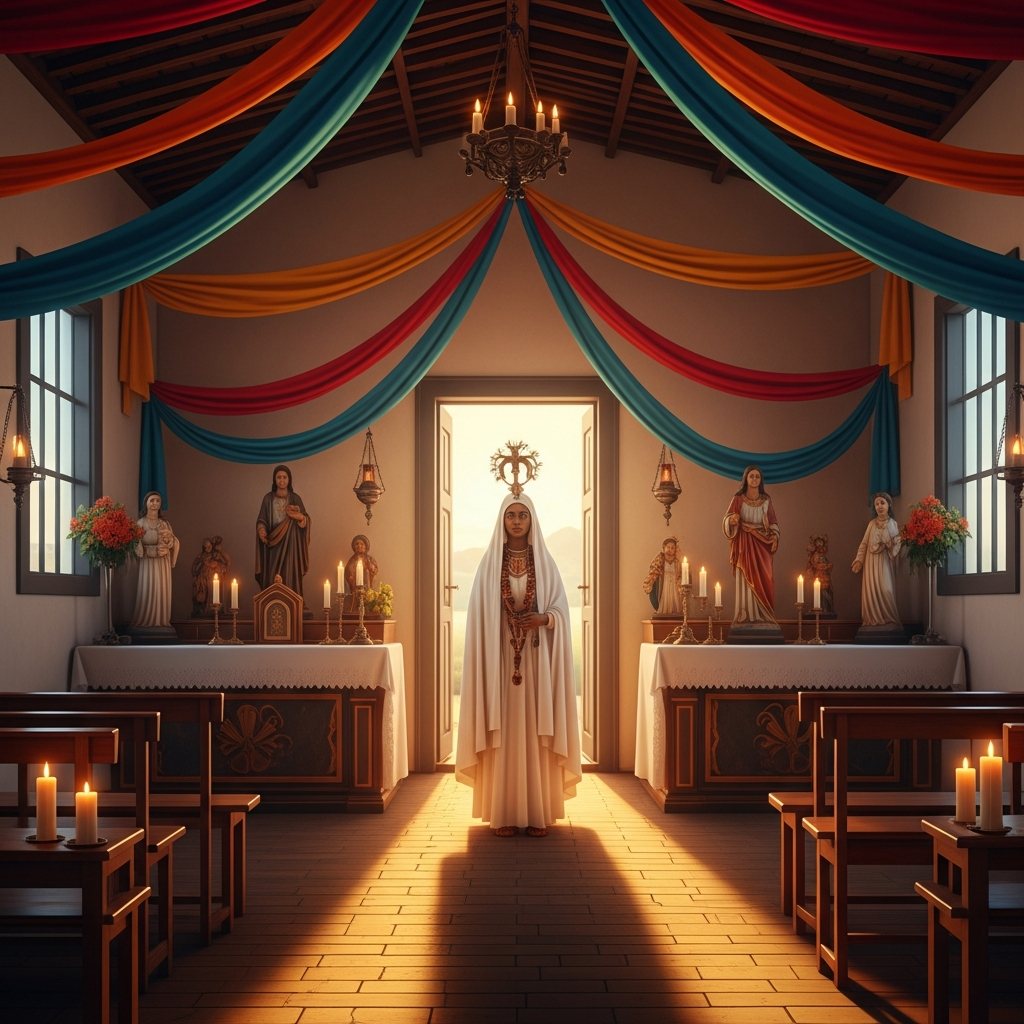
Oxum and the Mirror She Will Not Put Down
c. 1550 CE–present (Candomblé tradition, active) · Salvador, Bahia, Brazil; the rivers and waterfalls of Oxum's domain
Contents
Oxum, the Candomblé orixá of fresh water, love, beauty, and vanity, teaches a young woman in Salvador preparing for her initiation that vanity and self-knowledge are the same thing. The mirror as sacred instrument. Why Oxum never puts it down.
- When
- c. 1550 CE–present (Candomblé tradition, active)
- Where
- Salvador, Bahia, Brazil; the rivers and waterfalls of Oxum's domain
The woman who will become an iyawô — a bride of the orixá, a new initiate — is twenty-three years old, and her name before the ceremony is Fernanda, and she has been told that on the other side of the initiation her sacred name will be given to her and the name Fernanda will become a name that belongs to another life, which is true, which terrifies her, which she agreed to.
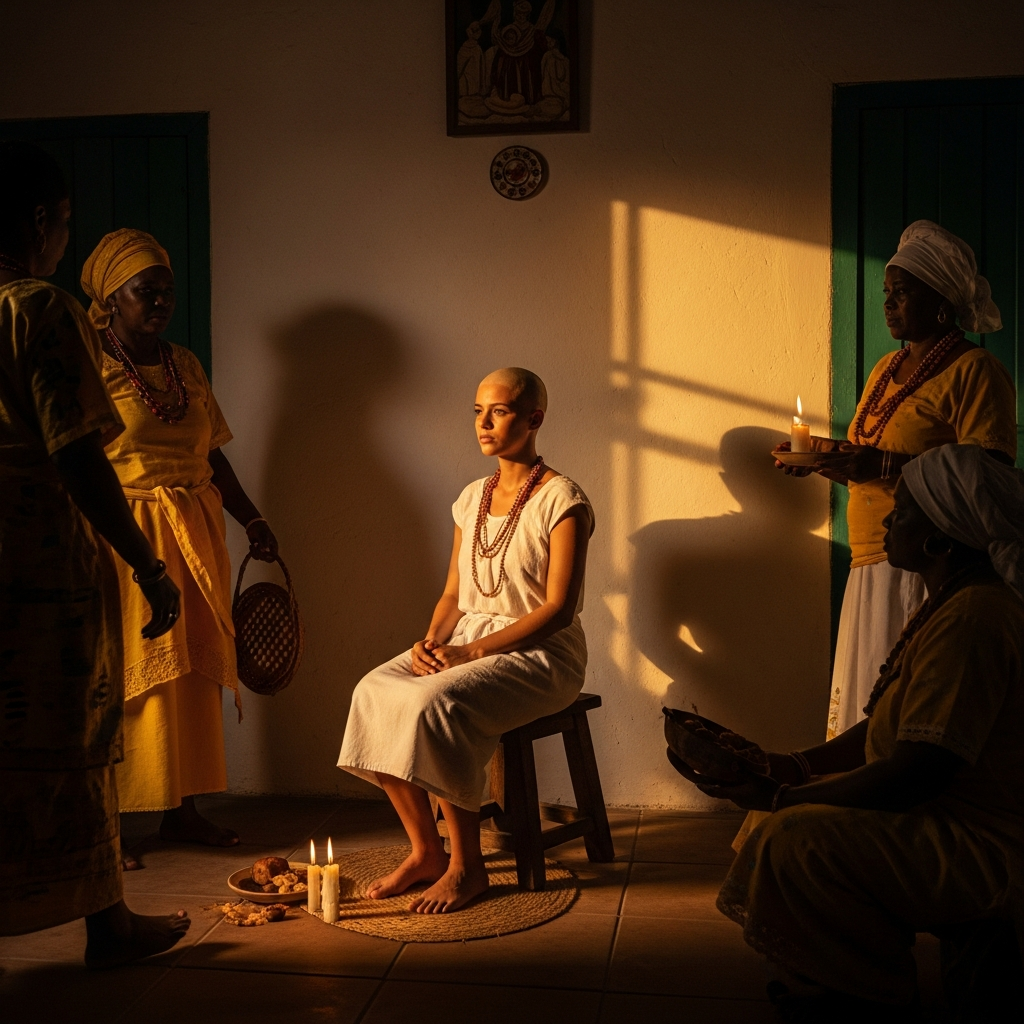
She is sitting in the terreiro in the Pelourinho neighborhood of Salvador, in the old colonial center of the city that was built by slave labor and that contains, within a few city blocks, some of the most elaborate Candomblé houses in Brazil. The walls of the terreiro are painted yellow and gold. The walls are painted yellow and gold because this house belongs to Oxum, whose colors are yellow and gold, whose metal is gold, whose river is the Oxum River in southwestern Nigeria and also every river that the diaspora has claimed since, whose mirror is gold-backed bronze and whose face in the mirror is the face of fresh water.
Fernanda, who will not be called Fernanda after this, sits on the low wooden stool and watches the preparations and tries to understand what she agreed to.
Oxum’s origin story is about the mirror, which is also a story about what happens when the world refuses to see itself.
At the beginning of Candomblé time, when the orixás were organizing the cosmos, Oxum was excluded from the council. The reason given was that she was a woman, or that she was too frivolous, or that her particular domain — love, beauty, fresh water, honey — was decorative rather than structural. The orixás took their various positions in the cosmos and began their work, and they noticed after some time that things were failing. Crops would not grow. Rivers went dry. Women could not conceive. Children died. The work was being done and the world was dying anyway, and nobody could explain it.
They went to Olodumare — the supreme divinity, the one behind all the orixás — and said: we have organized everything correctly and it is not working. Olodumare said: have you included Oxum? They had not included Oxum. Olodumare said: go include Oxum. They went to the river where Oxum sat with her mirror, and they begged her to return to the council, and she wept into the river — her tears are the fresh water that sustains life — and then she returned, and the crops grew, and the rivers filled, and the women conceived.
But she kept the mirror. This is the part the myth insists on. She could have put it down when she rejoined the council. She did not. The mirror is not a vanity prop. It is the instrument of the practice that the other orixás tried to do without: the practice of looking at yourself clearly enough to know what you bring to the work and what the work requires.
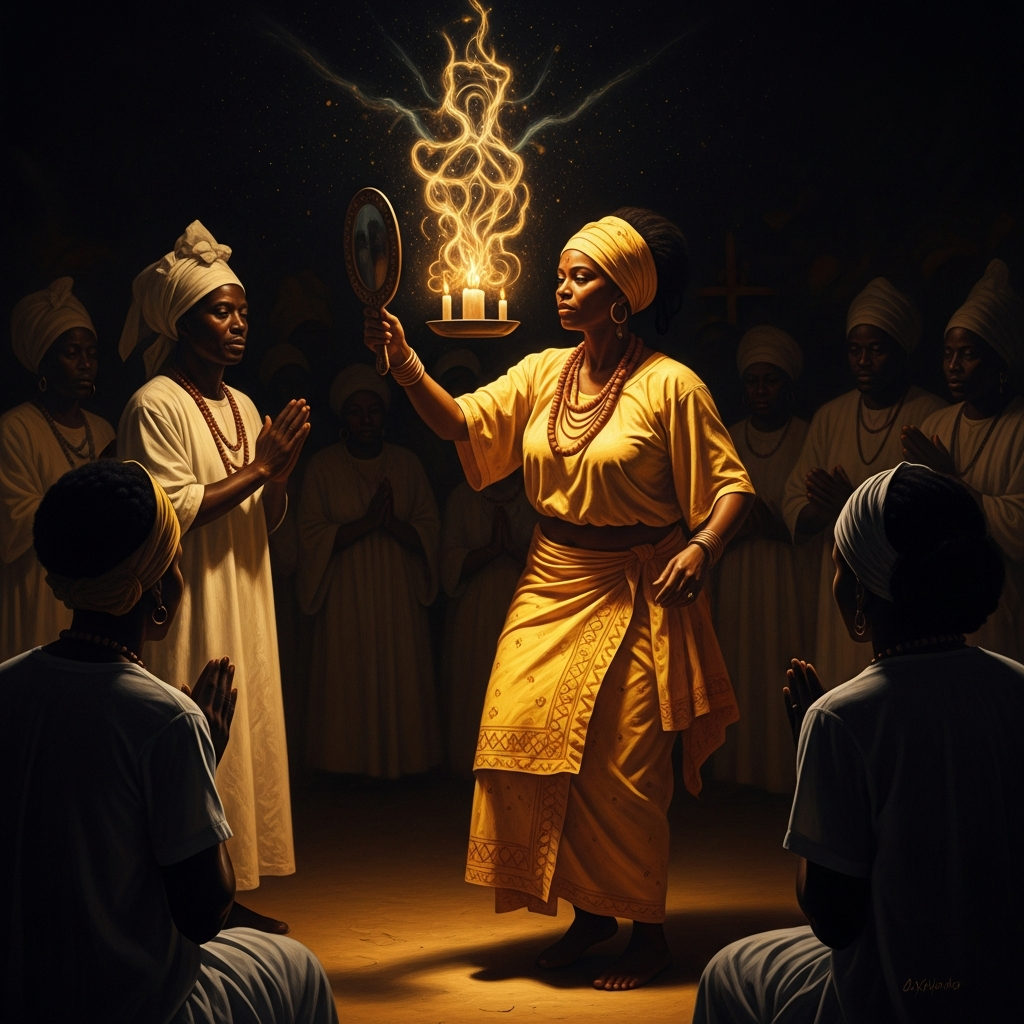
Fernanda does not yet understand why the mirror matters. She understands that Oxum carries it, that the initiates of Oxum are given small mirrors as part of their ritual equipment, that during possession ceremonies the devotee inhabited by Oxum will hold the mirror at face-level and dance slowly, watching herself watch herself, the reflection inside the reflection. She understands this as a fact. She does not yet understand it as a practice.
The senior priestesses — the iyalorixás, the mothers of the orixá — move around the preparation room with the particular efficiency of women who have done this many times and take it seriously. They are washing Fernanda’s head. They are shaving it. The hair falls in dark curves onto the floor, and watching her hair fall is the first thing that makes Fernanda understand, bodily, that the initiation is real. You do not shave your head as a metaphor. The shaving is the argument. What you thought was you — the particular arrangement of your appearance that you have managed and curated and presented to the world — is coming off, and what is underneath it is what Oxum is interested in.
What is underneath it is just a face. Just a skull. Just the thing that has always been there beneath the arrangement.
Oxum’s teaching, in the Candomblé tradition as it is practiced in Bahia, is not that you should love yourself instead of the divine, or that your beauty matters more than your practice. The teaching is that you cannot see anything else clearly if you cannot see yourself. The mirror is not the opposite of selflessness. It is the prerequisite.
She is the orixá of sweet water — the fresh water that is drinkable, that sustains the body, that pools in still places where you can see your own reflection. Salt water distorts the reflection. The ocean is Yemoja’s domain, and Yemoja’s seeing is different — deep, dark, oriented toward the dead and the uncontrollable. Oxum’s seeing is the clear pool. The still water. The place where the image is accurate enough that you can use it.
The initiation puts Fernanda in the water — metaphorically, and then literally, at the river ceremony on the third day. She goes into the river as someone who knows her name and comes out as someone who knows her orixá’s name for her, which is different information, which is what she agreed to receive. The river receives her and returns her. Oxum’s still surface shows her what she looks like from the river’s side.
What she looks like is a person. Not Fernanda. Not the daughter of a particular family in Salvador. Not the particular arrangement of appearance and opinion and desire that has been accumulating since birth. A person, unadorned, standing at the river’s edge at the moment of beginning.
The iyalorixá tells her, after the river: Oxum does not put down the mirror because Oxum knows what happens when you stop looking. She has seen it. The other orixás stopped looking — at themselves, at what they lacked, at what they had excluded — and the world died. The mirror is not vanity. The mirror is vigilance. The mirror is the practice of not pretending that you are complete, that you have seen everything, that the arrangement you have made of yourself is the final one.
Vanity, in this theology, is the refusal to look at the mirror at all — the insistence that you already know what you look like, that you have already understood who you are, that there is nothing left to see. Vanity is not caring too much about your reflection. Vanity is never looking at it honestly.
Oxum looks. She looked into the river when the world was dying and she saw herself — the weeping, excluded, overlooked orixá of fresh water — and she wept into the river, and the water that is her tears is the same water that makes the crops grow and the children come and the rivers run. The tears and the life-water are the same. She put her grief into the water and the water gave it back as nourishment.
Fernanda — who will be called something else, whose name will arrive when the ceremony tells her what it is — holds the small mirror the iyalorixá places in her hands and looks at her shaved head and her face and the candle-fire behind her reflected in the bronze backing, and she sees what she is, which is: a person at the beginning of something, at the surface of fresh water, with the river in front of her and everything she thought she was on the floor behind her.
Oxum never puts the mirror down because the looking is not a phase. It is not preparation for something else. It is the practice itself: to see clearly what you are, which changes what you are, which requires looking again. The mirror in Oxum’s hand is not proving she is beautiful. It is proving she is still here. It is proving she is still willing to look. This is the teaching she offers to those who kneel at the river’s edge and ask for clarity: you will not find it by looking away from yourself. You will find it exactly where you are most afraid to look — in the still water, in the honest surface, in the face you carry that is not an arrangement but a fact.
Scenes
Oxum at the river's edge, her reflection doubled in the still water
 Generating art…
 A young woman in white cotton sits on a low stool in a Candomblé terreiro in Salvador, Bahia
 Generating art…
 A waterfall in green forest, the pool at its base clear and still before the cascade enters it
 Generating art…
 The myth in art: Oxum weeping into the river, her tears falling into the water that is already hers
 Generating art…
 A Candomblé ceremony: a woman in yellow and gold, possessed by Oxum, dancing slowly with the mirror held at eye level
 Generating art…
 Echoes Across Traditions
Entities
- Oxum
- Yemoja
- Ogum
- the iyawô

Sources
- Candomblé e a Filosofia Africana* (Editora Pallas, 2004) — various authors
- Vagner Gonçalves da Silva, *Candomblé e Umbanda: Caminhos da Devoção Brasileira* (Editora Ática, 1994)
- J. Lowell Lewis, *Ring of Liberation: Deceptive Discourse in Brazilian Capoeira* (University of Chicago Press, 1992)
- Rachel E. Harding, *A Refuge in Thunder: Candomblé and Alternative Spaces of Blackness* (Indiana University Press, 2000)
- Reginaldo Prandi, *Mitologia dos Orixás* (Companhia das Letras, 2001)