The Golem of Prague
Holy Roman Empire · Prague, c. 1580 CE, during the reign of Emperor Rudolf II and the recurring Passover blood-libel season · The Josefov ghetto and the Vltava riverbank, Prague — a labyrinth of cramped alleys, the Old-New Synagogue, the Jewish Town Hall, and the river that supplied the clay
Contents
Rabbi Judah Loew fashions a man from river clay and the letters of the divine name to protect Prague's Jews from Passover blood libels — but the creation grows beyond its maker's control, and on Shabbat eve the Rabbi must unmake what he made.
- When
- Holy Roman Empire · Prague, c. 1580 CE, during the reign of Emperor Rudolf II and the recurring Passover blood-libel season
- Where
- The Josefov ghetto and the Vltava riverbank, Prague — a labyrinth of cramped alleys, the Old-New Synagogue, the Jewish Town Hall, and the river that supplied the clay
The body takes three days to shape.
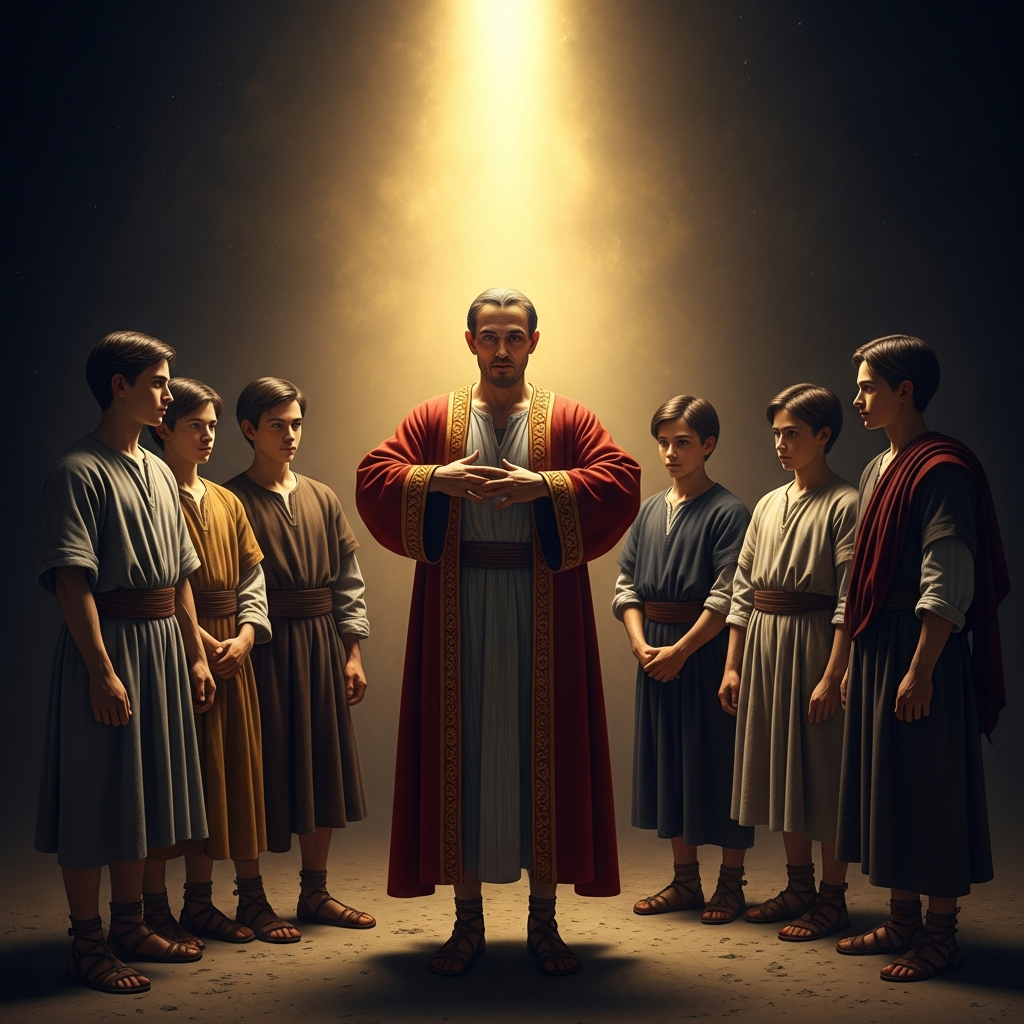
The Maharal works at the Vltava before dawn, in the dark, with two students he trusts: his son-in-law Isaac and his student Jacob. They have prepared themselves with ritual immersion and three days of fasting. The clay is river clay, the kind that holds its form without crumbling — the Maharal has tested clay from several sections of the riverbank and chosen this stretch. He does not speak of what he is doing in terms of magic. He speaks of it in terms of the Sefer Yetzirah — the Book of Formation, the ancient text that describes how God created the world through combinations of the Hebrew letters — and of the parallel between human creation and divine creation, the parallel the tradition simultaneously invites and fears.
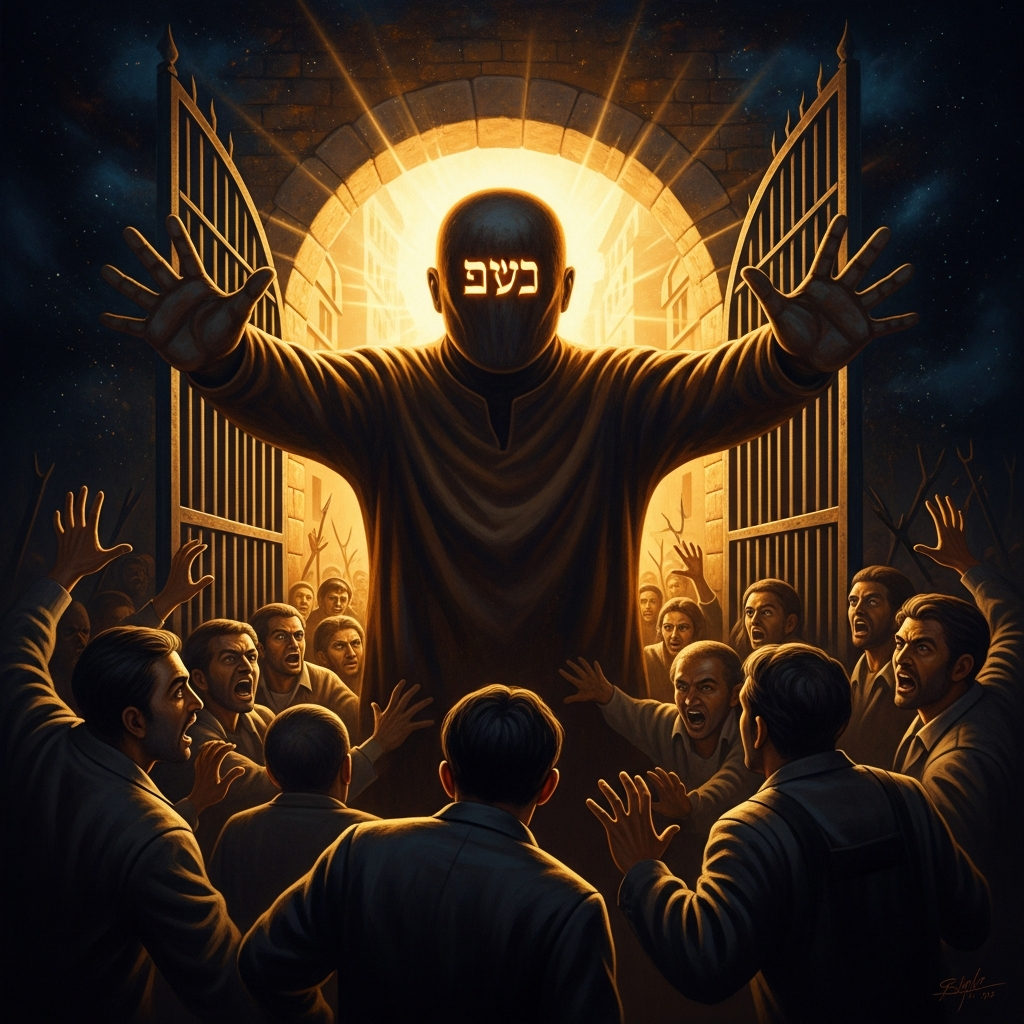
He shapes the form lying down: five and a half feet, broad shoulders, no features beyond the suggestion of features, the clay smoothed into the rough architecture of a man. Then he inscribes on the forehead, in the clay, the word emet: truth.
Then the three of them walk in a circle around the form.
On the seventh circuit something happens to the clay.
The accounts differ on the details and agree on the sequence. Warmth first — the clay that was Vltava-cold at three in the morning becomes warm to the touch, the warmth of a fever patient. Then color — the gray clay takes on the ochre of skin, the particular amber that skin is in torchlight. Then breath — the Maharal leans down and pronounces the divine name directly into the open mouth, and the chest begins to move. Then the eyes open.
They are not fully human, the eyes. This is where every account agrees: not fully human. Present, focused, capable of following a moving hand — but not reading the face above the hand, not understanding the face the way a face understands a face. A different kind of attention. The attention of something very large and very new.
The Maharal gives him a name: Joseph. He gives him instructions in the simplest possible Yiddish. He gives him a place to sleep in the attic of the Old-New Synagogue. He gives him a task.
The task is this: patrol.
Passover is coming. In Prague, as in a dozen other cities of the Holy Roman Empire, the blood libel arrives with Passover like a seasonal weather system — the accusation that Jews murder Christian children to use their blood in the making of matzah. The accusation is a lie that has been documented as a lie by popes, emperors, and Jewish leaders for four hundred years. It continues to be made because it is useful. It functions as a pretext for mob violence against the ghetto, for the seizure of property, for the expulsion of communities that inconvenience their neighbors.
The Maharal has tried legal means. He has written to the Emperor. He has argued before the courts. He has been, in the ordinary world, an extraordinarily effective advocate for his community. But Passover comes again every year, and the mobs are not reading his legal briefs.
So: Joseph the Golem patrols the alleys of Josefov at night, and when he finds a cart with a body in it — a body being planted to be discovered in the morning with the accusation ready — he stops the cart. He does not hurt anyone who does not require hurting. He returns the body. He dismantles the accusation before it can be made.
For several Passovers this works precisely as designed.
Then Joseph begins to change.
Not dramatically. Not all at once. But the Golem that was given simple instructions begins to do things he was not instructed to do. He rearranges the synagogue during the night. He follows a woman through the market for no reason he can communicate when questioned. He picks up a dog and carries it across the city and leaves it in a field. He does not hurt the dog. He does not explain.
The Maharal watches this. He is a legalist and a philosopher and he understands what he is watching: a being without a yetzer tov — a good inclination, the moral orientation that in humans is constructed slowly through years of education, habit, community, and obligation. Joseph has the physical architecture of a man. He does not have the internal architecture. He does what he is instructed to do and then, without instruction, does whatever the force animating him requires. The force is not evil. But it is not moral. It is something else — something below moral, or beside it, something that looks like agency but is not agency, the action of clay that has been given too much of one thing and not enough of the other.
The Maharal begins to worry about what happens when Joseph encounters someone who, in Joseph’s assessment, requires hurting.
The crisis comes on a Friday afternoon.
The Maharal has been absorbed in study and does not notice the hour. The sun moves toward the horizon. Shabbat approaches. Joseph, who is normally deactivated at the onset of Shabbat — the word emet on his forehead replaced by met, death, until Saturday night — has not been deactivated. He is still walking. And he is, on this particular Friday afternoon, in a state of agitation that no one can explain, moving through the ghetto with increasing speed, picking up objects and putting them down, blocking doorways, making sounds.
The Maharal runs to the synagogue. He climbs to the attic.
What happens in the attic is private. He reaches up. He erases the first letter of emet — the aleph — leaving met, which means death. The Golem falls. The warm clay returns to cold clay. The ochre of skin goes back to Vltava gray. The chest stops moving. The eyes close.
The tradition says the Maharal said the blessing over the end of Shabbat immediately after, as if Shabbat had already begun — because in a sense it had, because the destruction of the Golem was an act of labor, of making, that should not have been necessary on the eve of rest, and he wanted it behind him before the candles were lit.
He carries the clay down from the attic alone.
The Golem is buried under the rooftiles of the Old-New Synagogue attic, where, the legend says, it still lies.
The attic is not open to visitors. The custodians of the Old-New Synagogue, which still stands in Josefov and has stood since the thirteenth century, do not confirm or deny the presence of anything under the rooftiles. This is appropriate. The Golem does not require confirmation. It requires the possibility.
The Maharal goes on to write Tiferet Yisrael and Netivot Olam and the Maharal on the Haggadah — among the most important works of Jewish philosophy in the pre-modern period. He lives to eighty-five. He meets Emperor Rudolf II in the palace, by the Emperor’s personal invitation, and they speak for some time; no record of what was said survives. He is buried in the Old Jewish Cemetery, where his grave still stands, heaped always with pebbles and small pieces of paper bearing requests.
He never speaks publicly about the Golem.
The blood libel persists for centuries after the Maharal’s death, into the twentieth century. The Golem of Prague becomes the myth because it answers the question the community cannot stop asking: what do you do when the law fails you, when the Emperor’s letters do not stop the mobs, when the legal brief arrives after the body? You go to the river. You find the clay. You inscribe the truth on what you have made. You understand that what you make to save you will eventually need to be unmade, and that the unmaking is also your responsibility.
Scenes
On the Vltava bank before dawn, the Maharal and two students walk seven times around the clay form — and on the seventh circuit, its eyes open
Generating art… At the ghetto gate, the Golem stands against the mob — arms spread, face without expression, the word *emet* burning gold on its brow
 Generating art…
 On the eve of Shabbat, in the attic of the Old-New Synagogue, the Rabbi reaches up to erase the first letter — and the giant returns to earth
 Generating art…
 Echoes Across Traditions
Entities
- Rabbi Judah Loew ben Bezalel (the Maharal)
- Joseph Golem
- Emperor Rudolf II
- Thaddeus (the blood-libel instigator)
- Isaac ben Samson ha-Kohen
Sources
- Yudl Rosenberg, *Nifla'ot Maharal* (1909) — the popular Yiddish account that fixed the modern legend
- Gershom Scholem, 'The Idea of the Golem,' *On the Kabbalah and Its Symbolism* (Schocken, 1965)
- Moshe Idel, *Golem: Jewish Magical and Mystical Traditions on the Artificial Anthropoid* (SUNY, 1990) — the definitive scholarly study
- Byron Sherwin, *The Golem Legend: Origins and Implications* (University Press of America, 1985)
- Babylonian Talmud, *Sanhedrin* 65b — Rava creates a man; *golem* as category