Contents
The first family after Eden. Two brothers, two offerings, one accepted. God's silence on why becomes the oldest unanswered question in monotheism — and the first murder is also the birth of civilization.
- When
- Genesis 4 · the first generation after Eden
- Where
- East of Eden
The ground has been cursed. Adam and Eve know it now in the way you know a thing that has already happened to your body — not as idea but as weight. Every furrow resists. Every seed is a small argument with the soil. They are east of Eden, and east of Eden is where the story continues.
Eve bears a son and names him Cain — qayin, from the root that means to acquire, to forge, to make. I have gotten a man with YHWH. The sentence is extravagant, almost boastful. The firstborn is hers and God’s both.
Then Abel. The text spends one word on his birth. Hevel — breath, vapor, a thing that dissipates. He is named for his ending before it happens.
Cain works the soil. Abel keeps the flocks.
This is not metaphor. These are the two economies of the ancient Near East — the farmer rooted to one place, the herder moving with the animals across open ground. They represent different relationships to the land, to ownership, to time. The farmer bets on permanence; the herder bets on motion. Both bets are rational. Neither man has chosen wrong.
In time, both bring offerings.
Cain brings the fruit of the ground. Abel brings the firstborn of his flock — the best ones, the fat portions, the animals he could least afford to give. The text is careful here. It says God looks with favor on Abel and his offering. It says God does not look with favor on Cain and his offering. It does not say why.
This is the oldest cruelty in the Hebrew Bible, and it arrives before the first murder.
God says nothing to explain the preference. The rabbis of Bereshit Rabbah fill the silence for centuries — Cain brought inferior fruit, Cain’s heart was wrong, Cain withheld his best. Maybe. The text does not confirm it. What the text confirms is that Cain’s face falls, and God notices.
Why are you angry? Why has your face fallen?
God’s tone is almost curious. Not accusatory. Not dismissive. Curious, the way a parent asks a question they already know the answer to. If you do well, will you not be accepted? And if you do not do well, sin is crouching at the door. Its desire is for you, but you must rule over it.
Sin crouching at the door. The image is feline, predatory, patient. It is not sin that has been committed. It is sin that is waiting. There is still time. The door is still shut.
Cain does not answer. In the entire exchange, he says nothing.
He says something to Abel.
The text in the Masoretic tradition is broken at exactly this point. Cain spoke to Abel his brother — and it came to pass when they were in the field. The words between the dash are missing. The Septuagint supplies them: Let us go out to the field. The Samaritan Pentateuch agrees. What was said in that gap is gone. What we have is the walk to the field, and then what happens in the field.
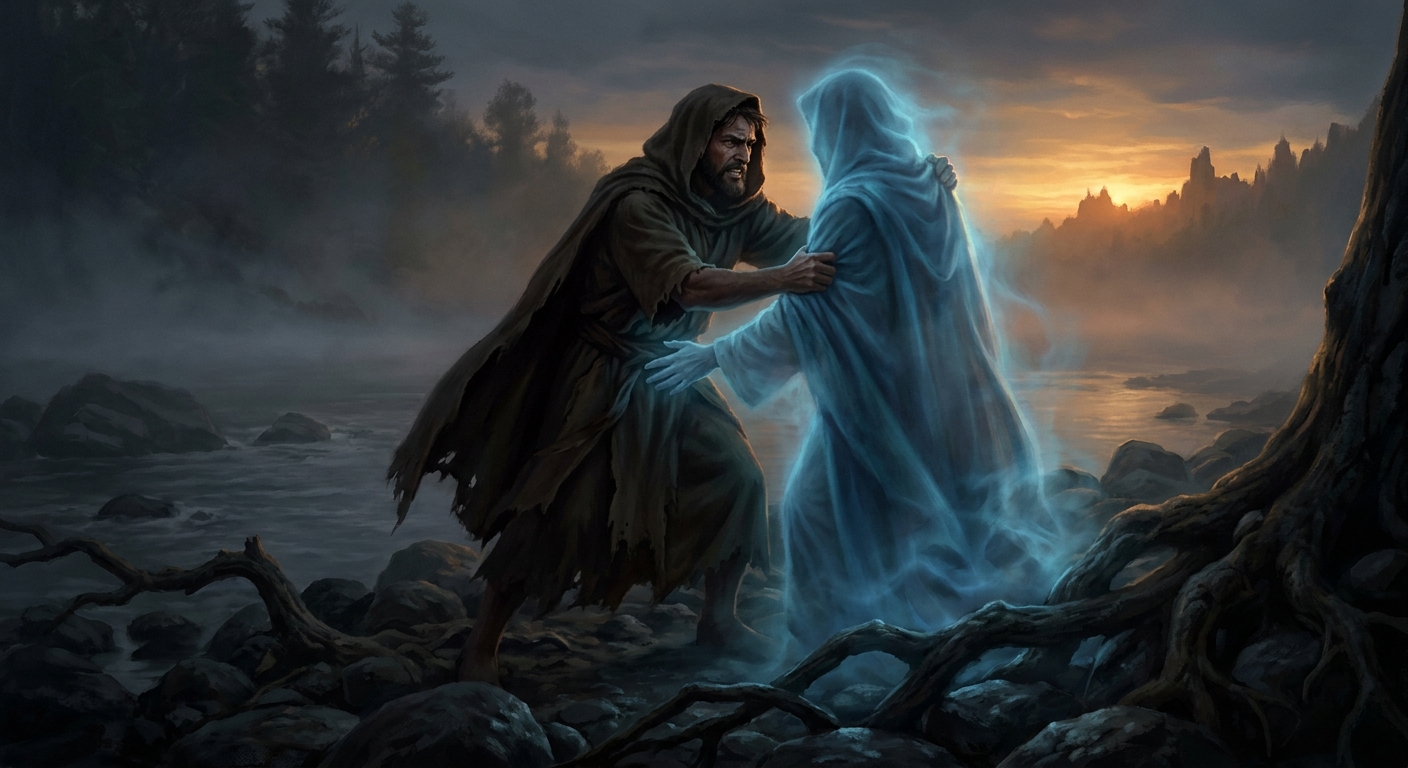
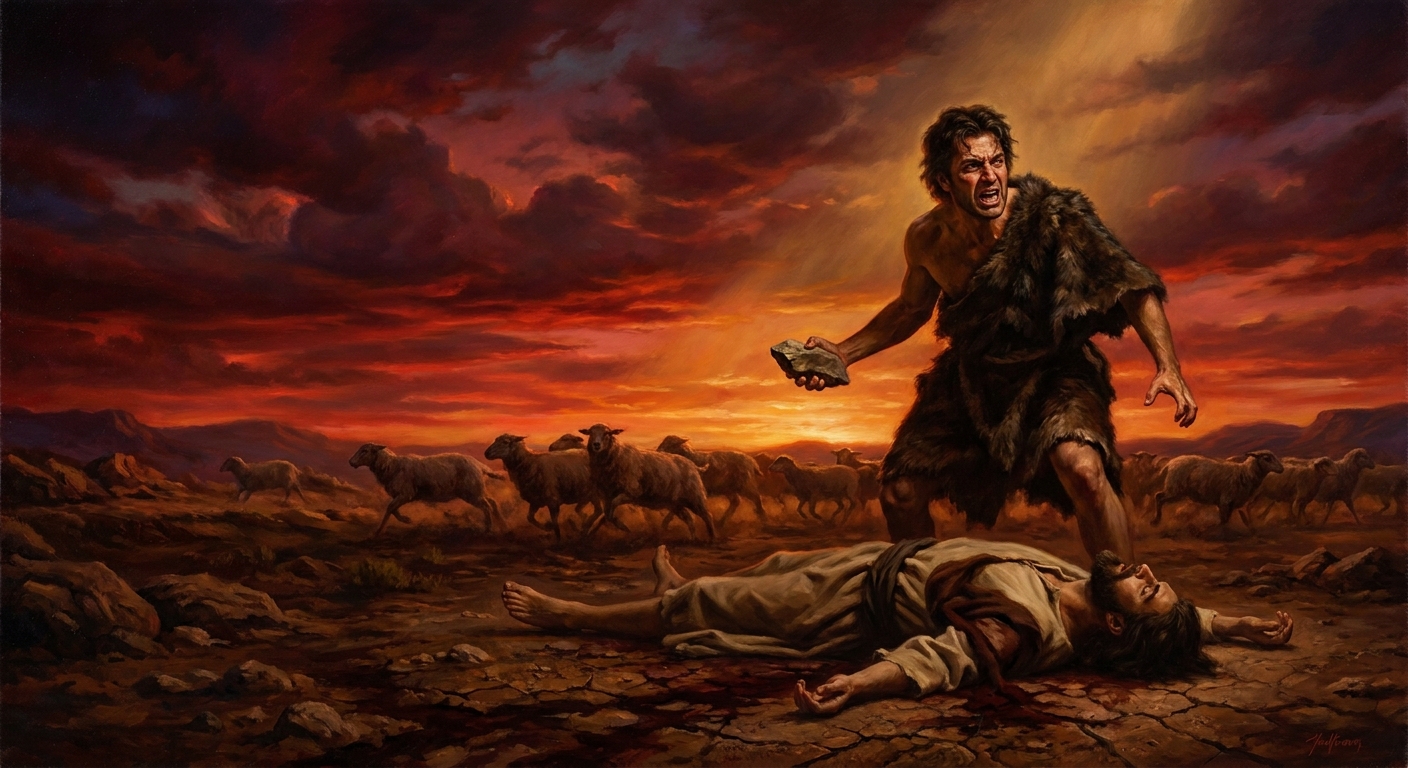
Cain rises against his brother and kills him.
The weapon is not named. The method is not named. The text moves from one clause to the next without pausing on the mechanics of it, the way a story sometimes looks away from the thing it cannot describe. The first death in human history is rendered in a single verb: wayyahargehu. He killed him.
God asks again. Where is Abel your brother?
Cain answers with a question: Am I my brother’s keeper?
Robert Alter notes the Hebrew word for keeper — shomer — is the same word used for a shepherd watching a flock. The irony is precise and savage. Abel was the shepherd. Now Cain is asked whether he was his brother’s shepherd, and the answer embedded in the deflection is no. Cain refused the role. He took the opposite one.
God does not debate it. The voice drops from question to statement: The voice of your brother’s blood is crying out to me from the ground.
Dam, blood. But the Hebrew is plural — damim, bloods. The Talmud reads this as the blood of Abel and the blood of all his descendants who would never be born. The ground does not hold one death. It holds every death that might have come from that death. Every life that will not exist because Cain did not rule the thing crouching at the door.
The curse comes quickly. The ground that drank Abel’s blood will no longer yield for Cain. He is sent from it — a wanderer, a fugitive, a man without place. The word is na va-nad, a paired formula of rootlessness. He will drift.
Cain’s response is the first recorded complaint about divine punishment in the Bible. My punishment is greater than I can bear. Whoever finds me will kill me.
And here the story does the thing it does best — it surprises you. God does not say: you deserve it. God does not say: let them. God marks Cain. The mark is protective. Whoever kills Cain will suffer sevenfold. The first murderer is given the first protection. The logic of it is not mercy exactly, and it is not justice exactly. It is something the Hebrew Bible returns to again and again: a God who refuses to let the story end here.
Cain goes east of Eden. Eastward from east of Eden, further from the garden, further from whatever the garden represented.
He builds a city. He names it after his son, Enoch.
This is not incidental. The first city in human history is built by the first murderer. The text does not comment on this. It simply states it. Kugel and others have noted the implication: civilization — settlement, architecture, permanence, the stacking of human beings into proximity — begins with Cain. His descendants invent the tools of culture: Jabal, father of those who live in tents and keep livestock; Jubal, father of those who play the harp and flute; Tubal-Cain, who forges every cutting instrument of bronze and iron.
Music. Metalwork. Animal husbandry. The arts, the weapons, the economy.
All of it from the line of the man who killed his brother.
The story gives you no resolution because there is none. Abel’s blood still cries from the ground. The question Cain refused to answer has not been answered since. Every monotheism that descends from this text — Judaism, Christianity, Islam — inherits the question along with the stories, and each one circles it for the same reason: it cannot be closed.
Am I my brother’s keeper?
The silence that follows is not God failing to respond. It is God waiting to hear what you say.
The mark of Cain has been misread for two millennia as a curse, a stigma, a sign of damnation. The text says the opposite: it is a ward. It keeps him alive. Whatever the mark is — no tradition agrees on its form — its function is protection, not punishment. The first sinner after Eden is also the first person God refuses to abandon.
That is either the most uncomfortable thing in Genesis or the most important. Probably both.
Echoes Across Traditions
Entities


Sources
- Genesis 4:1-16 (Robert Alter translation)
- *Bereshit Rabbah* 22 (Midrash on the Cain and Abel narrative)
- John Steinbeck, *East of Eden* (1952)
- James Kugel, *Traditions of the Bible* (1998)