Shakuntala and the Lost Ring
Mythic Time · Mahabharata, Adi Parva ~400 BCE-400 CE; also Kalidasa's Abhijnanasakuntalam ~4th-5th century CE · A forest hermitage on the banks of the Malini river — and the court of Hastinapura
Contents
Shakuntala, foster daughter of the sage Kanva, falls in love with King Dushyanta at the forest hermitage. They marry by mutual declaration. He leaves her his ring as a token of remembrance. She loses the ring in a river. He looks at her and does not know her. She stands in his court, pregnant with his child, with no proof of anything — because a fish swallowed a ring.
- When
- Mythic Time · Mahabharata, Adi Parva ~400 BCE-400 CE; also Kalidasa's Abhijnanasakuntalam ~4th-5th century CE
- Where
- A forest hermitage on the banks of the Malini river — and the court of Hastinapura
The sage Kanva is not her father, not exactly.
She was left in the forest on the banks of the Malini river when her mother, the apsara Menaka, was sent by Indra to seduce the sage Vishvamitra and break his meditation. She succeeded. She spent years with him in the forest, long enough for Shakuntala to be born, and then Menaka’s term of celestial service ended and she returned to Indra’s court. Vishvamitra, ashamed of the distraction, returned to his austerities. The infant was left in a forest clearing where birds — shakuntas — kept her warm with their wings until Kanva found her. He named her for the birds. He raised her as his own.
She grows up in the hermitage on the Malini — a place of extraordinary beauty and complete other-worldliness, where sages meditate and deer wander the paths as though they own them, where the social hierarchy of the kingdoms beyond the forest has no purchase. She tends the gardens. She studies the texts with her foster sisters. She takes care of the deer with the particular tenderness of someone raised by a man whose compassion for all creatures is the condition of the air she breathed as a child.
She is entirely happy, in the serene, unexamined way that people are entirely happy when they have never been required to want anything they cannot have.
Then the king arrives.
Dushyanta comes to the hermitage by accident, or something that resembles accident in the way that meetings arranged by karma resemble accident. He has been hunting and has wandered, following a deer, into the forest around Kanva’s hermitage. He is a king — descended from the lunar dynasty, young, intelligent, handsome in the way of men who have never had to think about whether they are handsome because the answer has always been obvious. He has a retinue and weapons and the entitlement of a man who owns everything between the horizon lines.
He sees her tending the garden and stops.
They talk. Kanva is away on pilgrimage. Shakuntala is unexpectedly intelligent — she knows the lineages, the histories, the texts. She knows her own origins: the apsara and the sage, the clearing and the birds and the foster father who made a family from what was left. She tells him all of this without embarrassment, because embarrassment requires a framework of social judgment that the hermitage has not provided her.
He stays for days. He is a king who has many wives, as kings of his time and narrative function routinely do, but she is something he has not encountered: a woman made entirely of forest intelligence, entirely herself, entirely outside the social machinery that shapes the women in his court. He proposes marriage in the gandharva form — the marriage of mutual declaration, valid without priest or witness, recognized by the texts as one of the eight legitimate forms. She accepts.
They are married in the forest, which is to say: they make promises to each other in a clearing with only the deer as witnesses.
He must go back to his kingdom. He frames the departure as temporary. He will send for her; she will come to court as his queen. He gives her his royal ring — gold, bearing his name and seal — as the token by which his ministers will recognize her when she arrives. He rides out of the hermitage with his retinue and the particular forward-moving momentum of a man who has his next thing already waiting.
She is already lost in thinking about him.
This is the element the Mahabharata includes and Kalidasa embellishes: Shakuntala, after Dushyanta’s departure, walks through the hermitage in a dream-state. She tends the deer but her hands know the task without her attention. She feeds the birds without noticing the birds. She is everywhere he is, which is to say she is nowhere he is not, which is to say she is not quite here anymore. She has given herself over to the interior life of someone waiting.
The sage Durvasa arrives at the hermitage gate.
Durvasa is the sage who must be received and tended with precise attention. His gift is the knowledge of mantras. His other gift — inseparable from the first, the shadow side of the same intensity — is rage at insufficient welcome. He stands at the gate and calls out three times. Shakuntala, deep in her reverie, does not hear him. He calls a fourth time. She does not come.
He curses her: The one you are dreaming of will forget you entirely.
He adds the clause that will determine everything: Unless he sees the ring.
She learns of the curse from her foster sisters, who heard it. She understands what it means. She travels to Dushyanta’s capital with a slower dread than the journey itself requires — not afraid of the journey but afraid of what waits at its end, the slow unwinding of a thing she cannot stop. She travels with his ring. The ring is the exception clause. As long as she has the ring, she has the proof. As long as she has the proof, the curse has a limit.
She is crossing the river.
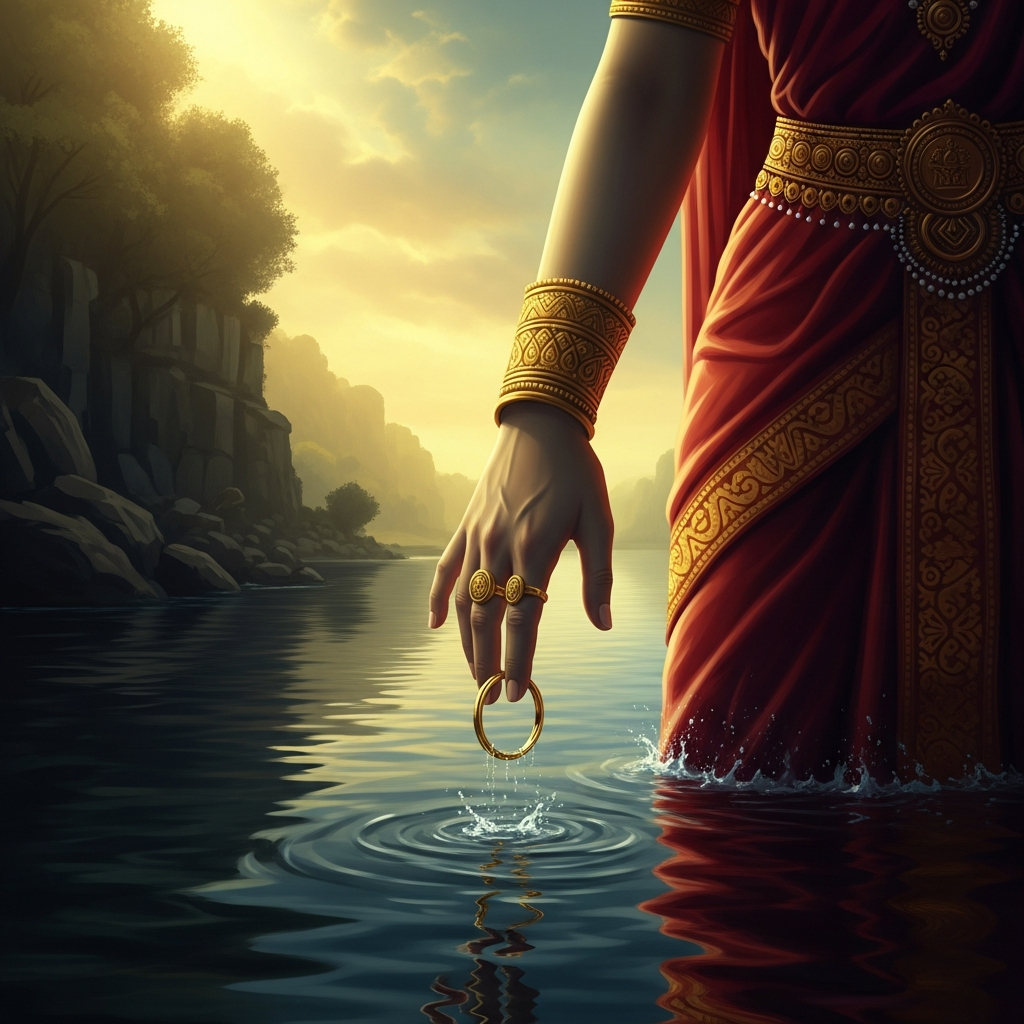
It is ordinary — the river crossing that pilgrims and travelers make a thousand times in a hundred epics, the ford that leads from the forest into the kingdom, from the world-outside-time into the world-of-ordinary-consequence. She trails her hand in the water. It is a day of extraordinary summer heat and the water is cold against her fingers and she has been traveling and she is tired and she is not paying attention.
The ring slips. The current takes it before she knows it is gone.
She looks at her bare finger for a long time. The river continues in the direction rivers continue.
She arrives at the court of Hastinapura.
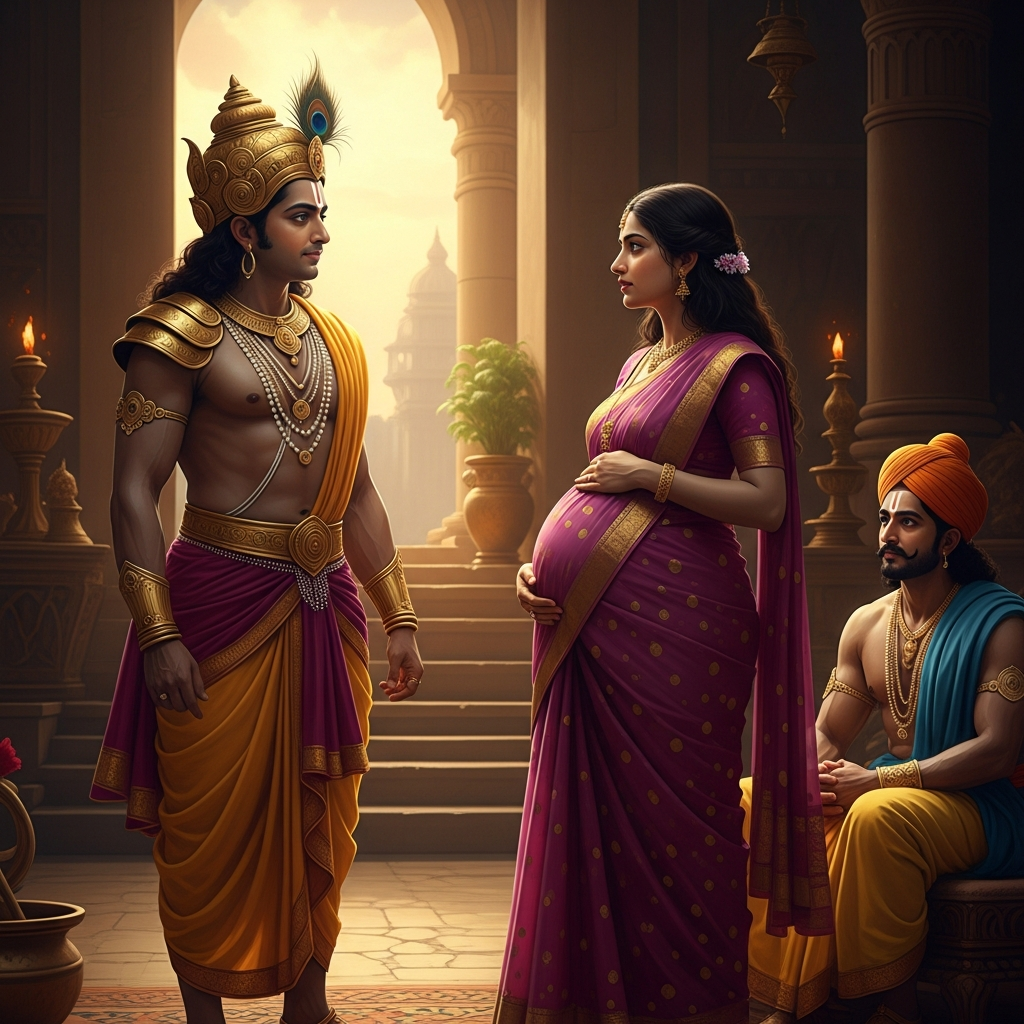
Dushyanta is on his throne in the assembly hall, surrounded by ministers and petitioners and the ordinary apparatus of kingship. She enters and looks at him across the hall and her whole body orients toward him the way a plant orients toward light, the involuntary alignment of someone in the presence of the person they think about when they are not thinking about anything.
He looks at her.
He is polite. He is a king who receives petitioners every day and is practiced at giving them his attention without giving them his time. He looks at her with the careful courtesy of someone who is about to hear a claim he will need to evaluate, and she watches his face for the thing that should be behind the courtesy — the recognition, the shift in his eyes when they find what they remember — and it is not there. His face is attentive and blank. He does not know her.
She tells him. She tells him everything: the hermitage, the deer, the garden, the days they talked, the gandharva marriage in the clearing, the ring he gave her. She tells him she is carrying his child. She tells him the ring is gone — stolen by a fish in a river crossing, she thinks, because what else takes a ring from a moving finger in a current?
He listens with the same careful courtesy he has been giving her from the beginning.
He does not remember.
She has no witnesses. The hermitage marriage had no priest and no formal witness, only the gandharva form, only the deer in the clearing. Her foster sisters are back at the hermitage. Kanva is on pilgrimage. The ring is in a fish. She is standing in the assembly hall of the man whose child she is carrying, and he is looking at her from behind a distance she cannot cross, with no proof to cross it with.
The court is silent. The ministers look at the floor. The king looks at the woman in front of him with an expression that is genuinely, deeply sorry — not for anything he has done, because he has no memory of doing anything, but sorry that she is clearly in distress and that he cannot help her.
This is the cruelty of the curse, its specific texture: it does not make him cruel. It makes him simply absent. The man who promised to send for her is gone; the man who remains is a good king who has never met her and cannot be blamed for not remembering something that has been erased. The love that built a life in her body — that she has been carrying for months, that she tends with the same careful attention she gave the deer in the hermitage — is real in her and does not exist in him, and there is no social or legal mechanism to bridge that gap.
The fish is eating its way through some part of the river. Inside the fish is a gold ring with a royal seal.
There is nothing more to be done today. She withdraws.
The fisherman finds the ring in the belly of a carp.
He brings it to the palace because it has the king’s seal on it and the king’s seal on a ring found inside a fish is a situation that requires reporting. Dushyanta holds the ring and looks at it and the ring looks back at him and something that has been sealed moves.
He remembers.
The recognition is total and immediate — the hermitage, the garden, the deer that pressed against her ankles, the particular quality of her attention when she was explaining her own origins, the clearing, the marriage, the ring sliding from his own finger onto hers. He remembers all of it in the time it takes to look at a piece of gold, and with the memory comes the understanding of what he did in the hall, what he said, what her face looked like when he said it.
He finds her. The texts differ on where — some say she has been taken by her celestial grandfather into a middle realm, cared for until the curse lifted; some say she is waiting at the edge of the kingdom. He finds her with the child, a boy of extraordinary force and beauty who has been spending his time in the forest catching young lions and prying open their jaws to count their teeth.
The boy’s name will be Bharata. The dynasty will be named for him. The epic that contains this story will take his name as its title.
Kalidasa’s version — the Abhijnanasakuntalam, the Recognition of Shakuntala — is considered the finest Sanskrit play ever written. Goethe read a German translation and wrote: “If you want the flowers of spring and the fruits of autumn, if you want the heavens and earth in a single name — I say Sakuntala, and all is spoken.” He was not wrong about the play’s achievement. He was perhaps not thinking carefully enough about what the play is actually about.
Shakuntala’s story is about the cruelty of forgetting and the insufficiency of proof. A love so real it founded the dynasty that the entire Mahabharata concerns — that produced Arjuna and Bhishma and the war and the Gita and everything downstream — was nearly destroyed by a fish and a ring and a moment of inattention at a hermitage gate. The cosmic machinery that produced the Bharata dynasty depended on a fisherman’s knife.
She never entirely forgives him. The texts don’t say this outright. But in Kalidasa’s version, the reunion scene has a particular quality: she receives him back without coldness and without the full warmth of before, the way someone receives the return of something they had given up on — grateful, yes, and also changed by the giving up. The deer at the hermitage pressed against her ankles. The ring is in his hand. The boy is catching lions. Everything is restored.
The restoration is real. So is the distance it crossed to get there.
Scenes
Dushyanta arrives at the forest hermitage of the sage Kanva on a hunting detour and finds it empty of all but a young woman tending the deer
 Generating art…
 Crossing the river on the journey to Dushyanta's court, Shakuntala trails her hand in the water
 Generating art…
 She stands in Dushyanta's court, visibly pregnant, and watches his face for the recognition that does not come
 Generating art…
 Echoes Across Traditions
Entities
- Shakuntala
- Dushyanta
- Durvasa
- Kanva
- Bharata
Sources
- *Mahabharata*, Adi Parva 62-69 (Shakuntala Upakhyana, BORI critical edition)
- Kalidasa, *Abhijnanasakuntalam* (~4th-5th century CE)
- Barbara Stoler Miller, *Theater of Memory: The Plays of Kalidasa* (1984)
- Wendy Doniger, *The Hindus: An Alternative History* (2009)
- A.K. Ramanujan, *The Interior Landscape* (1967)