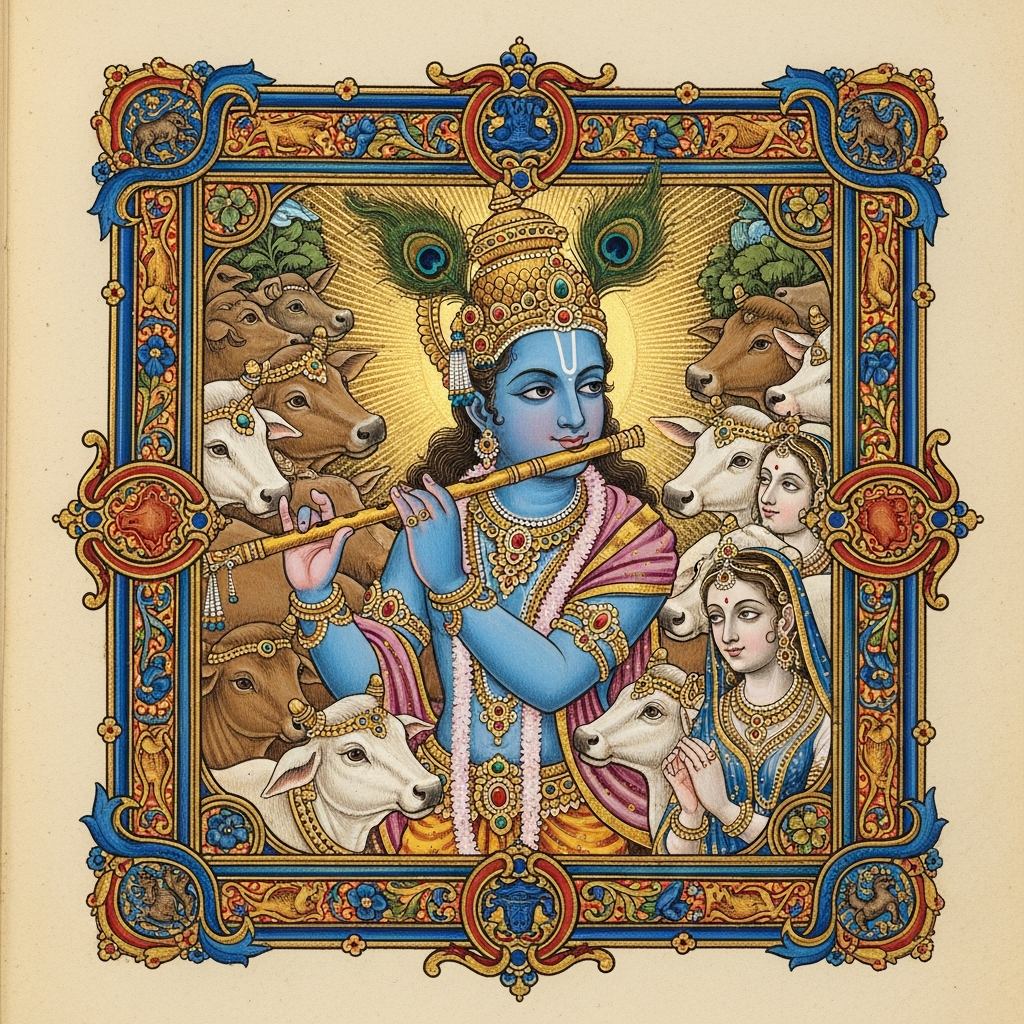
Draupadi's Disrobing
Mythic Time · Mahabharata, Sabha Parva ~400 BCE-400 CE · Hastinapura — the great assembly hall of the Kuru court
Contents
Draupadi, wife of the five Pandavas, has been staked and lost in a dice game. Duhshasana drags her by the hair into the Kuru court and begins pulling at her sari while every elder in the hall watches in silence. She raises her hands from the cloth and prays to Krishna. The sari does not end. Everything that follows — the eighteen days of Kurukshetra — begins here.
- When
- Mythic Time · Mahabharata, Sabha Parva ~400 BCE-400 CE
- Where
- Hastinapura — the great assembly hall of the Kuru court
The dice fall and the world ends, slowly, over the course of an afternoon.
Yudhishthira sits across from Shakuni, his uncle-in-law, in the great assembly hall of Hastinapura. The hall is new — Duryodhana built it in a fit of envy after visiting the Pandavas’ palace at Indraprastha, which Maya the architect raised from solid air, where the floors were water and the water looked like floor. This hall is Duryodhana’s answer, massive and overlit, packed with the great men of the Kuru dynasty: Bhishma the patriarch, Drona the teacher of weapons, Kripa the preceptor, Karna the sun-touched archer, the blind king Dhritarashtra on his throne.
Shakuni has loaded dice. He has loaded them for years, waiting for this room, this moment, this man.
Yudhishthira, who is called Dharmaraja — the king whose nature is righteousness — should not be gambling. Everyone in the hall knows he should not be gambling. He has a compulsion that the texts don’t explain and don’t apologize for: the eldest Pandava, who is the son of Yama the god of justice, cannot refuse a dice invitation. He stakes his kingdom, Indraprastha. He loses it. He stakes his treasury, his armies, his palace. He loses them. He stakes his brothers, one by one, with a specificity that the Mahabharata records in full — Nakula first, then Sahadeva, then Arjuna, then Bhima. He loses them all.
And then, in the silence between one throw and the next, Shakuni says: you have one stake remaining.
There is a legal question the Mahabharata plants here and never fully resolves.
A man who has already staked himself and lost — does he retain the right to stake others? Yudhishthira has already gambled away his freedom. He is now a slave of Duryodhana’s court. Can a slave bet a wife? The question is not merely philosophical. Every man in the hall is a legal scholar. Bhishma, who knows more about dharma than almost any living creature, is sitting thirty feet from Yudhishthira. Drona, who trained the greatest warriors of the age, is sitting beside him. The blind king Dhritarashtra, whose entire reign is a study in what happens when a father lets love deform his judgment, sits on the throne above them all.
None of them speak.
Yudhishthira says her name: Draupadi. His queen. The daughter of Drupada, king of Panchala, who was born from a sacrificial fire and grew into the most accomplished and formidable woman in the epic. The woman who married five brothers simultaneously — a situation the gods themselves arranged, the karma of a previous life — and ruled Indraprastha with a mind sharp enough to embarrass Duryodhana in her own house. She is not in the room. She does not know she has been staked.
The dice fall.
Duryodhana sends Vikarna first — his younger brother, who will later be the only voice of dissent in this hall. Vikarna goes to the women’s quarters and comes back alone. He will not drag her. Duryodhana is not surprised. He sends Duhshasana.
Duhshasana is the one who will do things Duryodhana imagines but cannot bring himself to do personally. He walks to the women’s quarters and tells Draupadi she is lost, she is a slave, she must come to the hall. She is in the middle of her monthly period — this detail the text preserves because it matters, because it compounds the violation, because by every code of the culture Duhshasana observes she should not be touched. She is in one garment. She refuses.
He drags her by the hair.
She comes into the assembly hall of Hastinapura with her hair loose and her hands on her sari and her question still on her lips: I ask the dharmic question. Yudhishthira lost himself before he staked me. A man who has no freedom cannot bargain away another’s. Answer me. Is the bet legal?
The hall is silent.
She turns to each of them in turn.
She faces Bhishma — the grandfather of the dynasty, who took a vow of celibacy to protect the throne and has kept it for a century, whose word has settled every question of honor for two generations. Bhishma’s answer is one of the most famous non-answers in Sanskrit literature: the question is very subtle, he says. Dharma is very difficult. He cannot say.
She faces Drona. Drona, who taught Arjuna to shoot arrows through shadows, who knows the texts of dharma as well as the texts of war. Drona is silent. He eats Duryodhana’s salt. He owes the Kuru court his position and his son’s education and thirty years of patronage. He does not speak.
She faces Dhritarashtra. The blind king, whose blindness the text treats as both physical fact and moral condition — a man who has spent his entire reign not-seeing what his son is doing, who loves Duryodhana the way weak men love the parts of themselves they cannot control. He does not speak.
The assembly of the greatest men in the world answers the question of whether a woman’s dignity can be legally stripped by her husband’s dice loss with absolute collective silence.
Duryodhana bares his thigh and looks at her and says: sit here.
Duhshasana begins to pull.
She is holding the sari with both hands. The cloth is wound many times, the way women of her station and era wore it — elaborate, layered, crimson and gold, the clothes of a queen in her own court. She holds it. Her hands are not enough. He has the full strength of a Kuru prince and the full permission of a court that has decided not to see, and he is pulling with both arms and the cloth is moving despite everything she can do.
Draupadi stops trying to hold the cloth.
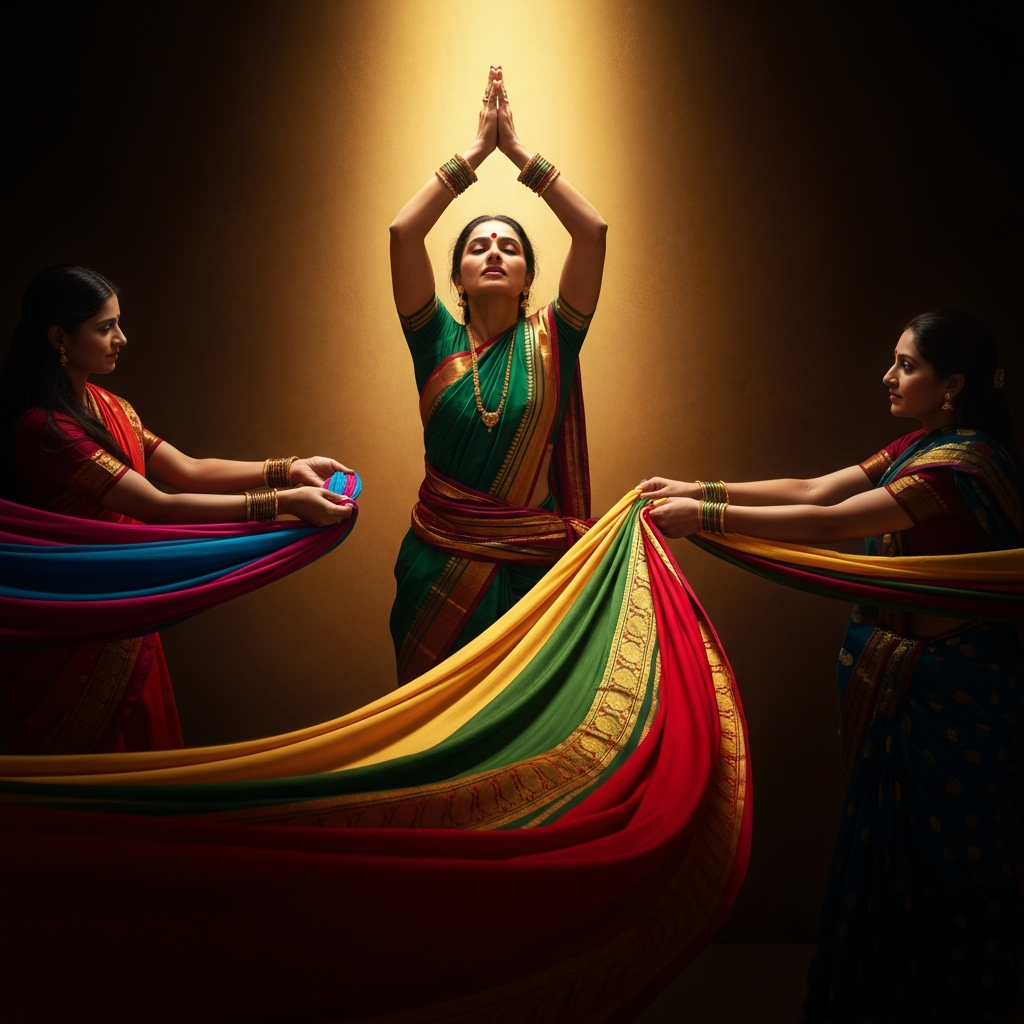
She raises both hands. The gesture is precise: palms open, arms extended upward, the posture of a devotee who has given up all other recourse. She calls on Krishna — who is in Dwaraka, far to the west, not present, not watching in any physical sense. She calls not as a woman hoping someone will intervene but as a devotee who has reached the end of her own strength and is releasing herself entirely into the hands of the one she trusts.
Govinda, she says. Dwaraka-natha. You are the shelter of the shelterless. I have let go. I am yours.
The sari does not end.
Duhshasana pulls and cloth comes and cloth comes and cloth comes — yard after yard, color after color, the pile of silk growing at his feet until it reaches his knees, until his arms are burning, until the men nearest him are pulling it out of the way to make room for more — and the garment does not end. There is no miracle announced, no divine light, no Krishna appearing in the hall. There is only more cloth than the universe should contain, coming and coming, and a woman standing in the middle of it with her hands raised and her face composed and her eyes elsewhere.
Duhshasana finally lets go. He sits down in the pile of silk, winded, defeated by a garment.
In the aftermath of the miracle, three things happen.
Bhishma and Drona sit in the hall knowing what they permitted and say nothing. Dhritarashtra, alarmed enough to act now that the cosmos has visibly intervened, calls Draupadi to him and offers her boons — frees her husbands, returns their kingdom and their weapons and their wealth. He is restoring what should never have been taken, and he does it not from justice but from fear of divine displeasure, which is not the same thing at all.
And Draupadi, when she is given the freedom to choose her own boons, does not ask for punishment of Duryodhana. She does not ask for the disgracing of the men who watched. She asks for her husbands’ freedom and their weapons, and that is all, because the war she is planning does not require her to ask for it — it has already been set in motion by what this hall permitted.
Yudhishthira has been returned his freedom. He is, impossibly, invited to gamble again — Dhritarashtra has given everything back and Duryodhana immediately arranges another game, because Duryodhana is the kind of creature who takes what the divine has just returned. The second game’s stakes are different: the losers go into thirteen years of exile, twelve in the forest and one incognito, and then the kingdom is restored. The Pandavas lose again.
But before they go into the forest, Draupadi speaks.
She speaks to Bhima, who is weeping with rage. She speaks quietly and at length. She names every elder who sat in silence. She names what was done to her hair. She names what Duhshasana’s hands touched. She says: Remember. When the war comes — remember.
Bhima remembers.
The Sabha Parva — the Book of the Assembly — records what the Mahabharata considers the actual cause of the war. Not the land dispute. Not Duryodhana’s pride or Yudhishthira’s compulsion or any of the dynastic machinations that surround them. The cause is the question Draupadi asked in the hall, the question that received no answer, and the silence of every wise man present.
She saved herself. Krishna provided the cloth, but she provided the prayer, which is to say: she provided the release of her own grip. The miracle required her to stop protecting herself. The theology is exact — bhakti is not passive, but it requires the surrender of the self-sufficient position, the moment when the devotee acknowledges that their own hands are not enough.
The eighteen-day war at Kurukshetra — the longest, largest, most philosophically documented battle in world literature — is downstream of Duhshasana’s arms giving out in a hall full of silent men. Every death at Kurukshetra, every arrow Arjuna fires and every chariot wheel Bhima shatters, is an answer to Draupadi’s question. The hall gave no answer. The war did.
Scenes
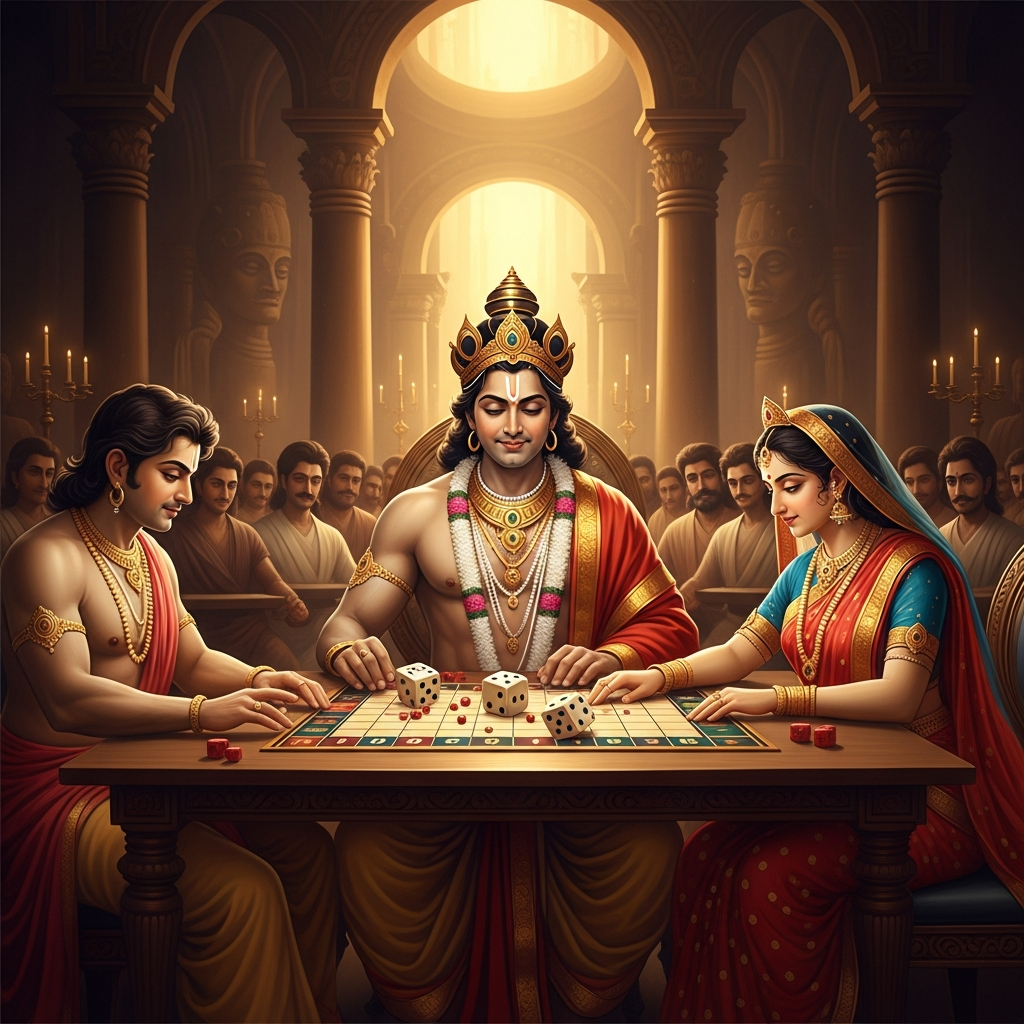
Yudhishthira sits at the dice board in the Kuru assembly hall, each stake lost, his brothers now staked and lost, and finally Draupadi — his queen, their shared wife — placed on the table by a man who has already lost himself
 Generating art…
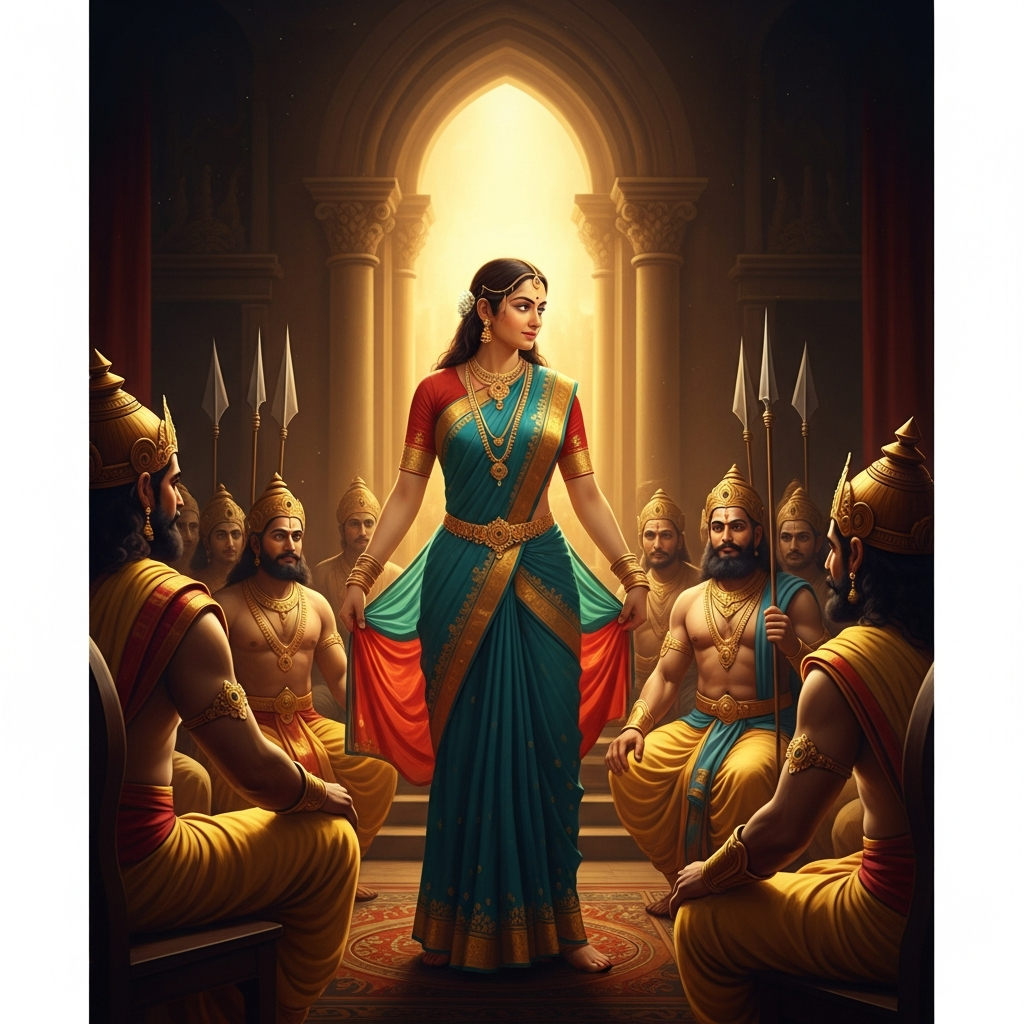
 Draupadi stands in the assembly and turns to Bhishma, to Drona, to the blind king Dhritarashtra
 Generating art…
 She releases the cloth
 Generating art…
 Echoes Across Traditions
Entities
- Draupadi
- Yudhishthira
- Duryodhana
- Duhshasana
- Bhishma
- Krishna

Sources
- *Mahabharata*, Sabha Parva 60-68 (BORI critical edition)
- Iravati Karve, *Yuganta: The End of an Epoch* (1969)
- Wendy Doniger, *The Hindus: An Alternative History* (2009)
- Alf Hiltebeitel, *Rethinking the Mahabharata* (2001)
- Chitra Banerjee Divakaruni, *The Palace of Illusions* (2008)