Combat Profile
Cosmic Revelation
Krishna unveils the true nature of reality and existence itself, granting perfect knowledge of past, present, and future to all who witness his divine form.
Divine Play
All of Krishna's actions exist simultaneously across infinite timelines and realities as expressions of cosmic lila, allowing him to act with omniscient grace and transform any situation through love and wisdom.
Krishna’s birth narrative is strikingly parallel to Christ’s. The tyrant King Kamsa received a prophecy that his sister Devaki’s eighth child would destroy him (Bhagavata Purana 10.1). Kamsa imprisoned Devaki and her husband Vasudeva and killed their first six children. When Krishna (the eighth) was born, Vasudeva smuggled him out of the prison at night — the guards fell asleep, chains fell away, doors opened by themselves — and brought him to the cowherd village of Gokul, where he was raised by foster parents Nanda and Yashoda (Bhagavata Purana 10.3). Kamsa, learning a child had escaped, ordered the massacre of all newborns in the region.
Compare: Jesus was born while Herod ruled; a prophecy warned of a newborn king; Joseph was warned in a dream to flee to Egypt; Herod ordered the massacre of all male infants in Bethlehem (Matthew 2:13-18). The parallels — tyrant, prophecy, divine birth, smuggled infant, massacre of innocents — are extraordinary.
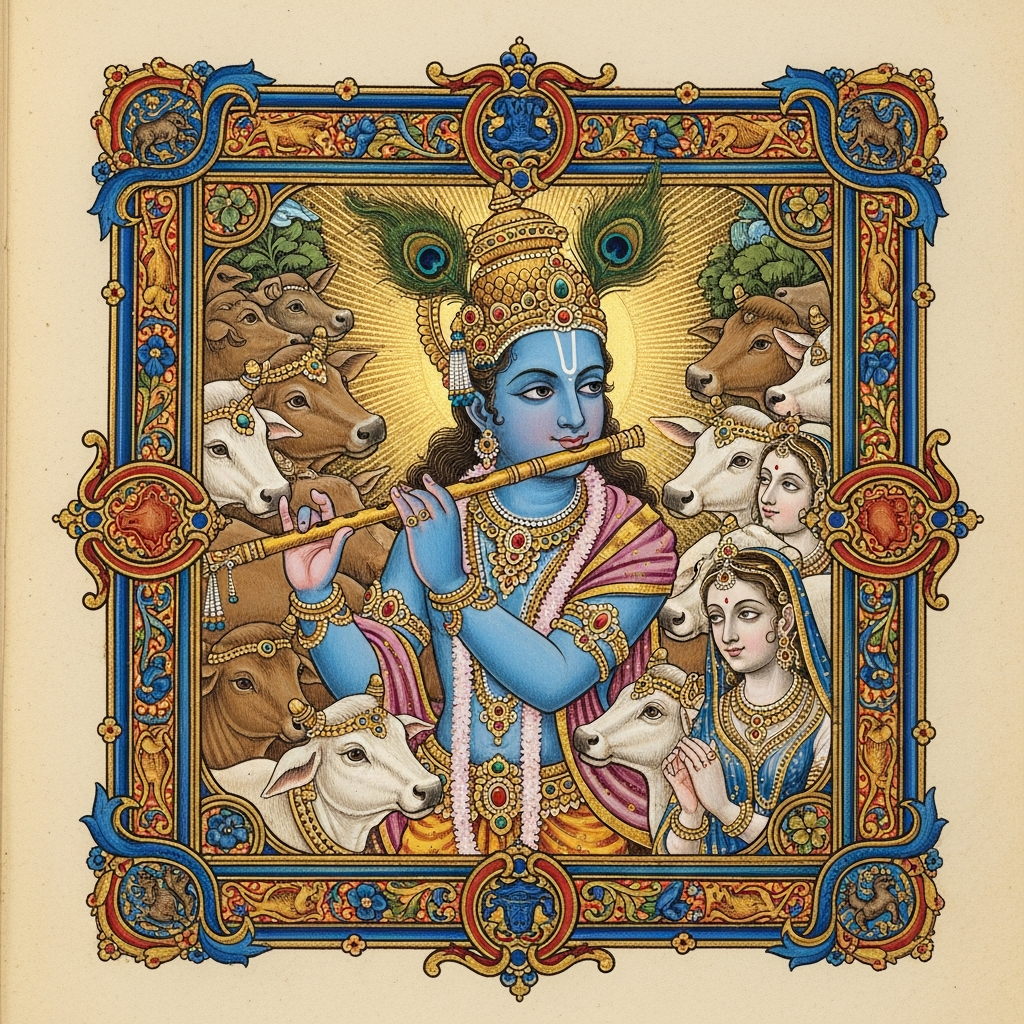
As a child, Krishna was mischievous, playful, and irresistibly charming — stealing butter, playing the flute, enchanting the gopis (cowherd women) (Bhagavata Purana 10.8-11). This phase (Bala Krishna) represents the divine as accessible, intimate, and joyful. As an adolescent and young man, he was the lover of Radha and the gopis — divine love expressed through human longing. As an adult, he was a warrior, diplomat, and philosopher who orchestrated the great Mahabharata war.
The Bhagavad Gita (“Song of God”) is his supreme teaching: on the battlefield of Kurukshetra, with two armies facing each other, the warrior prince Arjuna despairs at having to fight his own relatives (Bhagavad Gita 1-2). Krishna, serving as his charioteer, delivers a discourse on duty, the nature of the self, the paths to God, and ultimately reveals his Vishvarupa — his cosmic universal form, in which Arjuna sees all of creation, all gods, all beings, all time contained within Krishna’s body (Bhagavad Gita 11). Arjuna is overwhelmed: “If a thousand suns were to blaze forth all at once in the sky, that radiance might resemble the splendor of that great being” (Bhagavad Gita 11.12). Compare to the Transfiguration (Matthew 17:1-8), where Jesus reveals his divine glory to three disciples on a mountaintop — a moment of cosmic unveiling that overwhelms human perception.
“I am the beginning, the middle, and the end of all beings.” (Bhagavad Gita 10.20)
“I am the same to all beings. I have neither friend nor foe.” (Bhagavad Gita 9.29)
2 min read
Mahabharata, Bhagavad Gita, Bhagavata Purana, Harivamsa