Combat Profile
Vighnaharta
Ganesh removes all obstacles from the path of the supplicant and grants them assured success in their endeavors.
Siddhidata
All learning, writing, and new beginnings undertaken in Ganesh's presence gain divine blessing and clarity of purpose.
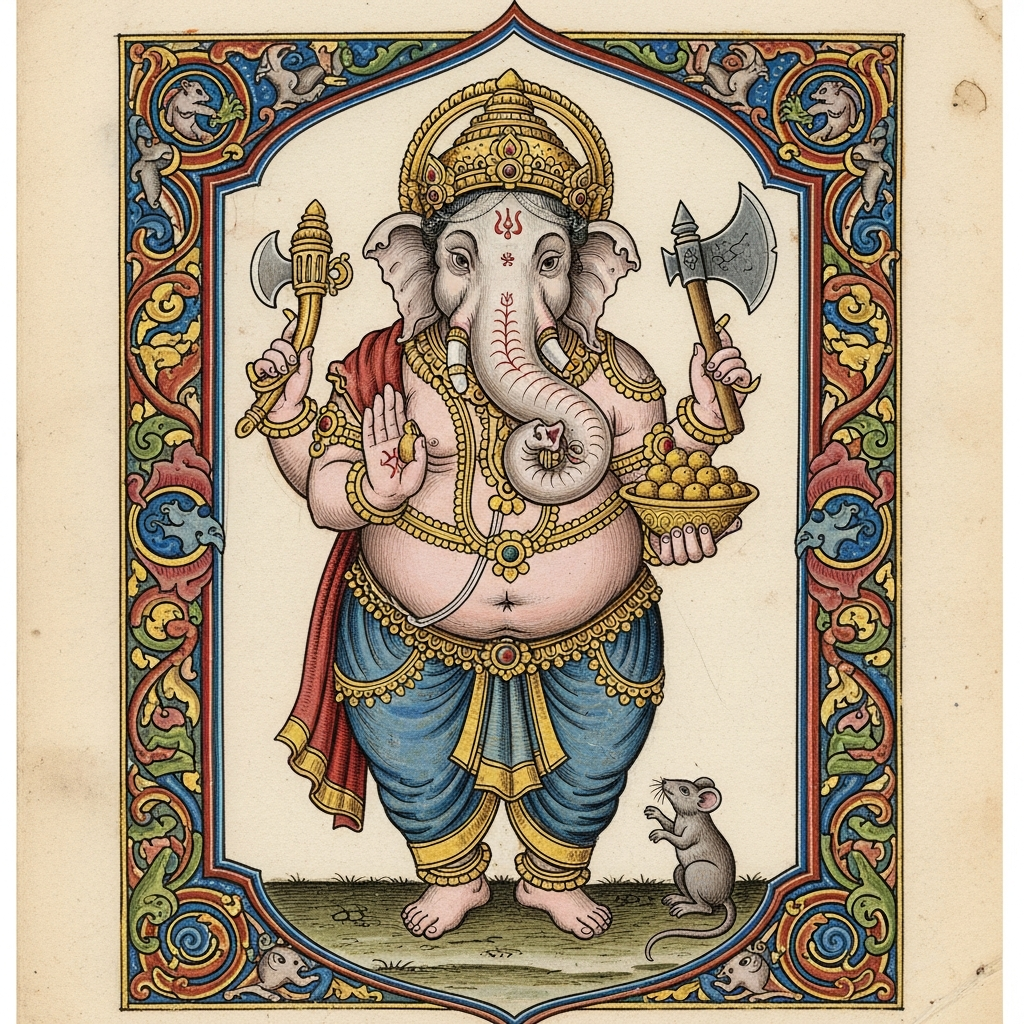
Ganesh is the elephant-headed god — the single most widely worshipped deity in Hinduism, invoked at the beginning of virtually every prayer, ceremony, journey, and written work (Ganesha Purana, Mudgala Purana). His origin: Parvati created a boy from the turmeric paste of her body to guard her door while she bathed. When Shiva returned home, the boy blocked his entry (not recognizing his father). Shiva, enraged, cut off the boy’s head. Parvati was devastated (Shiva Purana). To make amends, Shiva sent his followers to bring the head of the first creature they found sleeping facing north — an elephant. The elephant’s head was placed on the boy’s body, and Shiva restored him to life, declaring him the lord of all beginnings.
The symbolism: the elephant head represents wisdom (large brain), the ability to remove obstacles (an elephant clears any path), and patience. His broken tusk (he broke it off to use as a pen to transcribe the Mahabharata) represents sacrifice for knowledge. His large belly holds the entire universe. His mouse mount (Mushika) represents the ability of wisdom to penetrate the smallest spaces.
The parallel to the Abrahamic wisdom tradition is in the domain rather than the mythology: Ganesh presides over new beginnings after loss (his own death and rebirth), wisdom earned through sacrifice, and the principle that the divine meets you at the threshold of every new chapter.
1 min read
Ganesha Purana, Mudgala Purana, Shiva Purana