Combat Profile
Vedic Manifestation
Brahma speaks a verse from the Vedas to fundamentally reshape reality, creating new entities or restoring cosmic order
Creator's Omniscience
Brahma perceives all knowledge and sees the blueprint of creation, granting immunity to deception and perfect awareness of all cosmic workings
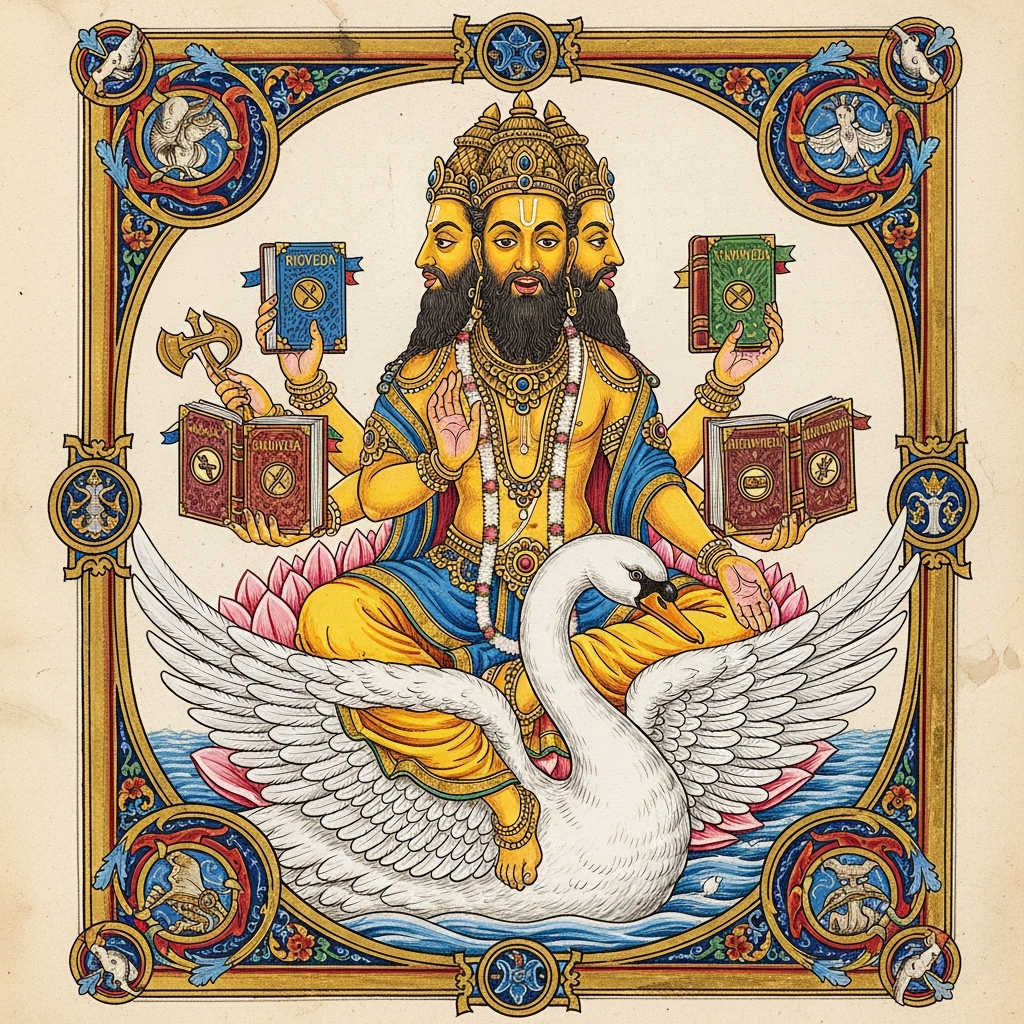
Brahma has four heads, each continuously reciting one of the four Vedas (Rig, Yajur, Sama, Atharva). He rides the swan Hamsa, which symbolizes the ability to discern truth from illusion, and holds the Vedas, a rosary (representing time), a water pot (representing creation), and a lotus. He is the cosmic architect who brought the universe into being.
The paradox of Brahma is that he is the least worshipped member of the Trimurti. There are only a handful of Brahma temples in all of India (the most notable at Pushkar, Rajasthan). The theological logic: creation is finished — Brahma’s primary work is done. Worship flows instead toward Vishnu (who sustains the world now) and Shiva (who will transform it). This parallels a subtle tendency in some Christian traditions where God the Father is the least “personally” worshipped of the Trinity — devotion gravitates toward Christ (the incarnate, relatable God) and the Holy Spirit (the active, present God).
“In the beginning, this universe was nothing but the Self… He thought, ‘Let me create the worlds.’” (Aitareya Upanishad 1.1)
1 min read
Rig Veda, Brahma Purana, Aitareya Upanishad