Combat Profile
Boon of Brahma
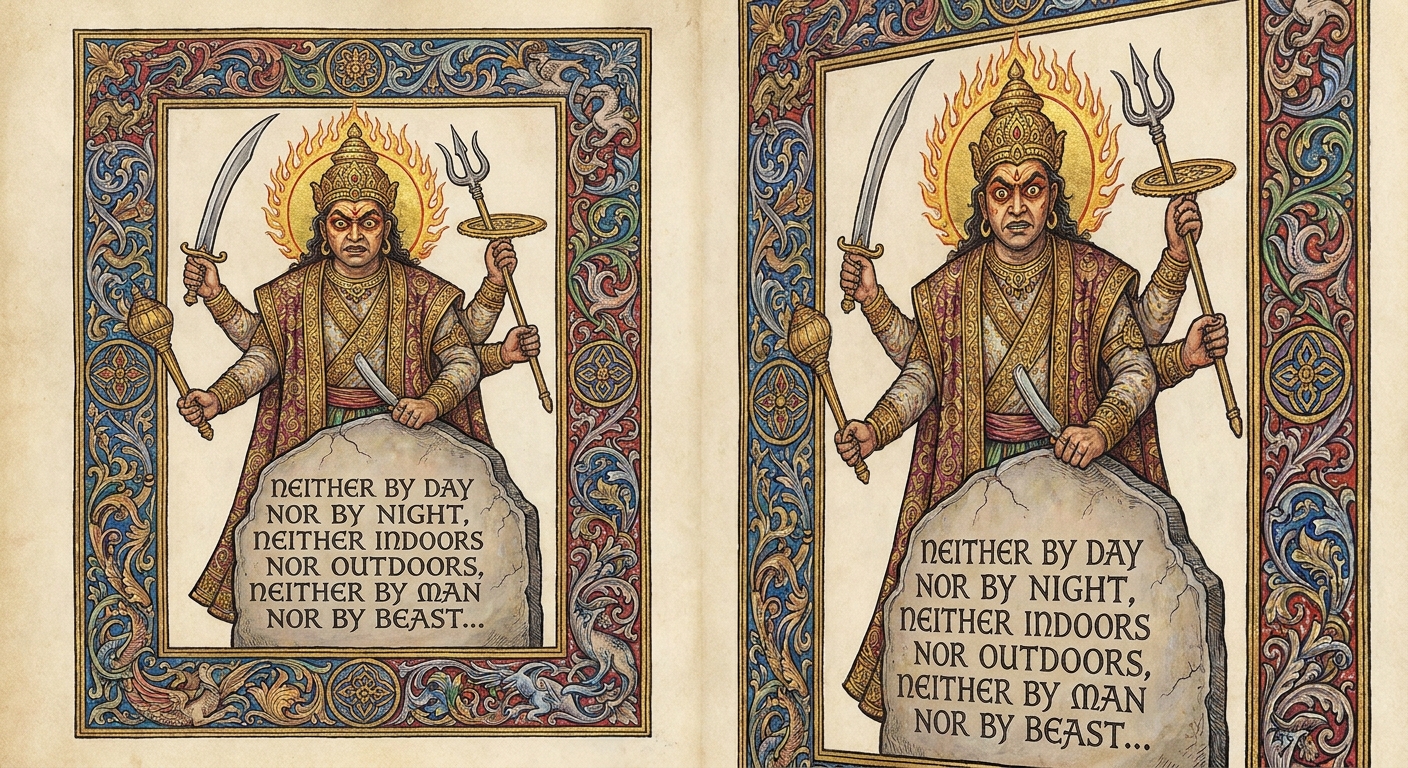
Hiranyakashipu is immune to harm from all beings except those neither human nor animal, day nor night, inside nor outside, rendering him nearly invulnerable until a loophole is exploited.
Asura Tyranny
All divine opposition to Hiranyakashipu's rule is suppressed; his cosmic authority paralyzes the natural order and compels even gods to yield or hide.
Hiranyakashipu’s boon from Brahma was a masterpiece of legalistic invincibility: he could not be killed by man or animal, inside or outside a building, during day or night, on the ground or in the air, by any weapon (Bhagavata Purana 7.3, Vishnu Purana 1.19). He declared himself God and demanded universal worship (Bhagavata Purana 7.2). His own son, Prahlada, refused — remaining a devoted worshipper of Vishnu despite torture, assassination attempts, and every form of coercion (Bhagavata Purana 7.4-7).
Vishnu incarnated as Narasimha (man-lion: neither man nor animal), appeared at twilight (neither day nor night), on the threshold of a doorway (neither inside nor outside), placed Hiranyakashipu across his lap (neither ground nor air), and disemboweled him with his claws (not a weapon) (Bhagavata Purana 7.8). Every clause of the boon was honored; every clause was circumvented.
This is one of the most theologically sophisticated demon-slaying narratives in any tradition. The parallel to Abrahamic theology is the principle that God defeats evil through creative covenant-keeping — not by breaking the rules, but by finding solutions within them. God does not violate his own word; he fulfills it in ways no one anticipated. The Incarnation itself follows this pattern: the law demanded death for sin, so God didn’t abolish the law — he fulfilled it by dying himself (Romans 8:3-4).
1 min read
Bhagavata Purana, Vishnu Purana