Combat Profile
Mahakali's Dance
Kali enters a transcendent frenzy, decimating all evil and ego-bound existence within her temporal domain, collapsing time itself around her enemies.
Destroyer of Illusion
Kali strips away maya and delusion from all she encounters, revealing the void beyond form and accelerating the inevitable death of all mortal things.
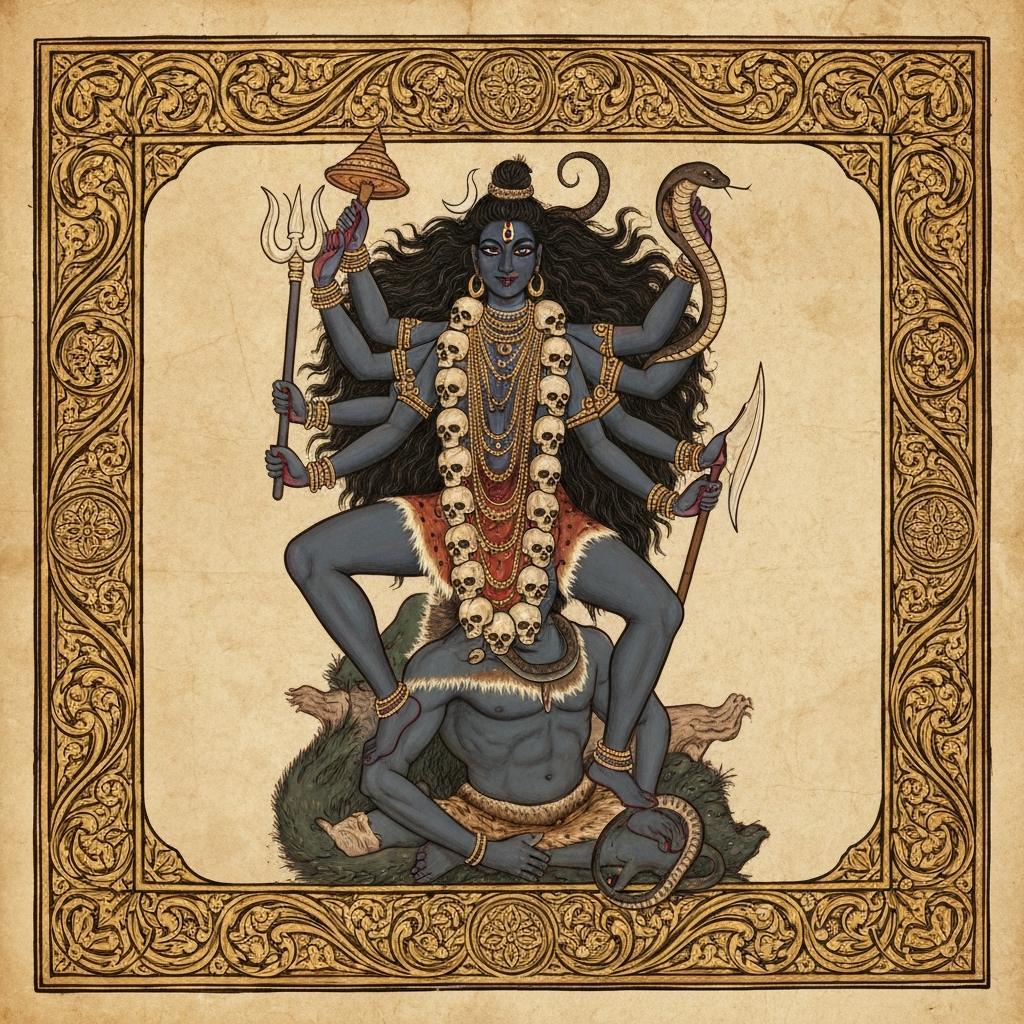
Kali is one of the most visually striking and most misunderstood figures in world religion. She is depicted with black or dark blue skin (representing the void beyond all form), wild disheveled hair, a necklace of severed heads or skulls (the ego-deaths of those she has liberated), a skirt of severed arms (the karmic actions she has cut away), a severed head in one hand (ego destroyed), a sword in another (discrimination/knowledge that cuts through illusion), and her tongue extended — either in bloodlust, shock at stepping on Shiva, or the gesture of feminine shame, depending on the tradition (Devi Mahatmya, Kalika Purana).
Kali is terrifying but not evil. She destroys ego, ignorance, and evil — not the righteous. Her destruction is liberation. She stands on Shiva’s prone body because Shakti (energy) is active while consciousness (Shiva) is passive (Devi Mahatmya); she IS the dynamic power of the divine. Devotees of Kali (and they are millions, particularly in Bengal and Assam) worship her as the most loving mother precisely because she will destroy everything false in your life to bring you to truth.
The parallel to Abrahamic theology is the wrath of God that serves justice — the Angel of Death at Passover (Exodus 12), the destroying angel of 2 Samuel 24:16, God’s fury against injustice in the prophets. Kali IS the principle that destruction of evil is an act of love. “The fear of the LORD is the beginning of wisdom” (Proverbs 9:10) — Kali embodies this paradox: the terrifying face of the divine is simultaneously the most compassionate.
1 min read
Devi Mahatmya, Kalika Purana, Mahabhagavata Purana