Combat Profile
Surya's Eye
Surya reveals all hidden truths and illusions within his gaze, burning away deception and granting perfect vision of past, present, and future.
Solar Sovereignty
Surya's presence restores vitality to all living things and grants divine authority; his light cannot be extinguished by shadow or darkness.
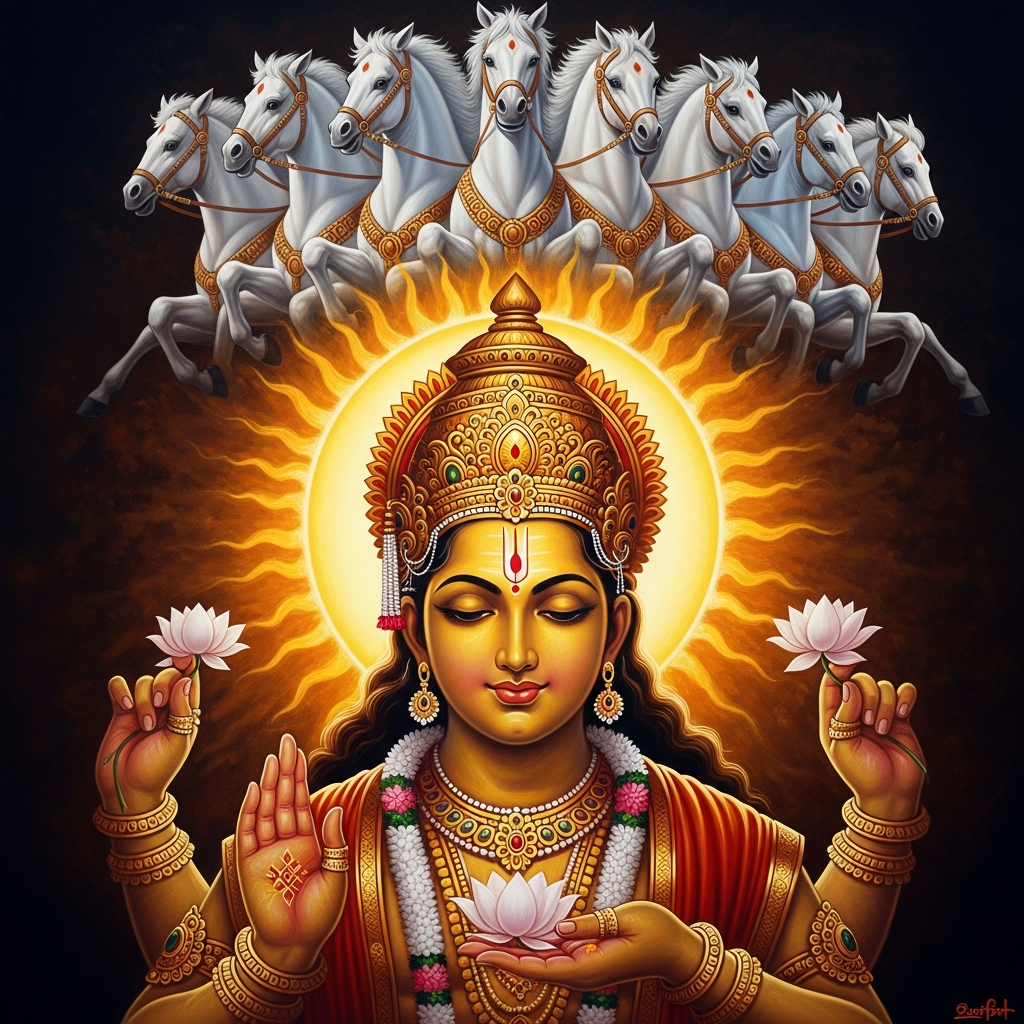
Surya is one of the most ancient Vedic deities, often invoked at dawn (Rig Veda 1.50). His chariot has one wheel, driven by Aruna (the charioteer of the dawn, who is also Garuda’s brother), pulled by seven horses representing the seven days, the seven meters of Vedic poetry, or the seven colors of light (Saurapurana 11). The Mahabharata recounts that his glow was so unbearable his wife Saranyu (Sanjna) abandoned him and left her shadow (Chhaya) in her place; Vishvakarma the divine architect ground down one-eighth of Surya’s radiance to make him approachable (Mahabharata 3.3).
Surya is the only Hindu deity who survived the medieval transition into temple worship as a primary cult object across India — the Konark Sun Temple (13th century, Odisha) is one of his greatest monuments. He is also the father of Karna in the Mahabharata, the tragic warrior born to Kunti before her marriage.
Cross-tradition parallels: Ra/Amun-Ra (Egyptian sun god whose solar barque parallels Surya’s chariot); Apollo/Helios (Greek sun god in a chariot); Shamash (Mesopotamian sun-and-justice god); Sol Invictus (Roman late imperial sun deity).
1 min read
Rig Veda 1.50, 1.115, Saurapurana, Mahabharata (Vana Parva), Aditya Hridayam