Combat Profile
Cycle's End
Destroys all corruption and evil forces, then initiates cosmic renewal and the return of Satya Yuga.
Eternal Judge
Perceives the spiritual state of all beings and judges righteousness with absolute cosmic authority.
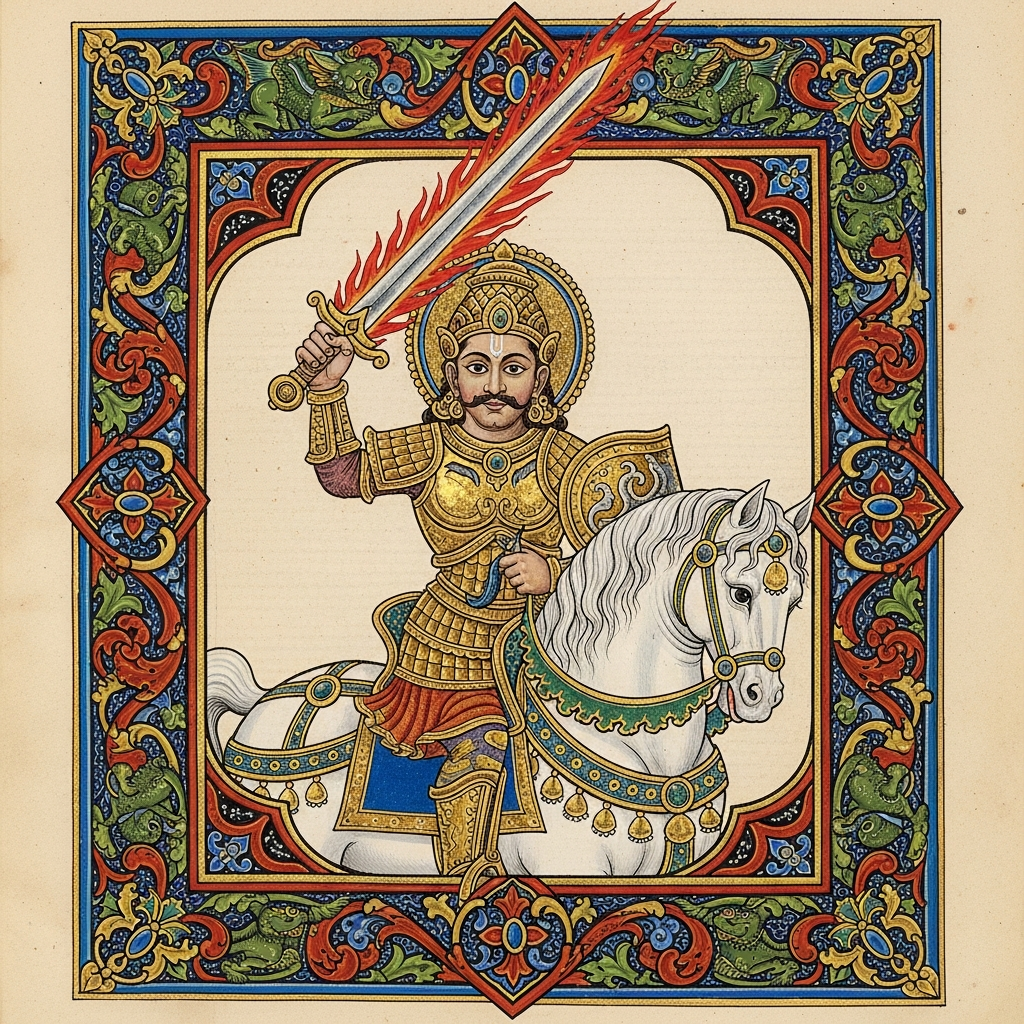
Kalki is the avatar who has not yet come. At the end of the Kali Yuga — the current cosmic age, characterized by spiritual darkness, moral degradation, shortened lifespans, and the decline of dharma (Bhagavata Purana 12) — Vishnu will incarnate one final time as Kalki. He will appear riding a white horse (named Devadatta, “God-given”) (Kalki Purana), carrying a blazing sword (or comet-like weapon), and will destroy the forces of evil, punish the wicked, and restart the cosmic cycle with a new Satya Yuga (age of truth and righteousness) (Vishnu Purana 4.24).
The parallel to Revelation 19:11-16 is among the most striking in all of comparative religion: “Then I saw heaven opened, and behold, a white horse! The one sitting on it is called Faithful and True, and in righteousness he judges and makes war… From his mouth comes a sharp sword with which to strike down the nations.” Both traditions envision a future divine figure arriving on a white horse with a weapon, destroying evil, and inaugurating a new age of righteousness. Zoroastrianism contributes a third parallel: the Saoshyant, a future savior born of a virgin, who will raise the dead and defeat evil at the end of time (Frashokereti). Three independent traditions, three eschatological riders.
“At the end of the Kali age… a Brahmana named Kalki will arise, endowed with great power, intelligence, and prowess. He will destroy all the mlecchas and thieves, and will restore righteousness on earth.” (Vishnu Purana 4.24)
1 min read
Kalki Purana, Vishnu Purana, Bhagavata Purana, Mahabharata