Shiva Drinks the Halahala
Mythic Time · Bhagavata Purana ~10th-12th century CE redaction · The shore of the Ocean of Milk, mid-churn
Contents
When the churning of the cosmic ocean throws up a poison that would unmake every world, no other god will drink it. Shiva walks down from Kailash, cups the halahala in his palm, swallows — and his wife Parvati closes her hand on his throat to stop the death from spreading further.
- When
- Mythic Time · Bhagavata Purana ~10th-12th century CE redaction
- Where
- The shore of the Ocean of Milk, mid-churn
The poison rises first.
A thousand years of churning, the Devas at the tail of the serpent Vasuki, the Asuras at his head, Mount Mandara spinning between them on the back of Vishnu’s tortoise — and what surfaces from the ocean before any wealth, any gift, any drop of nectar, is a black density that the eye cannot quite resolve. Halahala. The poison that has no antidote and no precedent. It does not float. It does not dissolve. It rises in a slow column out of the milky foam and begins to spread.
The first wisp drifts and a Deva drops where he stands. The Asuras at the serpent’s head, who have been breathing his exhalations for a millennium, choke and stagger backward into their own ranks. The churn slows. The rope falls slack. Vasuki’s eyes glaze.
The poison is going to reach the worlds.
Every god in attendance looks at every other god.
Brahma cannot drink it; the cosmos cannot lose its first cause. Vishnu, who could drink it, has the mountain on his back and is occupied. Indra is the king of heaven, the sustainer of the storm — too central to spend. Surya cannot drink it. Agni cannot drink it. Yama, the king of death, looks at the rising column and shakes his head: I am death, but this is something death does not know how to hold.
The conversation lasts the length of one of those silences in which everyone understands the answer and everyone hopes someone else will say it.
Then someone walks down the slope.
Shiva comes from Kailash.
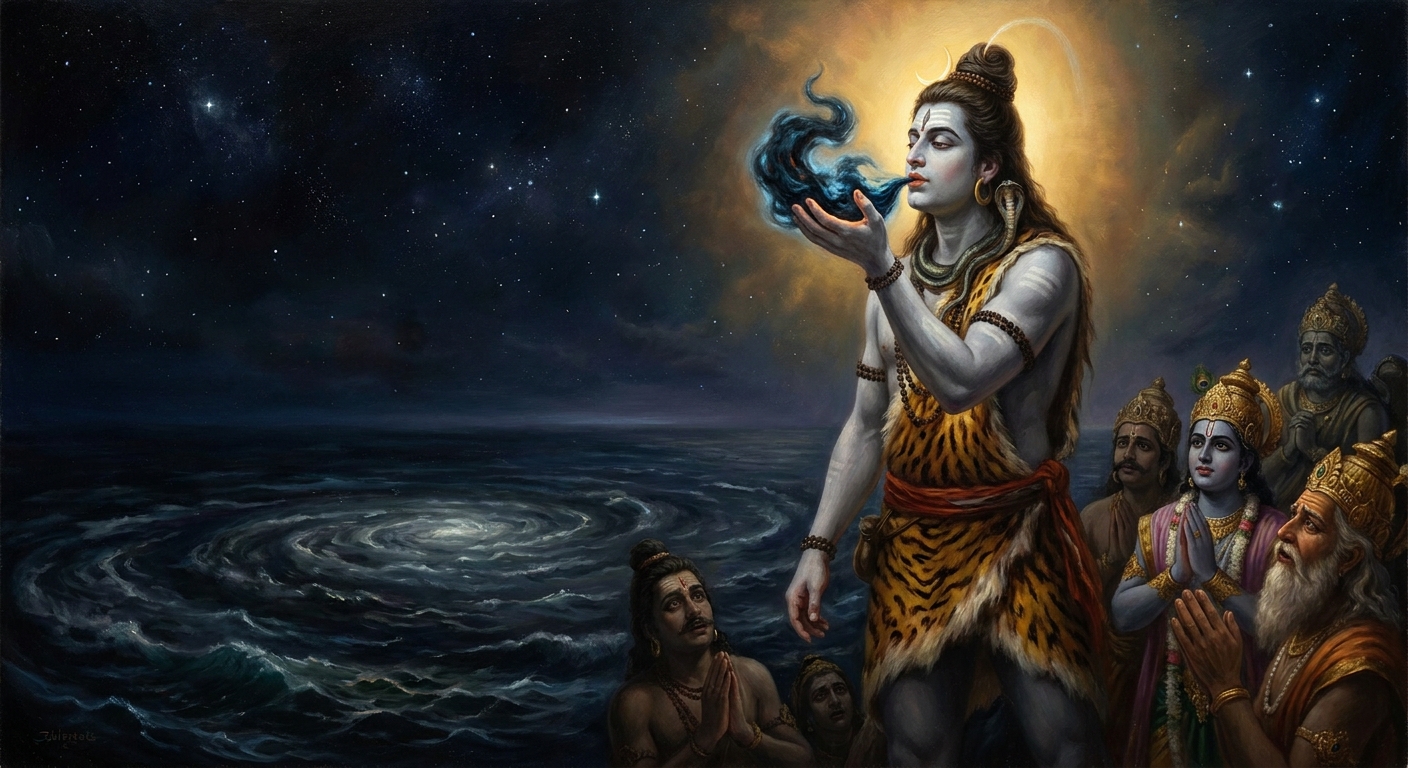
He walks barefoot across the foam at the ocean’s edge. His skin is ash-grey. His hair is matted and contains the headwaters of the Ganga in its coils. The crescent moon rests on his brow. His third eye is closed. He carries no weapon. He says nothing as he descends.
The Devas open a path for him. The Asuras open a path for him. Even at the height of their war, both sides have always understood Shiva to be standing somewhere else — the destroyer, the renunciate, the god who lives in cremation grounds and dances the Tandava — and both sides recognize that the substance rising from the ocean has called him by name and he has answered.
Parvati comes with him, half a pace behind. She does not try to stop him. She has known what he would do since the column began to rise. She is not here to argue. She is here to watch — and, when the moment comes, to act.
Shiva reaches the shoreline. He kneels. He lifts the halahala in his cupped palms.
The poison in his hands is heavier than rock.
It moves like dense oil. It is so cold it burns. The Devas standing at the rope of Vasuki feel their own breath stop watching him hold it. He looks at it for a moment — not to summon courage, the texts insist; he is not summoning courage; he is simply seeing the thing he is about to drink, paying it the respect a guest pays the host’s offering before accepting — and he lifts the halahala to his mouth.
He drinks.
The Bhagavata Purana is exact about this: he does not gulp. He does not perform. He swallows the poison the way an ascetic swallows river water during a long fast — with the attention of a body that has long since stopped distinguishing what it is given. The halahala goes into his mouth and starts down his throat.
Parvati moves.
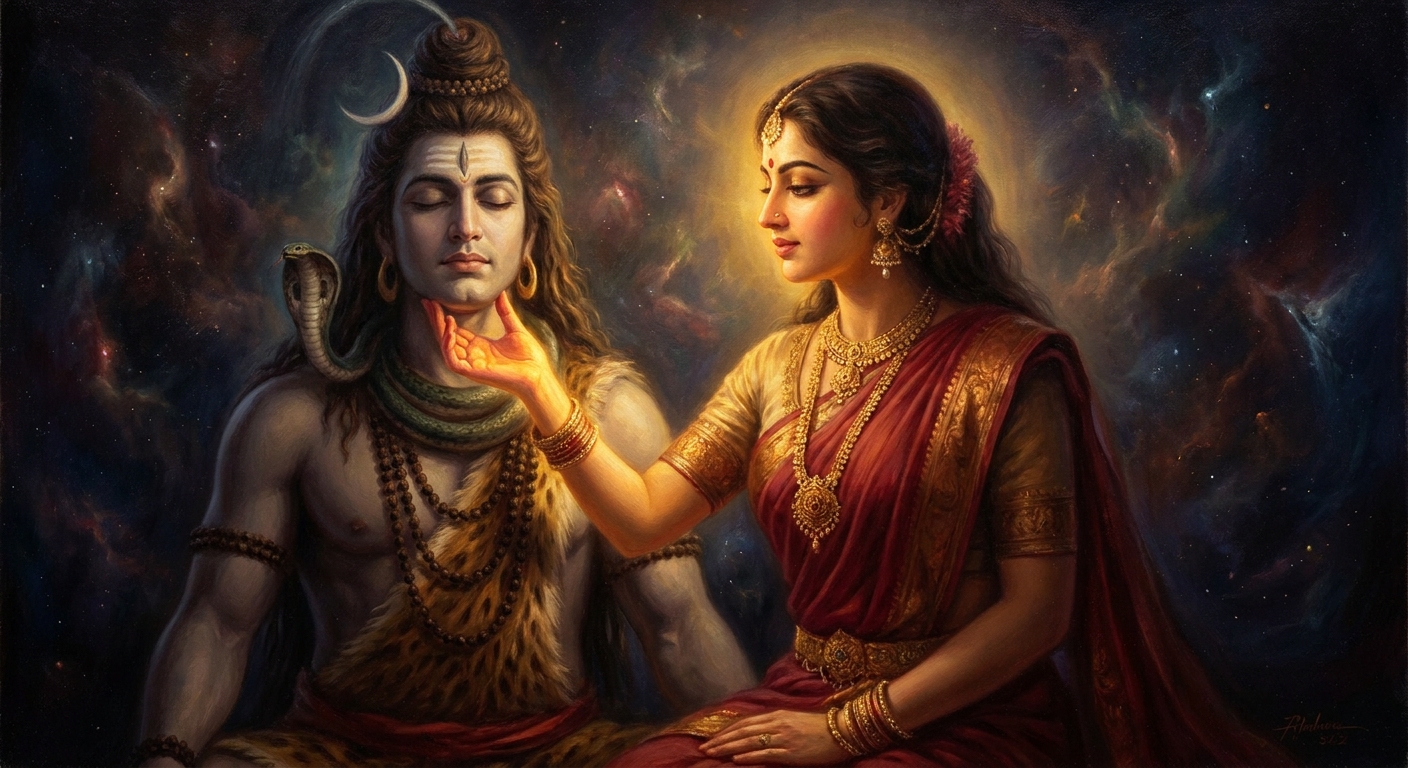
She closes her hand on his neck.
Five fingers. A grip that is not quite a strangulation, not quite a caress — something more precise, the grip of a wife who knows her husband’s anatomy as her own and is now using that knowledge to hold a substance in place. The halahala has descended to the level of his throat. Her hand catches it there.
It cannot go down. If it descends into his body, the poison reaches every world Shiva contains — and Shiva, the destroyer, contains many. It cannot come back up. If he spits it onto the foam, the cosmos that has been spared inhales it and ends.
She holds it at his throat.
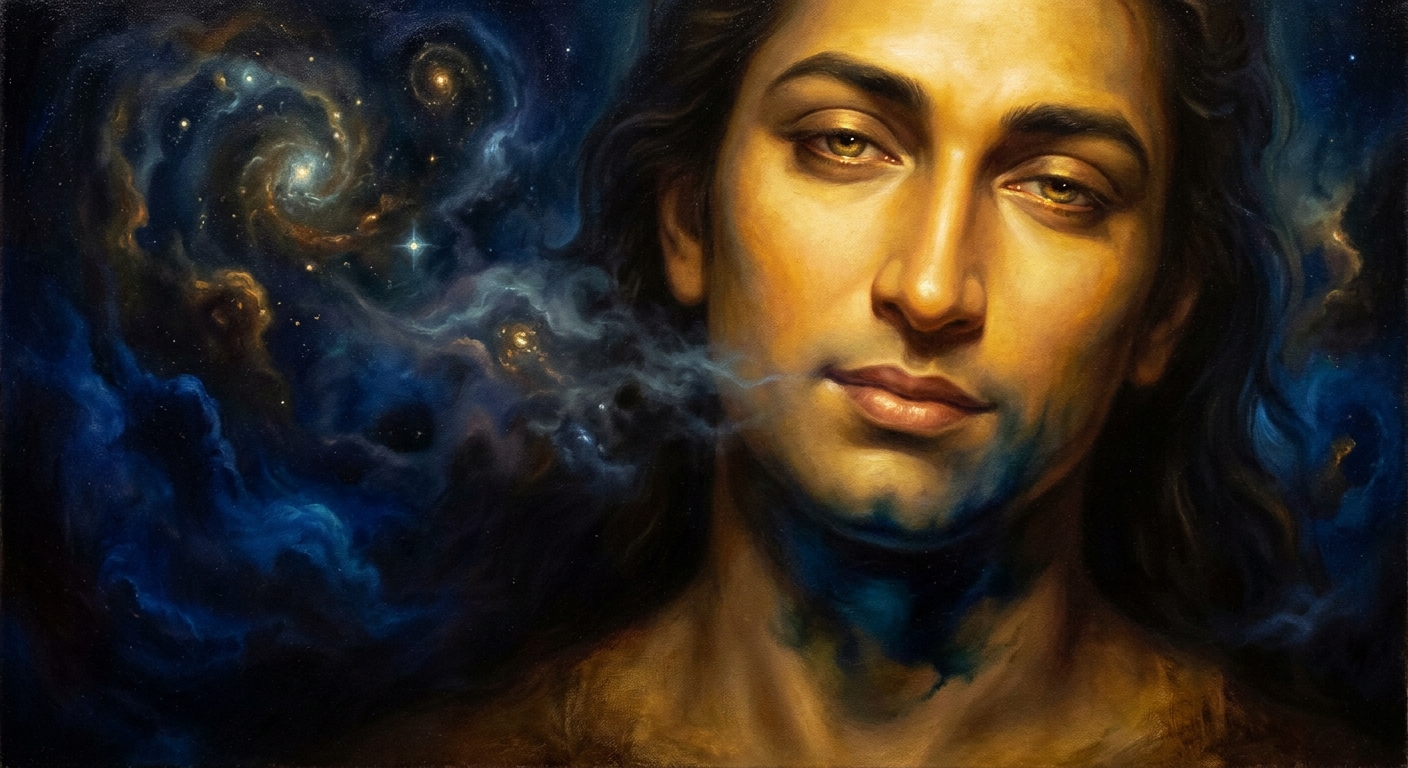
The skin beneath her fingers darkens. First a violet bloom, like a bruise that has just bloomed. Then indigo. Then the deep cobalt the Puranas call neela — a blue so saturated it is almost black, the blue of a thunderhead’s underside, the blue of the deepest part of a peacock’s tail. The pigment travels the width of his throat from one collarbone to the other and stops at the line her hand has set.
Shiva breathes. The cosmos breathes. The Devas at the rope, the Asuras at the serpent’s head, the Kurma beneath the mountain, the gods on the slopes — every conscious being from Brahma’s perch downward exhales at the same instant.
The halahala has been held.
Shiva opens his eyes.
He places one ash-coated hand over Parvati’s. He does not pry her grip away. He does not need to — the poison has localized itself, found its prison in the muscle and the skin of his neck, and the worlds have been spared. Her hand will let go in a moment. The hand will let go. The blue will not.
He stands up.
He nods, once, to the gathered Devas — neither benediction nor reproach, simply acknowledgement that the work has been done — and he turns and walks back up the slope toward Kailash. Parvati walks beside him. Neither of them looks back at the ocean. The churn behind them resumes its motion. The Asuras shake the venom off their hands and pick up Vasuki’s head again. The Devas adjust their grip on the tail. The labor continues.
Inside the next thousand years, the wealth will rise. Lakshmi will rise. The amrita will rise. The cosmos will be saved a second time, more spectacularly, and the priests will compose hymns to those gifts.
But the gift that came first was the one nobody hymns. A god walking down a slope. A handful of darkness lifted to a mouth. A wife’s hand closing on a throat. The cosmos saved before the cosmos noticed.
Hindus call him Nilakantha — the Blue-Throated — and the name has outlasted every other epithet the Puranas tried to attach to him. The destroyer. The lord of yogis. The dancer of the Tandava. All of these have their hymns and their festivals. None of them is the name a worshipper says first when she looks at his throat. The blue mark is the resume. The mark says: this is the god who, when the churn produced what no one else would touch, walked down and drank.
The teaching is small and exact. The cosmos is held together by acts of voluntary swallowing. Someone keeps drinking the halahala that someone else’s churning produces. Sometimes it is a god on a shore. Sometimes it is a mother holding the line for a child who does not yet know what was held. Sometimes it is a wife with her hand around a throat, deciding how far the death is allowed to descend.
Compassion is not a feeling, in the Bhagavata Purana’s vocabulary. It is a body that has accepted a stain it cannot remove. The blue throat does not fade. Shiva carries it through every age. The mark is the work.
Scenes
Shiva at the shore of the cosmic ocean, halahala cupped in his palm — a black weight that should not exist — already lifting it to his mouth without ceremony, without speech, without anyone asking him to
Generating art… Parvati's hand at his throat — five fingers locked around the windpipe of her husband to hold the death exactly there
 Generating art…
 The throat darkens — first violet, then indigo, then the deep cobalt the Puranas call neela
 Generating art…
 Echoes Across Traditions
Entities


Sources
- *Bhagavata Purana* 8.7 (10th-12th c. CE redaction)
- *Vishnu Purana* 1.9
- *Mahabharata*, Adi Parva 18 (BORI critical edition, 1933-1966)
- Wendy Doniger, *Hindu Myths* (1975)
- Cornelia Dimmitt, *Classical Hindu Mythology* (1978)