Narasimha Tears Hiranyakashipu
Mythic Time · Bhagavata Purana ~10th-12th century CE redaction · Hiranyakashipu's palace — the threshold between hall and courtyard
Contents
The asura king Hiranyakashipu has Brahma's boon: he cannot be killed by man or beast, indoors or out, by day or night, on earth or in sky, by any weapon. So Vishnu becomes a thing that is none of those — bursts from a temple pillar at twilight, half-man half-lion, and disembowels a god-defying tyrant on his own threshold.
- When
- Mythic Time · Bhagavata Purana ~10th-12th century CE redaction
- Where
- Hiranyakashipu's palace — the threshold between hall and courtyard
The boon was perfect.
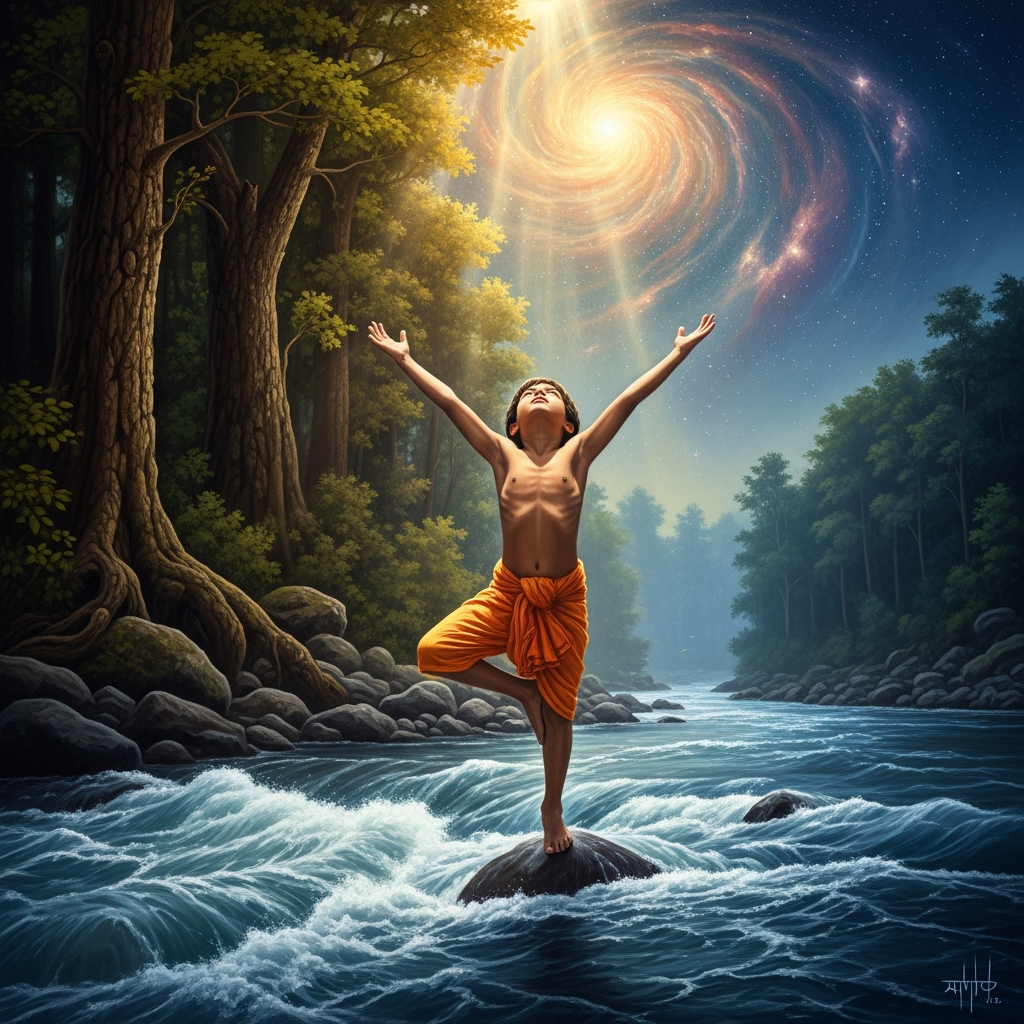
Hiranyakashipu had stood on one toe in the Himalayas for a thousand years, breathing through a single nostril, eating air, until Brahma himself descended to grant a wish. The asura king had thought it through. He recited the clauses one by one, and Brahma — bound by the rules of asceticism — granted them all.
Let me not be killed by any creature you have created. Not by man. Not by beast. Not indoors. Not outdoors. Not by day. Not by night. Not on earth. Not in sky. Not by any weapon.
Brahma listened to the list and granted the list. Hiranyakashipu came down from the mountain immortal in nine directions and proceeded to make himself the cosmos’s worst problem. He drove Indra from heaven. He occupied the throne of the gods. He demanded the sacrifices that had been Vishnu’s. He executed the priests who refused. He taught the worlds that the bargain with Brahma had a winner and the winner was him.
Then his son was born.
Prahlada is small. Prahlada is gentle. Prahlada, from the moment he can speak, speaks the name of Vishnu — the very god his father has banished from the worlds.
The asura king tries everything. He sends his son to the priest-tutors who teach asuric lore; the boy listens politely and goes on chanting Hari, Hari, Hari. He has Prahlada thrown from a cliff; the boy lands on grass with the absent calm of a child set down by a parent. He has him placed beneath the foot of a war-elephant; the elephant kneels and lifts the boy with its trunk. He has him fed serpents in a sealed room; the serpents coil at his feet without striking. He has his sister Holika — who possesses a fire-resistant cloak — sit in a bonfire holding the boy in her lap; the cloak flies to Prahlada and Holika burns to ash.
(That fire is the one India still lights every spring at Holi. The festival is named for the aunt who caught fire trying to murder her nephew. The festival celebrates her failure.)
Hiranyakashipu watches each protection happen and understands what it means. His son is not protected by accident. His son is protected by Vishnu. Vishnu is in his palace. Vishnu has, somehow, walked through every wall the boon was supposed to seal.
He decides to settle the matter.
He calls Prahlada into the great hall at the hinge of evening — not day, not night — twilight, the hour when shadows lengthen and the corners of rooms become indistinct.
The hall is the palace’s central audience chamber. Stone pillars run along its length. The throne is at one end. The doorway out to the courtyard is at the other. The threshold between them — the carved stone lintel above and the worn stone underfoot — is the line that separates indoors from outdoors.
The king is seated on the throne in his armor, mace across his knees. The boy walks in. The court watches.
Where is your god, exactly? Hiranyakashipu asks. Show me. Where is the Vishnu who has been frustrating my discipline of you?
Everywhere, the boy says.
In this pillar?
In this pillar.
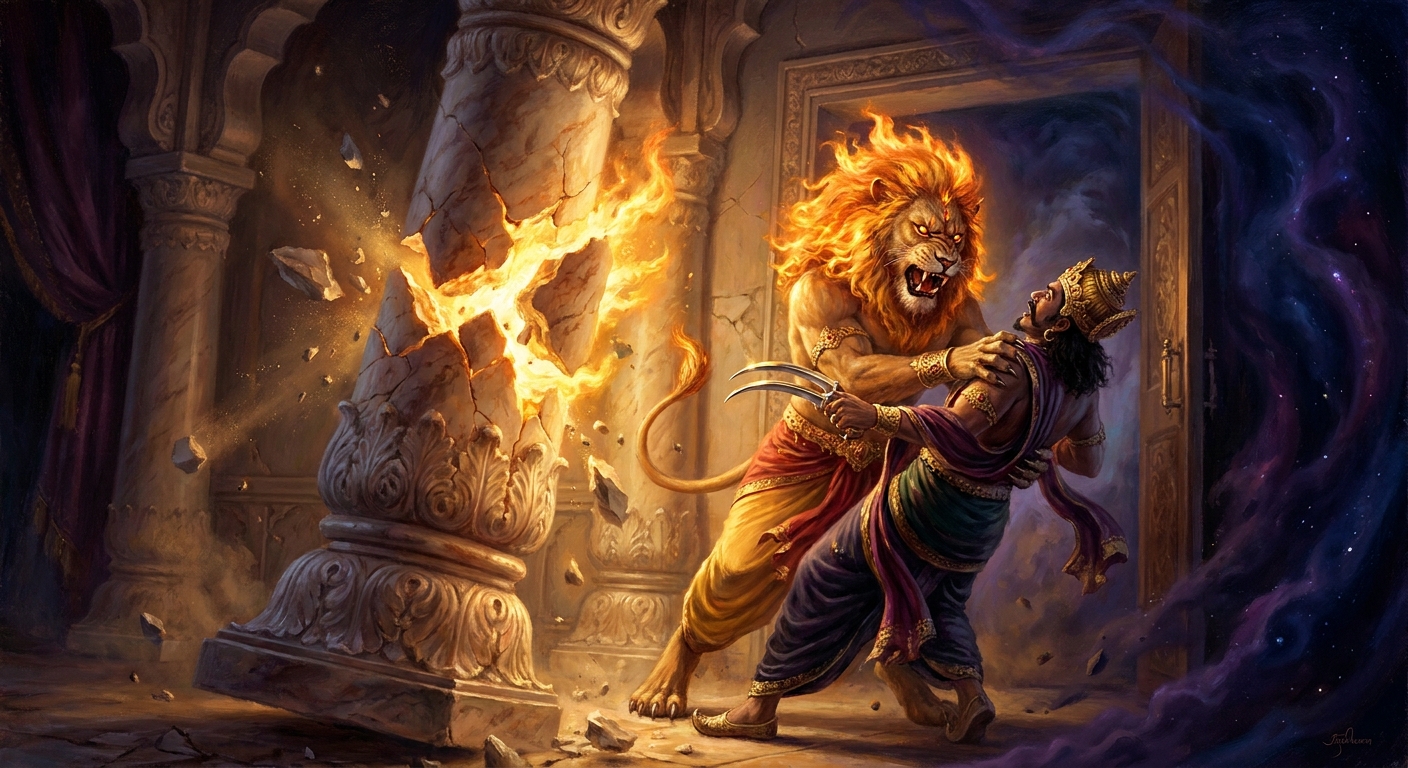
The king laughs. He stands. He swings the mace overhead — a blow that would split granite — and brings it down across the nearest pillar of the hall.
The pillar bursts.
What comes out of the pillar is not a thing the cosmos has produced before.
It is the size of a man and the size of a lion at once and somehow neither. The face is the face of a lion — golden mane on fire, jaws unhinged, teeth that the asura court will later describe as longer than swords and yellower than old bone. The body is the body of a man — bipedal, four-armed, torso of muscle and gold. The hands are not hands. The hands are claws. The eyes are the eyes of something that has been waiting a long time for the bargain to expose its seam.
This is Narasimha. Man-Lion. The fourth avatar.
Narasimha is not a man and not a beast. The boon does not cover him. The boon’s clauses begin to fail in real time, one by one, as the avatar steps out of the broken pillar and the asura king sees them fail.
Hiranyakashipu turns to run. There is nowhere to run. Narasimha closes the distance in two strides — across the hall, past the throne, toward the doorway. He reaches the king on the threshold itself.
Not indoors. Not outdoors. On the threshold.
He seizes the asura by the waist and lifts him.
He lifts him onto his lap.
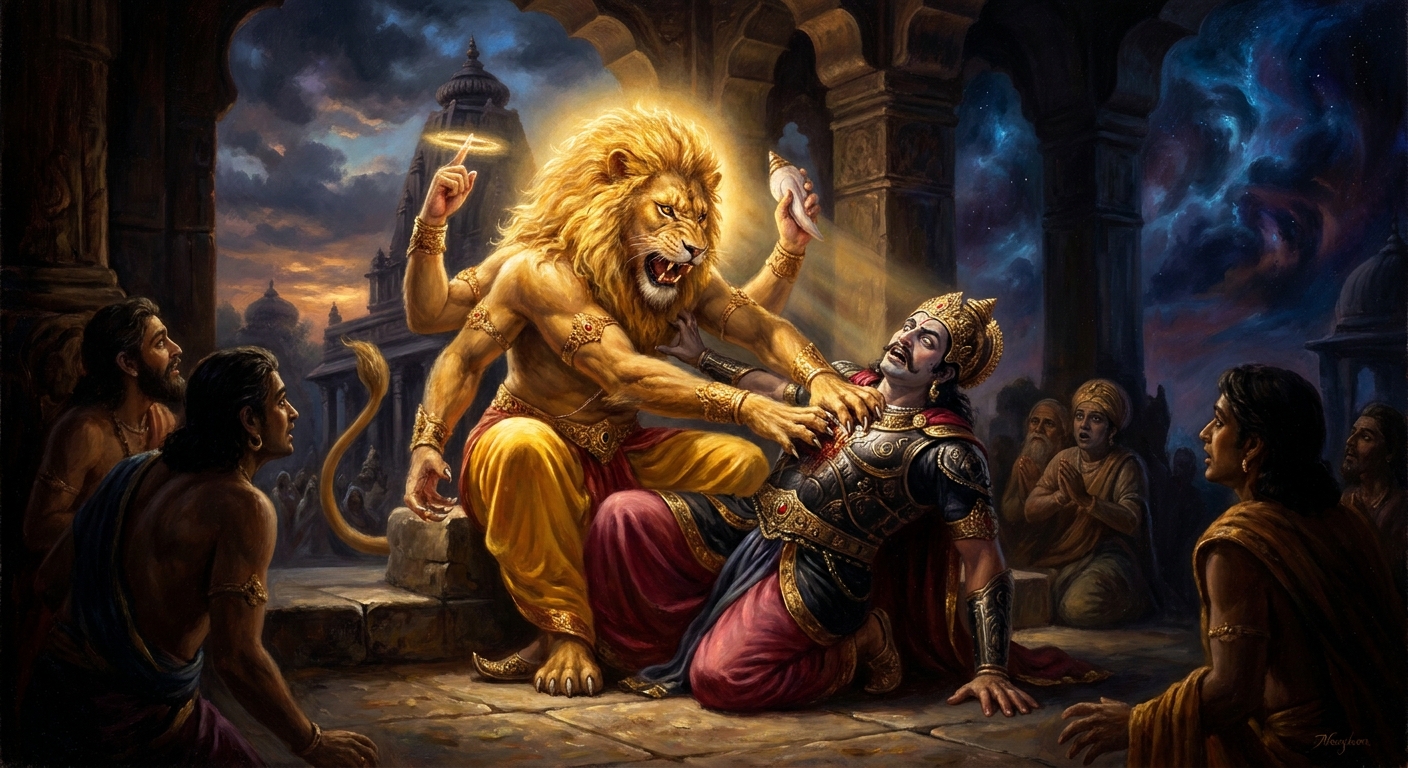
Narasimha sits, mid-stride, on the threshold stone. The king is across his thighs — not on earth. Not in sky. The hour is twilight — not day. Not night. The avatar is half-man, half-lion — not a creature Brahma made. Not man. Not beast. The asura, supine across the lion-god’s lap, opens his mouth to speak the boon’s invocation, but every clause has already failed.
Narasimha extends his hands. The claws — not weapons, not blades, not anything Brahma gave the cosmos a name for — slide into Hiranyakashipu’s belly and pull.
The asura opens like a fruit. Entrails fall onto the threshold stone. The eyes go wide and stay wide. The mace, which has cracked granite, makes no sound as it falls. Narasimha holds the dying king above his own emptied chest and roars — a roar that travels up through the palace, out across the courtyard, into the sky where the Devas have been watching, and the Devas flinch even though they know whose side it is on.
The boon held against everything except the seam. The seam was the avatar.
Then Narasimha cannot stop.
The roar continues. The claws drip. The lion-god remains on the threshold with the corpse, but the rage of the form has not exhausted itself, and the cosmos begins to feel the heat. Mountains crack. The Devas in heaven step back from their thrones. Brahma himself, who set this in motion by granting the boon a thousand years ago, hides behind Vishnu’s other avatars and does not come forward. Indra does not come forward. Shiva does not come forward.
Prahlada walks across the courtyard.
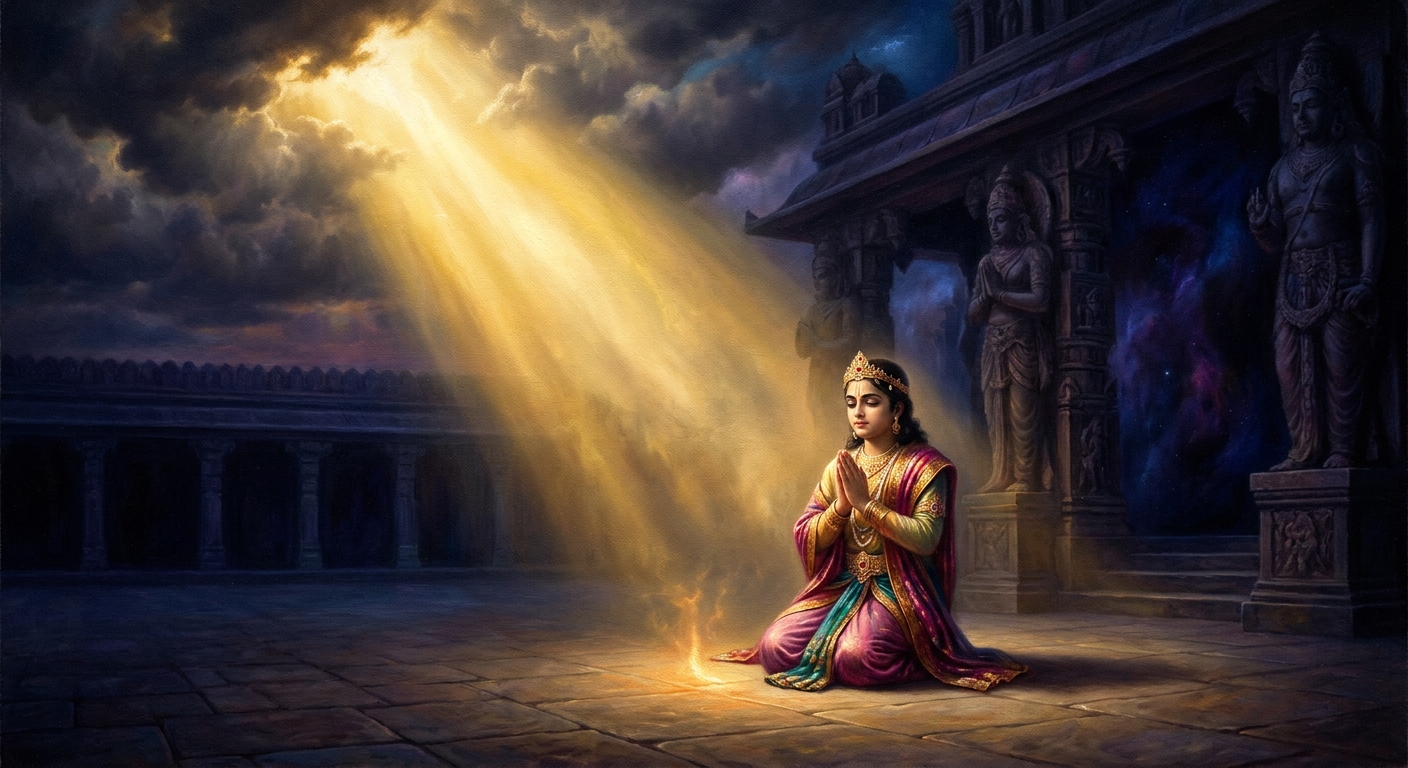
The boy, who has just watched his father be torn apart, walks across the bloodied stones toward the avatar of the god he has prayed to since he could speak. He climbs into the lion-god’s lap beside the corpse he is replacing. He puts his small hands on the burning chest. He sings.
He sings the same hymn he has been singing since he was three. Hari, Hari, Hari — the syllables that protected him from the cliff and the elephant and the snake-room and the fire — sung now into the chest of the form that came to protect him. The lion-god’s breath slows. The roar thins. The fire in the mane dims to gold. Narasimha closes his eyes.
The hand that destroyed Hiranyakashipu rests on the back of Prahlada’s small skull.
Narasimha is the avatar of the loophole — the seam in the bargain, the unforeseen clause, the thing-that-is-neither. The Puranas put him fourth in the avatar list because he comes when reason itself has been weaponized: when an asura has talked his way to immortality and ruled the cosmos by the letter of a vow. The form that arrives is the form the letter does not cover.
But the deeper teaching is in Prahlada. The boy is the reason Vishnu came. Not the cosmic insult, not the displaced sacrifices, not Indra’s grievance — the child who would not stop singing the name. Bhakti, in the Bhagavata Purana, is the gravitational pull that draws the divine into matter. Prahlada’s devotion is the rope. Narasimha is what the rope pulled out of the pillar.
The avatar’s wrath needed a child’s hand to settle. That is the order the Puranas insist on: the lion-god is not soothed by another god. He is soothed by the bhakta. The boy in the lap is the only force in the cosmos that can quiet the form he summoned.
Scenes
The pillar bursts
Generating art… Prahlada, the asura's small son, kneels in the courtyard with folded hands
 Generating art…
 Across the lap of the lion-god, the king of the asuras opens
 Generating art…
 Echoes Across Traditions
Entities
- Vishnu
- Narasimha
- Hiranyakashipu
- Prahlada
- Brahma


Sources
- *Bhagavata Purana* 7.2-10 (10th-12th c. CE redaction)
- *Vishnu Purana* 1.16-20
- Wendy Doniger, *Hindu Myths* (1975)
- Cornelia Dimmitt, *Classical Hindu Mythology* (1978)
- Edwin Bryant, *Krishna: A Sourcebook* (2007)