Coyote Steals Fire
In the time before time · oral tradition recorded ~late 19th–early 20th century CE · The mountain at the edge of the world — Karuk and Pomo country, northern California / Pacific Northwest
Contents
The trickster runs fire down a mountain in a relay of frog and squirrel and wood, and the world's first warmth arrives smelling faintly of singed fur.
- When
- In the time before time · oral tradition recorded ~late 19th–early 20th century CE
- Where
- The mountain at the edge of the world — Karuk and Pomo country, northern California / Pacific Northwest
There is no fire in the world.
The people huddle in their houses through the long dark months, eating raw meat that the cold barely keeps from rotting. Children die in the winter the way mosquitos die in the autumn — quietly, in numbers, without anyone able to stop it. The old people remember when there was no fire and they remember the names of the children who did not survive the not-having of it. They have stopped remembering anything else.
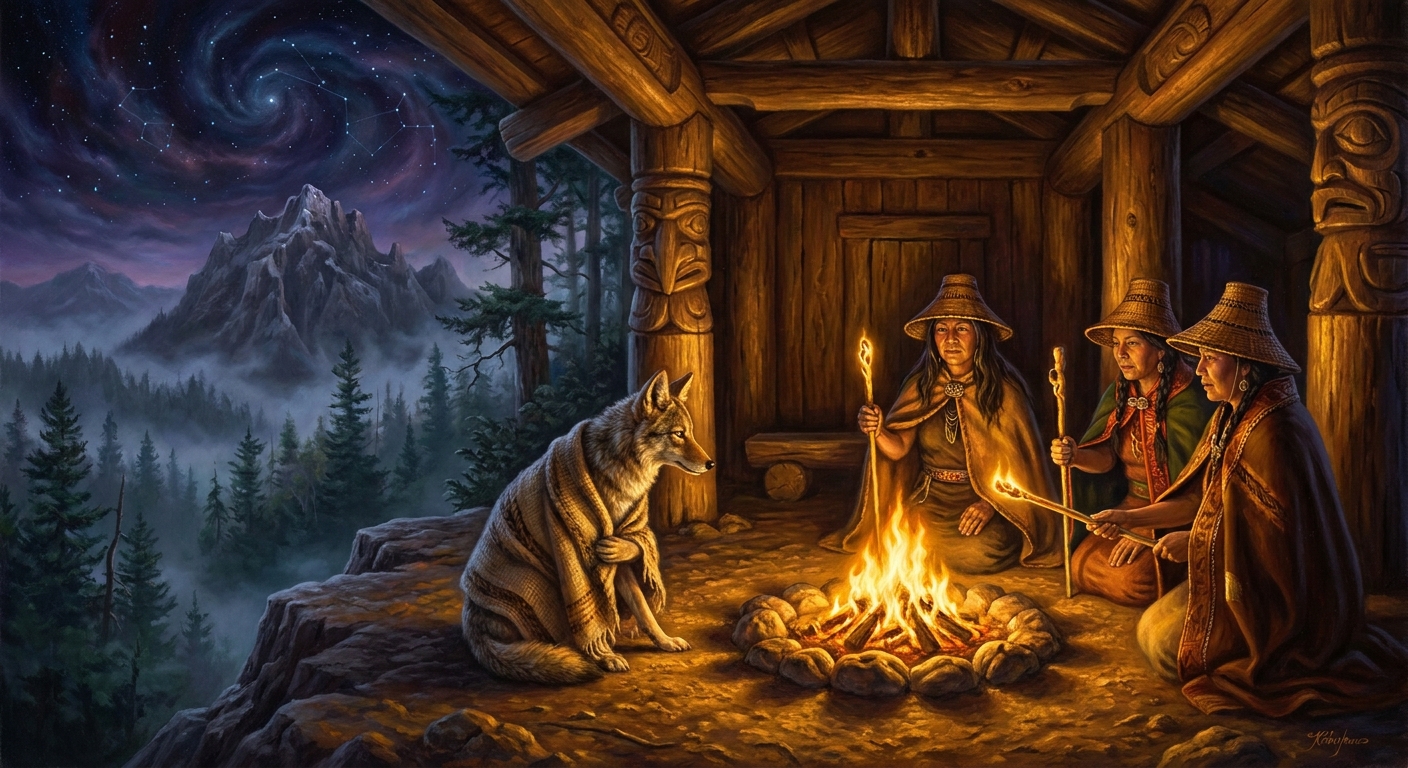
On the mountain at the edge of the world, the Fire Beings keep the only fire there is. They are three sisters, and they are jealous. One of them tends the flame, always; the other two sleep in shifts. They have built their house with no door on the human-world side, only an opening that faces the cold sky, and they listen for the sound of feet in the snow.
Coyote, walking past one autumn evening, hears the people crying.
He does not love the people. Coyote does not love anyone, not really. But he is bored, and pity at one remove looks a lot like boredom in a trickster — a low itch under the ribs that demands a story to scratch it. He sits on a rock above a village and listens to a mother weep over a child who will not warm again, and he thinks: this is a problem the size of a good theft.
He calls a council. Not of people — the people are too sad to plan. He calls Squirrel, and Frog, and Wood. (Wood, in those days, could walk. Wood was an animal. The world had not yet made it stand still.)
“We are going up the mountain,” he tells them. “We are going to take the fire. Not all of it — just enough. The Fire Beings will chase us. They run faster than any of us alone. So we will not run alone. We will run in a relay. Each of you will carry the fire one stage of the way down. By the time the sisters catch up, the fire will be in the village, and they will not dare to follow it where humans have hands.”
Squirrel says: “They will burn me.”
Coyote says: “Yes. A little. Your tail will curl. You will live.”
Frog says: “They will burn me too.”
Coyote says: “Yes. More than a little. You will lose what you carry it on. You will live.”
Wood says nothing. Wood, even then, was the quietest of them.
They climb the mountain at dusk.
Coyote goes first, alone, the way a thief goes first — not because he is bravest but because he is the one with the plan and the plan has to be defended from itself. He scratches at the smoke-hole of the Fire Beings’ house and whines like a winter dog. The sister on watch looks down through the smoke and laughs.
“Old grey one,” she says. “You are cold. Come in. Warm yourself a little. We have been bored all season.”
He comes in. He shivers theatrically. He turns himself in the firelight the way a piece of meat turns on a spit, and the sister laughs again, and her two sleeping sisters do not wake. He keeps turning. He keeps shivering. He waits until the sister on watch lowers her eyes for one heartbeat — a yawn, a blink, the small private moment when even a fire-keeper stops keeping fire — and he seizes a brand from the hearth in his teeth and is out the smoke-hole and down the slope before the laughter has finished leaving her throat.
She screams. Her sisters wake. The mountain wakes with them.
Coyote runs.
He runs with the brand in his teeth and the fire is eating his muzzle as he runs — he can smell his own whiskers burning, his own tongue blistering, the inside of his cheek scorching black against the wood. The Fire Beings come down the mountain behind him in a sound like three winds braided together. They are faster than he is. He always knew they would be.
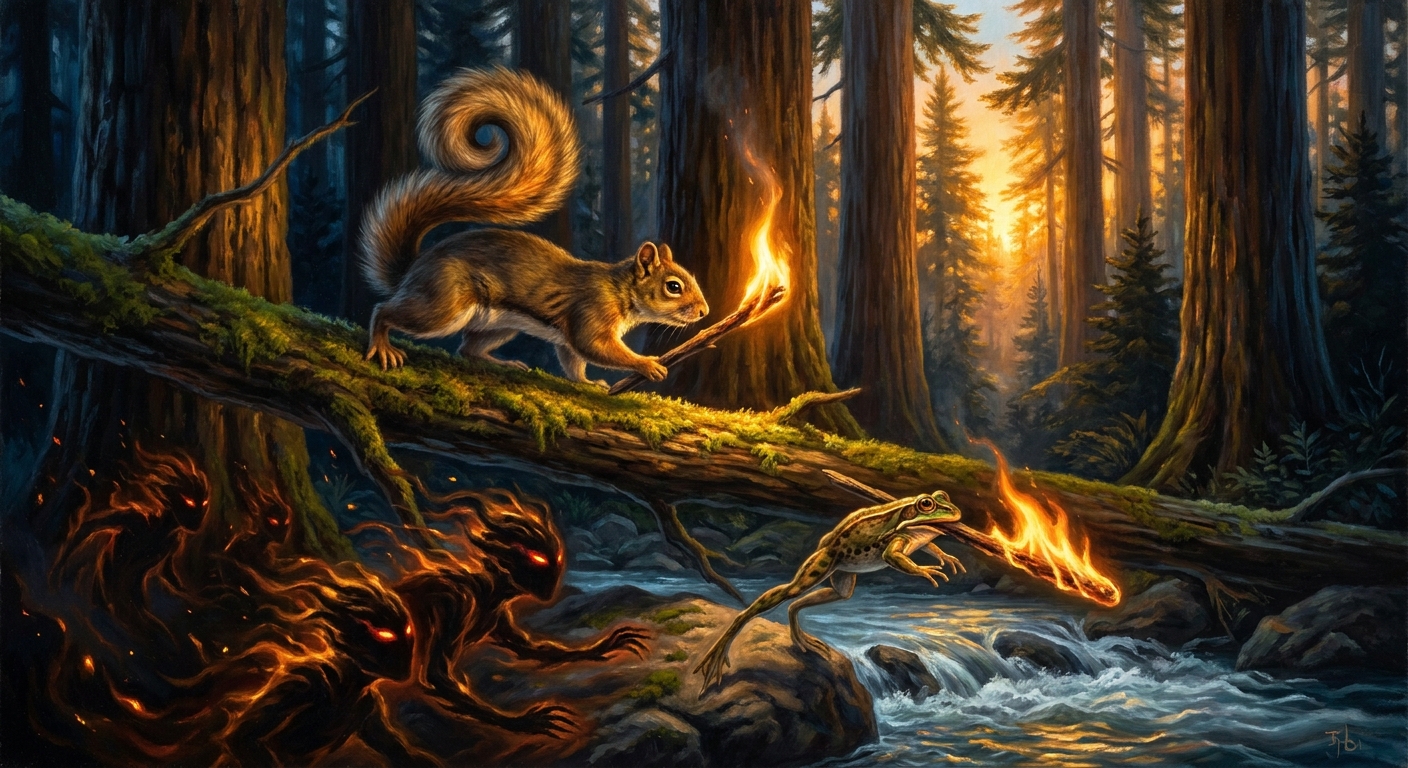
At the first ridge, Squirrel is waiting. Coyote drops the brand into Squirrel’s small front paws and collapses, smoking, into the snow. Squirrel takes the fire and runs.
The fire is too big for Squirrel. It curls his tail back over his spine as he runs — the heat lifting the fur, the tail bending up and forward until it lies along his back like a question mark — and that is why every squirrel since has carried his tail that way, an arch of memory burnt into the species. He runs on. He is small and he is fast, but the Fire Beings are faster, and at the second ridge his paws are on fire and he is weeping smoke.
Frog is waiting at the second ridge.
Frog, in those days, had a tail.
He was a long animal, almost an otter, almost a snake — a creature with a beautiful tail that he was vain about. Squirrel drops the brand into Frog’s mouth and Frog swallows hard, eyes streaming, and leaps.
He leaps for the river. The Fire Beings are screaming on the slope behind him. He leaps and leaps and his tail is alight, the beautiful long tail he had been vain about, burning behind him in the dusk like a comet, and at the last leap before the riverbank a Fire Being’s hand closes on the tail itself and tears it off.
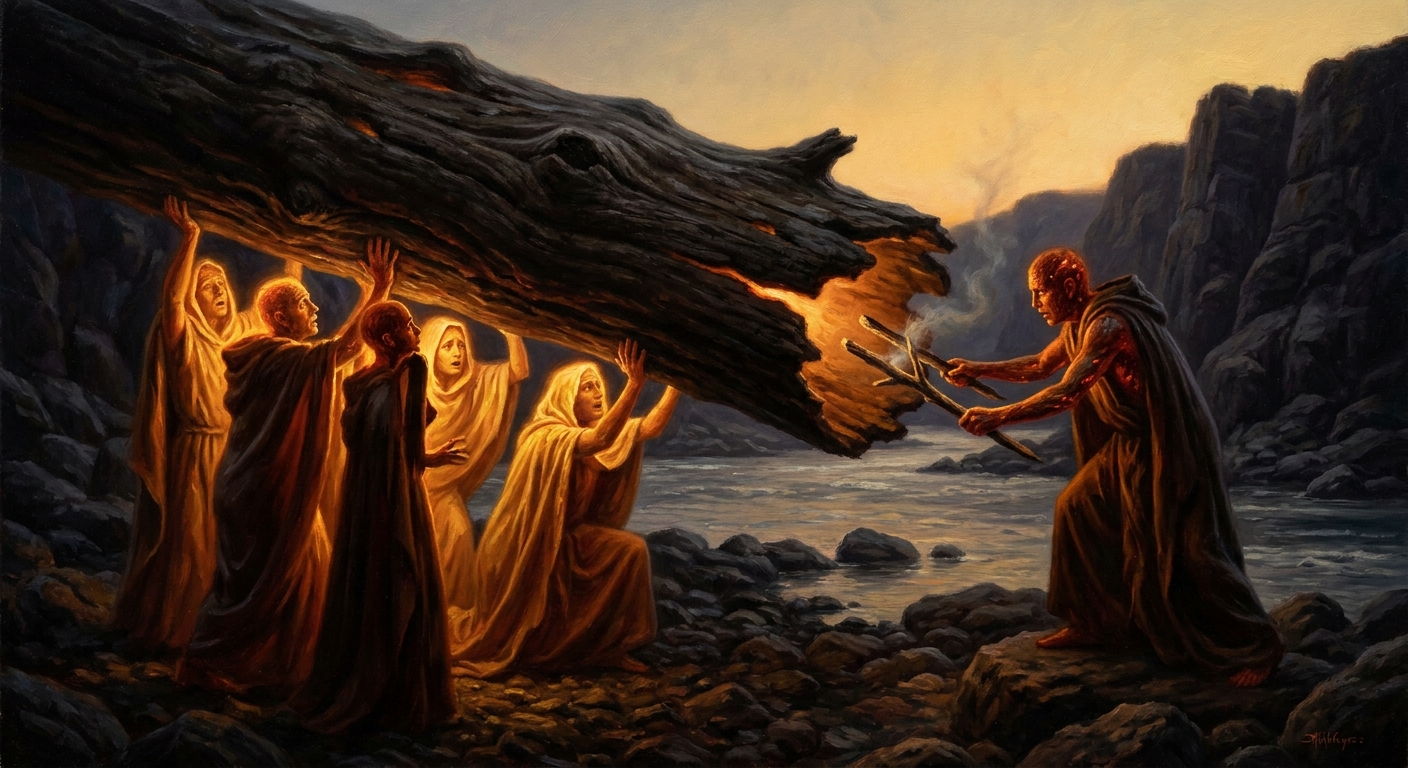
Frog hits the water tailless. He spits the brand out in a high arc and the brand lands — already half-extinguished, almost gone — in the lap of Wood, waiting on the far bank.
Wood swallows the fire.
This is the part the story sometimes pauses on, because it is the part children ask about.
How can wood swallow fire? Like this: Wood, in those days, was alive, and Wood understood that some gifts have to be hidden inside their opposite to survive. Wood took the brand into the soft heart of itself and closed around it. The flame went down inside the wood-body and did not come out. The Fire Beings stood on the riverbank, screaming, and could not see where their fire had gone.
They searched Wood. They held Wood up to the dying light. They listened to Wood. Wood stood there with fire inside it and did not move and did not speak, and the Fire Beings, after a long time, gave up and climbed back up their mountain.
When they were gone, Coyote — bandaged, burned, panting — came down to the riverbank and tapped Wood on the shoulder. “Now,” he said.
Wood showed the people how to take the fire back out. Two sticks. A spindle. A bow. The friction. The smoke. The first orange ember in a bed of dry moss, pulled out of Wood’s body the way a midwife pulls a child. The people learned the trick. They have been doing it ever since.
Coyote, of course, vanished.
He always vanishes after the gift. He does not stay for the gratitude — gratitude bores him faster than pity. He went off to find another itch. He left Squirrel with the curled tail and Frog with no tail and Wood with the black heart-line that every split log shows even now, the trace of the fire it once swallowed.
The people kept the fire. They keep it still. Every hearth is a memory of the relay. Every burned tongue, every smoke-stained roof beam, every winter that the children survive — all of it is a debt owed to a thief who didn’t love them, a squirrel whose tail will never lie flat, a tailless frog at the edge of a river, and a piece of wood who agreed to hide a fire inside itself and not tell anyone where.
The Karuk and Pomo tellings differ on details — the relay sometimes runs four animals, sometimes seven; sometimes Coyote is alone and Wood is the only helper. The structural claim is identical: fire arrives by community, not by hero. Prometheus’s individualism is a Mediterranean inflection. North of the Klamath, the gift moves by relay because no single creature is supposed to be able to carry it.
And the trickster is not punished. That is the other Mediterranean inflection the Karuk story refuses. Coyote walks away. The cost of fire is borne by the helpers — by the small, by the willing, by the wood that agreed to hold the burning. It is a theology of warmth that knows where warmth actually comes from: not from the genius who plans the theft, but from the bodies that carry it down the mountain and do not let go.
Scenes
The Fire Beings' house on the mountain at the edge of the world
Generating art… The relay down the slope
 Generating art…
 On the far bank, Wood swallows the dying brand into the soft heart of itself
 Generating art…
 Echoes Across Traditions
Entities
- Coyote
- the Fire Beings
- Squirrel
- Frog
- Wood

Sources
- A. L. Kroeber and E. W. Gifford, *Karok Myths* (University of California Press, 1980)
- S. A. Barrett, *Pomo Myths* (Bulletin of the Public Museum of the City of Milwaukee, 1933)
- Jaime de Angulo, *Indian Tales* (1953) — Pit River and Pomo trickster narratives
- Dell Hymes, *'In Vain I Tried to Tell You': Essays in Native American Ethnopoetics* (1981)