Bochica Breaks the Rock at Tequendama
Mythic time · Muisca cultural hero tradition · recorded by Pedro Simon, 1623; Juan Rodriguez Freyle, 1636 · Bogotá savannah and the Falls of Tequendama, Cundinamarca, Colombia
Contents
An old man arrives from the east, walking slowly, carrying a golden staff. He teaches the Muisca of the Bogotá savannah to weave and to live by law. Then he disappears toward the west. When the god Chibchacum floods the savannah in malice, Bochica appears in the sun and drives his staff into the rock face at the edge of the plateau — and the water roars through the crack and falls away. The Falls of Tequendama are where the staff struck.
- When
- Mythic time · Muisca cultural hero tradition · recorded by Pedro Simon, 1623; Juan Rodriguez Freyle, 1636
- Where
- Bogotá savannah and the Falls of Tequendama, Cundinamarca, Colombia
He comes from the east, which is where the important things come from.
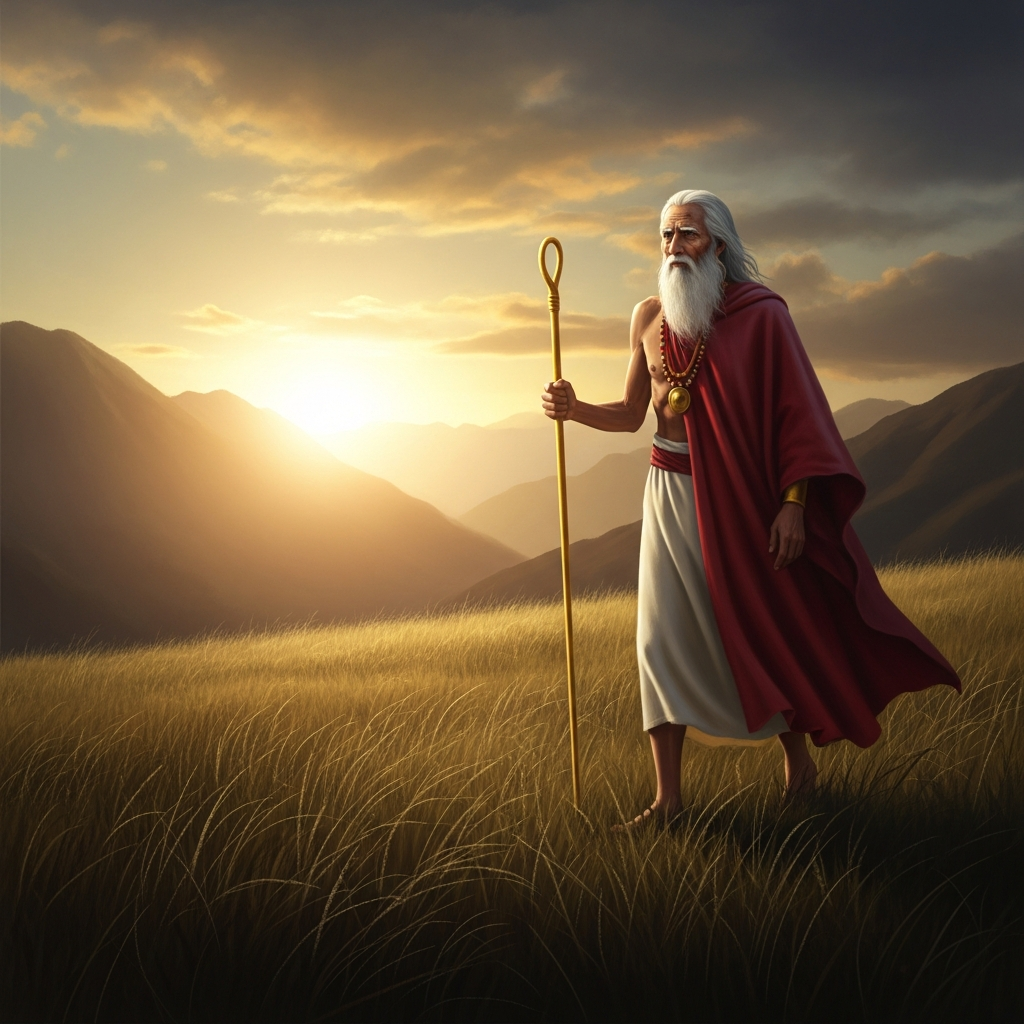
The Muisca of the Bogotá savannah — the people who occupied the high plateau of what is now Colombia’s central Andes at altitudes above 2,600 meters, in the cold and foggy highland that the Spanish would eventually transform into their colonial capital — first see him as a figure on the eastern horizon. An old man. Walking slowly. The long white beard that the Spanish chroniclers note specifically — Pedro Simon, Juan Rodriguez Freyle, Lucas Fernandez de Piedrahita, all noting the beard because it was remarkable: the Muisca had no bearded elder men, and an old man with a long white beard walking out of the morning sun from the east was clearly not a man of the ordinary kind.
He carries a golden staff.
The staff is the thing that confirms his nature for those who understand such things: not just any old man’s walking stick but a staff of gold, the metal of the sun, the substance that in Muisca theology is associated with solar power, with divine authority, with the specific quality of Bochica’s presence in the world. He walks without hurrying, the way someone walks who has no need to arrive faster than they arrive, and he enters the communities of the Bogotá savannah and sits down with the people and begins to teach.
Sua — the Muisca sun, the divine power that governs the agricultural calendar, that measures time, that is the source of warmth in a high-altitude world where cold is constant and warmth is precious. Bochica is not the sun. He is the sun’s representative in the world of human beings — the solar principle made ambulatory, made teachable, made available for conversation.
He teaches weaving.
This sounds modest but is not. In the Andean and sub-Andean highland tradition, weaving is not a craft. It is a cosmological practice — the work of creating fabric by interlacing threads in ordered patterns is the material metaphor for the work of creating social order by interlacing individuals in correct relationships. The specific patterns woven into Muisca cloaks (mantas) encode information about social status, ceremonial role, seasonal timing. To weave correctly is to participate in the ordering of the world. To weave incorrectly is a social and cosmological error.
Bochica teaches the patterns and the relationships between them. He teaches the weight of the thread and the tension of the loom and the significance of the specific designs that will mark the Muisca ceremonial garments for the centuries of his influence. He is not teaching a craft. He is teaching a language.
He also teaches the law.
The cacique system — the network of local chiefs whose authority the Spanish would later try to co-opt for colonial administration — receives, in the Muisca origin accounts, its foundational charter from Bochica’s instruction. The correct behavior at funerals, the rules of inheritance, the protocols for conflict resolution, the obligations of chiefs to communities and communities to chiefs: Bochica walks through the savannah for years, settling in one place and then another, teaching the same foundations wherever he goes and ensuring that the fabric of the social world is woven as correctly as the fabric of the ceremonial cloaks.
Then he goes west.
The enemy of order is not chaos but malice.
Chibchacum is the god of labor, of the underground, of the heavy loads that the earth carries — and in some accounts he is also the god of the merchants, which is to say the god of the redistribution of wealth, which in a hierarchical society is always a complex and potentially dangerous function. When Chibchacum decides to flood the Bogotá savannah, the myth gives no reason. It happens. The god of the underground moves, and the water rises.
The Bogotá savannah is a natural basin — a high plateau ringed by mountains, drained by the Bogotá River, which exits through a narrow gorge to the west. When Chibchacum blocks the drainage — the accounts differ on whether he physically blocks the river’s exit or simply calls the water up from the underground springs that feed the savannah — the plateau fills. The agricultural fields go under first, then the villages, then the hilltops where the people flee with what they can carry.
The Muisca prayer in this crisis is not addressed to Bachué, who is in the lake and who is a mother rather than a warrior. It is addressed to Bochica — the teacher, the solar representative, the one who gave the law that Chibchacum has violated by flooding the people without just cause. The prayer rises from the hilltops where the community huddles above the floodline, and it goes up into the sky, toward the sun.
And from the sun, Bochica answers.
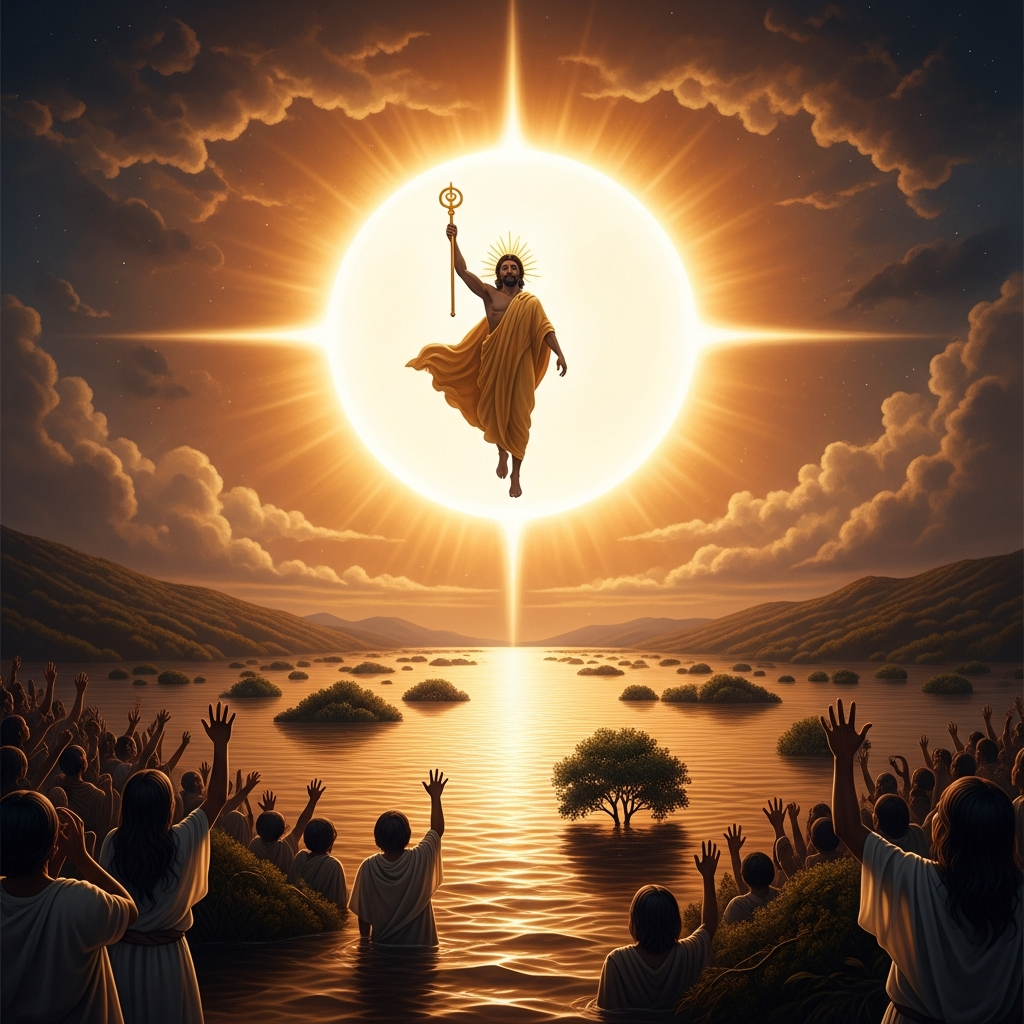
He appears in the disc of the sun.
The accounts agree on this: Bochica becomes visible in the solar disk, a radiant figure within the light, the golden staff held above him, looking down at the flooded savannah below. The people on the hilltops see him and understand that the appeal has been heard. They watch him descend — not physically descend, but bring his power to bear on the world below — and carry his staff toward the western edge of the plateau where the Bogotá River exits through its gorge.
The gorge at Tequendama — Tequendama being a Muisca word that means something like “precipice” or “place where it falls” — is a natural bottleneck in the river’s course: the water of the entire Bogotá savannah funnels through a narrow canyon and then drops 132 meters in a single spectacular fall, the water vapor rising in a permanent mist cloud visible from the savannah on clear days. The gorge existed before the myth. The falls existed before the myth. But the myth explains why they are so dramatic: the rock was broken open by a golden staff in the moment of the world’s rescue.
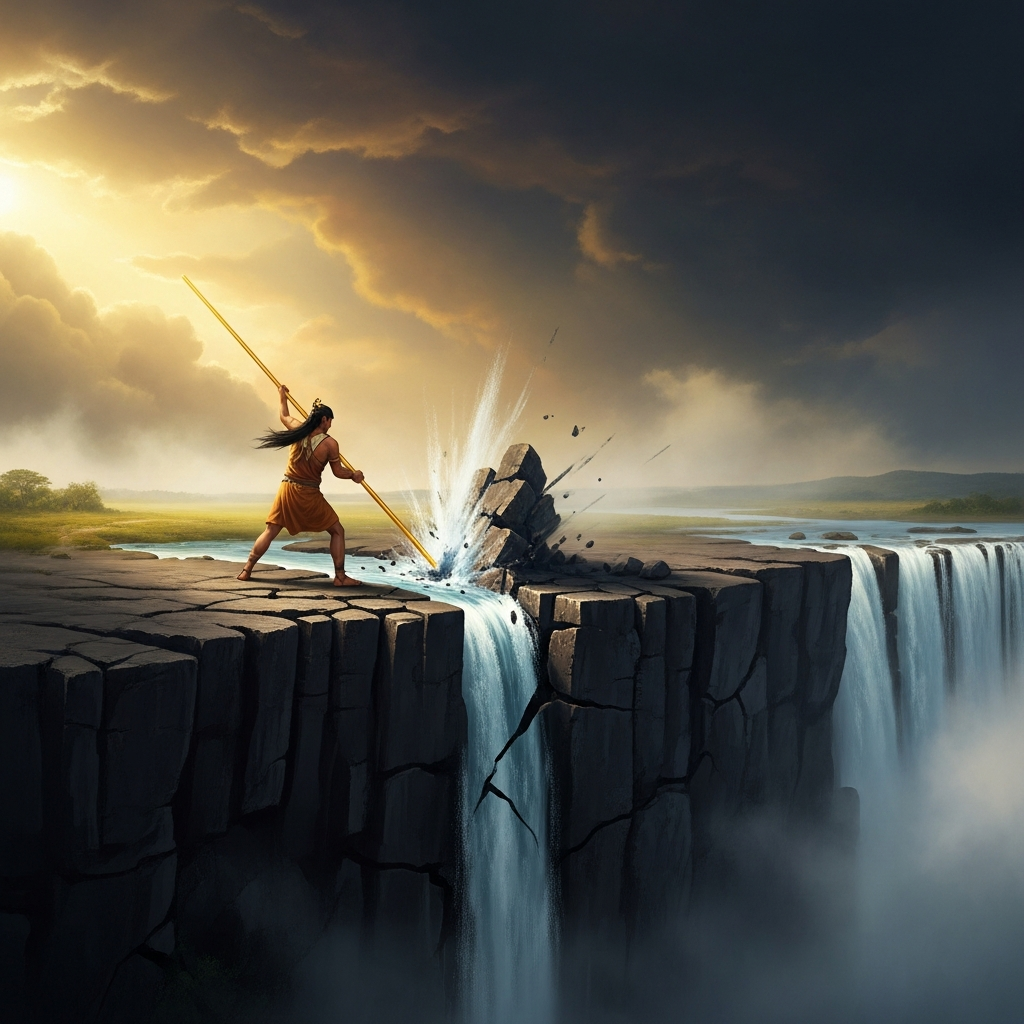
Bochica drives the staff into the rock at the edge of the gorge.
The rock cracks.
The water roars through.
The flood drains in hours, days, the myth is not specific on the duration because it is not interested in the hydraulics. What interests the myth is the moment of the crack — the physical contact between the divine instrument and the geological reality, the staff applying solar authority to the basalt that was holding the water back, and the immediate consequence: the world is draining, the savannah is reappearing, the Muisca people can come down from their hilltops and return to the fields.
Chibchacum, punished for the flooding, is given a new role: he is condemned to carry the world on his shoulders (or, in some accounts, a great log on his back), and when he shifts his weight, the earth trembles. This is the Muisca explanation for earthquakes — not Pachamama turning in her sleep, as in the Quechua tradition, but Chibchacum adjusting the burden he was given as punishment, his shoulders aching under the weight of a world he tried to destroy and was made to bear instead.
The Falls of Tequendama today are 30 kilometers southwest of Bogotá, easily accessible by road. The waterfall has been reduced from its historical volume by the water extraction of a city of ten million people drawing from the same Bogotá River basin, and the water that does fall is now heavily polluted from the same city’s untreated sewage. The Hotel El Salto, built in 1923 to allow tourists to experience the falls up close, has been closed for decades. The falls themselves are still impressive, particularly in the rainy season when the river runs higher.
If you stand at the lookout point above Tequendama and look at the gorge where the water drops, you are looking at the crack Bochica made. The basalt is still cracked. The water still pours through. Whether or not you hold the Muisca theological position that the crack was made by a golden staff wielded by a solar deity who appeared in the disc of the sun above a flooded highland basin — whether or not that is your working cosmology — the fact is that someone or something made this geological formation, and the Muisca had a name for who did it and why.
Huitaca — the moon goddess, associated in some accounts with the dissolution of Bochica’s law, the female power of the night that opposes the solar law he established — was also punished at this moment, transformed into an owl and sent into the darkness. The tension between solar law and lunar dissolution, between the civilization Bochica wove into the Muisca world and the forces that periodically threaten to undo it, is ongoing. It was ongoing before the Spanish arrived. The Spanish added a layer to it, a colonial layer, but they did not resolve it.
The old man with the golden staff walked west and has not been seen since. The falls still mark where he struck.
Bochica teaches a theology of rescue that depends on one prior thing: the establishment, through patient teaching, of a relationship between the divine and the human that makes it possible for the human to call on the divine in a crisis. He does not save people he has never met. He saves the people he taught to weave and to live by law, the people whose prayers rise from their flooded hilltops because he taught them to pray, the people who are the consequence of his years of instruction. The golden staff is available for striking the rock because the teaching was done first. The civilization is worth rescuing because it was built correctly. And the crack in the basalt at Tequendama — still visible, still draining the savannah into the gorge — is what the rescue looks like when the relationship between teacher and community was maintained.
Scenes
Bochica arriving from the east across the Andean highlands — a thin old man with a long white beard and a golden staff, walking unhurriedly across the Bogotá savannah toward the Muisca communities, the morning sun behind him, the highland grasses and the distant mountains framing his approach
 Generating art…
 Bochica appearing as a radiant figure within the disc of the sun above the flooded Bogotá savannah — the entire highland plateau submerged in brown water, the Muisca people on the hilltops waving and crying out, Bochica visible in the solar light with his golden staff raised, about to descend
 Generating art…
 The moment the golden staff strikes the rock at Tequendama — Bochica driving the staff into the basalt edge of the plateau, a crack opening explosively in the rock, the flood water beginning to pour through in a torrent that will become the great waterfall, mist rising in clouds, the savannah beginning to drain
 Generating art…
 Echoes Across Traditions
Entities
- Bochica
- Chibchacum
- Huitaca
Sources
- Pedro Simon, *Noticias Historiales de las Conquistas de Tierra Firme en las Indias Occidentales* (1623)
- Juan Rodriguez Freyle, *El Carnero* (1636; Biblioteca Popular de Cultura Colombiana, 1942)
- Lucas Fernandez de Piedrahita, *Historia General de las Conquistas del Nuevo Reino de Granada* (1688)
- Maria Victoria Uribe, *Matar, Rematar y Contramatar* (CINEP, Bogotá, 1992)
- Sylvia Broadbent, *Los Chibchas: Organización Socio-Política* (Universidad Nacional de Colombia, 1964)