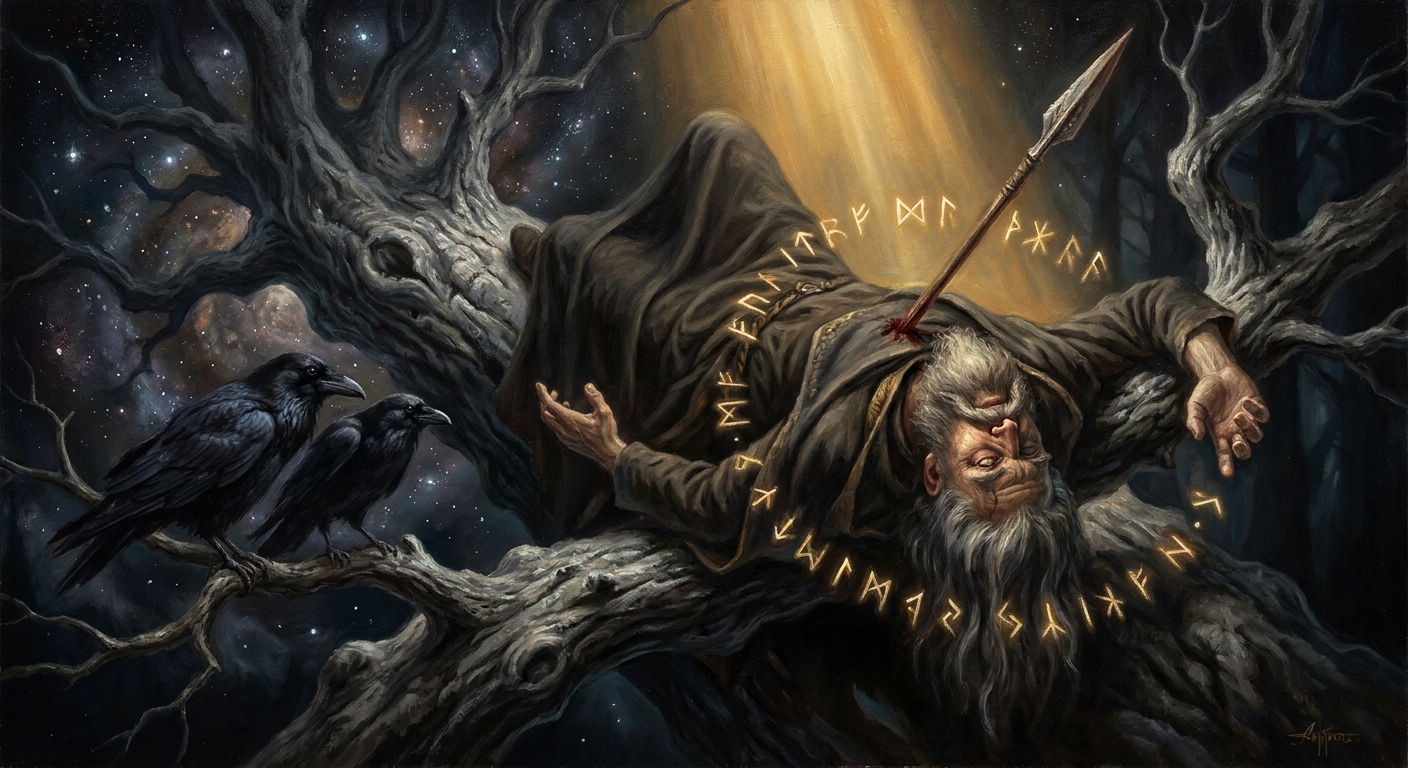
How the World Was Made from a Giant's Body
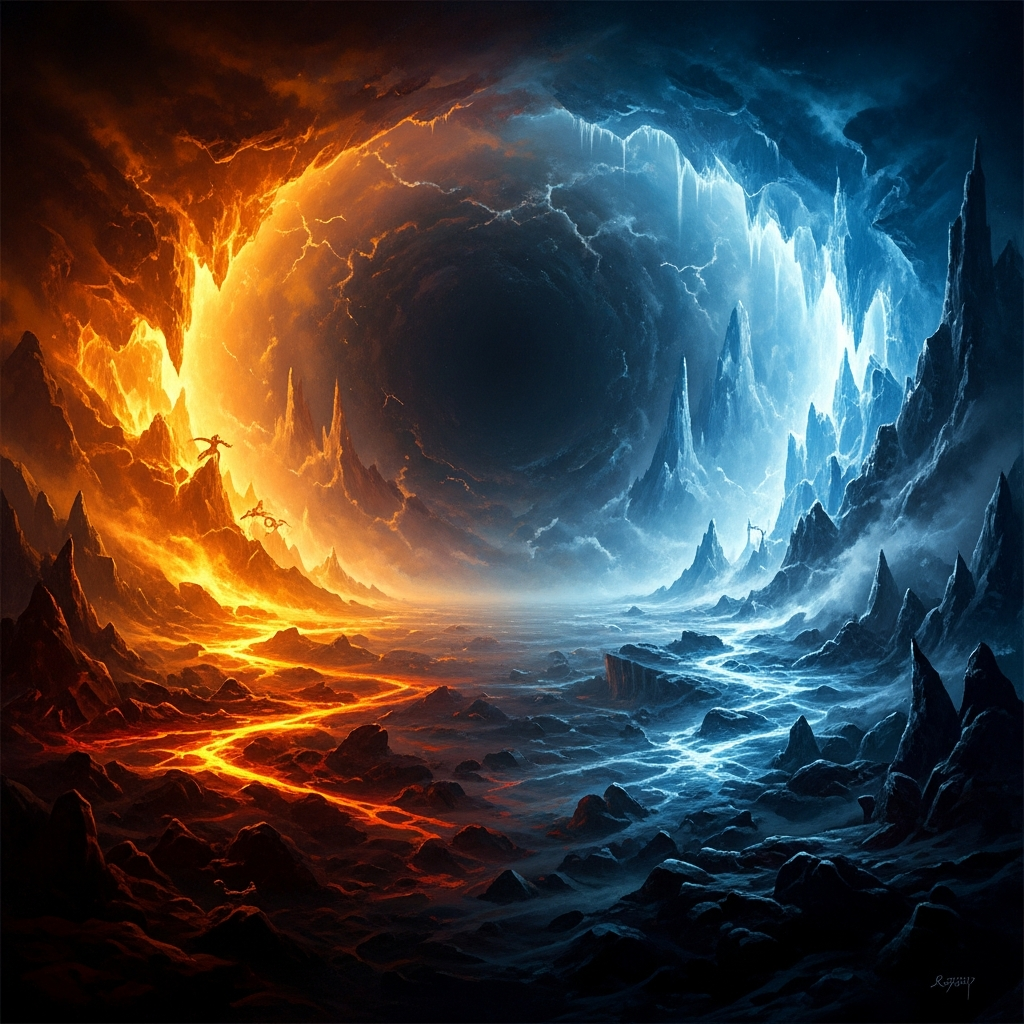
Mythic time (recorded in *Völuspá* and *Prose Edda*, c. 1220 CE) · Ginnungagap — the void between Niflheim (ice) and Muspelheim (fire)
Contents
Before there is a world there is only Ginnungagap, the yawning void between the fire of Muspelheim and the ice of Niflheim. Where they meet, the ice drips, and from the drips wakes Ymir, the first frost giant. The cosmic cow Auðumbla licks salt from the ice and uncovers the first god. His grandsons — Odin, Vili, Vé — kill Ymir and build the world from his body. The skull becomes the sky. The blood becomes the sea. Humans, when they finally arrive, are made last and made of driftwood.
- When
- Mythic time (recorded in *Völuspá* and *Prose Edda*, c. 1220 CE)
- Where
- Ginnungagap — the void between Niflheim (ice) and Muspelheim (fire)
In the beginning there is the gap.
Not the dark — there is no dark, because dark requires the absence of light and there is yet no light to be absent. Not the silence — there is no silence, because silence requires the absence of sound and there is yet no air for sound to travel through. There is only Ginnungagap. The word is hard to translate. It means the yawning gulf, the magic-charged void, the space that contains the possibility of everything. It is not nothing. It is the readiness of nothing to become something. To the south of it — though south is also a word that does not yet quite mean anything — burns Muspelheim, the realm of pure fire, presided over by the silent giant Surt with his flaming sword. To the north freezes Niflheim, the realm of pure ice, eleven rivers running cold from the well Hvergelmir. The fire and the ice are reaching toward each other across the gap.
They meet.
Where they meet, the ice begins to melt. The drops that fall from the melting do not fall into nothing; they fall into the gap, and in the gap they take on a form they did not have when they were ice or steam. The first form they take is a body.
The body is enormous. It is hairy. It is asleep. Its name will be Ymir, but it does not yet know its name; it is only the first thing that has woken up. It is hungry. There is nothing to eat. Then, from the same dripping ice, a second form: a cow. Her name is Auðumbla. Four rivers of milk flow from her udders, and Ymir, by some instinct that requires no teaching, drinks from them. He is fed.
But what does Auðumbla eat?
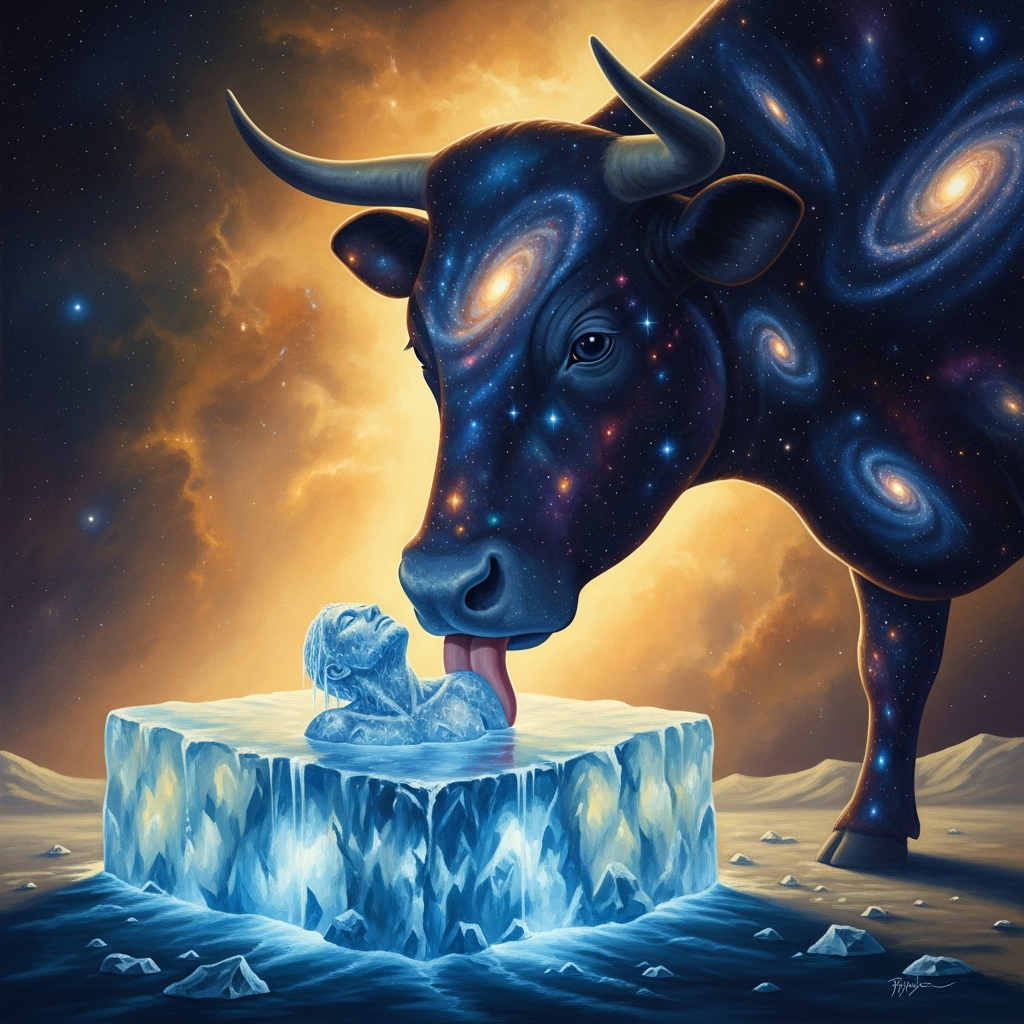
She licks the ice. She licks salt-blocks of frozen rime, because the rime tastes of the deep places where the cosmos is concentrated. She licks the same block for three days. On the first day, the licking uncovers a man’s hair. On the second day, the licking uncovers a man’s face. On the third day, she licks the block away entirely, and out of it walks Búri, the first of the gods.
He is alone for a long time. He has a son named Borr — Snorri does not explain how, and we should not press him on the point — and Borr marries a giantess named Bestla, daughter of the giant Bölthorn, and Borr and Bestla have three sons: Odin, Vili, Vé. The brothers grow up in the gap. They watch Ymir, who has become the father and grandfather of every frost-giant in creation, sweat in his sleep and birth more giants from the sweat of his armpits and the joining of his legs. The frost-giants are many and they are growing. The world is, for a long time, a nursery of monstrous patriarchs and a single calm cow and three young gods who are watching and counting and waiting.
Eventually they decide.
The killing of Ymir is not described at length in any source. Snorri tells it in a sentence. The Vafþrúðnismál is barely more verbose. The brothers attack the giant in his sleep and they kill him. That is all the texts will say. The brevity is itself the point: the foundational violence of the cosmos is not dramatized, because to dramatize it would be to make it negotiable, and it is not negotiable. The world is going to be made and the only material available to make it from is a body, and the only body available is the one breathing in front of them, and so they take it. Odin strikes first. Vili and Vé hold the limbs.
The blood comes out of Ymir like a sea coming out of a sea.
The frost-giants drown. All of them. The whole vast nursery of grotesque patriarchs is killed in the flood of their progenitor’s arteries — except for one couple, a giant named Bergelmir and his wife, who escape in a hollowed-out tree-trunk and float on the surface of the flood until the worst is past. From them every later frost-giant descends. The world has not yet been made and already there are survivors. There will always be survivors. Norse mythology is unable to imagine a fresh start; even the killing of the first giant leaves a tree-trunk, a wife, a son, a future feud.
When the bleeding stops, the brothers begin.
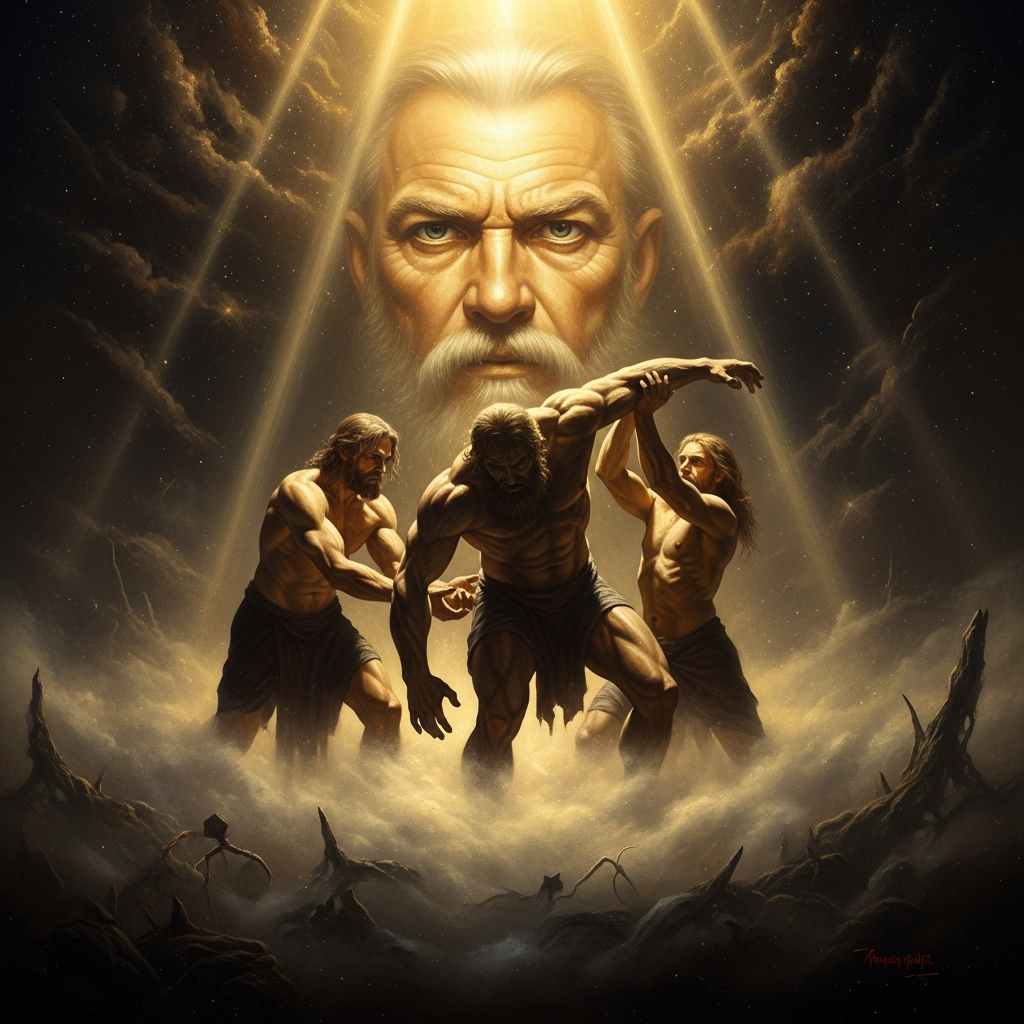
They take Ymir’s flesh and they shape it into the earth. They take his bones and they make the mountains. They take his teeth and his shattered jaw and they grind them into stones and gravel and the boulders that will roll downhill in spring. They take his skull and they raise it as a great vault over the earth, and where it begins to sag they pin it at four corners with four dwarves: Norðri, Suðri, Austri, Vestri — north, south, east, west. The dwarves are still there. The sky is still being held up. When you look up at the dome of heaven, what you are looking at is the inside of Ymir’s skull, and what is keeping it from falling is the unrelieved labor of four small persons in the four corners of the cosmos.
They take his blood — the blood that has not been lost in the drowning — and they make the encircling sea.
They take his hair and they make the trees.
They take his brain — and the Vafþrúðnismál lingers here, because the medieval Icelandic poet finds this detail particularly satisfying — and they cast it into the air, and from his brain come the clouds. The clouds are a giant’s mind, says the poem, scattered across the high places of heaven. When you look up at a thunderstorm what you are looking at is the residue of someone else’s thinking.
They take the eyebrows, finally — and this detail is so specific it must be ancient — and they use them to fence off a place in the middle of the world. They call this enclosure Midgarðr: the middle-yard, the inner garden, the only place in the cosmos that is not under direct giant management. Inside the eyebrow-fence they will plant a great ash tree, Yggdrasil, whose roots will reach into all nine worlds and whose branches will hold up the sky from the inside while the four dwarves hold it up from the outside. Inside the eyebrow-fence they will eventually place a species. The species will be us.
But humans are not yet here.
There is a long pause in the texts at this point. The world is built. The walls are up. The sea is encircling. The clouds are drifting. The sun and the moon — Sól and Máni, brother and sister — have been set in their chariots and are being chased forever by two wolves who will catch them at last on the day the world ends. Day and night have been appointed. The dwarves have been bred from the maggots in Ymir’s flesh, because of course the maggots in the flesh of the cosmic body would themselves be a person. Everything has been made except the part of the world that watches the rest of the world.
The brothers walk along the beach.
This is the gentlest passage in the entire creation account, and it is striking how gentle it is, given everything that has come before. The cosmos has been made by murder; it has been made by drowning; it has been made by skull-pinning and brain-scattering and the careful rationing of a giant’s intestines. But humans are made differently. Humans are made by walking on a beach.
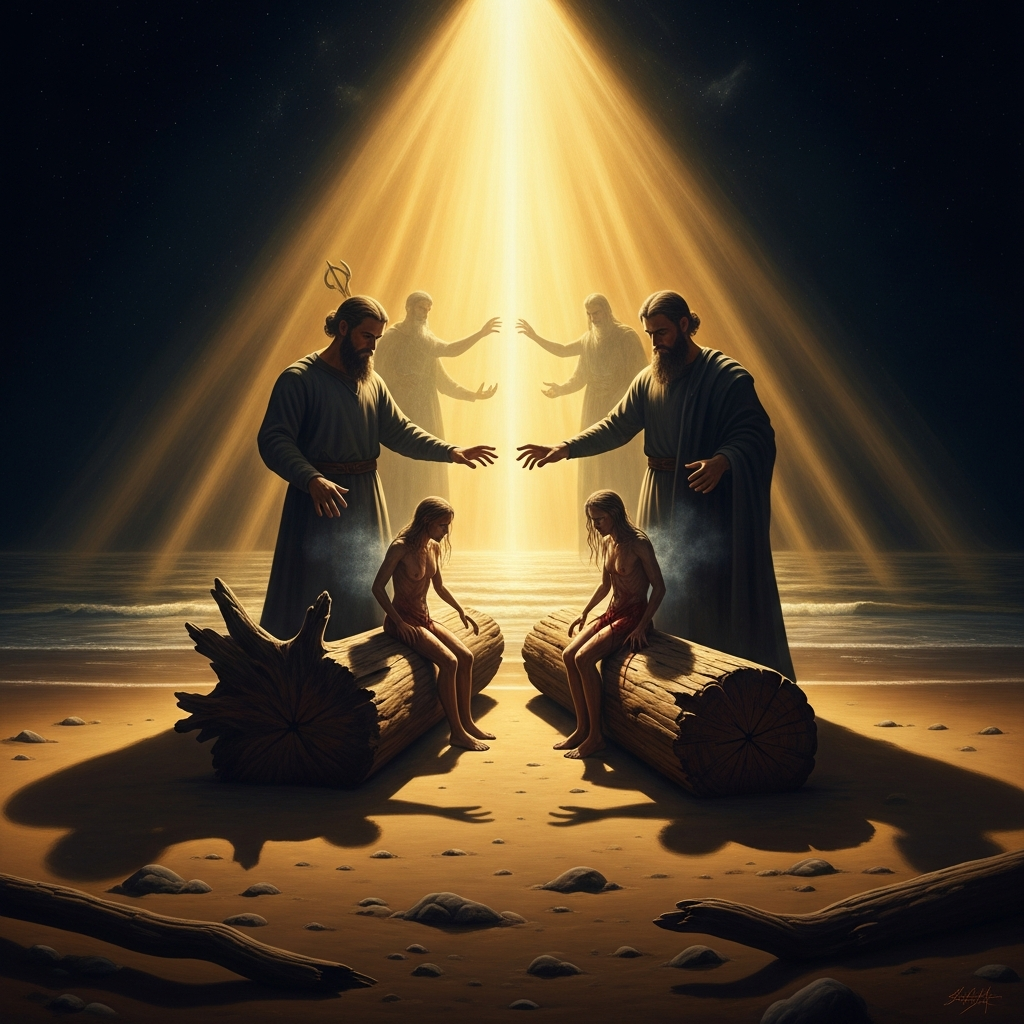
Odin, Vili, Vé. Three brothers in the long pale light of an afternoon at the edge of the world. They are walking on a strand at the boundary between Midgarðr and the encircling sea. They find two logs. The logs have been tossed up by the surf. One of the logs is an ash; the other is an elm. They are not particularly distinguished logs. They are weather-worn and salt-bleached and unimportant.
Odin stoops and picks up the ash. He breathes on it. The wood does not burn or smoke; it warms. The brothers look at one another. They lay the log down on the sand and they breathe on it together. Vili gives it a mind. Vé gives it speech and senses and a face. The log opens its eyes. The log is a man. They name him Askr — Ash.
They do the same to the elm. The log opens its eyes. The log is a woman. They name her Embla — possibly Elm, possibly Vine, the philologists are not sure, and it matters less than it might because the name is also a sound and the sound is a sound the wind makes through a leafless tree in winter. Embla.
The brothers give them clothes. They give them the world. They walk away.
This is what the Völuspá will not let the listener forget: that humans are the youngest thing in the world, the newest invention, the smallest of the late additions, and that the cosmos around them was built by violence they did not commit and cannot undo. The mountains they climb are bones; the rivers they drink are blood; the sky they stand under is a skull pinned at four corners by four small persons who have been holding it up since before history began. The clouds are someone else’s thinking.
To live in this world, the Norse texts insist, is to live inside a body that was killed for the purpose. There is no consolation that disguises this fact. There is only the hall-fire, and the loyalty of companions, and the brief warmth of being awake at all in a cosmos that was furnished, before you arrived, by murder.
Askr and Embla, the texts say, looked around them at the world the brothers had given them. They did not, in any version of the myth, give thanks. They did not pray. They did not weep.
They began to walk inland.
The eyebrow-fence was high. The light was failing. They had a long way to go before they would find the ash tree at the center of the world, and they did not yet know that they were going to find it; they only knew that they had been made, that they were here, and that the country in which they were here was made of someone.
It was getting cold.
They walked faster.
Scenes
Before the world: Ginnungagap, the yawning void
Generating art… The cosmic cow Auðumbla licks salt from a block of ice
 Generating art…
 Odin, Vili, and Vé kill Ymir at the foot of the world
 Generating art…
 The brothers raise Ymir's skull as the dome of the sky
 Generating art…
 On a beach at the edge of Midgard the brothers find two logs of driftwood: an ash and an elm
 Generating art…
 Echoes Across Traditions
Entities
- Ymir
- Auðumbla
- Búri
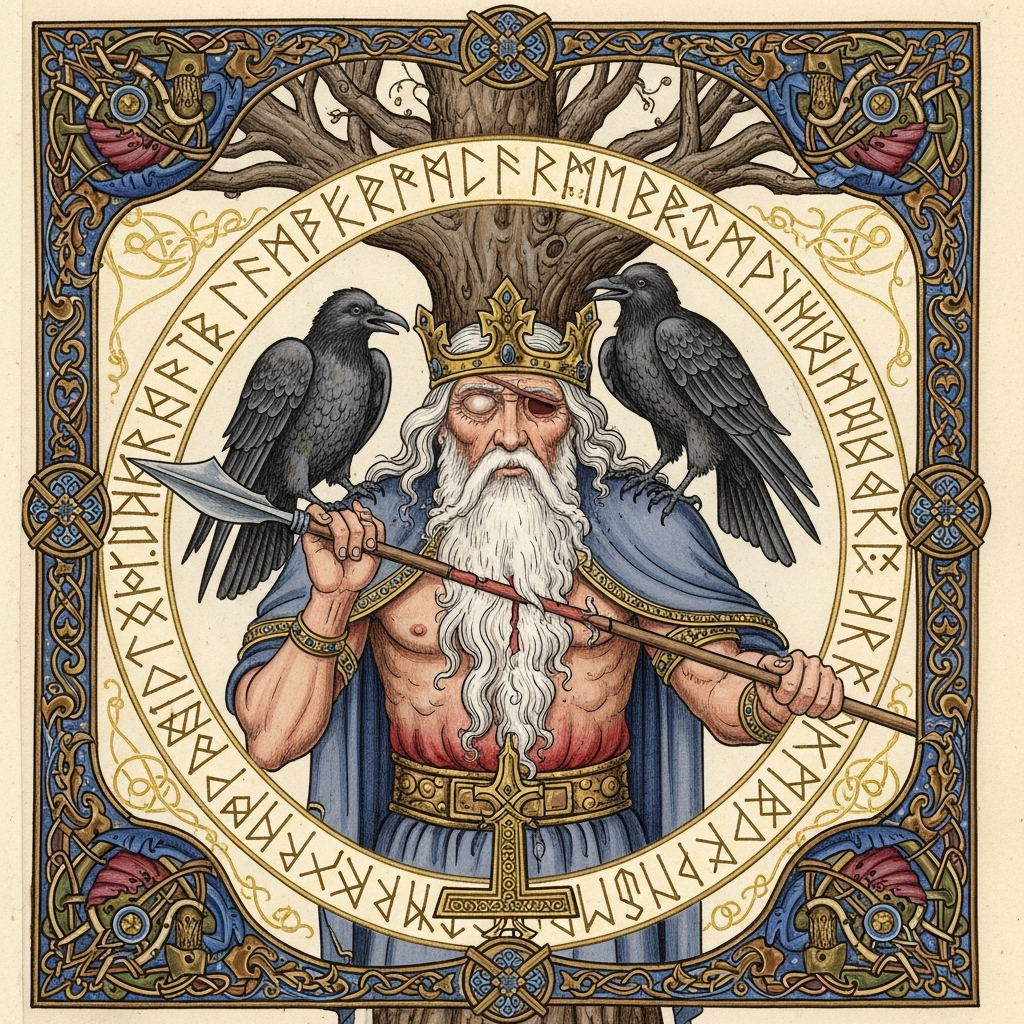
- Odin
- Vili
- Vé
- Askr
- Embla

Sources
- Snorri Sturluson, *Prose Edda* (Gylfaginning ch. 4–9), c. 1220 CE
- *Völuspá* (Poetic Edda), stanzas 3–4, 17–18
- *Vafþrúðnismál* (Poetic Edda), stanzas 20–21, 28–35
- John McKinnell, *Meeting the Other in Norse Myth and Legend* (Brewer, 2005)
- Rudolf Simek, *Dictionary of Northern Mythology* (trans. Angela Hall, Brewer, 1993)