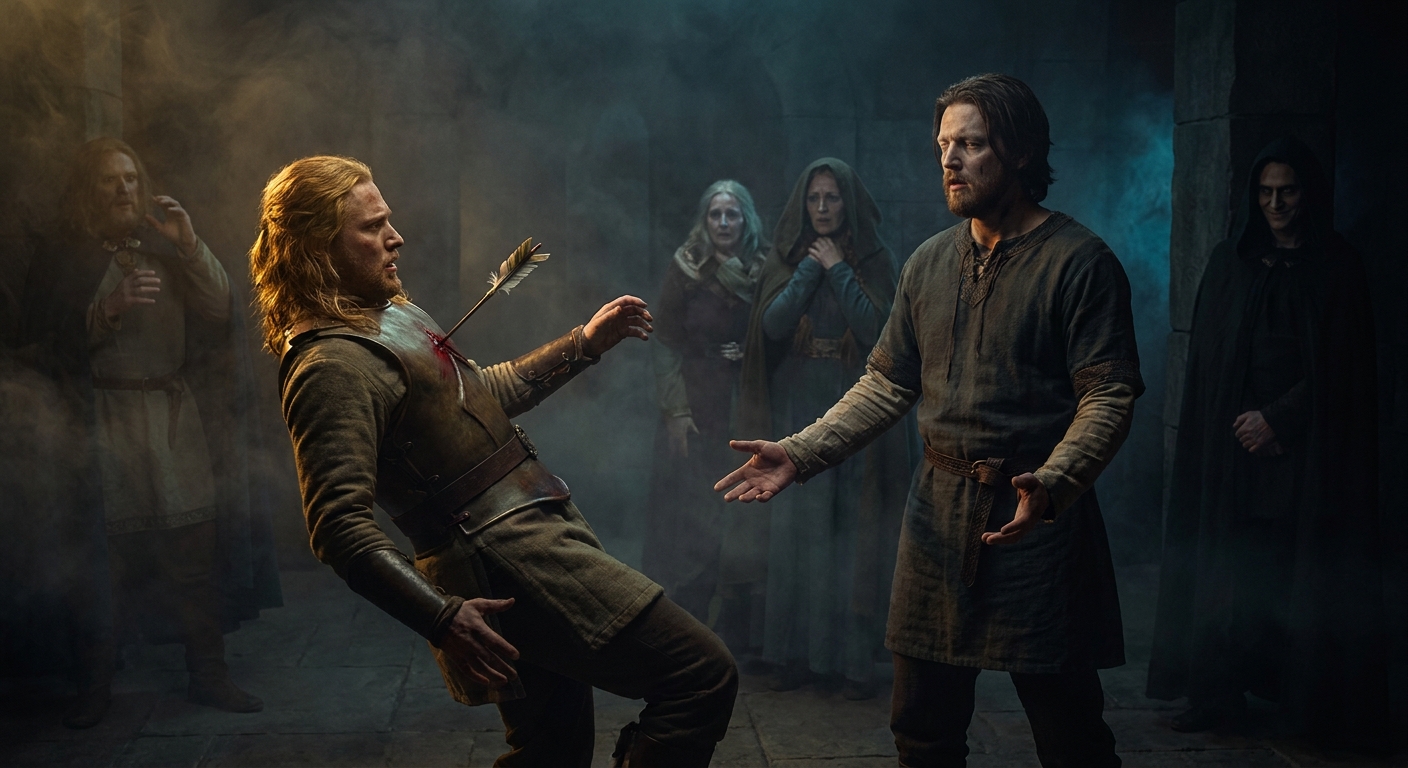
The Death of Baldur
Mythic Time · Snorri ~1220 CE; oral tradition centuries earlier · Asgard · then the road to Hel
Contents
Frigg makes all of creation swear not to harm her radiant son — all except the mistletoe, too small to matter. Loki finds the gap. The blind god Hodur throws. The world's most beloved god falls, and every road from that moment leads to Ragnarok.
- When
- Mythic Time · Snorri ~1220 CE; oral tradition centuries earlier
- Where
- Asgard · then the road to Hel
The dreams begin in the dark.
Baldur — brightest of the Aesir, the one whose radiance makes Asgard worth looking at — wakes screaming. Night after night the same images: darkness swallowing him, the cold that has no season, the road that runs only one direction. He is not a god given to fear. He tells Frigg. He tells Odin. He tells the hall.
This is the mistake that starts everything.
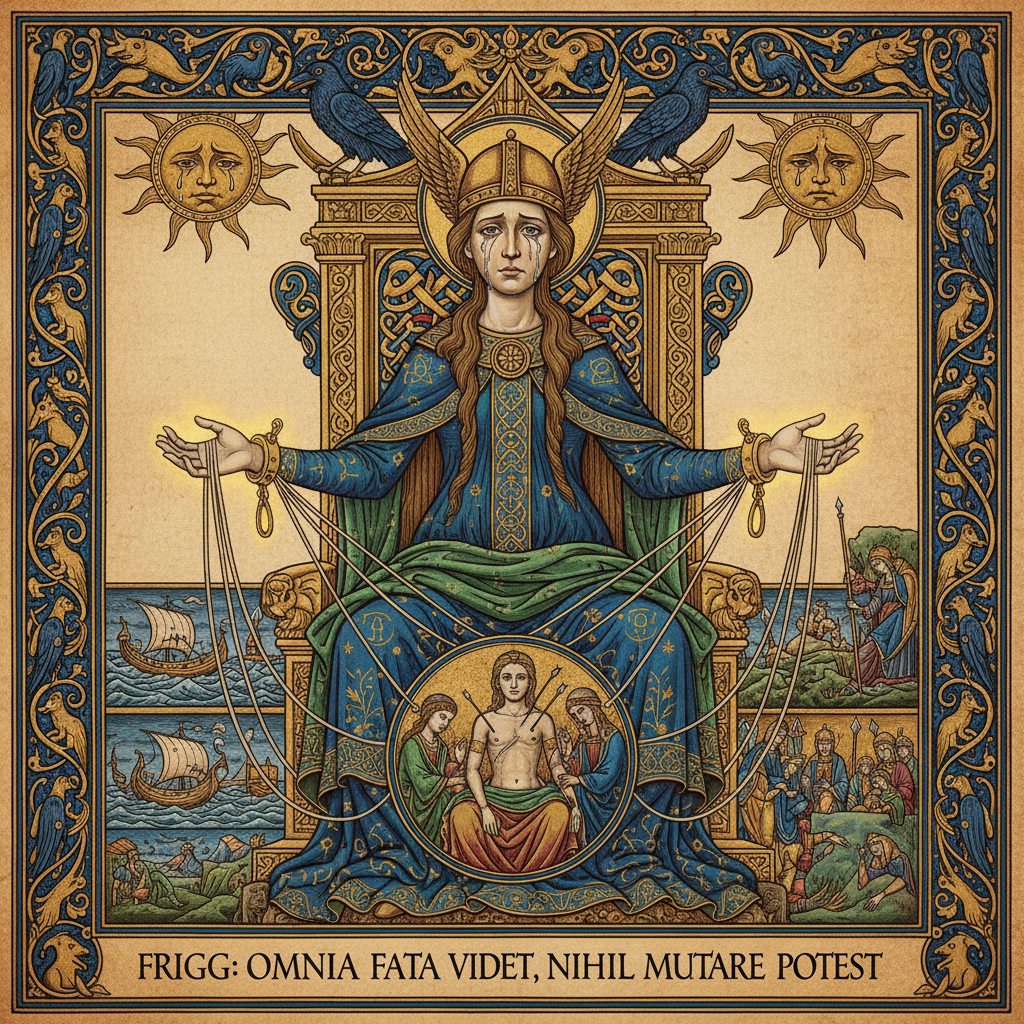
Frigg acts the way a mother acts when the world threatens her child: she moves. She travels to every corner of the Nine Realms — fire and ice, stone and water, metal and disease, poison and every beast that walks or swims or crawls — and she extracts an oath from each. Swear you will not harm him. Swear it on whatever you are. They swear. Every substance in creation makes the same promise.
She returns to Asgard with the weight of ten thousand oaths in her hands. It is the largest net ever cast across fate. It has one hole.
The mistletoe. She finds it growing on the west side of Valhalla — a small, pale, almost accidental plant. She looks at it and makes a decision that will end an age: it is too young, she thinks. Too weak. Not worth the ceremony of an oath. She passes it by.
Fate is patient. It can wait for a mother to look away.
In Asgard they turn Baldur’s invulnerability into a game. The Aesir take turns throwing things at him — spears, stones, axes — and everything bounces back harmlessly. He stands in the middle of the field and laughs. The gods laugh. It is the best game anyone has ever played, because the beloved is perfectly safe and the reminder of his safety is a kind of joy.
Only Hodur does not throw. Hodur is blind. He stands at the edge of the field and listens to his brother’s laughter and does not know what to do with his hands.
Loki notices the one god standing apart.
Loki is bored the way Loki is always bored when things go well — with a specific, focused malice. He has already assessed the oaths. He already knows about the mistletoe. He finds it where Frigg left it, cuts a sprig, shapes it into something that can be thrown. Then he walks to where Hodur stands.
Why don’t you honor your brother? he asks. Why do you stand here doing nothing while the others celebrate him?
Hodur says: I cannot see. I have nothing to throw.
Loki presses the mistletoe into his hands. He stands behind the blind god and aims him like a weapon. Here, he says. I’ll guide you. Throw toward your brother’s laughter.
Hodur throws.
The mistletoe goes through Baldur.
That is the only way to say it. Not deflected. Not stopped. Through. He falls the way a cut tree falls — without drama, without a fight, the way things fall when they have simply been struck true. He hits the ground and does not get up.
The field goes silent. The kind of silence that rewrites everything that came before it.
Odin knows before anyone else says a word. The All-Father stands at the edge of the gathering and knows, because this is the crack he has been watching for — the fracture line that runs from this moment forward to the last battle. He has sat in the high seat Hliðskjálf and seen every corner of the Nine Realms, and the one thing he has never been able to see past is this: his son on the ground, the game stopped, the age turning.
He does not shout. He does not move. He does not weep. He is the god who hung nine nights on a tree to learn the cost of knowledge, and now he knows that some costs are not metaphors.
They carry Baldur to his ship, Hringhorni, the largest ship ever built. They load it with everything worthy of him: his horse, his weapons, his wife Nanna — who looks at the pyre and her heart simply stops, the way hearts stop when the reason for them is gone. They place her beside him. They set it alight and push it to sea.
The fire on the water is visible from every realm.
Hermod, Odin’s swift son, rides nine days and nine nights through valleys of darkness to reach the gates of Hel. He finds Hel’s hall: broad and cold, the gate Nágrind, the river Gjöll. Baldur is there, seated in the place of honor, because even in death the beloved is given the best seat. He looks well. He looks exactly like himself, except that the light around him is the light of a place where no sun reaches.
Hermod asks Hel for his return.
Hel sets her condition the way a ruler sets conditions — with the certainty of someone who has never been refused. If every being in all the Nine Realms weeps for Baldur, she says, he may return. If even one being refuses, he stays.
Every being weeps. The rocks weep. The trees weep. Even the creatures of Jotunheim, who have no particular affection for the Aesir, weep — because Baldur was the kind of thing that even enemies mourn, the beauty that belonged to everyone simply by existing.
One being does not weep.
In a cave at the edge of a forest, a giantess named Thökk — old, colorless, indifferent — hears the messengers and says: Baldur brought me no joy in life. Let Hel keep him. She says it with the flat certainty of someone who has decided the world does not deserve to have beautiful things back.
Thökk is Loki. The messengers return empty-handed.
Baldur remains in Hel.
Loki’s role becomes known. The Aesir bind him in a cave with the entrails of his own son, a serpent dripping venom on his face. He writhes there until the end of days, and the earth shakes with his writhing, and men call it earthquakes, because the truth is too large.
Ragnarok is not scheduled yet. But the clock has started. The first god is dead. The god of joy and light and the thing that made the games worth playing is gone from the realm of the living. What remains of Asgard functions as it always has — the feasts, the hunts, the preparations for the last battle — but something is missing from the center of it.
Vǫluspá names the moment: the seeress sees it in her vision of the past and it is still grieving when she speaks it. She saw Baldur’s fate / the blood-drenched god / Odin’s son / his destiny set. The verb tenses do not matter. Past or future, the wound is the same shape.
The story does not end in darkness. The Vǫluspá looks past Ragnarok to the world that comes after — earth rising green from the sea, unsown fields growing themselves, waterfalls running clean — and in that new world Baldur comes back. He and Hodur both, reconciled, walking back out of Hel into the light of a sun that has a daughter now, because the old one was swallowed.
But that is after the burning. After the wolf and the serpent and the fire from the south. After everything that Odin has been trying to prevent since the moment his bright son hit the ground.
He has been to see the seeress. He knows how it goes. He knows that Baldur returns.
He knows what has to happen first.
The Death of Baldur is Norse mythology’s central tragedy — not a war story, not a monster story, but a story about the thing that protection cannot protect against. Frigg’s oaths are as complete as love can make them. Loki’s plan requires only the one gap she left. The gap is always the thing you deemed too small to matter.
The structural echo across traditions is precise enough to be unsettling: Christ betrayed by Judas; Osiris deceived by Set; Achilles struck in the heel; all of them the beloved, the luminous, the one whose death the world cannot absorb. What the Norse version adds is the refusal — Thökk in the cave, the one withheld tear that keeps Baldur in Hel. Every tradition has the death. Not every tradition has the moment where rescue is possible and someone chooses to let it fail.
That choice — Loki’s second intervention, the disguise in the cave, the single dry eye — is the hinge of the mythology. It is not enough to kill the god. The adversary must also prevent the return. And he does, at the cost of everything, because in the end Loki is not satisfied with one wound.
He needs the world to know it cannot have Baldur back.
Echoes Across Traditions
Entities


Sources
- Snorri Sturluson, *Prose Edda* (Gylfaginning 49-51, ~1220 CE)
- *Vǫluspá* 31-33, 62 (*Poetic Edda*, Codex Regius c. 1270)
- *Baldrs draumar* (*Poetic Edda*)
- Carolyne Larrington (trans.), *The Poetic Edda* (Oxford, 1996)