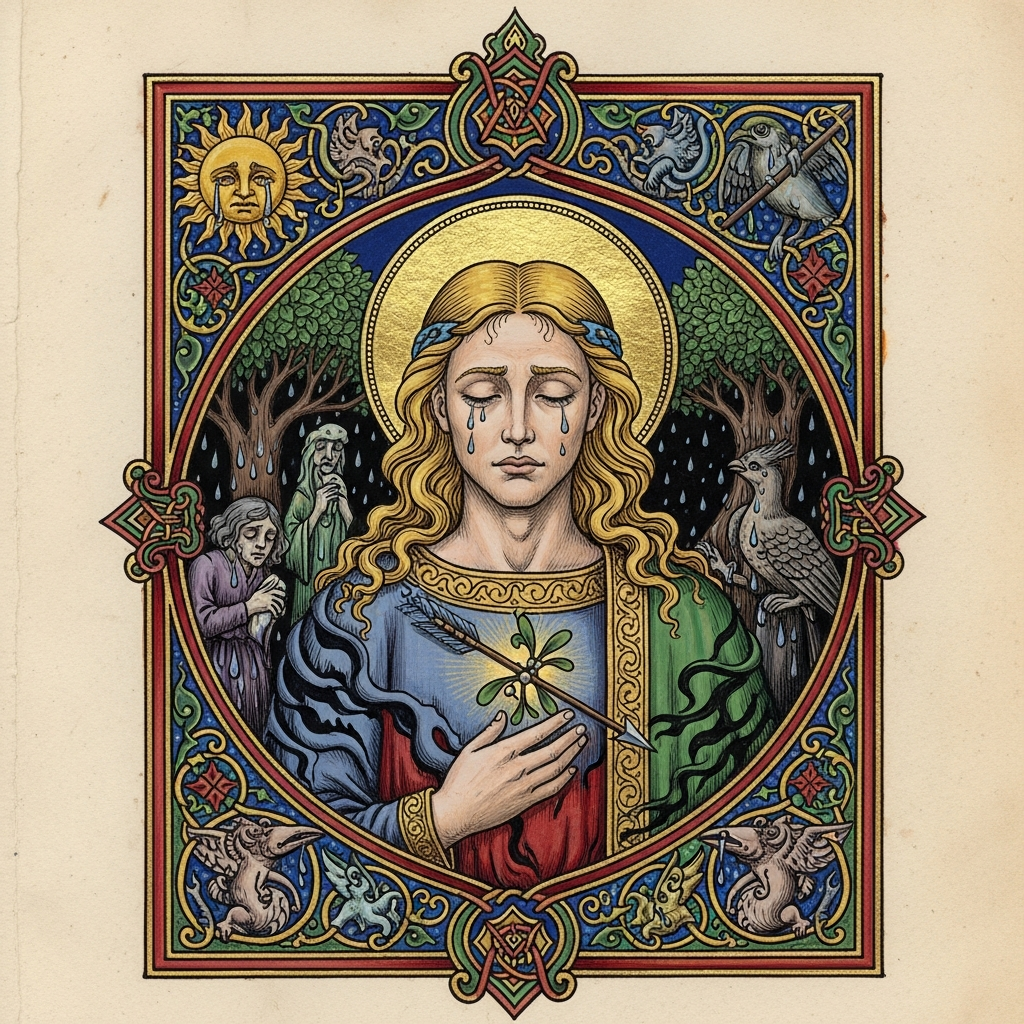
Combat Profile
Ragnarök's Sorrow
Baldur's death and prophesied return symbolizes cyclical renewal, allowing him to resurrect fallen allies once per battle.
Aesir Radiance
All nearby allies gain immunity to despair and dark magic while Baldur's presence endures, reflecting his nature as the purest light in Norse cosmology.
Mistletoe -- the one substance that never swore not to harm him
“Baldur the Good dreamed great and perilous dreams touching his life. When he told them to the Aesir, they took counsel together and resolved to seek protection for Baldur from every kind of danger.” — Prose Edda, Gylfaginning 49
“She saw there wading through heavy streams / men foresworn and murderers… / there Nidhogg sucked the corpses of the dead / — would you know yet more? / … / She sees, coming up a second time, / earth from the ocean, eternally green; / the waterfalls plunge, an eagle flies over them… / Unsown acres will grow, / all ills will be healed, / Baldur will come back.” — Voluspa 39-62 (selected stanzas)
Lore: Baldur is the most beloved figure in Norse mythology. He is the son of Odin and Frigg, and everything about him radiates light and goodness. The myths describe him as the most beautiful of the gods, the wisest, the most eloquent, the most gracious — and so beloved that no judgment against him can hold (Snorri, Gylfaginning 49). When Baldur began having dreams of his own death, the gods were terrified, and Frigg extracted oaths from all things in creation not to harm him (Gylfaginning 49). The gods then amused themselves by throwing weapons at Baldur and watching everything bounce off (Gylfaginning 49). But Loki discovered that Frigg had overlooked the mistletoe. He fashioned a dart from it and placed it in the hands of Baldur’s blind brother Hodur, guiding his throw (Gylfaginning 49). The mistletoe pierced Baldur, and he fell dead. The grief of the gods was absolute. They sent Hermod to Hel to beg for Baldur’s return. Hel agreed — if every being in creation would weep for Baldur (Gylfaginning 49). Everything wept: gods, humans, animals, stones, trees, metals. Everything except one giantess, Thokk (Loki in disguise), who said: “Let Hel hold what she has” (Gylfaginning 49). And Baldur remained among the dead. But the Voluspa prophesies that after Ragnarok, after the old world burns and sinks and rises again green from the sea, Baldur will return to rule the renewed creation (Voluspa 62).
Parallel: This is the strongest single parallel in all of comparative mythology. Baldur is the most beloved and innocent figure in the divine order, killed through treachery engineered by the adversary, using an unwitting human instrument. He descends to the realm of the dead. He returns after the apocalypse to rule the new world. Christ is the most beloved of God’s creation, killed through treachery engineered by Satan, using Judas as the unwitting instrument. He descends to the dead (1 Peter 3:19, the Harrowing of Hell). He returns after the apocalypse to reign over the new creation (Revelation 21-22). The pattern is not approximate — it is structurally identical. Whether this represents independent theological insight, shared Indo-European mythological patterns, or Christian influence on the Norse retelling (see scholarly note below) is one of the great open questions in comparative religion.
2 min read
Loki (engineers his death); Hodur (the unwitting weapon)
Prose Edda (Gylfaginning 49); *Voluspa* 31-33, 62; *Baldrs Draumar*