Combat Profile
Gnaw the Roots
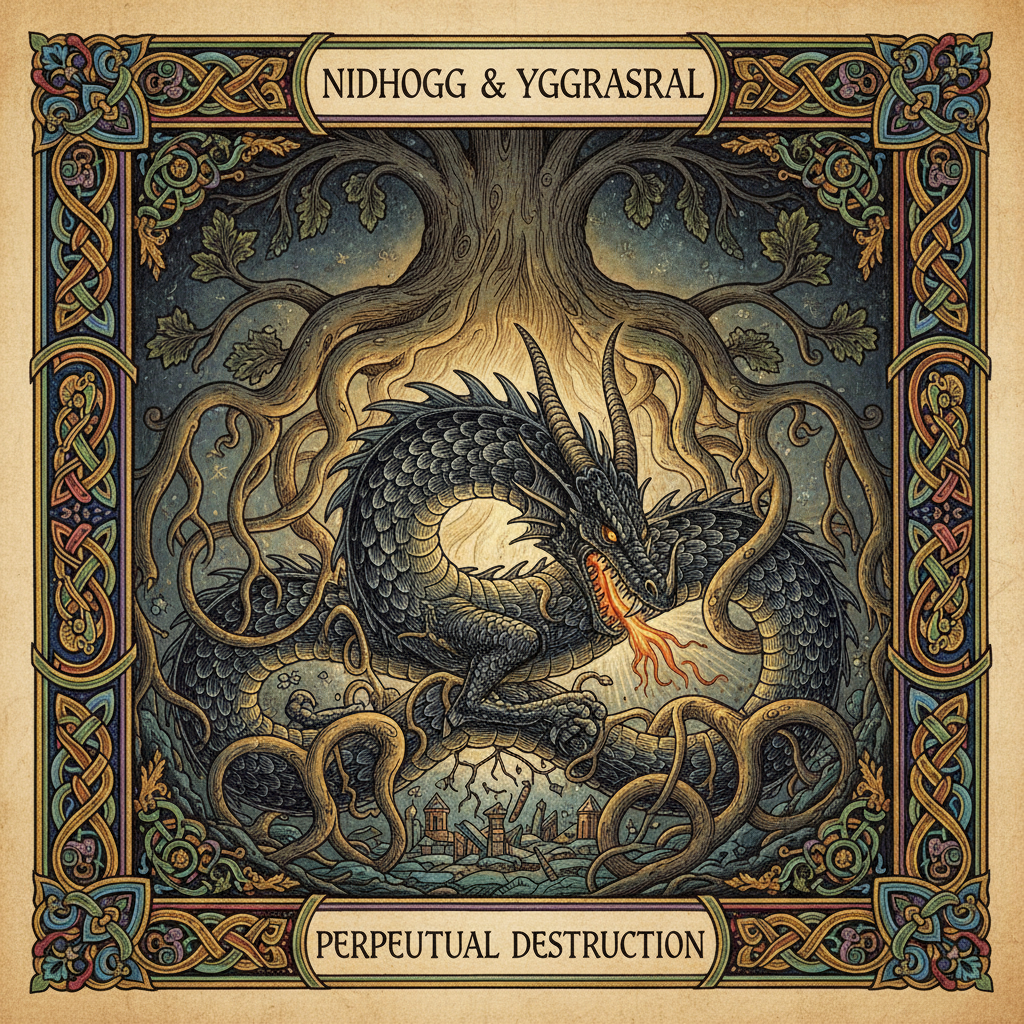
Nidhogg permanently weakens the fabric of reality itself, causing all defenses to crumble and all life to wither toward inevitable entropy.
Cosmic Decay
Everything Nidhogg touches begins to rot and corrupt, spreading inevitable doom that cannot be stopped, only delayed.
Bound to the roots of Yggdrasil -- it gnaws but cannot fully sever them
“There Nidhogg sucked the corpses of the dead, the wolf tore men — would you know yet more?” — Voluspa 39
Lore: Nidhogg (“Malice Striker”) is the dragon that dwells at the base of Yggdrasil, among the roots that reach into Niflheim. It gnaws ceaselessly at the roots of the World Tree, slowly weakening the structure that holds all Nine Realms in place. It also feeds on the corpses of oath-breakers, murderers, and adulterers who have been sent to the shore of corpses (Nastrond) in Hel. An eagle sits at the top of Yggdrasil, and the squirrel Ratatosk runs up and down the trunk carrying insults between the eagle and Nidhogg, fueling their eternal enmity. In the final stanza of the Voluspa, after the new world has risen green from the sea, Nidhogg is seen flying over the renewed earth carrying corpses in its wings — suggesting that even after Ragnarok, the dragon persists. Corruption and decay may be woven into the fabric of existence itself.
Parallel: Nidhogg parallels Satan’s role as the underminer of God’s creation — not through open warfare but through slow corruption, gnawing at the foundations. The serpent in Eden attacks the root of the human relationship with God; Nidhogg attacks the literal root of the cosmos. The image of a dragon/serpent at the base of a cosmic tree also appears in other traditions and may represent a universal mythological archetype: the chaos force that constantly threatens the ordered world.
1 min read
The eagle at the top of Yggdrasil (perpetual enemy; the squirrel Ratatosk carries insults between them)
*Voluspa* 39, 66; *Grimnismal* 32, 35; Prose Edda (Gylfaginning 15-16)