Combat Profile
Sight of All-Father
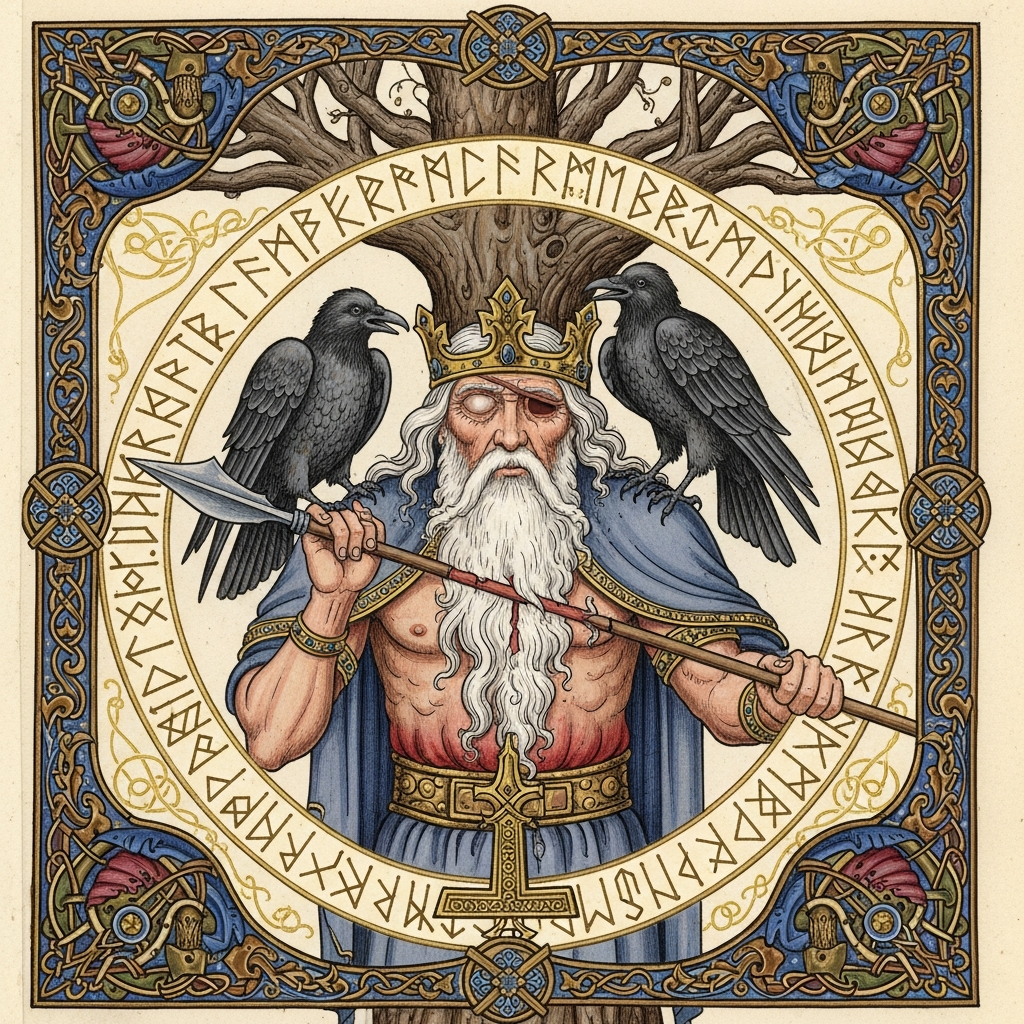
Odin perceives all events across the Nine Realms simultaneously through his ravens Huginn and Muninn, granting perfect knowledge of enemy tactics and future outcomes.
Rune Master
Odin's mastery of the Elder Futhark allows him to rewrite fate itself, gaining immunity to death magic and the ability to sacrifice himself to gain overwhelming power in critical moments.
Fated to die -- Fenrir will swallow him at Ragnarok. His pursuit of knowledge makes him ruthless and morally ambiguous
“I know that I hung on that windswept tree, / swung there for nine long nights, / wounded by my own spear, / dedicated to Odin, / myself to myself, / on that tree of which no man knows / from where its roots run.” — Havamal 138
Lore: Odin is the Allfather, lord of Asgard, god of wisdom, war, death, and poetry. He is not a benevolent sky-father in the Zeus or YHWH mold — he is a wanderer, a seeker, a manipulator, endlessly hungry for knowledge and willing to pay any price for it. He sacrificed his right eye at Mimir’s Well to drink from the waters of cosmic wisdom (Vafthrudnismal 26-27). He hung himself on Yggdrasil (the World Tree) for nine days and nine nights, pierced by his own spear, an offering of himself to himself, to gain the secret of the runes — the fundamental alphabet of reality (Havamal 138-141). He maintains two ravens, Huginn and Muninn (Thought and Memory), who fly across the world each day and report back everything they see (Grimnismal 20). He rules Valhalla, the hall of the slain, where the Einherjar (chosen warriors) feast and fight until they are needed for Ragnarok (Grimnismal 23-24). He knows the future. He knows he will die. He gathers his forces anyway.
Parallel: The parallels with Christ are among the most debated in comparative mythology. Both hang on a “tree” (the cross was called a tree — Acts 5:30, 1 Peter 2:24). Both are pierced by a weapon (spear of Gungnir / spear of Longinus). Both sacrifice themselves to achieve cosmic knowledge/salvation. Both endure the ordeal for a specific number of days (nine / three). Both offer “themselves to themselves” (Christ, as God, sacrifices himself to God). The differences are equally significant: Odin’s sacrifice gains knowledge for himself; Christ’s sacrifice gains salvation for others. Odin is cunning, deceptive, and self-serving; Christ is presented as selfless. Whether these parallels represent independent mythological patterns, Christian influence on Norse tradition, or something deeper is an open question.
2 min read
Fenrir (destined to kill him); his own fate-knowledge (he knows the end and cannot change it)
*Havamal* (Poetic Edda) 138-141; *Voluspa*; *Grimnismal*; Prose Edda (Gylfaginning)