Combat Profile
Seidr
Freya weaves fate itself through ancient magic, granting her the power to reshape destiny and perceive hidden threads of wyrd
Queen of the Valkyries
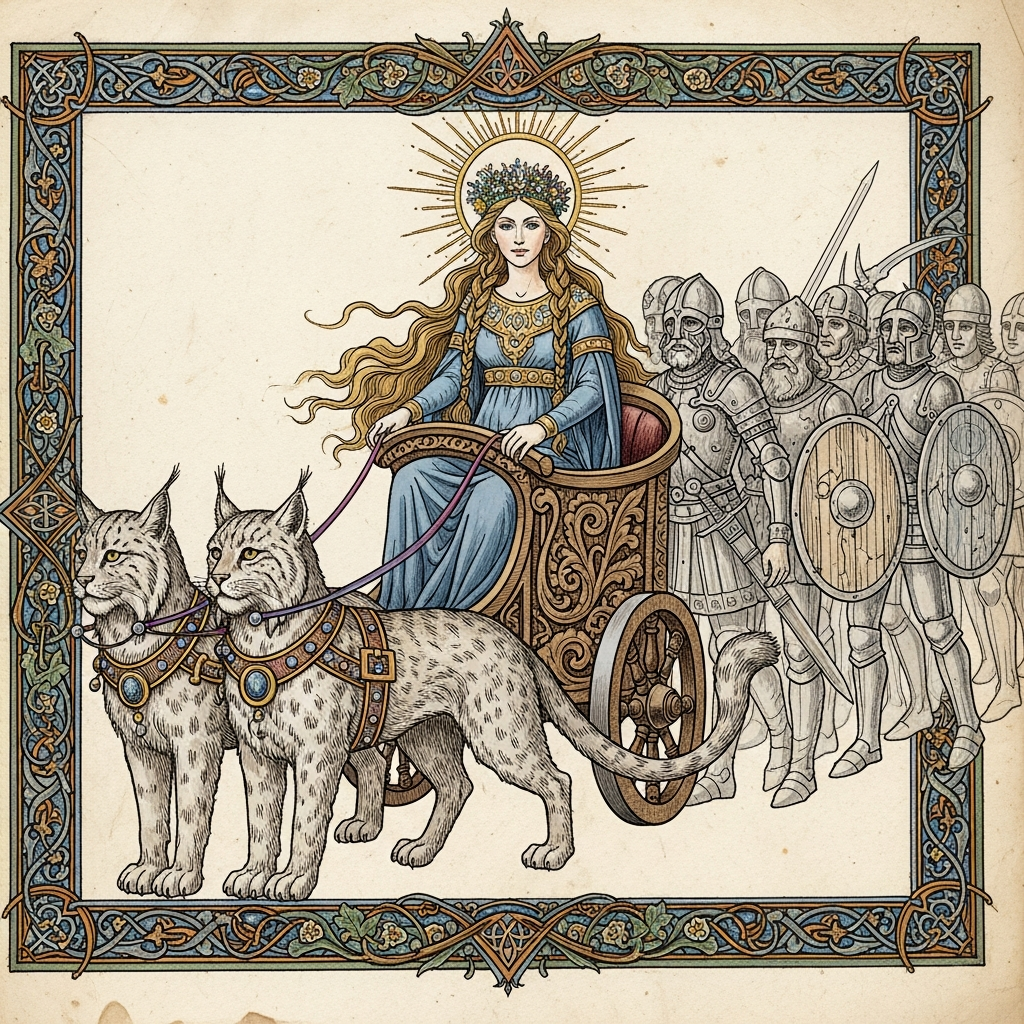
Freya claims half of all honored battle-slain, granting her dominion over death and resurrection of fallen warriors
Her husband Od is lost -- she weeps tears of gold searching for him. The Brisingamen necklace was gained at a controversial price
“Freya is the most renowned of the goddesses. She has a dwelling in heaven called Folkvangr, and wherever she rides to battle, she receives half of the slain.” — Prose Edda, Gylfaginning 24
Lore: Freya is the most complex goddess of the Norse pantheon. She is simultaneously the goddess of love and the goddess of death, of beauty and of war. She is one of the Vanir, sent to Asgard as part of the truce after the Aesir-Vanir War (Voluspa 21-24), and she brought with her the magic of seidr — the shamanic practice that Odin himself learned from her (Havamal 161). She wears the Brisingamen, a necklace of surpassing beauty forged by four dwarves (Sorla thattr). She drives a chariot pulled by two cats (Grimnismal 14). She has a cloak of falcon feathers that allows her to fly between realms (Havamal 49). Of all the Norse deities, Freya may have the broadest portfolio: love, sex, fertility, war, death, magic, and prophecy.
Parallel: Freya’s dual nature as love-goddess and death-goddess mirrors the ancient Near Eastern pattern seen in Ishtar/Inanna (Mesopotamian) and Astarte (Canaanite) — goddesses who ruled both erotic love and the battlefield. The “half of the slain” division with Odin is unique to Norse tradition and has no direct biblical parallel, though the concept of a feminine divine figure receiving the dead resonates with Catholic veneration of Mary as intercessor for souls.
1 min read
None specific; she survives Ragnarok in most traditions
*Voluspa*; *Thrymskvida*; Prose Edda (Gylfaginning); *Sorla thattr*