Combat Profile
Ragnarök's Herald
Loki breaks free from his chains and triggers the end of all things, dealing catastrophic damage and reshaping the battlefield itself.
Master of Deception
Loki's true form is obscured; enemies cannot reliably target or predict his actions, and he gains advantage on deception and misdirection.
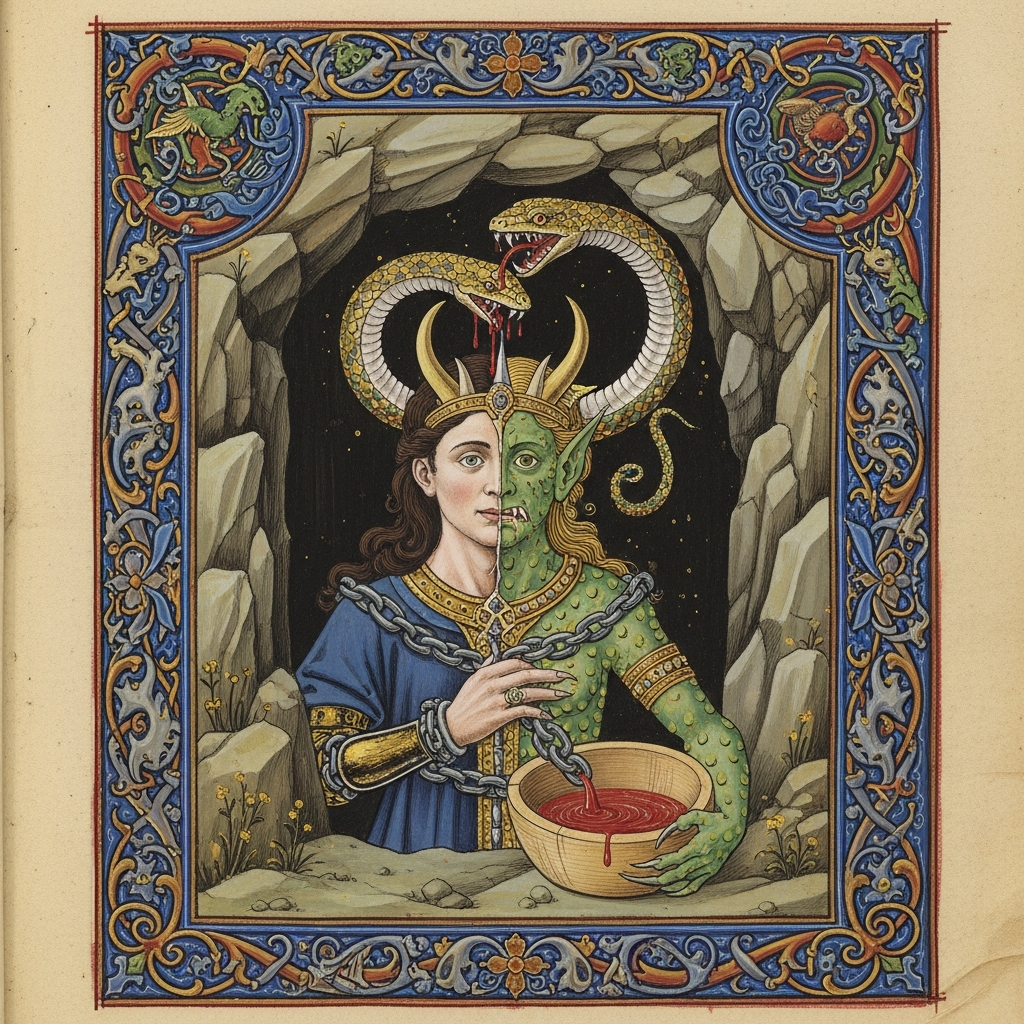
His own children are used against him (Narfi's entrails bind him). Serpent venom tortures him until Ragnarok
“Loki begat the wolf Fenrir with the giantess Angrboda; and he also begat the Midgard Serpent, and Hel.” — Prose Edda, Gylfaginning 34
Lore: Loki is perhaps the most fascinating figure in Norse mythology and one of the most debated. He is not one of the Aesir by birth — he is a giant’s son who became Odin’s blood-brother through a pact the myths never fully explain. He is the father of three of the most dangerous beings in the cosmos: Fenrir (the great wolf), Jormungandr (the World Serpent), and Hel (ruler of the dead). He is a shape-shifter who has been a salmon, a fly, a mare (and in that form gave birth to Odin’s eight-legged horse Sleipnir), and an old woman. In the early myths he is helpful, clever, and indispensable — it is Loki who retrieves Thor’s hammer, who obtains the treasures of the gods, who solves problems no one else can. But he grows darker. He becomes cruel. His tricks stop being funny. And then he engineers the death of Baldur — the single most devastating act in Norse mythology — by discovering that mistletoe was the one thing that never swore not to harm the beloved god, fashioning it into a weapon, and placing it in blind Hodur’s hand. After Baldur’s death, when Hel agrees to release Baldur if every being in creation weeps for him, Loki (disguised as the giantess Thokk) refuses to weep — condemning Baldur to remain among the dead. For this, the gods bind Loki with the entrails of his own son Narfi, beneath a serpent whose venom drips onto his face for eternity. His wife Sigyn holds a bowl to catch the venom, but when she turns to empty it, the drops hit Loki’s face and his writhing causes earthquakes. He will remain bound until Ragnarok, when he breaks free and sails to battle against the gods on the ship Naglfar (made from the fingernails of the dead), leading the forces of chaos alongside his children and the fire giants.
Parallel: The Loki-Satan parallel is among the most exact in all of comparative mythology. Both begin as members of the divine order (Loki as Odin’s blood-brother; Satan as a high angel). Both become adversaries through pride and malice. Both father or generate monstrous offspring (Loki’s children; Satan’s beasts in Revelation). Both engineer the fall of an innocent, beloved figure through deception (Baldur via mistletoe; Christ via Judas). Both are bound in chains as punishment (Loki under the serpent; Satan in the bottomless pit — Revelation 20:1-2). Both break free for the final battle. Both lead the forces of evil against the forces of good in the apocalypse. Both are ultimately defeated. The structural correspondence is almost point-for-point.
2 min read
Heimdall (they kill each other at Ragnarok)
*Lokasenna*; *Voluspa*; Prose Edda (Gylfaginning 49-51); *Baldrs Draumar*