Combat Profile
Mjolnir's Wrath
Unleash a devastating lightning strike that returns to your hand and strikes all enemies in its path, dealing massive damage.
Protector of Midgard
Reduce all damage taken by allies and gain increased strength during storms; immunity to lightning-based harm.
Jormungandr's venom (will kill him after he slays the serpent). Not clever -- frequently outwitted by giants and Loki
“Then Thor became angry, as he always did when he heard talk of trouble.” — Prose Edda
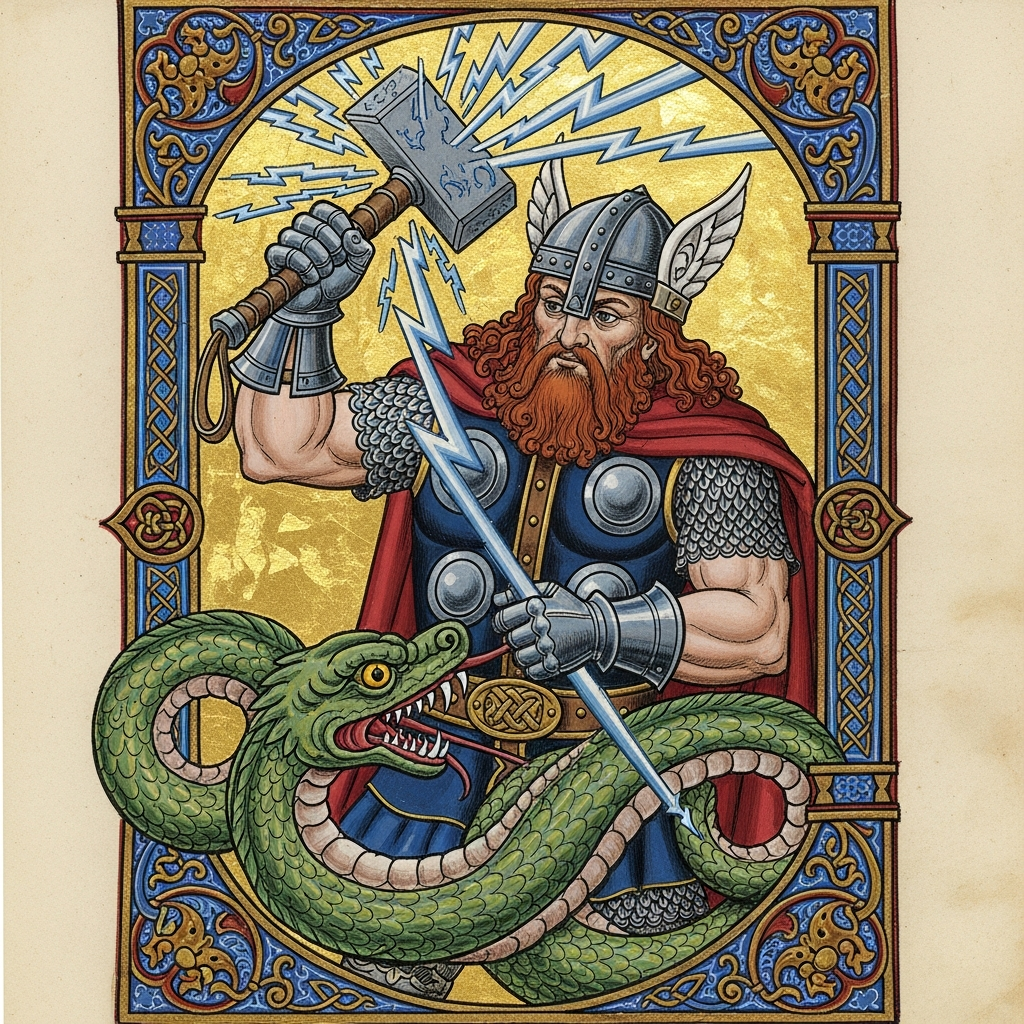
Lore: Thor is the most popular god of the Norse pantheon — not among the aristocracy (who favored Odin), but among the common people, farmers, and warriors. He is Odin’s son, the god of thunder, wielder of the hammer Mjolnir (forged by the dwarves Sindri and Brokkr, Skaldskaparmal), wearer of the iron gauntlets Jarngreipr and the belt Megingjord (which doubles his already legendary strength, Grimnismal 8). He rides a chariot pulled by two goats, Tanngrisnir and Tanngnjostr, which he can eat each night and resurrect each morning (Grimnismal 14). He is the protector of Midgard (the human realm) against the giants, and he is the arch-enemy of the World Serpent Jormungandr (Hymiskvida). At Ragnarok, Thor and Jormungandr will face each other for the last time. Thor will slay the serpent with Mjolnir, then walk nine steps and fall dead from its venom (Voluspa 56).
Parallel: Thor killing the great serpent parallels Michael the Archangel fighting the Dragon (Revelation 12:7-9). Both are the champion warrior of the divine order. Both face the serpentine embodiment of chaos. The key difference: Michael wins cleanly; Thor wins but dies. The Norse vision is tragic — even the gods cannot survive the end. Thunder gods who fight cosmic serpents appear across Indo-European mythology (Indra vs. Vritra in Vedic tradition; Zeus vs. Typhon in Greek), suggesting a deep shared root.
1 min read
Jormungandr (mutual kill at Ragnarok)
*Thrymskvida*; *Hymiskvida*; Prose Edda (Gylfaginning, Skaldskaparmal)