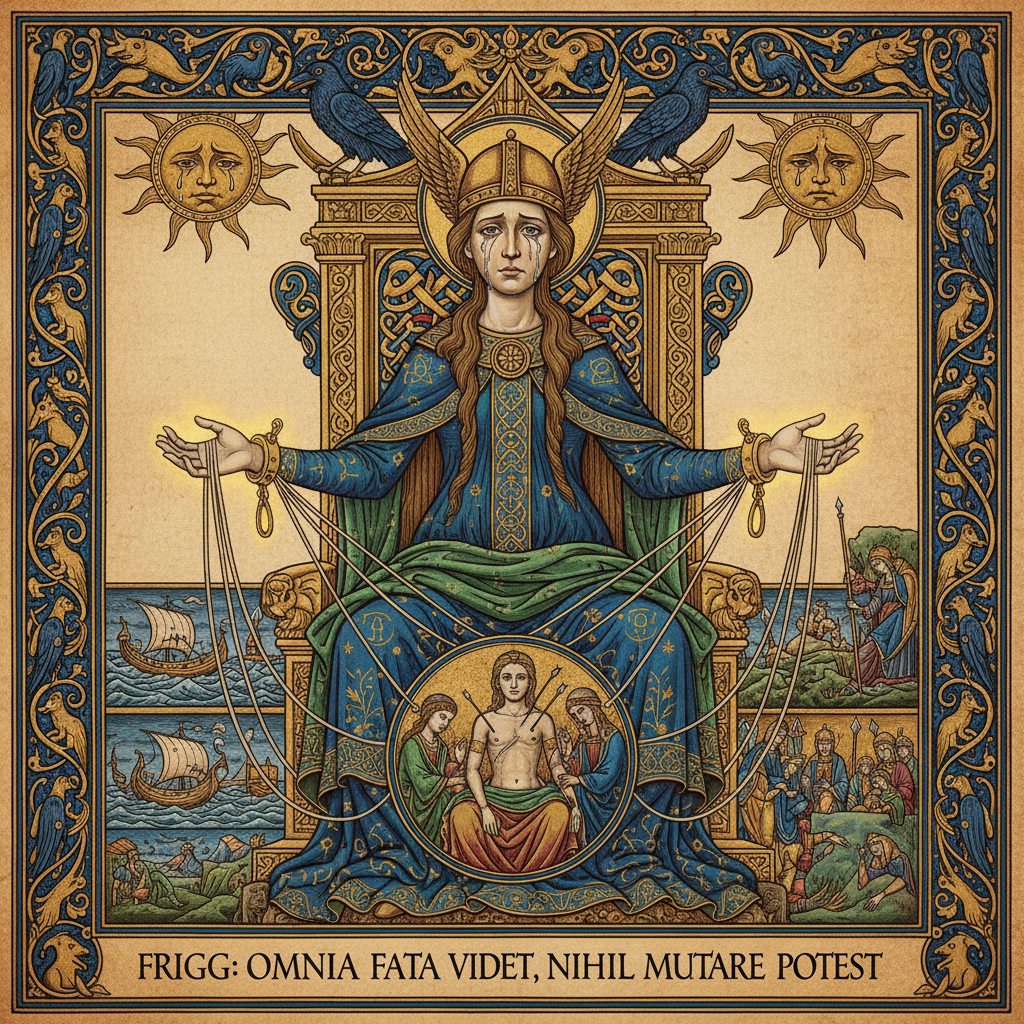
The Death of Baldr
Mythic time (recorded in *Gylfaginning* ch. 48–49, c. 1220 CE; *Baldrs draumar*, Poetic Edda) · Asgard — Baldr's hall Breidablik, the shore of the gods, and the burning sea
Contents
Baldr, the most beloved of all gods, begins to dream of his own death. Frigg extracts oaths from every thing in creation — all except one. Loki finds the exception. The dart flies. And Odin, standing on the burning pyre, leans down and whispers something in his dead son's ear that no one has ever heard.
- When
- Mythic time (recorded in *Gylfaginning* ch. 48–49, c. 1220 CE; *Baldrs draumar*, Poetic Edda)
- Where
- Asgard — Baldr's hall Breidablik, the shore of the gods, and the burning sea
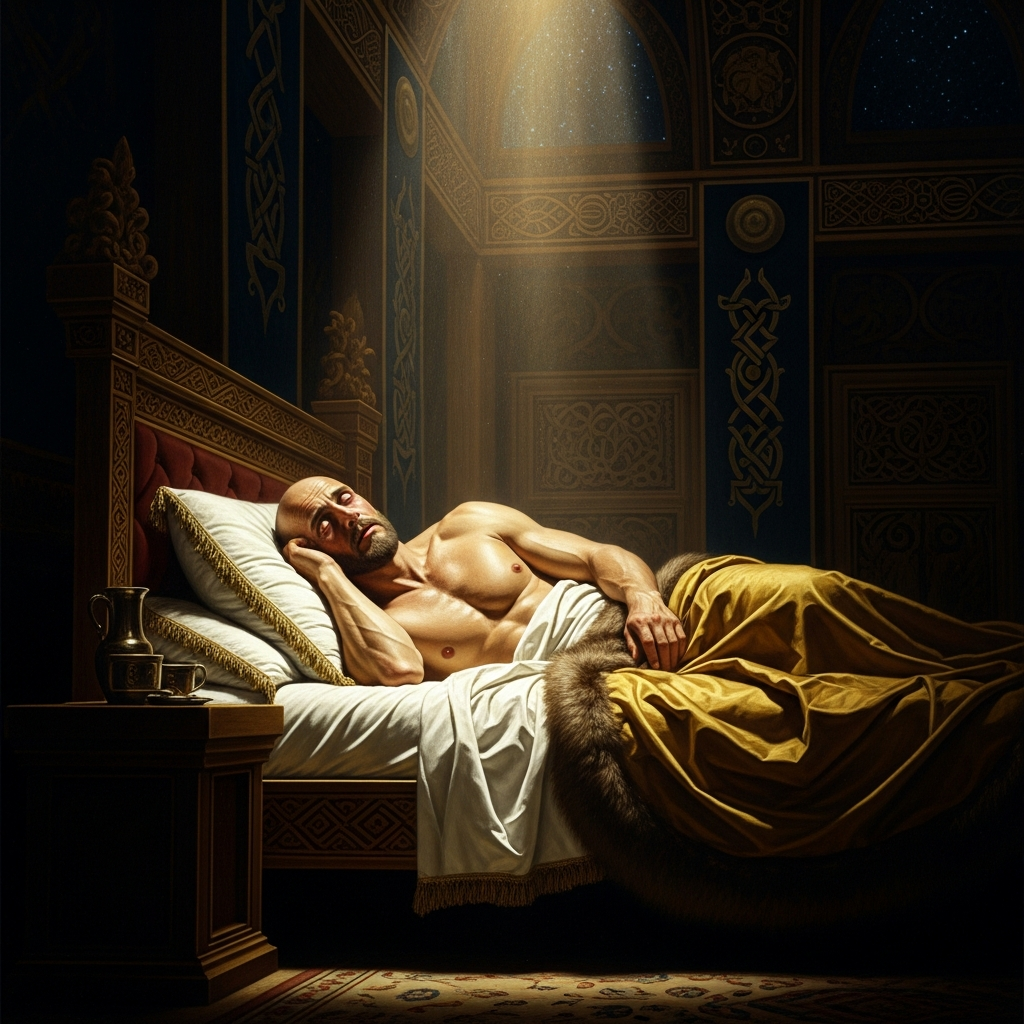
The dreams begin without warning.
Baldr wakes in Breidablik — his hall, whose name means the broad-gleaming, the only hall in Asgard with a prohibition against anything unclean entering it — and the pillow is damp, and the light of early morning does not comfort him the way it always has. He says nothing for three days. On the fourth day, he speaks.
He has dreamed of his own death.
In Asgard, a god’s dream is not anxiety. It is not metaphor. A god’s dream is what is going to happen, as clearly as thunder announces rain. Every god in the hall understands this when Baldr says it, and the understanding moves through the room the way a wave moves through still water: first the ones nearest him, then outward, and then everyone is standing in it.
Frigg does not wait.
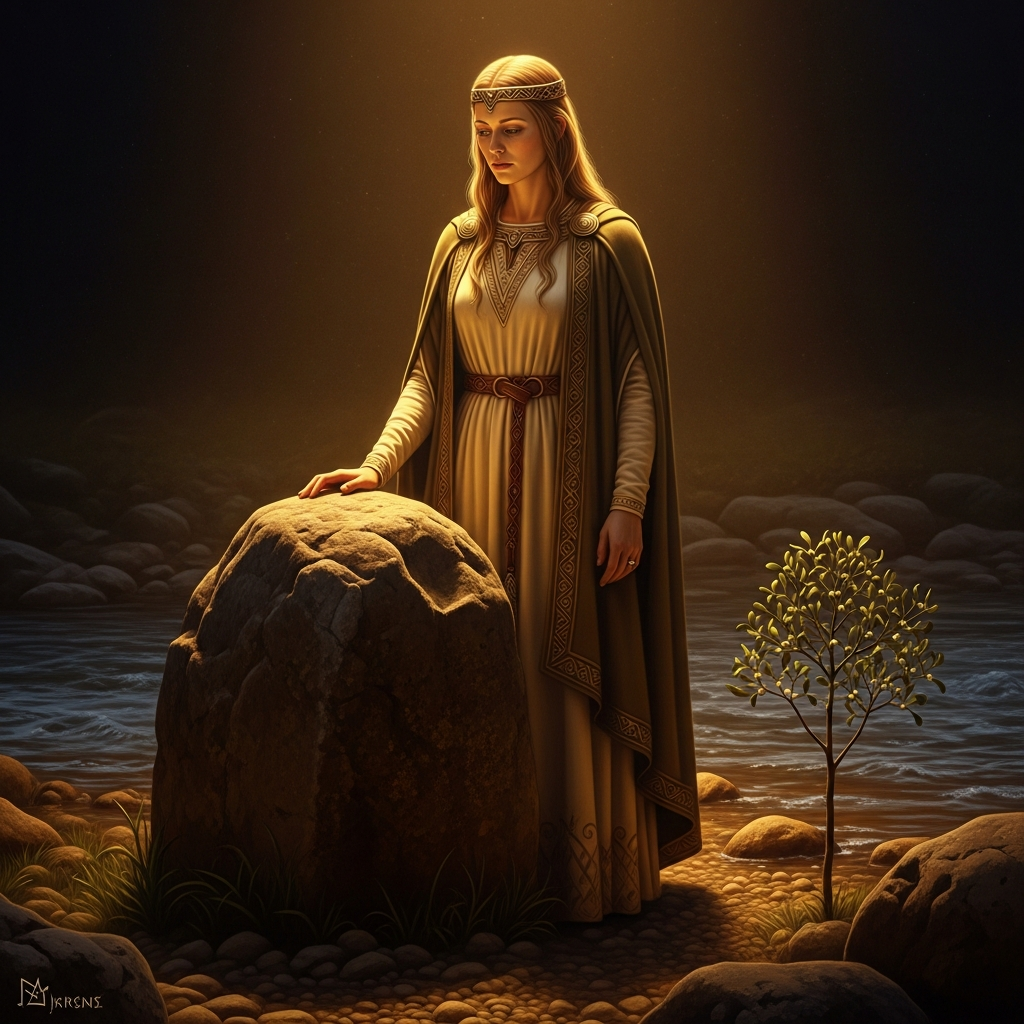
She leaves Asgard the same morning and begins to travel. She has decided on the only strategy available to a mother who loves what is most beloved: she will make the world promise. She speaks to fire. She speaks to water. She speaks to iron and to every other metal, to stones, to earth itself, to trees, to diseases, to animals, to birds, to every kind of venom, to every kind of serpent. They all agree. Why would they not? Baldr is Baldr — there is no malice in anything that looks at him. The oaths come easily.
She returns to Asgard. She has spoken to everything.
She has not spoken to the mistletoe.
It grew on the side of an oak east of Valhalla, she will say later, or not say — will think in the way that loss becomes permanent furniture in the mind. It was so young. It was small and pale and parasitic and it had no weapon and no will and no one had ever been afraid of mistletoe. There was no reason to ask it.
The gods, satisfied, invent a game.
They stand in a circle in the field before Valhalla and they throw things at Baldr. Stones. Axes. Fire. Spears. Each thing stops short of him as if the air itself refuses to be an instrument of harm. He stands in the center of the circle laughing, and the gods throw harder and laugh with him, and it becomes one of those afternoons in Asgard that are almost too good, the kind where eternity feels like enough.
Loki watches from the edge of the circle.
He watches for a long time. Later — much later, in the eddas, in every interpretation of the eddas, for centuries — people will ask why. The honest answer is that the myth does not give a reason, and the myth’s silence is more accurate than any reason would be. He watches. He cannot laugh. He cannot throw. He is outside the joy the way he is always outside it — too clever, too restless, too unfit for something this pure.
He leaves the field. He becomes an old woman. He finds Frigg.
He asks the old woman’s questions: what is everyone throwing at the young shining god, why does nothing hit him, did Frigg really get oaths from everything — everything? And Frigg, who has no reason to distrust an old woman, says almost. She mentions the mistletoe. Too young, too harmless.
Loki goes east of Valhalla to the oak.
The mistletoe is exactly as small and pale and harmless as Frigg described. He cuts a branch of it. He shapes it. What he makes is a dart — a small thing, a laughing thing, almost no thing at all. He carries it back to the field where the gods are still playing.
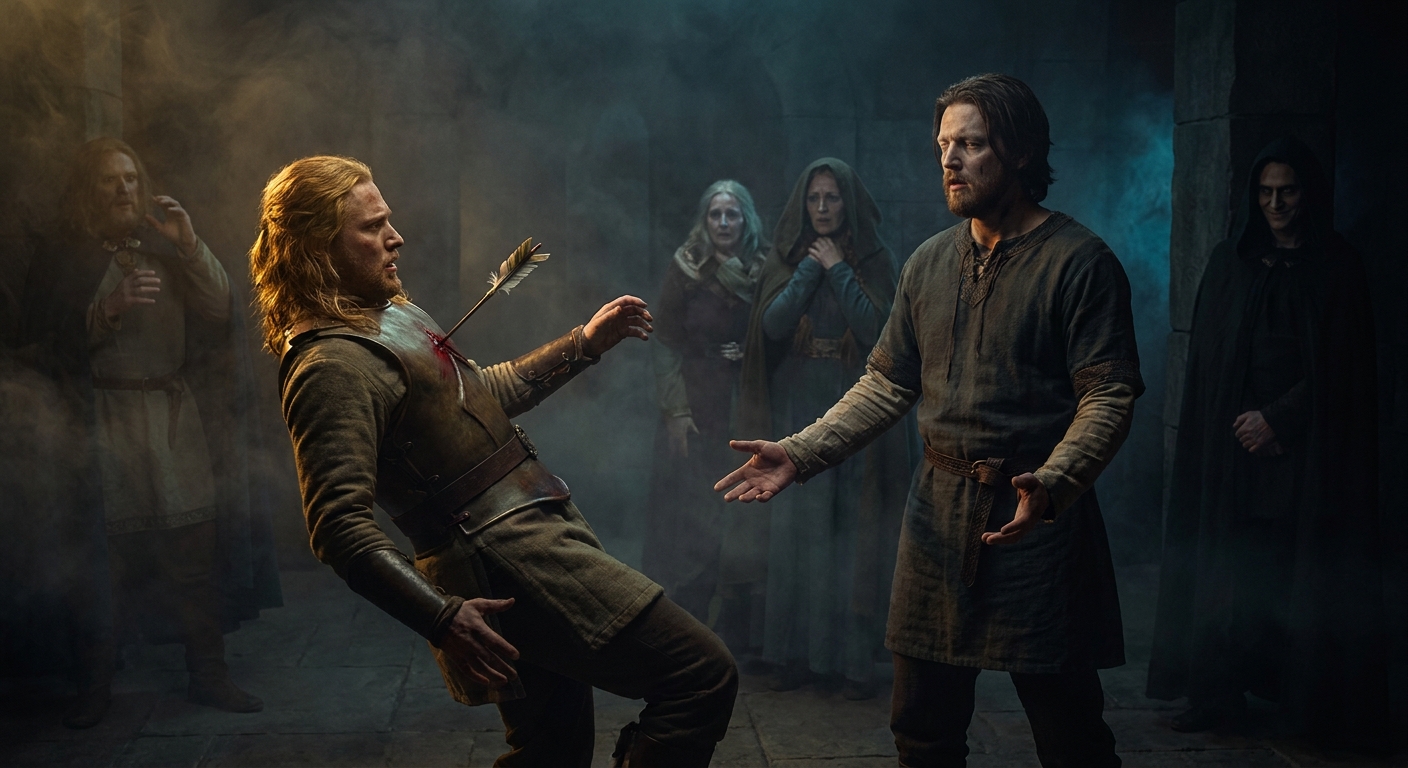
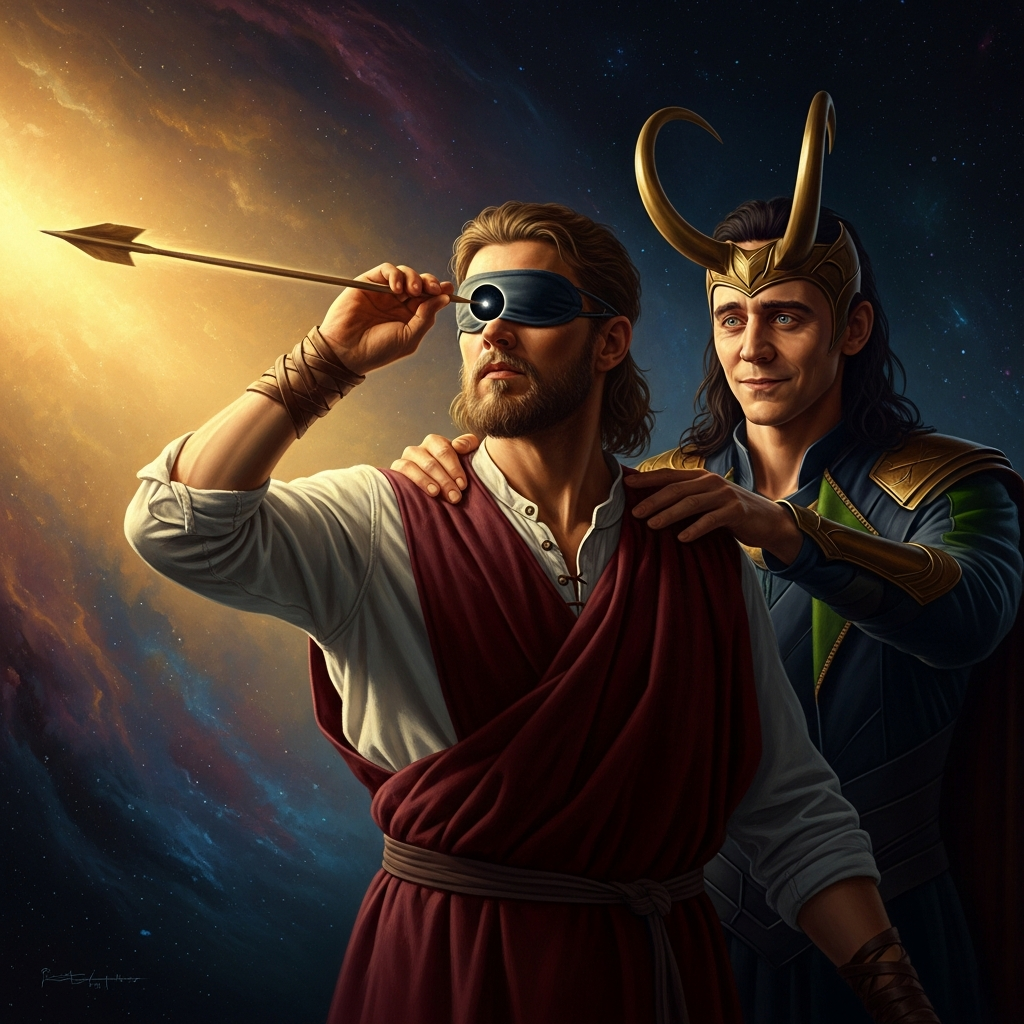
Höðr stands at the edge. Höðr, the blind god, Baldr’s brother, cannot participate. He has no weapon and could not aim it if he did. He is the only god outside the circle for a reason other than malice.
Loki stands behind him. He puts the mistletoe dart in Höðr’s hand. He aims for him. He says: throw.
Höðr throws.
The dart crosses the air. Baldr turns. The dart does not stop.
It enters him between two ribs and he falls.
The field goes absolutely quiet. Not the quiet of confusion — the quiet of comprehension. Every god there understands immediately what has happened and what it means. Baldr is lying in the grass in a way that grass does not support the living. The mistletoe dart is still in him. The game is over. The afternoon that felt like too much had been, it turns out, exactly that.
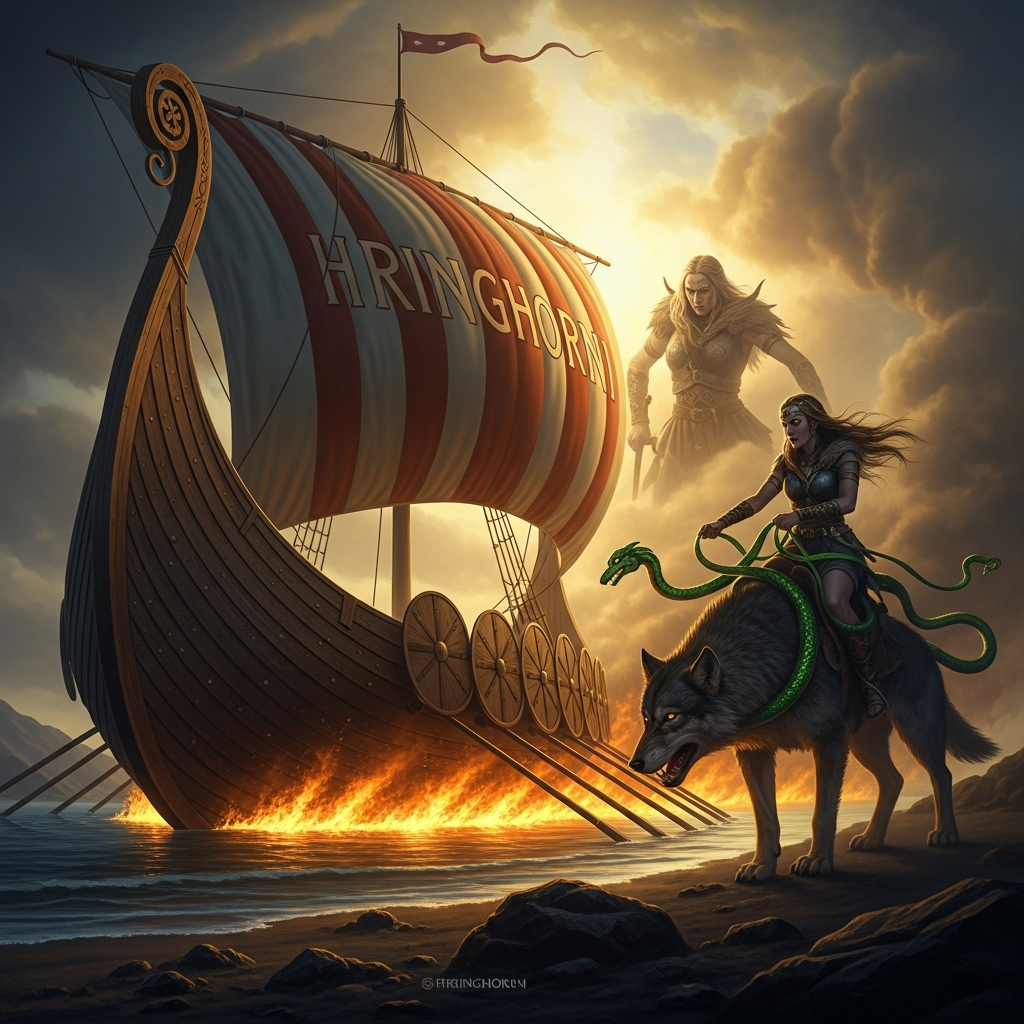
They carry him to the shore. Hringhorni — his ship, the greatest ship in the nine worlds — waits at the water’s edge. They try to push it out to sea so they can build the pyre on it. They cannot. No god can move it. A messenger rides to Jotunheim and returns with the giantess Hyrrokkin, who arrives riding a wolf the size of a small hill, using serpents as reins. Four berserkers hold the wolf while she dismounts. She puts her hands on the ship’s prow and shoves once, and the rollers beneath the hull catch fire from the friction, and the whole earth shakes, and Hringhorni moves into the water.
They carry Baldr’s body onto the ship. Nanna, his wife, sees him and her heart breaks in her chest — this is not a metaphor in the eddas; her heart breaks and she dies, and they lay her body beside his. Thor hallows the pyre with Mjölnir. The dwarf Litr runs across his path and Thor kicks him into the fire.
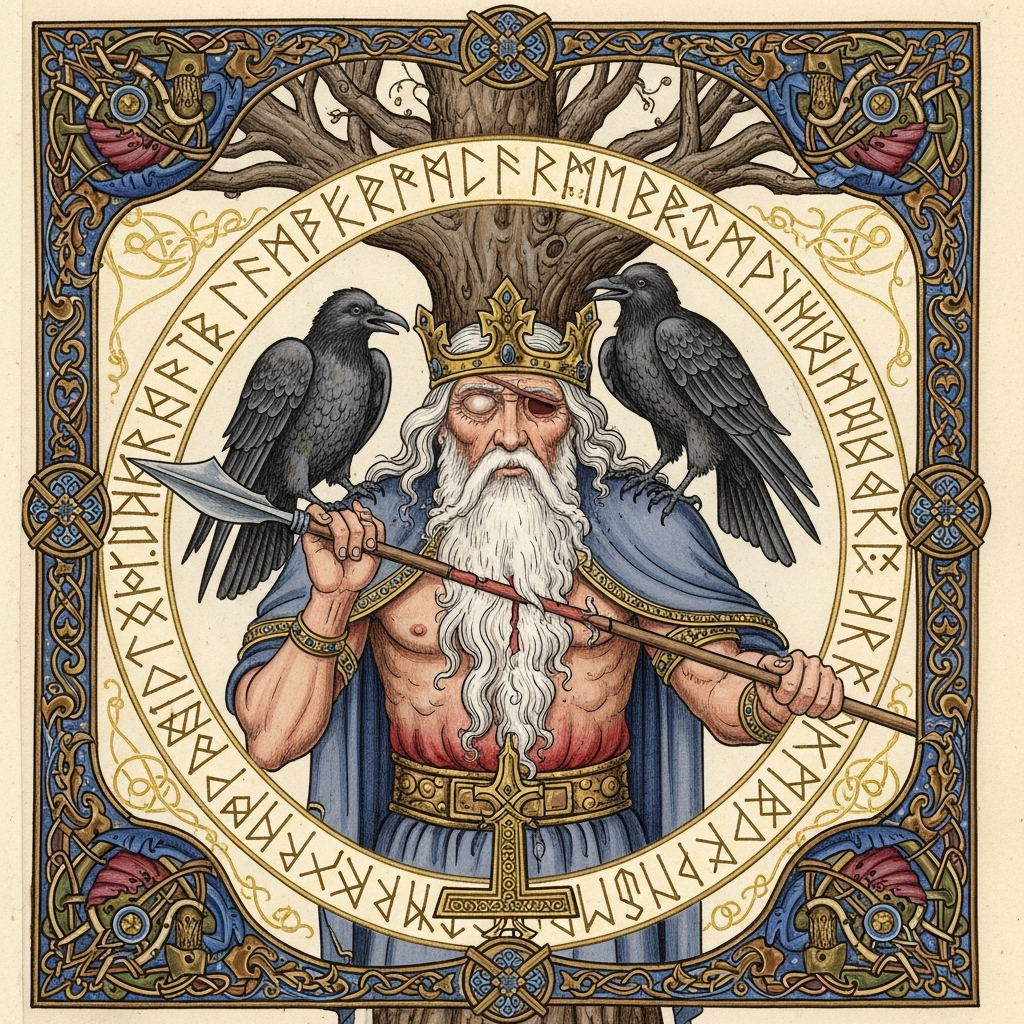
Then Odin steps forward.
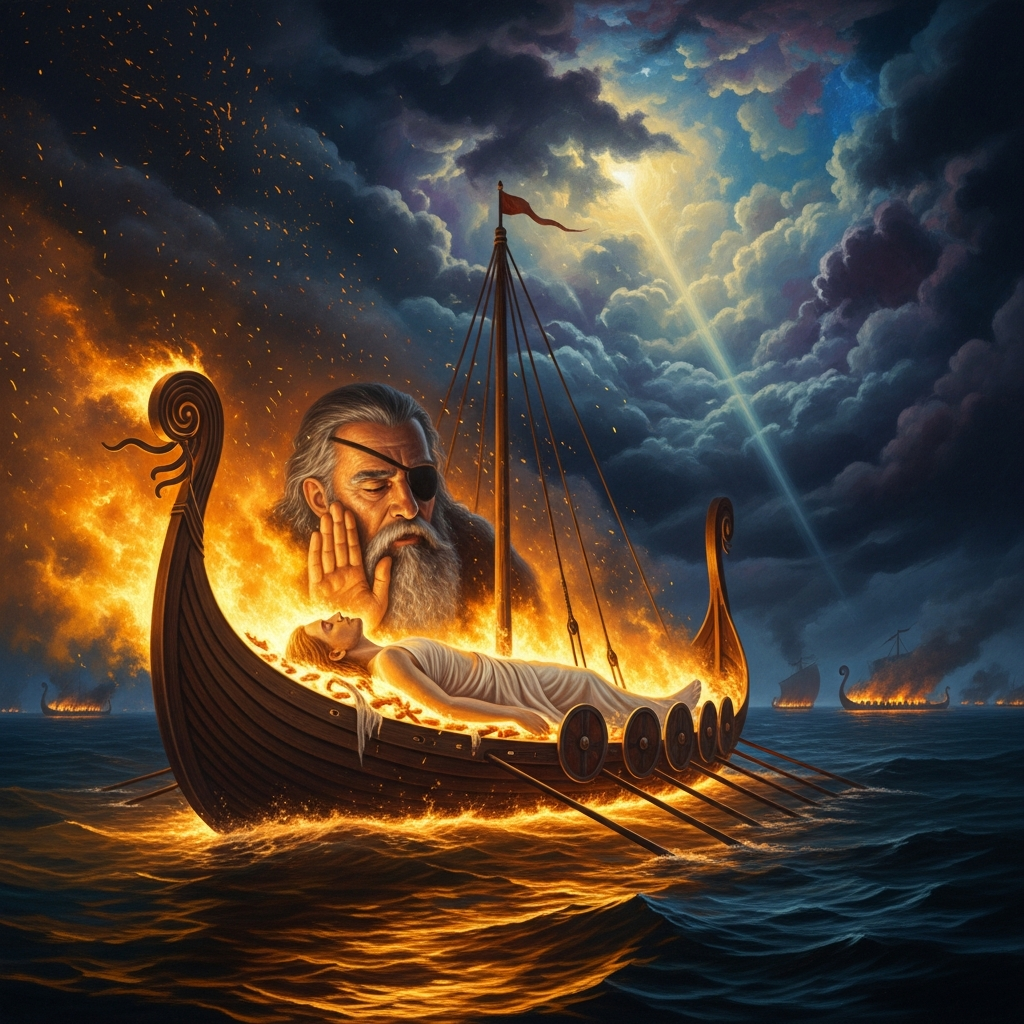
He approaches the pyre alone. He leans down over his son’s body. He puts his mouth at Baldr’s ear. He says something that no one hears. Not Frigg. Not any of the Æsir or Vanir gathered on the shore. Not the giants who have come to watch. The fire has not yet been lit. The world is holding its breath.
Whatever he says, he straightens, and he walks back.
The fire is lit. The ship goes out to sea. The flames climb until they are visible from the shore of every realm that has a shore. Odin stands on the beach with his arm around Frigg and watches until there is nothing left to watch.
What he said is the only secret in Norse mythology that remains a secret. The texts name it as a secret they will not reveal. The Vafþrúðnismál ends when Odin, in disguise, asks the giant Vafþrúðnir one last question: what did Odin whisper in Baldr’s ear? The giant understands then that only Odin could know the answer, and that he has lost the riddle contest, and that his life is forfeit. He says: no one knows what you said in your son’s ear, except yourself. He does not say he knows. Neither does anyone else.
Hermóðr rides to Hel on Sleipnir to ransom Baldr back. Hel agrees — if every being in every world weeps for Baldr, she will release him. The gods send messengers. Everything weeps. Stones weep. Metals weep. Animals weep. Every tree in every forest weeps. One giantess, sitting in a cave, does not.
Her name is Þökk. She says: Baldr gave me nothing. Let Hel keep what she has.
Some sources say Þökk is Loki. Most scholars believe it. The myth does not confirm it. The myth knows that confirmation is not the point.
Baldr stays in Hel. He will return after Ragnarök — one of the handful of survivors who walk out onto the new shore and find the golden chess-pieces in the grass. But that is afterward. Right now he is in Hel, and everything that has happened since the dart flew is aftermath.
The secret Odin whispered: the Norse did not record it, and neither should anyone. A father’s last word to a dead child is not theology. It is the only thing that remains private in a mythology that otherwise explains everything.
Scenes
Baldr sleeping in Breidablik
 Generating art…
 Frigg before a stone, a river, a stand of mistletoe
 Generating art…
 Höðr, blind, guided by Loki's quiet hand
 Generating art…
 The ship Hringhorni on the water's edge, too heavy for any god to move
 Generating art…
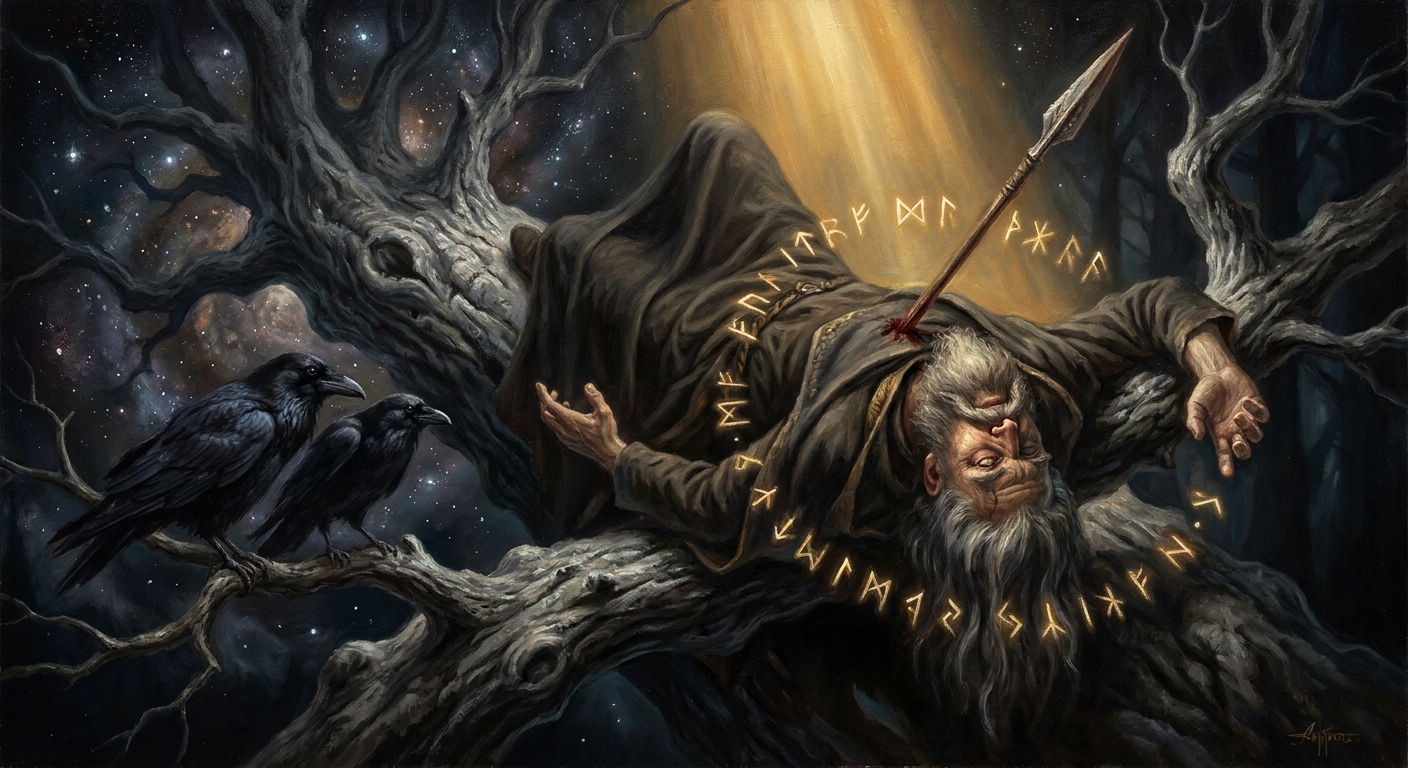
 Odin on the pyre, his mouth at Baldr's ear
 Generating art…
 Echoes Across Traditions
Entities


Sources
- Snorri Sturluson, *Prose Edda*, Gylfaginning 48–49 (c. 1220 CE)
- *Baldrs draumar* (Baldr's Dreams), Poetic Edda
- *Vǫluspá* 31–33, Codex Regius c. 1270 CE
- Saxo Grammaticus, *Gesta Danorum* III (c. 1200 CE, an alternate rationalized version)
- Carolyne Larrington (trans.), *The Poetic Edda* (Oxford, 1996)