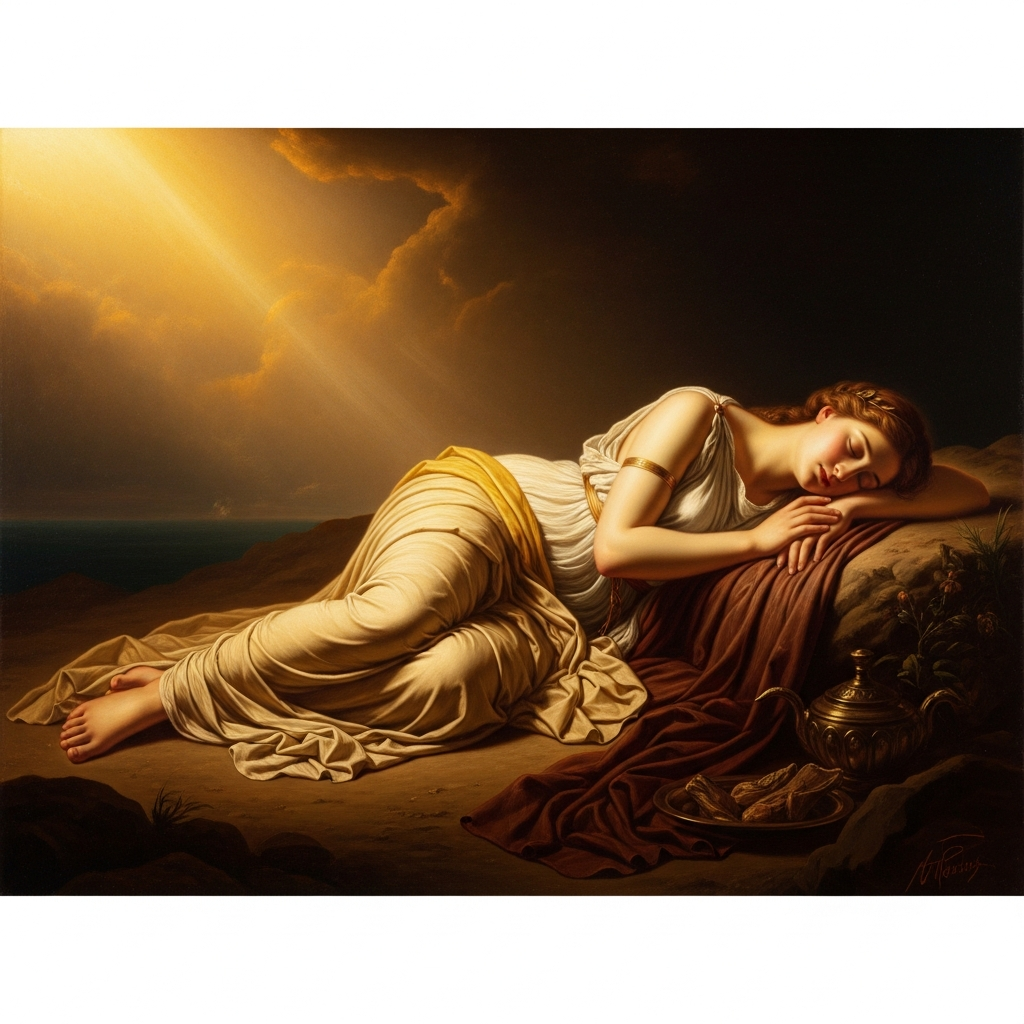
Ariadne on Naxos
Mythic Time · Bronze Age, fixed by Catullus 64 (~55 BCE) and Ovid (8 CE) · The shore of Naxos in the Cyclades, at dawn
Contents
She gives him the thread that saves his life and her promise of marriage. He kills the Minotaur — her half-brother — and sails her away from Crete. On the island of Naxos he leaves while she sleeps. She wakes alone on the shore. Then a god comes down the hillside, and her grief becomes a constellation.
- When
- Mythic Time · Bronze Age, fixed by Catullus 64 (~55 BCE) and Ovid (8 CE)
- Where
- The shore of Naxos in the Cyclades, at dawn
She sees him from the palace gate.
The Athenian ship has just made fast at the Cretan harbor. Fourteen children in chains are being walked up the road to be processed and stored until the labyrinth is hungry. Theseus is at the front of the line — not chained, because he volunteered, which is the small but visible distinction Ariadne notices first. He carries himself like a man who has decided in advance not to be afraid.
She is the daughter of Minos. She is also, by the same arithmetic, the half-sister of the thing that lives in the labyrinth — the bull-headed brother her mother bore, the secret her father refuses to call by a name. She has lived her entire life inside that arithmetic. She has watched fourteen Athenians come and not return every nine years for as long as she can count.
She looks at Theseus.
She makes the decision in the time it takes him to cross the courtyard.
She goes to Daedalus.
The architect built the labyrinth. He is the only person in Crete who knows how to leave it. He listens to her in his workshop, surrounded by the half-finished wings he is making for himself and his son — the wings that will, in another story, fail his son over the sea — and he does not argue with her.
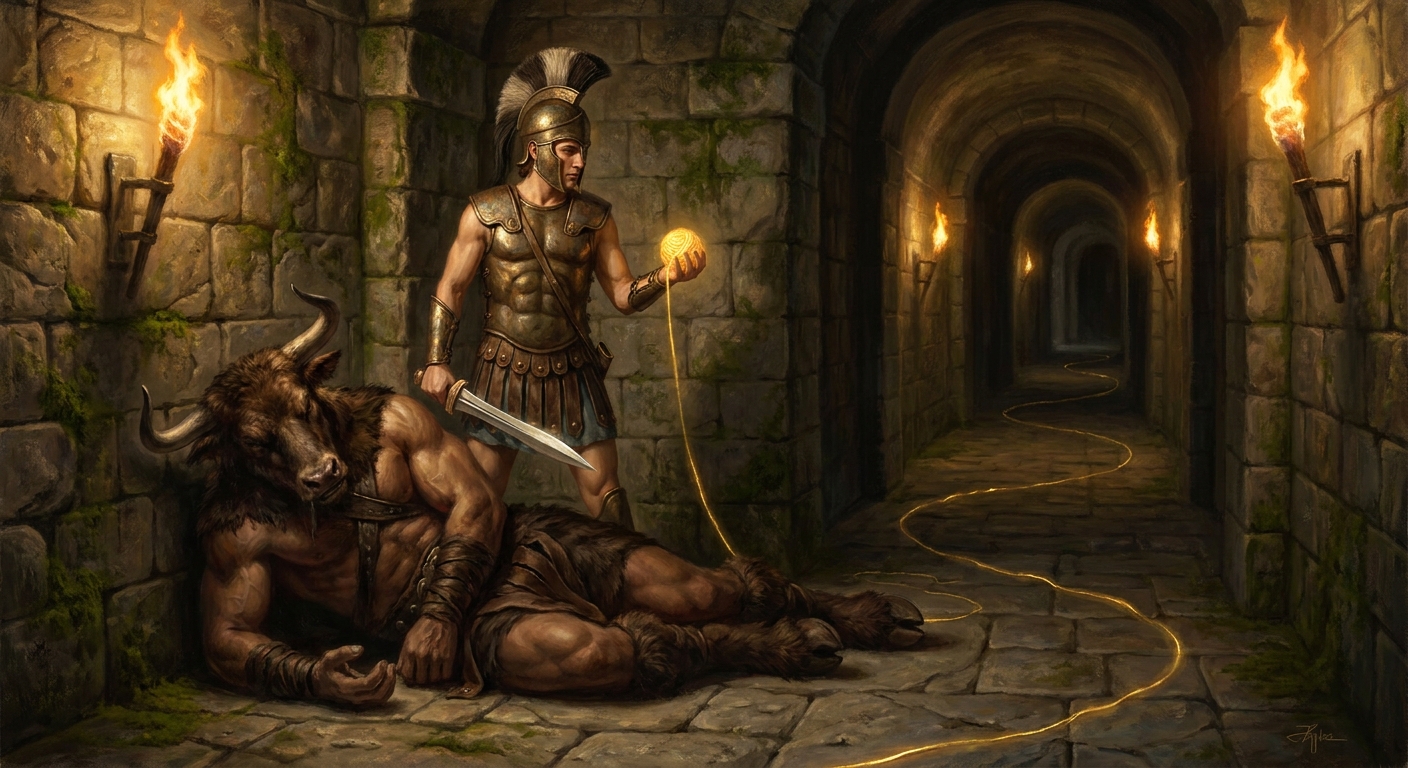
He gives her a ball of thread.
He tells her: fasten one end at the entrance. Let him pay it out as he walks. The labyrinth defeats memory. It cannot defeat a line. Wherever he goes inside, he can come back, hand over hand, along what he has left behind.
She takes the thread to Theseus that night.
He is being held in a chamber that opens onto a courtyard. The guards are bored; her father is not expecting his daughter to walk the wrong corridor. She gives him the ball. She gives him the instruction. She gives him one more thing — she extracts a promise. Take me with you. Marry me. Do not leave me here, where I am the half-sister of the monster my father feeds.
He takes the thread. He swears the oath.
She believes him, because the alternative — the alternative is staying.
He goes into the labyrinth at dawn.
She holds the other end of the thread.
She holds it for hours. The thread plays out through her fingers, slow at first, then faster as he descends, then slower as he reaches the depths. There is a long stillness when she is sure he has stopped — the moment he is at the center, when the thread does not move because he is no longer walking — and in that stillness she does not breathe. She feels the thread go suddenly slack, then taut, then slack again.
Then it begins to come back.
She winds it as he walks toward her. He is following his own line out of the dark. When he emerges from the entrance — bloodied, shaking, the smell of the thing on his hands — she is the first face he sees, and the thread is in her hands, and she has wound the entire ball back. She gives it to him. She does not say anything. They run for the harbor while the moon is still up.
The fourteen Athenians who did not die file aboard the ship behind them.
The ship pulls away from Crete in the dark.
They put in at Naxos.
The accounts disagree about why. Some say the sea was rough. Some say a storm. Some say Theseus put in for water. Some say a dream came to him in the night and a god’s voice told him: leave her. She is not yours. She belongs to me.
Catullus, writing the wedding-blanket of Peleus and Thetis, does not bother with a reason. He writes only that Theseus, immemor, forgetful, sailed away while Ariadne slept. The Latin word does double duty: forgetful, but also faithless, also indifferent — the kind of forgetting that is convenient to the forgetter.
She wakes at dawn.
The ship is a sail on the horizon. Then it is a smaller sail. Then it is gone. She walks to the water’s edge. The water laps at her feet the way it had lapped at her feet on the deck of the ship that brought her here. She is wearing the dress she slept in. The thread is not in her hand. The thread is in his hand, somewhere on the open Aegean, sailing north toward Athens with her fourteen Athenians whose lives she saved.
Catullus’s image is the one that has stuck for two thousand years: the queen of Crete on a strange shore at dawn, her hair undone, the salt on her lips, watching a sail vanish over the curve of the world. She is barefoot. She has been left.
She speaks.
Ovid puts the speech in her mouth in the Heroides — a letter she writes to Theseus from the shore she will never leave. Where am I to go? The island is empty. The sea is between me and home, and home is the place whose monster I helped you kill. I am the daughter of Minos. I am the sister of what you killed. Both of those facts make me unwelcome in every harbor on the inner sea. You took the thread and you took the promise and you took the sister and you left only the woman, and the woman is on a beach, and the woman has no boat.
She walks the beach for what feels like a long time. She tries to wave at the sail, and the sail does not turn around. She tries to bargain — with the sea, with whatever god might be listening, with her own breath — and the bargains do not catch. She sits down on the sand. She begins to cry. She cries the way an abandoned person cries on a deserted shore — without expectation of audience, because the audience has sailed away.
Then there is music behind her.
She turns around.
Coming down the hillside is a procession.
Leopards walk on either side of the chariot. Maenads — wild women with wine-stained mouths and ivy in their hair — dance ahead and behind. Satyrs play double-pipes. The chariot itself is wreathed in vines, and the vines are growing as it moves. At the center of the procession is the god.
Dionysus.
He has just returned from India, in some accounts; in others, he has been waiting for her here since before the bargain at Crete. He sees her on the shore. He stops the chariot. He steps down. He walks across the sand to the woman who has been left, and he does not speak first; he lets her see him, and the seeing is its own slow conversion.
He says: I claimed you before he ever came to Crete. He was the instrument. I am the destination.
This is, depending on the version, either consolation or further appropriation. Catullus presents it as triumph: the god rescues the abandoned woman; the wedding is glorious; her grief becomes a marriage. Ovid is more cautious; the Heroides leaves Ariadne mid-letter, and the god does not arrive within the frame. Nonnus, much later, gives her ecstatic divinization and a place among the stars.
The crown she is wearing — the wreath Theseus did not take — Dionysus lifts off her head and throws into the sky. It becomes the constellation Corona Borealis, the Northern Crown, which still wheels above Naxos every summer night.
She becomes his wife.
She bears him children, depending on the genealogy: Oenopion, Staphylos, Thoas, Peparethos — all of whom become founders of wine-island lineages, because Dionysus’s children always do. She becomes immortal in some accounts and remains mortal in others; the texts disagree, because the question of whether the rescued woman is elevated to divine status or merely consoled has never been settled, perhaps because the question is the wrong question.
What is consistent is that she does not see Theseus again.
He arrives in Athens. He forgets to change his sails from black to white. His father, watching from the cliff at Sunium, throws himself into the sea and gives the Aegean its name. Theseus inherits a city, founds Athens as a unified polis, and lives a long political life that ends badly. He is buried on Skyros after being pushed off a cliff by a man whose hospitality he had abused.
The thread he kept. The promise he broke. The sister he killed. The princess he left.
In Naxos every August, the islanders still tell the story. The constellation rises on schedule. The shore is unchanged.
Catullus 64 is the great Latin treatment, written into a wedding poem as a counterweight: at the marriage of Peleus and Thetis, the bedspread embroidered with Ariadne’s abandonment hangs in the bridal chamber, a reminder at the wedding of every wedding’s possible alternative. Catullus understood that the abandoned woman is the shadow of every bride.
Ovid’s Heroides 10 is the version where Ariadne speaks for herself. It is one of the first sustained female interior monologues in Western literature. The letter is unanswered, of course — Theseus is not coming back to read it, and even if he came back, he would not understand what he was reading. The unanswered letter is the form of the abandoned woman’s existence.
Dionysus arriving on the hillside is the part of the myth that does not survive in modern retellings. We have inherited Theseus on the ship and Ariadne on the shore. We have not always inherited the god. Without the god, the story is only abandonment. With the god, the story is the abandoned becoming the mother of vine-islands and her crown becoming a constellation. Whether that is restitution or only divine recompense — whether Dionysus is the answer or another claimant — depends, like so many of these myths, on which woman you ask.
She gave him the thread. He gave her the shore. The god gave her the sky.
Echoes Across Traditions
Entities
- Ariadne
- Theseus
- Dionysus
- the Minotaur
Sources
- Catullus 64 (the wedding-blanket of Peleus and Thetis), ~55 BCE
- Ovid, *Heroides* 10 (Ariadne to Theseus); *Metamorphoses* VIII.169-182, ~8 CE
- Plutarch, *Theseus* 19-20
- Apollodorus, *Epitome* 1.7-9
- Nonnus, *Dionysiaca* XLVII
- Edith Hall, *Introducing the Ancient Greeks* (2014)