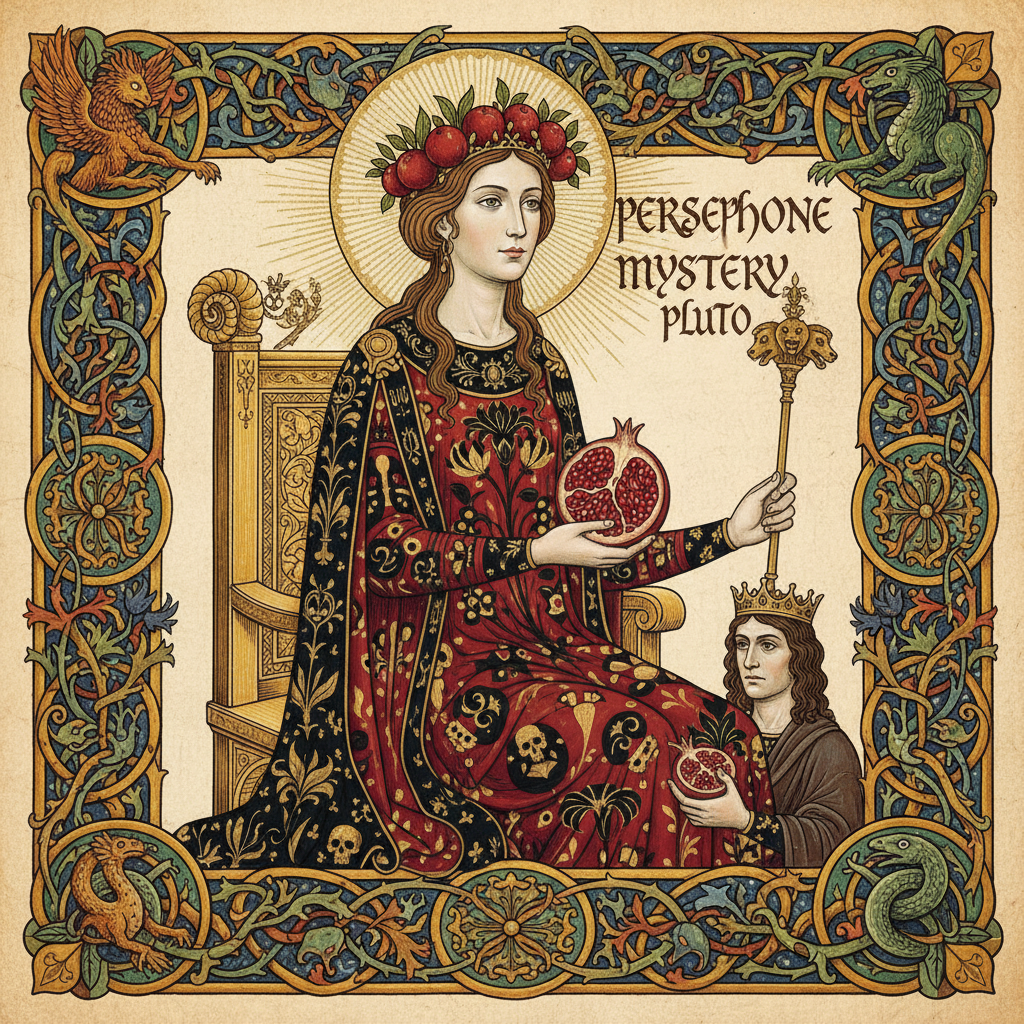
The Goddess Who Stopped the World
Mythic Time · *Homeric Hymn to Demeter* (7th c. BCE) · Sicily, then the surface of the entire earth, then Eleusis
Contents
When Persephone is taken to the underworld, Demeter does not mourn elegantly. She refuses to make anything grow. The earth goes barren. Famine threatens to exterminate humanity, which would mean no more sacrifices, which would mean the gods starve too. Even Zeus cannot coerce her. The gods must negotiate with a mother's grief. She gets six months of her daughter back. The other six months are winter.
- When
- Mythic Time · *Homeric Hymn to Demeter* (7th c. BCE)
- Where
- Sicily, then the surface of the entire earth, then Eleusis
The narcissus opens and the earth opens with it.
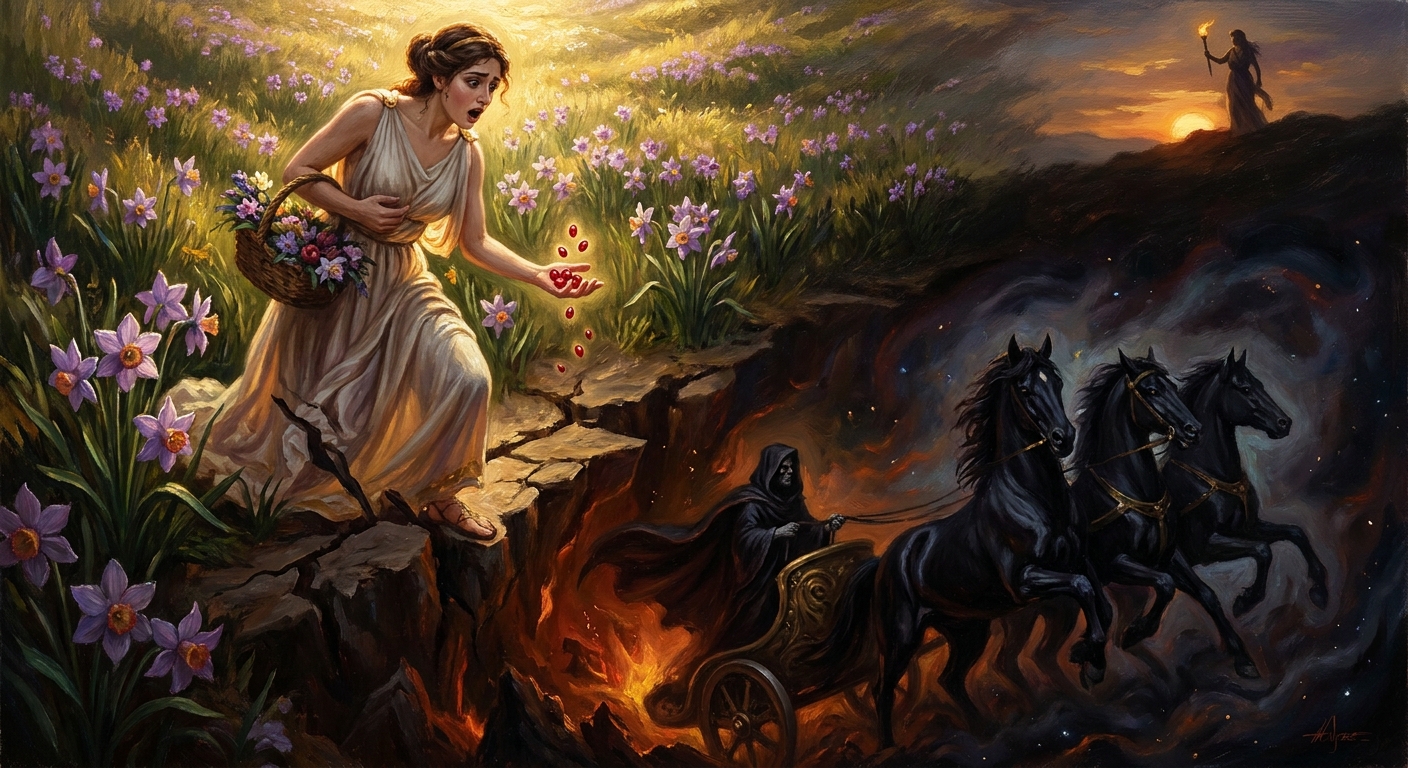
Persephone is in the meadow of Enna — or the Nysian plain, or the fields near Eleusis; the Homeric Hymn is not particular about geography because the location is secondary to the act — when the flower that Zeus caused the earth to produce for precisely this purpose blooms at her feet. A hundred blossoms from a single root. A smell so dense it stops the breath of gods and men alike. She reaches for it.
The ground cracks. The chariot comes up from below. Hades takes her. The earth seals behind them.
She screams. The ocean hears it. The mountains hear it. The Homeric Hymn says her cry is like a sharp spear driving through the air. No god comes. Her father Zeus is attending to something else — the Hymn says he was sitting apart from the other gods, in a temple, receiving the gifts of mortals — and her companions scatter and cannot remember, when the moment passes, what flower she was reaching for when she disappeared.
Hecate hears the cry from her cave. She cannot see who cried or who answered.
Demeter hears it differently.
She hears the grief in the air the way a mother hears a child’s cry in a crowd of crowds — not the words, not the direction, but the specific register, the pitch of this particular voice in this particular extremity. She leaves whatever she is doing. The Hymn gives her a shawl she throws over her shoulders as she runs, a human gesture for a goddess, and then she runs — not flies, not teleports, but runs, the physical effort of a body in shock going where the body of grief always goes, which is toward the last place the person was.
The meadow is empty. The flowers are still there. The narcissus, the one that opened and closed the earth, is still in the grass. Demeter searches the place the way someone searches a room where a terrible thing has just happened: inefficiently, repetitively, unable to leave because leaving confirms that there is nothing to find.
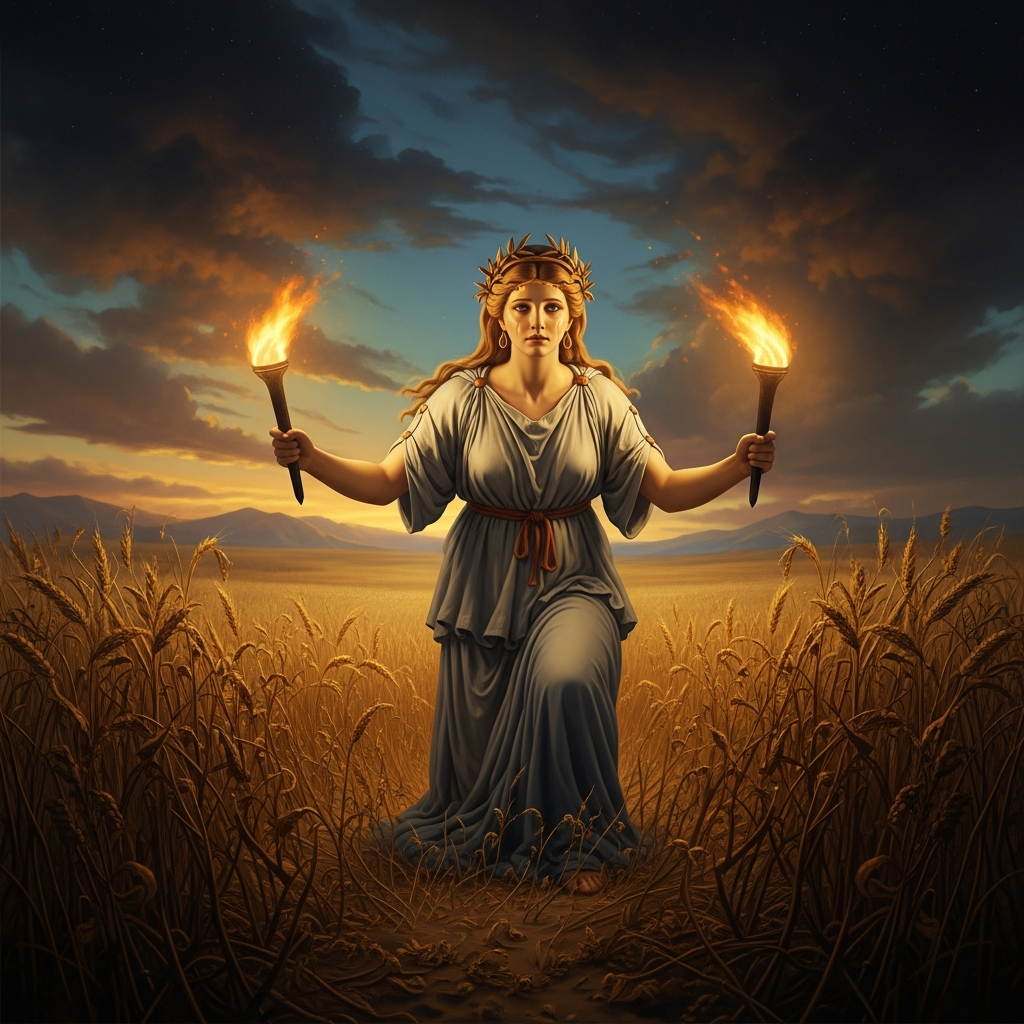
She lights two torches.
She will carry them for nine days. The Homeric Hymn gives the number precisely: nine days of searching, the whole surface of the earth, no food, no water, no bathing. The torches are the detail the tradition keeps returning to — Demeter with a torch in each hand, the goddess of grain becoming the goddess of search, the productive making itself the seeking, the whole agricultural order that she maintains suspended while she walks the earth looking for what was taken.
No god tells her anything.
On the tenth day, Hecate comes.
She has heard the scream. She did not see who screamed or who answered. She takes Demeter to Helios, because Helios sees everything from his chariot; he cannot avoid it. His route covers the entire surface of the earth each day, and what happens on the surface of the earth happens in his sight.
Helios tells her.
He tells her plainly, without mitigation, the way someone tells a truth that will not improve with gentleness: Zeus gave your daughter to his brother. This was agreed to. Hades is a god — not a bad match, Helios says, for what it is worth, and the Hymn shows that it is worth nothing. He adds that the king of the underworld is the lord of a third of the cosmos and that Persephone will be queen of all the dead.
Demeter listens to this and then does what she does.
She does not argue. She does not appeal to the council of the Olympians. She does not present her case for why the arrangement Zeus made without consulting her was unjust, though it is obviously unjust, though it is a theft carried out with the father’s collusion, though the mother was not asked and could not have been asked because asking her would have made the kidnapping impossible. She is past argument.
She stops making things grow.
This is the act the myth turns on, and it is worth understanding what it means.
Demeter is the goddess of grain. Not metaphorically — she is the principle by which grain grows, the force that causes seeds to open in wet earth, the power that pulls roots downward and stalks upward and fills the ear in autumn. When Demeter withdraws her attention from this process, the process stops. Not slows. Stops. The seeds are in the ground and they stay in the ground. The furrows are plowed and they stay empty. The animals are fed and the animals are fed and the animals are fed and the grain does not come back.
The Homeric Hymn gives the consequences: the oxen drag the plows for nothing. The earth gives nothing. The mortals will die of famine. The gods will get no offerings — no grain, no first-fruits, no sacrificial barley — because the dead give nothing, and the dead are what humanity becomes when there is nothing to eat.
The gods begin to notice.
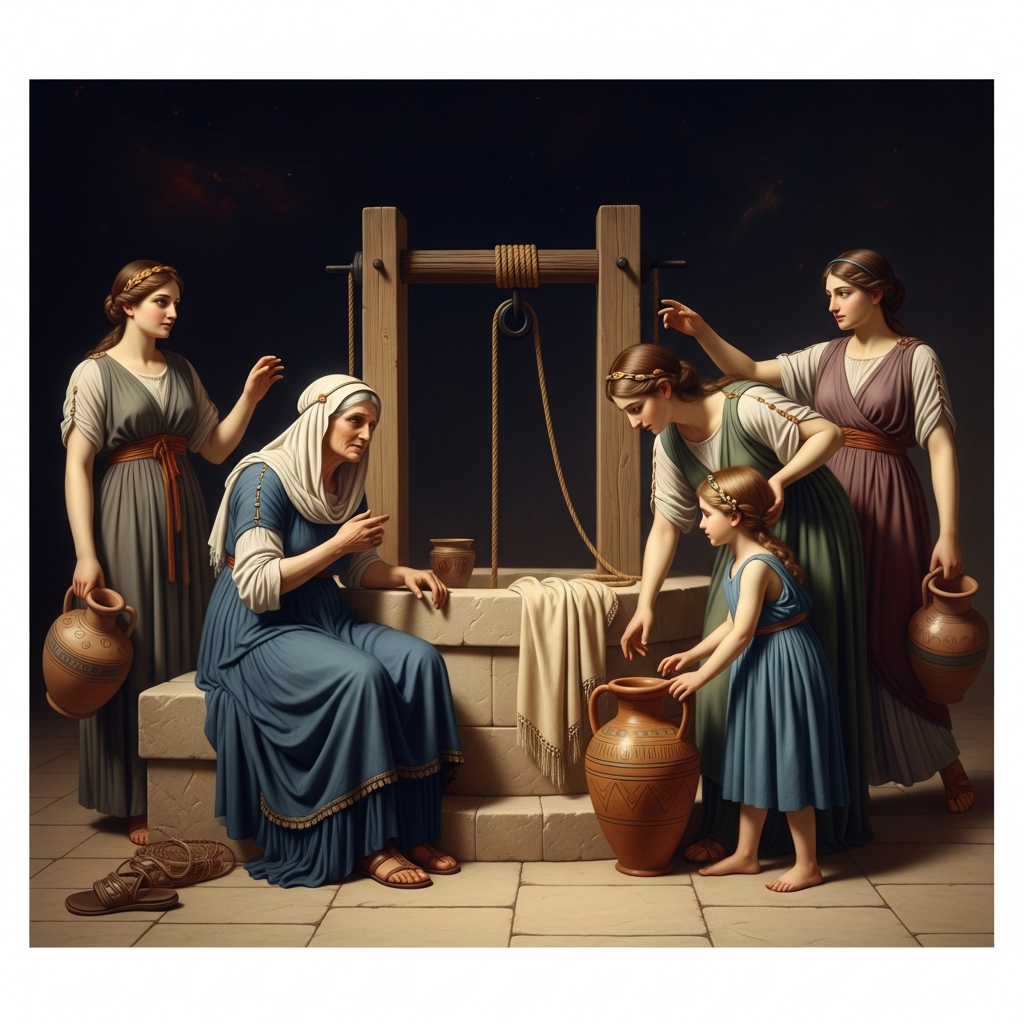
They send one messenger to Demeter and then another — the Hymn names Iris, the rainbow messenger, who carries Zeus’s offer of whatever honors Demeter wishes among the immortal gods. Demeter will not talk to Iris. She refuses to let the earth bear fruit. She refuses to return to Olympus. She has disguised herself as an old woman and is sitting at a well in Eleusis, in the town of Celeus, having accepted work as a nursemaid for the family’s infant son, and she has made herself as unreachable as grief is always unreachable: not gone, just absent in the way that the self becomes absent when the world has taken the one thing around which the self organized itself.
Even Zeus cannot coerce her.
This is the theological moment the myth exists to make.
The Greek cosmos is a hierarchy of power. Zeus is at the top of it. He commands the thunderbolt. He holds the balance that weighs the fates of men. He is the father of gods and men, which is not a metaphor but an administrative title: he governs. His governance is not perfect and not always just — the Iliad and the Odyssey are full of moments when Zeus acts arbitrarily, when he defers to Fate, when he cannot help a favorite against a stronger fate — but it is supreme. No god successfully resists Zeus by force.
Demeter does not use force.
She uses absence. She removes what only she can provide. And the removal of what only she can provide turns out to be more effective than any amount of force, because force can be answered with force and Zeus has more force than any other god, but the absence of grain cannot be answered with lightning. You cannot strike the earth with a thunderbolt and produce bread from the impact. The power to grow things and the power to destroy things are not the same power, and only one of them is in Zeus’s hands.
He blinks.
He sends Hermes to the underworld.
Hades is not villainous about it.
The Homeric Hymn is careful on this point. Hades listens to Hermes deliver the message and says: very well, she may go back. He does not resist. He tells Persephone herself that she should go, that her mother is making the earth barren and the mortals are starving and the gods are getting no offerings, and he says this with the dignity of a god who arranged a marriage through the proper channels — the proper channels being Zeus’s permission — and who is now complying with the Olympian consensus that the arrangement has consequences no one fully anticipated.
He gives her the pomegranate seeds.
Whether he intends what the seeds accomplish — whether Hades knows that she cannot leave the underworld permanently if she has eaten its food, and gives her the seeds knowing this — is the question the Hymn does not definitively answer. Some versions say he slips her the seeds at the last moment, knowing she will eat them reflexively. Some say she eats them of her own accord, knowing or not knowing what they mean. What matters is that she eats six seeds, and the rule of the underworld is absolute: what is eaten here binds you here.
Hermes drives the chariot up. Persephone arrives in Sicily. Demeter runs.
The reunion is the emotional climax of the Hymn, and it arrives quickly: mother and daughter together on the Rharian plain — the plain above Eleusis that is the most sacred agricultural land in Greece — embracing, asking questions simultaneously, the compressed reunion of people who have been separated by something that the language of separation does not quite cover.
Then Demeter asks: Did you eat anything below?
The question matters. Demeter already suspects the answer, because gods know things that mortals don’t. The Hymn gives Persephone a long answer that circles the essential fact from several directions before arriving at it: Hades gave me pomegranate seeds. I ate six. I didn’t want to. Or: I did want to, because he was kind to me, or because I was hungry, or because I was already his queen and the seeds were already mine, or because — the Hymn does not fully explain — six seeds was the answer to whatever question the underworld was asking.
Zeus sends Rhea, the mother of the gods, the grandmother of the cosmos, to soften Demeter. And Demeter agrees to a compromise: six months above, six months below. For the months Persephone walks the upper world, Demeter makes things grow. For the six months Persephone is below, Demeter stops.
The Hymn presents this as the origin of winter. It does not present it as a tragedy. It presents it as a bargain — the best bargain available, the only one both parties will accept.
Before she returns to Olympus, Demeter gives Eleusis a gift.
She teaches the local princes — Triptolemos, Diocles, Eumolpos, the men of the families who will become the priests of the mysteries — the rites and the sacred objects and the formula. The Hymn says she revealed her orgies — her sacred acts, her mysteries — to Triptolemos and the others, and that these were awesome mysteries which no one may in any way transgress or pry into or utter, for deep awe of the gods checks the voice.
Deep awe of the gods checks the voice. For two thousand years, it did.
What she teaches them is what the Eleusinian Mysteries preserve for nineteen more centuries: the knowledge that the descent into the dark is not the end of the story, that the grain that enters the earth in autumn comes back in spring, that what looks like loss is a structure with a second movement, that the mother’s grief is the mechanism not the conclusion. This is not a comfortable doctrine. It does not say that loss is painless or that the separation doesn’t cost anything. It says: the earth went barren for six months every year for the entire span of Greek civilization, and every year, on schedule, the narcissus came back.
The Homeric Hymn to Demeter is one of the oldest extended narratives in the Greek tradition, composed perhaps in the seventh century BCE, likely in connection with the Eleusinian cult. It is the only major Greek text in which a goddess wins a direct confrontation with Zeus — and she wins it not by argument or force but by the consistent refusal to do the one thing only she can do.
The myth has a specific kind of power for every reader who has ever watched institutional authority meet a grief it could not argue or threaten away. Zeus has everything — the thunderbolt, the governance of the cosmos, the formal consent of the other gods — and he loses to a woman sitting at a well in Eleusis, too sad to eat, waiting for the only resolution that will be acceptable.
The resolution is partial. Six months is not twelve months. The compromise is real and the loss is real and the winter is real. Demeter does not get everything she wanted. She gets enough to let the world continue.
The Eleusinian initiates understood what this meant: that the mysteries are not the promise that everything will be restored. They are the promise that the descent is not the end, that the thing you went into the dark holding will be in your hands when you come back up, changed by the dark, but yours. Six months. Then the narcissus. Then again.
Scenes
Demeter with a torch in each hand, searching the surface of the earth for nine days without eating or bathing — the goddess of grain in full divine mourning, the fields dying at her feet, the world watching a mother's grief become a weapon
 Generating art…
 Demeter disguised as an old woman, seated at the well of Eleusis, while the daughters of Celeus approach with their water jars — the goddess unrecognized in her grief, accepting work as a nursemaid from the family that will remember her forever
 Generating art…
 Demeter holding the infant Demophon in fire by night, burning away his mortality in secret while his mother sleeps — the goddess who stopped the world attempting to give one human child the immortality her daughter was denied
 Generating art…
 Echoes Across Traditions
Entities
- Demeter
- Persephone
- Zeus
- Hades
- Hecate
- Helios
- Hermes
- Iambe
- Metanira
- Demophon

Sources
- *Homeric Hymn to Demeter* (7th c. BCE, trans. Gregory Nagy)
- Ovid, *Metamorphoses* V.341-571 (8 CE)
- Apollodorus, *Library* 1.5.1-3
- Carl Kerényi, *Eleusis: Archetypal Image of Mother and Daughter* (Princeton, 1967)
- Helene Foley, *The Homeric Hymn to Demeter* (Princeton, 1994)
- Walter Burkert, *Greek Religion* (Harvard, 1985)