The Dagda's Cauldron That Left No One Unsatisfied
Mythic time of the Tuatha De Danann, recorded c. 8th-9th century CE · The plain of Mag Tuired, western Ireland, and the camp of the Fomorians
Contents
Before the Second Battle of Mag Tuired, the Tuatha De Danann's great god must humble himself before the Fomorians, eating a porridge mountain from a hole in the ground with a ladle large enough to fit two people lying down. The comedy of the good god, the enormous cauldron, and what it means to be the deity of excess in a world that requires war.
- When
- Mythic time of the Tuatha De Danann, recorded c. 8th-9th century CE
- Where
- The plain of Mag Tuired, western Ireland, and the camp of the Fomorians
Before the Second Battle of Mag Tuired, the Tuatha De Danann send their gods to negotiate.
This is not negotiation in the diplomatic sense. The Fomorians — the older powers, the gods under the earth and sea, whose king Balor has the eye that kills whatever it looks at — have been demanding tribute from the Tuatha De Danann for long enough that the debt has become structural. It shapes the year. The Tuatha De pay it and resent it and pay it again, and eventually the Dagda is sent to the Fomorian camp to buy time, or to spy, or simply because sending the Dagda is the kind of decision the divine council makes when it wants to solve a problem through appetite rather than tactics.
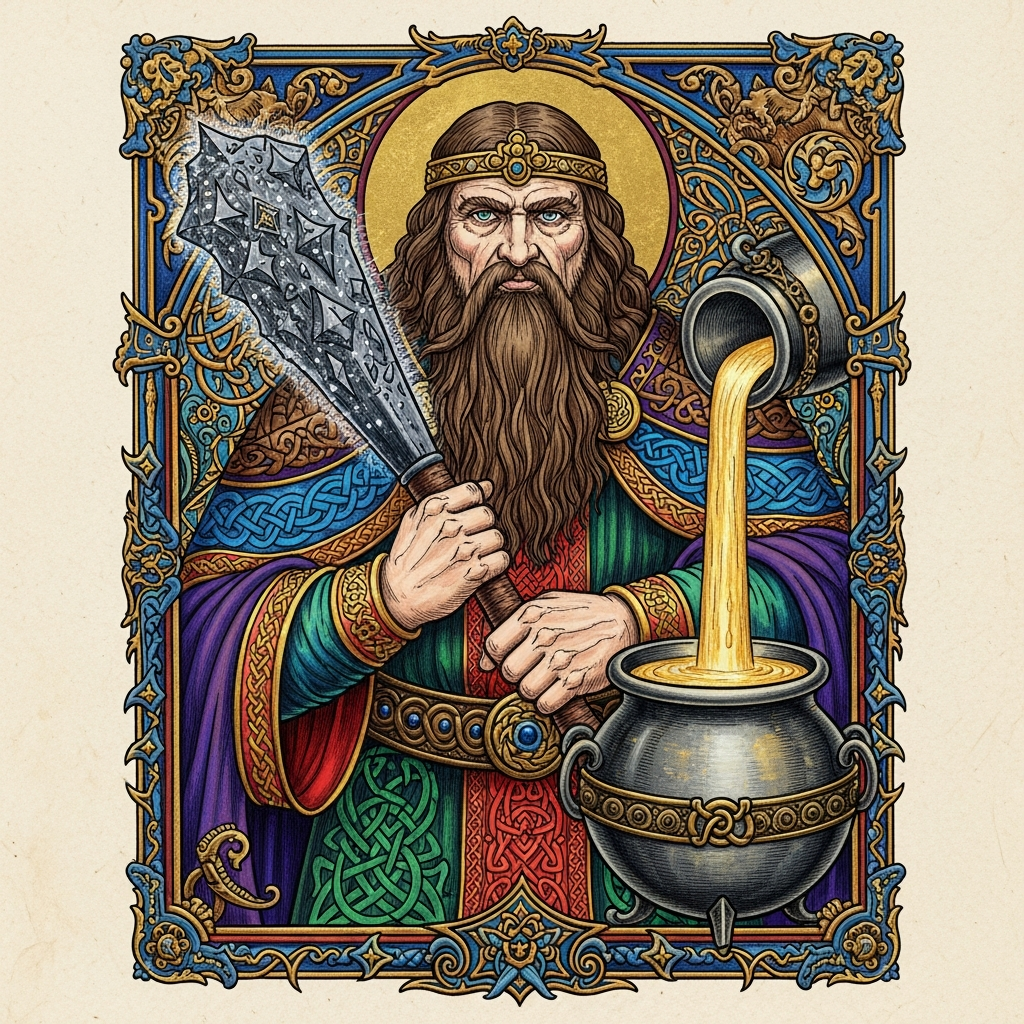
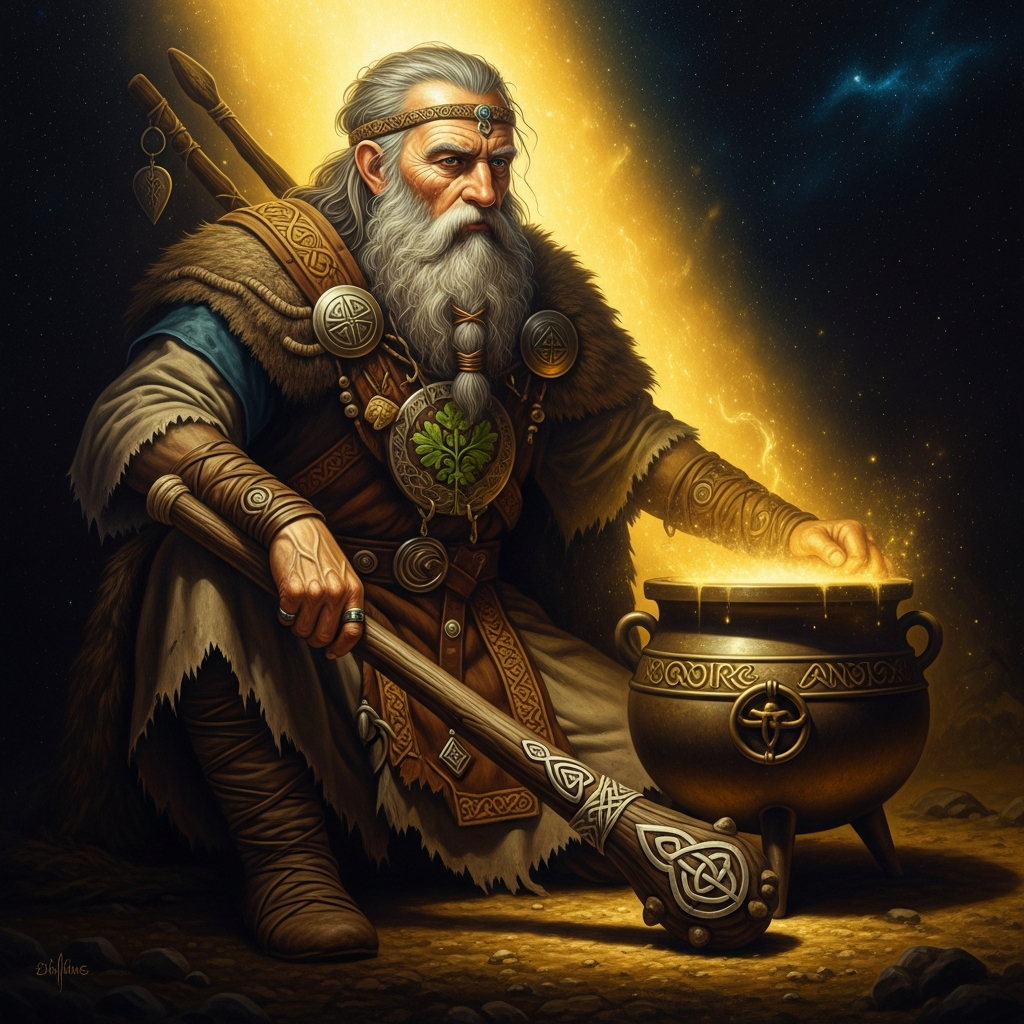
The Dagda goes. He is, by most accounts, the greatest of the Tuatha De: the Good God, Eochaid Ollathair, father of all. He carries his club on his shoulder. The club’s head drags behind him on the ground and makes a channel in the earth deep enough to be a territorial boundary; you can see the Dagda’s track across the landscape the way you can see a river valley. One end of the club kills eight men. The other end revives eight dead men. He carries both ends.
He wears a tunic that barely covers him. His penis hangs below the hem.
The Fomorians know he is coming. They dig the pit before he arrives.
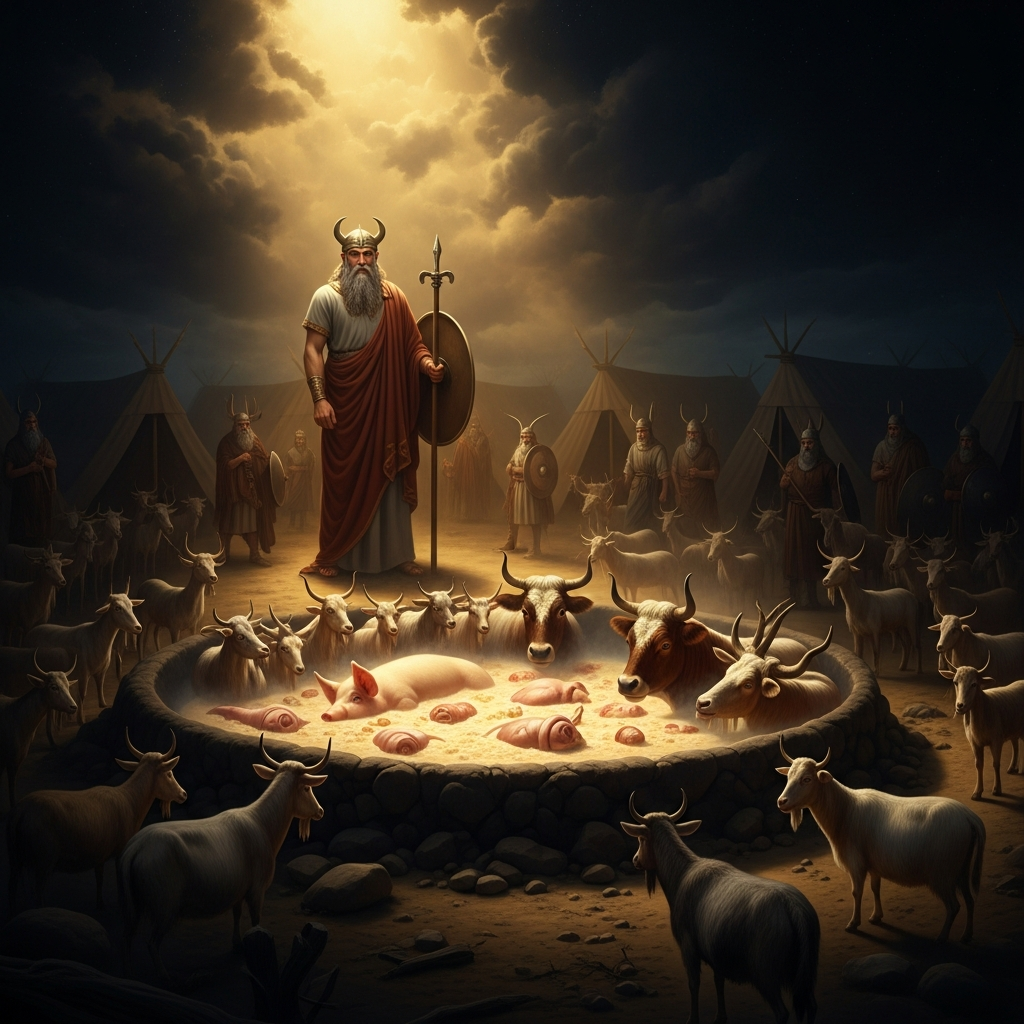
Into the pit they pour: twenty measures of new milk, twenty measures of broth, whole carcasses of goats and pigs and sheep, and a pig that has been boiled whole. They stir this into a porridge and they ladle it into the pit itself, which is five fists deep across a wide expanse of earth, and they tell the Dagda that if he does not eat it all, they will kill him. In the mythology of tribute and humiliation, this is the form the Fomorians have chosen: the god of abundance forced to demonstrate his abundance until it becomes grotesque.
The Dagda’s ladle is large enough for a man and woman to lie down in it together. He uses it.
He eats the porridge. He eats all of it. He scrapes the sides of the pit with his finger and eats what he scrapes. The Fomorians watch. The porridge was designed to be impossible, to be the quantity that even the god of plenty cannot finish, and the Dagda finishes it. He falls asleep at the edge of the pit with his belly distended to the ground, and the Fomorians find this funny in the way that people who designed a humiliation find it funny when the humiliation works, which is a complicated kind of funny.
He sleeps. In the morning he gets up and walks home, trailing his club.
The Dagda’s three treasures are the cauldron, the club, and the harp.
The cauldron came from the city of Murias in the sunken country before the Tuatha De Danann arrived in Ireland. It is called the Undry: the cauldron from which no one goes unsatisfied. This is not a modest claim. It means no one — not a petitioner, not an enemy, not a warrior, not a king, not a scullion, not a person whose appetite is inconvenient or embarrassing or larger than the occasion should require. The cauldron gives what is needed without accounting for it afterward. There is no ledger.
This is the theology of the Dagda’s excess: abundance is not stored. It is not rationed. It is not distributed according to merit or managed against future scarcity. It is given, fully, to whoever is there to receive it, and then it is full again. The cauldron that leaves no one unsatisfied is a description of the cosmos before economics. It is the memory of enough.
The club that kills with one end and revives with the other is a less comfortable treasure. The Dagda is also, this tells you, the deity of death and life held in the same hand. When the god of plenty comes to the battlefield, he brings both ends of the club. He kills his measure and then walks back across the corpses and revives his measure and the accounting is performed by the same hand that disturbed it. He is not a god of life against death. He is the god of the metabolism of the world, which requires both.
The harp is stolen by the Fomorians before the battle. They take it from the Tuatha De camp — the harp called Dur Da Bla, Oak of Two Greens, or Uaithne, the Living Wood — and hang it on the wall of the Fomorian hall, and it does not play for them, because it does not play for people who have not been invited to play it.
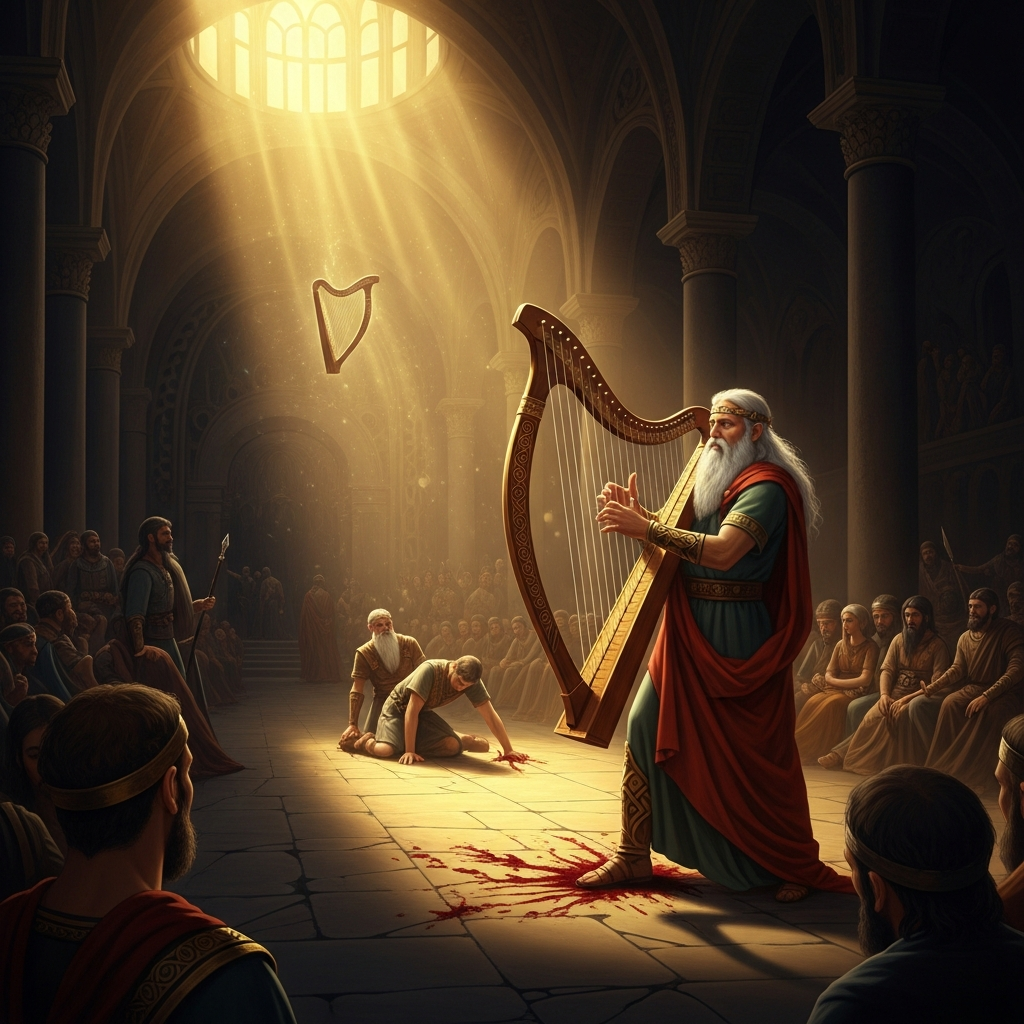
The Dagda comes to get it back with Lugh and Ogma, the three of them walking into the Fomorian hall in the middle of the night. He calls the harp by name. The harp comes off the wall and crosses the hall to him, killing nine Fomorians on its way across — the harp’s crossing is itself a weapon, which is the kind of detail the manuscripts preserve without comment, as if a musical instrument that kills nine men in transit is an ordinary feature of the world.
He plays the three strains before leaving. The three strains are: goltraige, the grief-music, which makes everyone in the hall weep. Then geantraige, the laughter-music, which makes everyone in the hall laugh. Then suantrai, the sleep-music, which makes everyone in the hall sleep. The Dagda and Lugh and Ogma walk out unmolested while the Fomorian army dreams.
This is the god who will fight in the battle the next day with his club. He has already won it with the harp.
The battle itself is the catastrophic inventory of Irish mythology: Nuada dies, Balor’s eye kills everything it opens on until Lugh sends a sling-stone through the eye from behind and the eye opens on the Fomorian army instead and destroys it. The Fomorians are driven into the sea. The Tuatha De Danann take the island.
The Dagda does not do anything in the battle that the text thinks is worth recording in detail. He has already done the relevant things: he ate the porridge, he retrieved the harp, he will walk across the battlefield afterward with the club’s reviving end. He is the baseline of the world, the condition that makes the specific heroics of Lugh and the specific tragedy of Nuada possible. You do not notice the Dagda for the same reason you do not notice that the ground is level and the air is breathable.
He walks home trailing his club. The channel behind him fills with rain.
The Dagda is the hardest Irish god to explain to a monotheist because his comedy and his cosmological function are not separate things. He is funny because he is the god of abundance, and abundance is inherently excessive — it is more than enough, it is enough until it is uncomfortable, it is the full barn and the overfull belly and the harp that plays itself and kills people crossing the room. There is no dignified version of this.
The porridge episode is the right story to begin with because it shows what happens when the god of plenty is tested by his own domain. The Fomorians thought they were humiliating him. They were performing, instead, a demonstration of his nature. The cauldron that leaves no one unsatisfied also cannot be satisfied. That is not a weakness. That is the definition.
He is called Eochaid Ollathair: the great father. He is called Ruad Rofhessa: the mighty one of great knowledge. He is called simply the Dagda: the Good God. The good here is not moral good. It is the good of a thing that works — the good hammer, the good soil, the good season. He is the god who functions. He is the world turning over and feeding itself and being fed, and the sound of that, if you could hear it at the pitch it actually operates, would be the three strains of the harp played simultaneously: grief and laughter and sleep, the full chord of a world that is enough.
Scenes
The pit in the ground at the Fomorian camp: twenty measures of new milk, a whole pig, a whole ox, and many goats boiled together in the porridge
 Generating art…
 The Dagda's club on his shoulder, trailing behind him, scoring a track in the ground deep enough to be a territorial boundary
 Generating art…
 The Dagda calling his harp back from the Fomorians who stole it
 Generating art…
 Echoes Across Traditions
Entities
- the Dagda
- Lugh
- the Morrigan
- Indech mac De Domhnann
- Cridenbel


Sources
- Elizabeth A. Gray (ed. and trans.), *Cath Maige Tuired: The Second Battle of Mag Tuired* (Irish Texts Society, 1982)
- Jeffrey Gantz (trans.), *Early Irish Myths and Sagas* (Penguin, 1981)
- Proinsias Mac Cana, *Celtic Mythology* (1970)
- Miranda Green, *Celtic Myths* (British Museum Press, 1993)
- Thomas Kinsella (trans.), *The Tain* (1969)