The Morrigan Offers Herself at the Ford
Mythic Iron Age, recorded c. 7th-8th century CE · The ford between Ulster and Connacht during the Tain Bo Cualinge
Contents
The Irish goddess of battle and fate comes to Cu Chulainn at the ford in the form of a beautiful woman and offers him her love. He refuses her, not recognising what he is refusing. She attacks him during his next combat in three animal forms. He wounds her three times. She returns as an old milkmaid and he heals her without knowing it.
- When
- Mythic Iron Age, recorded c. 7th-8th century CE
- Where
- The ford between Ulster and Connacht during the Tain Bo Cualinge
Between combats, the ford is quiet.
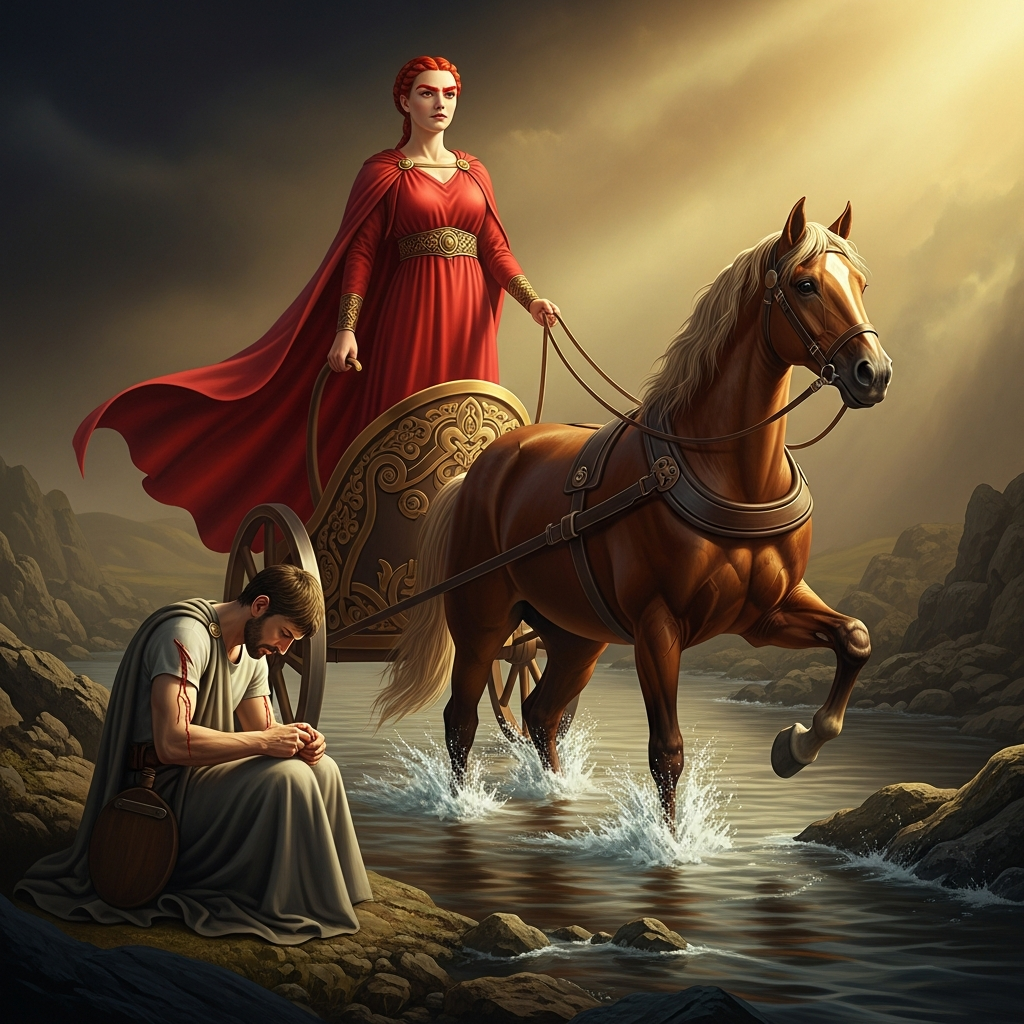
Cu Chulainn sits at the edge of the river tending his wounds with the slow efficiency of a man who has been doing this every evening for weeks. The cuts are numerous and shallow. The deeper ones he has learned to pack with moss from the bank while the bleeding slows. He does not look up when the chariot arrives.
The chariot has one horse. It is a chestnut, one-legged, and the pole of the chariot passes through the horse’s body and out again, held there by a wooden peg at the forehead — this is how the manuscripts describe it, without apology, because the vehicle is not from any stable that exists in the material world. The woman driving it has red eyebrows and a red dress and a crimson cloak that drags through the current as the horse wades. She is, by any ordinary accounting, very beautiful.
She tells Cu Chulainn that she has been watching him. She tells him that she loves him. She names the cattle of Ireland she will give him, the victories, the assistance. The grammar of what she is offering is the grammar of a war-goddess placing herself on one side of a conflict — she will fight with him, through him, as a kind of divine amplifier of everything he already is.
He does not recognise her. This is the hinge of the whole episode.
He tells her he is busy. He tells her he does not have the energy for a woman right now, which is true in a literal sense — he has been fighting daily for three weeks, he is exhausted, he is bleeding. He says, in the way that the manuscripts preserve his exact phrasing, that this is not the time for a girl’s backside. The insult is not calculated. He genuinely does not know what he is looking at.
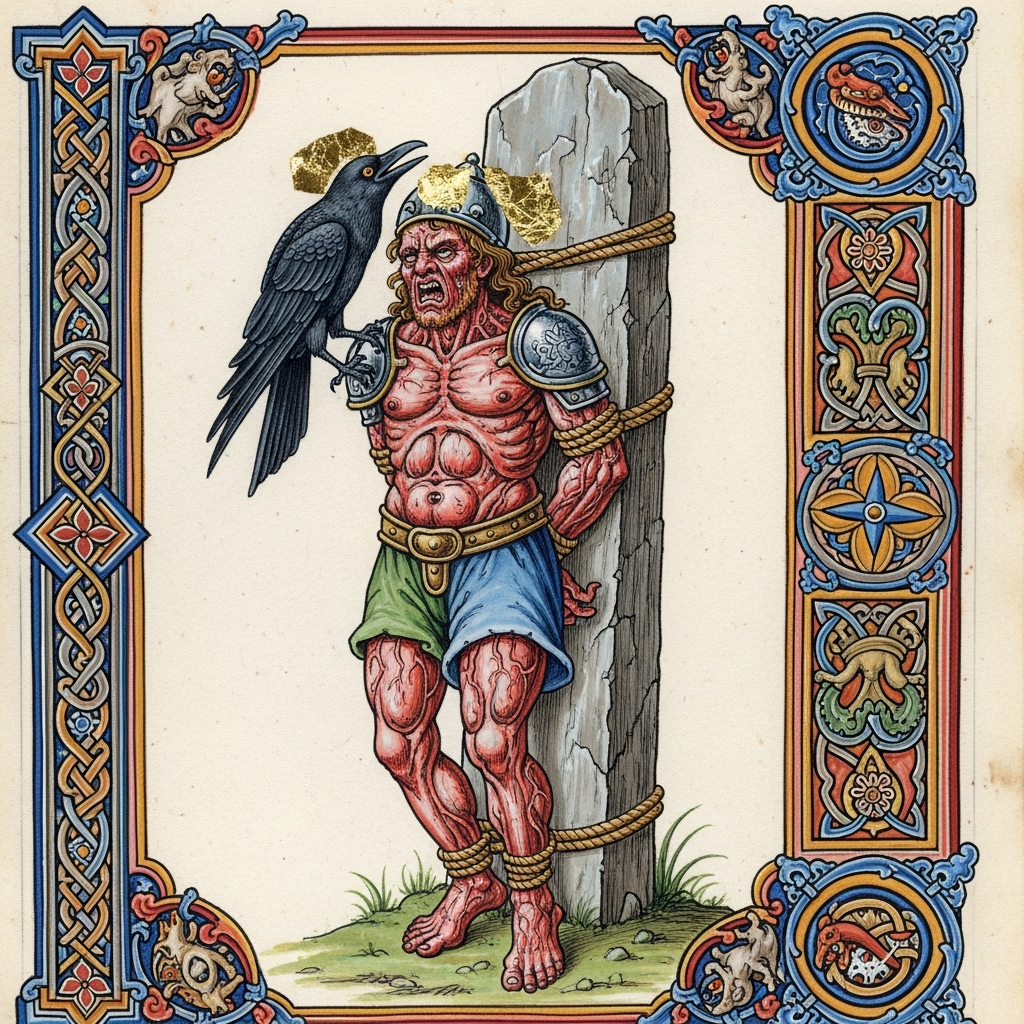
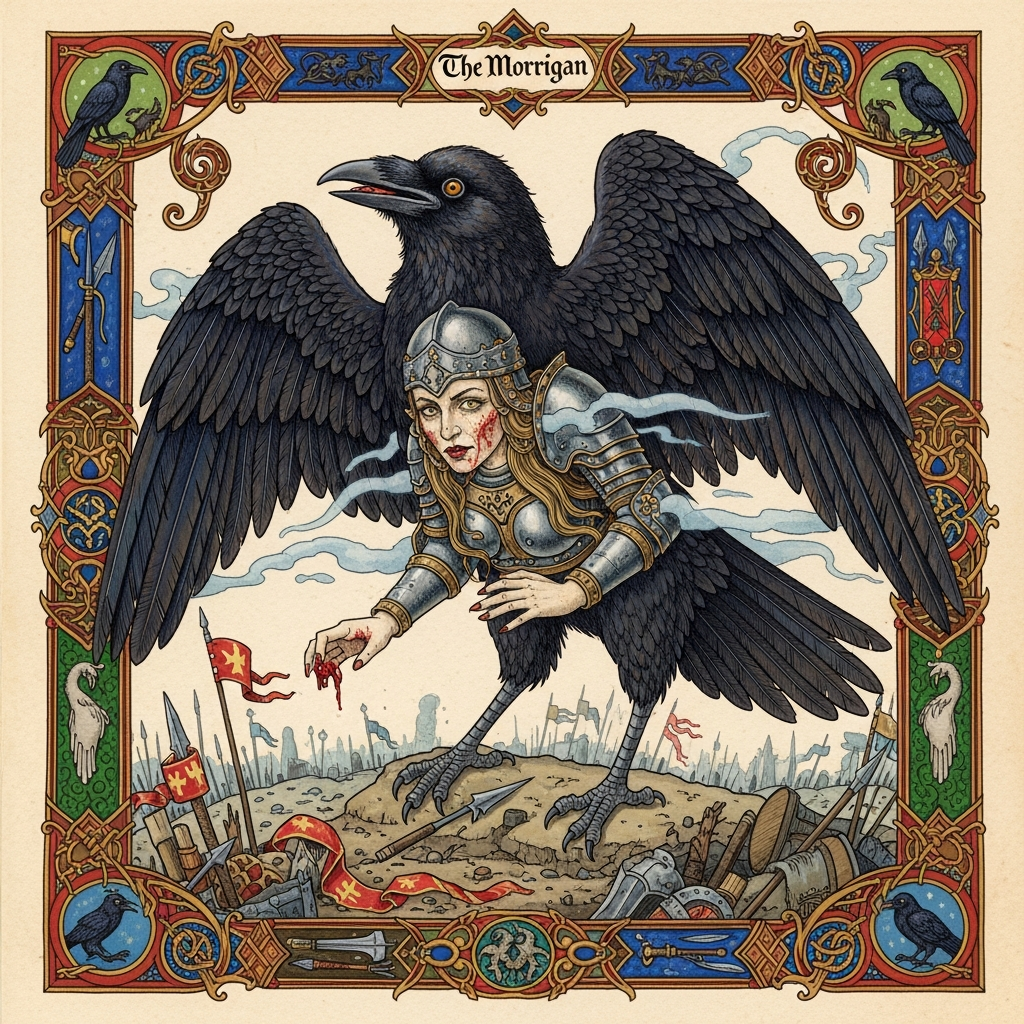
The Morrigan — crow-goddess, battle-feeder, fate-weaver, the one who will later perch on his shoulder as a raven when he dies at his standing stone — turns the chariot around and drives back the way she came.
She is not done. Refusal is not the end of the story. The Morrigan is the goddess of what happens anyway, of the battle that proceeds regardless of whether the warrior is ready for it. She does not abandon her chosen; she transforms the choosing into something else.
When Cu Chulainn meets Loch mac Emonis at the ford two days later, she is already in the water with them.
She comes as an eel first.
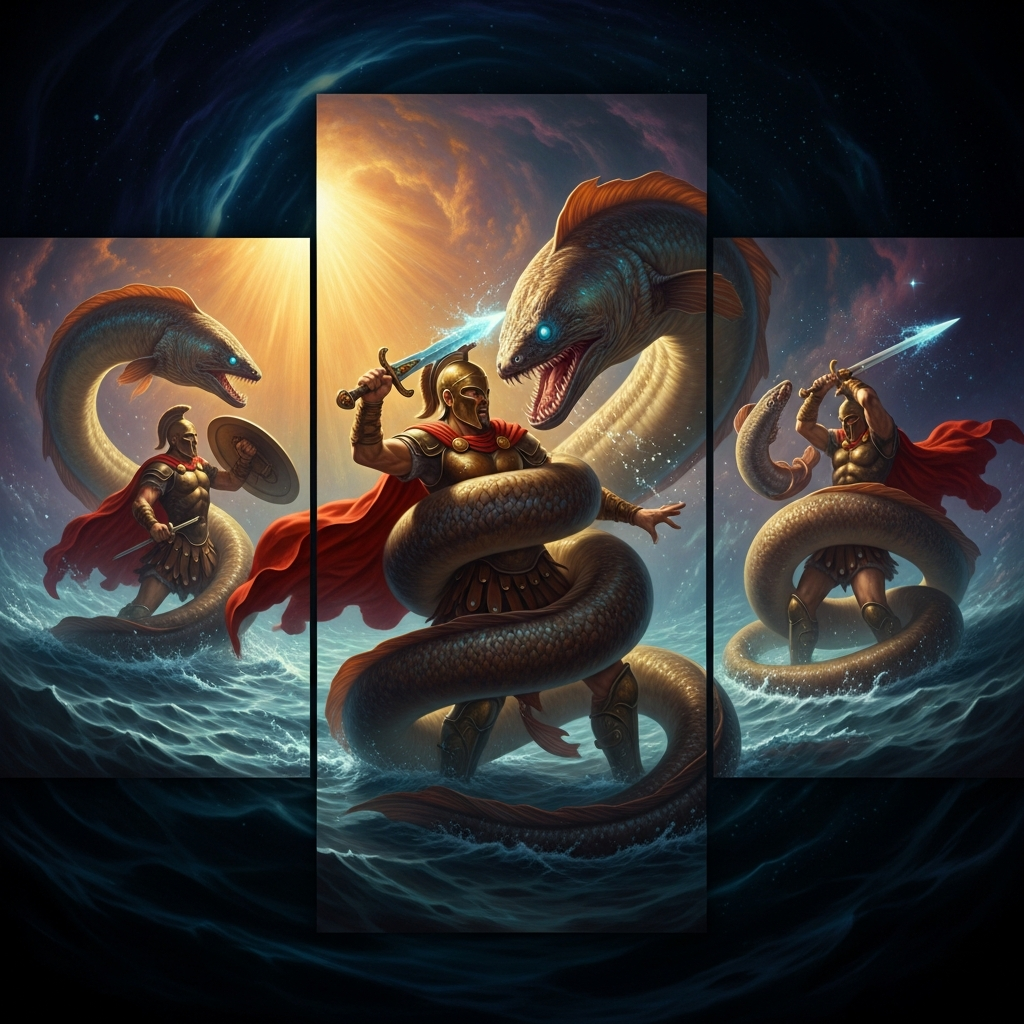
The eel coils around Cu Chulainn’s legs in the ford — a thick river-eel, unnaturally large, tightening around his ankles while Loch bears down on him with a sword. He loses his footing. He goes down on one knee in the current. He stamps the eel and feels something crack under his foot, something that is not just river-bottom — he feels the break travel up through the sole of his foot like a message. The eel slides away, and if it swims differently than before, he does not notice.
She comes as a wolf next. The wolf drives a stampede of cattle across the ford’s western bank — hundred-weight animals crashing through the shallows, turning the ford from a navigable crossing into a chaos of hooves and spray. Cu Chulainn fights Loch with cattle ramming into him from behind. He slings a stone from his sling in the middle of the melee and it finds the wolf’s eye. The wolf runs. He watches it go without quite registering what it was.
She comes last as a red heifer at the front of the herd — a cow with nothing unusual about her except that she is there at all, and that when his sling-stone catches her leg she breaks in a direction that is not the direction hooves break, and she is gone before he can look at her directly.
Loch falls at the end of all of this. The ford is won. Cu Chulainn stands in the bloody current and does not feel that he has won cleanly.
He meets her that evening on the road.
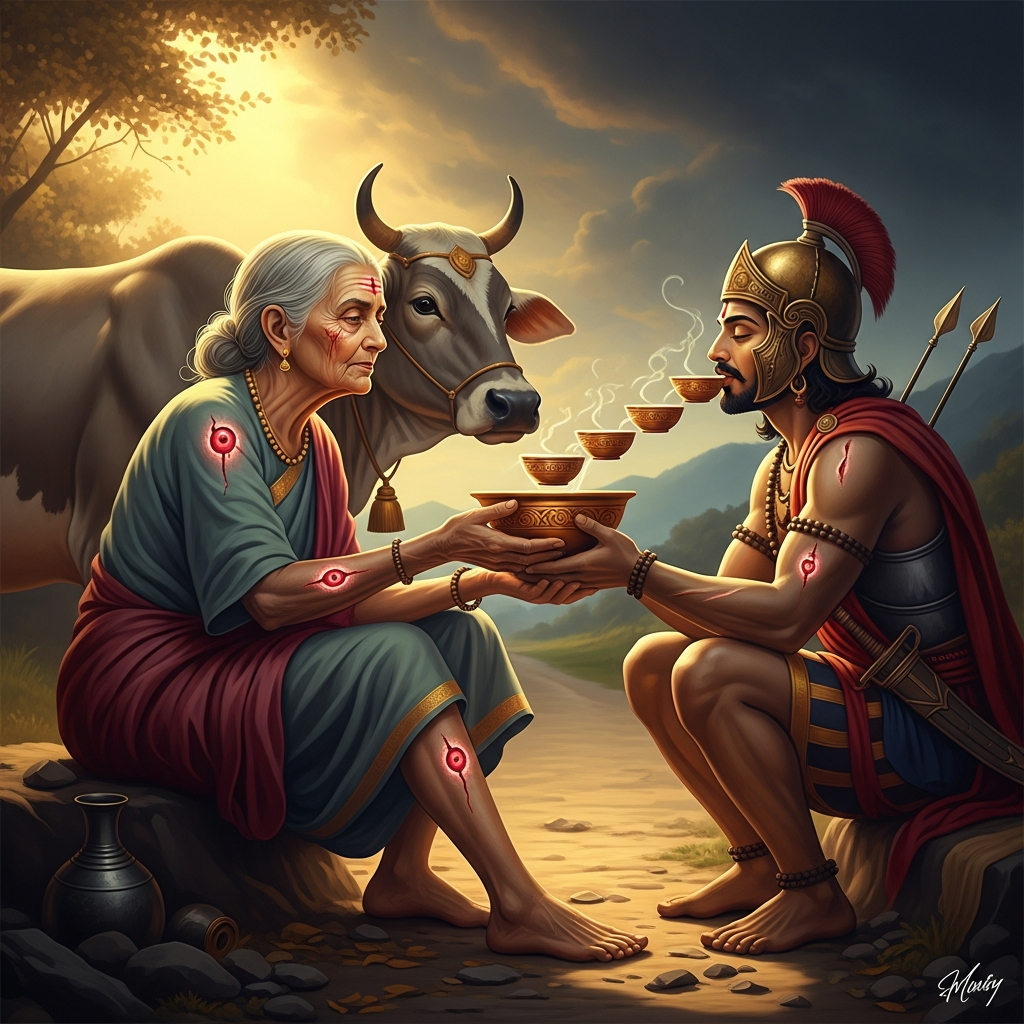
She is an old woman with a single eye and a lame leg and a wound in her shoulder that has been treated with meadowsweet and is still seeping at the edges. She is milking a three-teated cow by the verge and she offers him milk because that is what you do for a warrior on the road who looks as bad as he looks.
He drinks. A blessing on you, he says, because that is what you say to someone who feeds you. The old woman’s eye stops seeping. He drinks again. A blessing on you. Her leg straightens under her, imperceptibly, the way an old pain does not so much vanish as absent itself. He drinks the third time. A blessing on you for your generosity. The shoulder wound closes.
She looks at him with the one eye.
He does not look back. He is already thinking about tomorrow’s combat.
What has happened here is a covenant made entirely in the passive voice. The Morrigan chose Cu Chulainn and he refused the choice. The refusal did not end the relationship; it changed its terms. She attacked him and he wounded her three times without knowing what he was wounding. He healed her three times without knowing what he was healing. At no point did either of them consent to the arrangement in any legible sense. The arrangement proceeded anyway.
This is one of the claims the Tain makes about fate and battle-goddesses: they do not require your understanding. They require your presence. Cu Chulainn was present at the ford. That was enough.
She will be with him when he dies, twelve years from now, at his standing stone in Muirthemne. He will be mortally wounded and he will tie himself upright so that he can keep fighting, and a raven will land on his shoulder, and his enemies will use the raven’s landing as the signal that it is safe to approach. The raven is the Morrigan. The form she takes for his ending is the same form she takes for every battlefield: the carrion bird, the black witness, the one who was already there before the first blow was struck.
She told him at the ford that she loved him. The word she used was the Irish word for a love that encompasses what she will do on your behalf, and what you will lose because of it, and what she will do when it is over. He did not have the vocabulary for what she was offering. He was seventeen and tired and his ankles were bleeding.
The Tain does not present this as a failure of Cu Chulainn’s. It presents it as the condition of heroes: they are loved by forces they cannot name, in languages they have not been taught, and the love proceeds regardless.
The Morrigan is sometimes called a goddess of death, which is half-right. She is the goddess of the transition point, the moment in the ford when things could go either way and then do not. She is the weight on the scale, not the verdict.
Her three forms at the ford — eel, wolf, heifer — are the three forms of the threat that attends any great fight: the thing that trips you, the thing that panics you, and the thing that comes at you from where you are not looking. Cu Chulainn wounds all three. This is, in the theology of the Tain, the correct response to fate: not submission, not recognition, not accommodation. Wounding it back. Demanding, through force, that it honour you as an equal rather than a subject.
She accepts this. She is old enough to have seen how it goes otherwise.
Scenes
The Morrigan at the ford in her first form: a tall woman in a red dress with red eyebrows, driving a chariot with a one-legged chestnut horse, her cloak trailing in the current
 Generating art…
 Three moments from one combat: an eel coiling around the warrior's legs in the ford; a grey wolf driving a stampede of cattle across the bank; a red heifer at the head of the herd
 Generating art…
 An old woman with three wounds — her eye, her shoulder, her leg — sitting beside a cow at the roadside, offering milk to a warrior who accepts it without looking at her face
 Generating art…
 Echoes Across Traditions
Entities
- the Morrigan
- Cu Chulainn
- Loch mac Emonis
- Badb
- Nemain


Sources
- Thomas Kinsella (trans.), *The Tain* (1969)
- Jeffrey Gantz (trans.), *Early Irish Myths and Sagas* (Penguin, 1981)
- Proinsias Mac Cana, *Celtic Mythology* (1970)
- Miranda Green, *Celtic Myths* (British Museum Press, 1993)
- Joanne Findon, *A Woman's Words: Emer and Female Speech in the Ulster Cycle* (1997)