Combat Profile
Badb's Cry
Unleash a piercing wail that determines the fate of battle, granting allies victory and striking terror into enemies' hearts.
Triple Sovereignty
Manifest as maiden, mother, and crone simultaneously, shifting form to adapt to any conflict and read the threads of destiny itself.
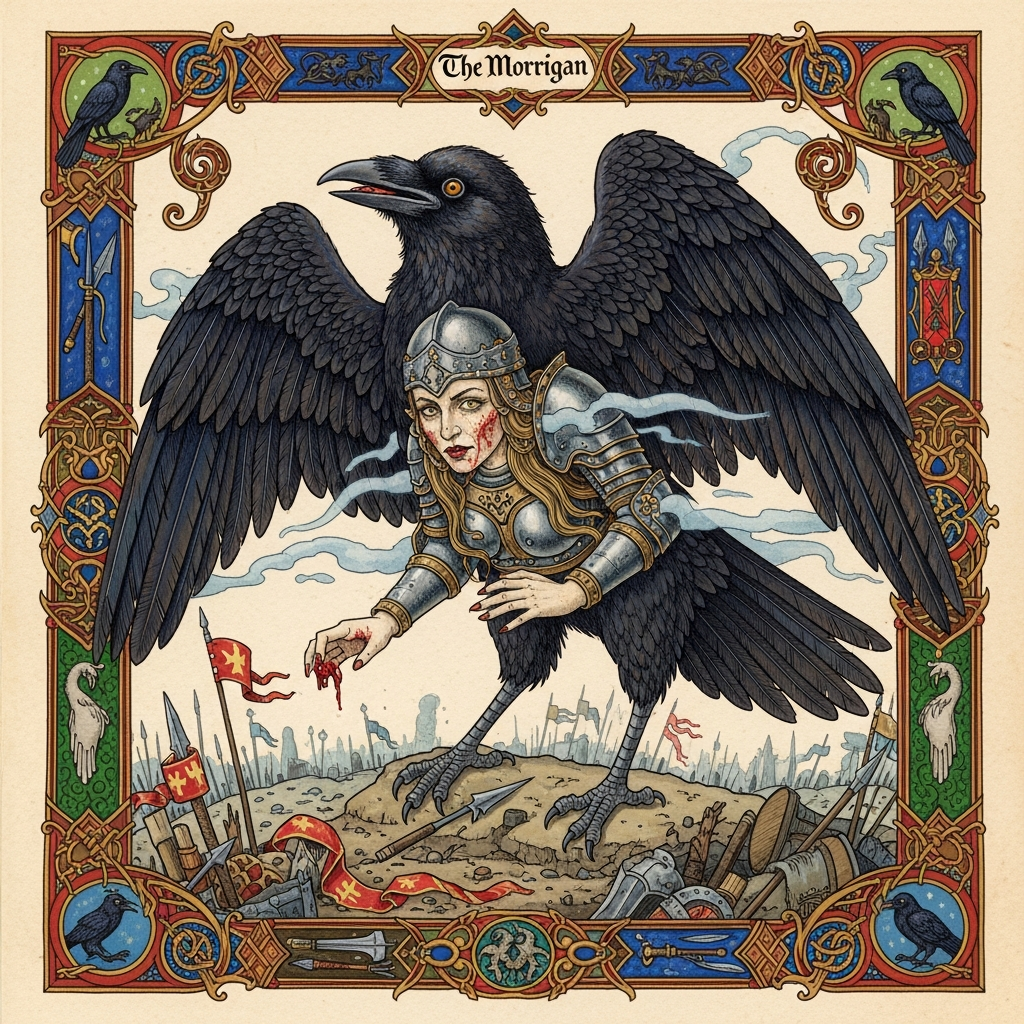
She does not fight directly -- she influences, foretells, and drives men to frenzy. Her power depends on the battlefield existing
“Over his head is shrieking / a lean hag, quickly hopping / over the points of their weapons and shields; / she is the grey-haired Morrigan.” — Tain Bo Cuailnge
Lore: The Morrigan (“Phantom Queen” or “Great Queen”) is the most terrifying figure in Celtic mythology. She is a triple goddess of war, composed of three aspects: Badb (the crow, who shrieks over battlefields and drives warriors to madness), Macha (who curses the men of Ulster with labor pains before battle), and Nemain (panic, confusion, the chaos of war). She is not a warrior-goddess in the Athena sense — she rarely fights directly. Instead, she shapes the battlefield: appearing as a harbinger of death, choosing who will fall, inciting battle-frenzy, and washing the armor of the doomed at river fords. She offered herself to Cu Chulainn during the Cattle Raid of Cooley; when he rejected her, she attacked him in three forms (an eel, a wolf, and a red heifer). He wounded her each time, and later healed her unknowingly by blessing her. When Cu Chulainn finally died, tied to a standing stone so he would die upright, it was a crow — Badb, the Morrigan’s aspect — that landed on his shoulder, and only then did his enemies dare approach.
Parallel: The Morrigan parallels the Valkyries of Norse mythology (female figures who choose the slain) and the Angel of Death in Jewish tradition (the destroyer who passes over the battlefield). Her triple nature parallels other triple goddess figures (Hecate in Greek tradition, the three Fates/Moirai). Her role as a crow over battlefields echoes Odin’s ravens, Huginn and Muninn. In the Christian framework, she represents the fear of divine wrath in feminine form — a concept largely absent from Christianity, where wrath is coded masculine, but deeply present in Celtic spirituality.
1 min read
Cu Chulainn resisted her romantic advances, which earned her enmity -- but even he could not escape her. She was present at his death
*Tain Bo Cuailnge*; *Cath Maige Tuired*; *Lebor Gabala Erenn*