Combat Profile
Cycle of Seasons
Cernunnos cycles all combatants through growth, abundance, decay, and rebirth, shifting their stats each round according to nature's eternal wheel.
Lord of the Wild
All beasts and creatures fight alongside Cernunnos with enhanced ferocity, and he gains power whenever life transitions to death or death to life nearby.
No surviving narrative mythology -- known almost entirely from iconography; absorbed by Christian demonology as a model for the horned devil
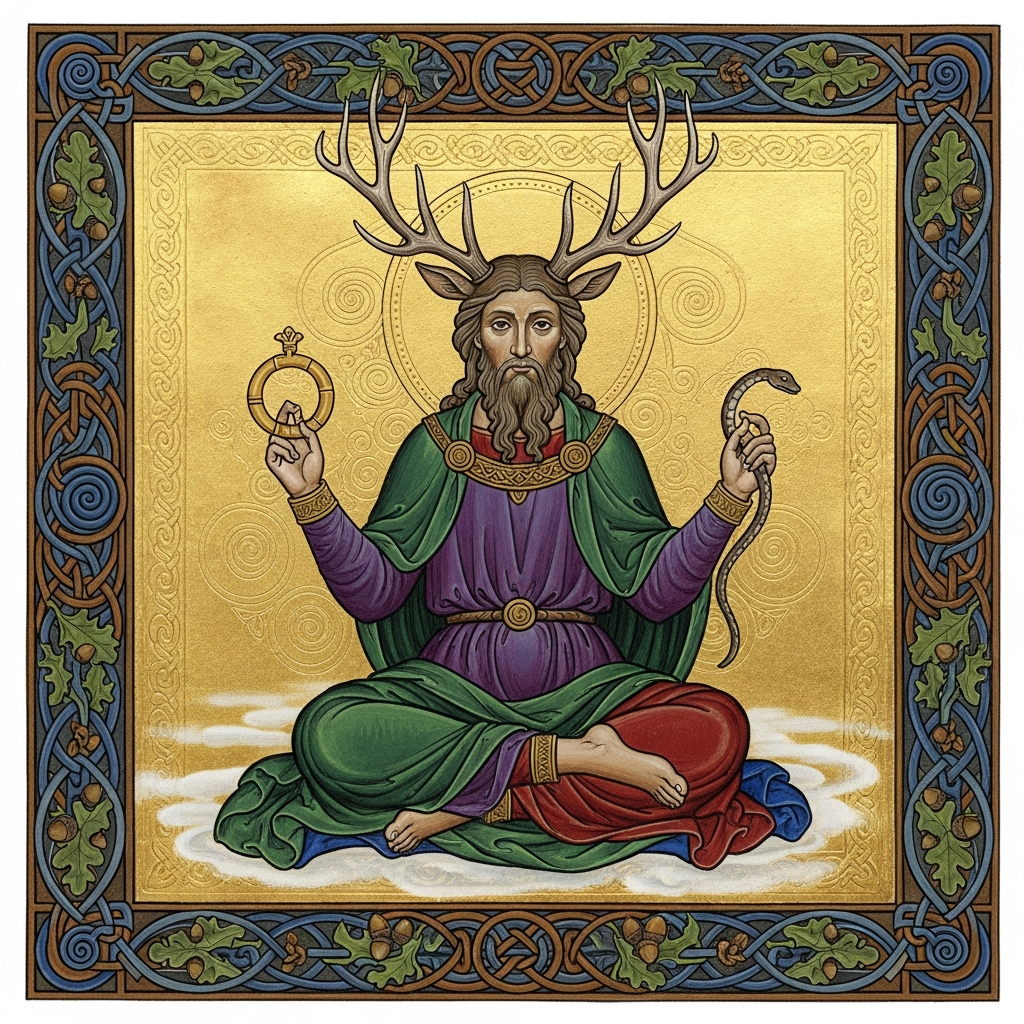
Lore: Cernunnos is the great mystery of Celtic religion — a god whose iconography is among the most widespread in the Iron Age Celtic world (from Ireland to Romania), yet whose name appears only once in the surviving textual record (the Pillar of the Boatmen, Paris, dated to Tiberius’s reign). He is depicted seated cross-legged in a posture later associated with Buddhist meditation, antlered like a stag, holding a torc (the symbol of Celtic nobility) and a ram-horned serpent. On the Gundestrup Cauldron he sits among wild animals — wolf, deer, lion, bull — the unmistakable Lord of the Wild. Stags shed and regrow their antlers each year, making him a god of cyclical death and rebirth without ever needing a resurrection narrative. Modern Wicca and neopaganism elevated him to a central position as “the Horned God,” though this is a 20th-century reconstruction more than a historical revival.
Parallel: Pashupati (the seated, horned, animal-flanked figure on the Indus Valley Pashupati Seal, c. 2500 BCE — a parallel so close some scholars argue for shared Indo-European roots); Pan (Greek goat-god of the wild); Shiva as Pashupati (“Lord of Animals”); the demonization of horned deities into the Christian devil (Cernunnos and Pan are the two greatest casualties of this process); Esau as the “hairy man” of the wild (Genesis 25:25, 27:11).
1 min read
The Christian missionaries who repurposed his image as Satan's horned form
The Pillar of the Boatmen (Paris, 1st century CE -- the only inscription bearing his name, *Cernunnos*); the Gundestrup Cauldron; Gallo-Roman votive reliefs; ethnographic reconstruction