Combat Profile
Tír na nÓg's Passage
Oisin temporarily transports himself and allies between the mortal realm and the Otherworld, gaining invulnerability for one turn while existing outside normal time.
Eternal Witness
Oisin retains perfect memory of all events and gains bonus power from recounting past victories; his poetic words strengthen allies' resolve and grant minor healing each round.
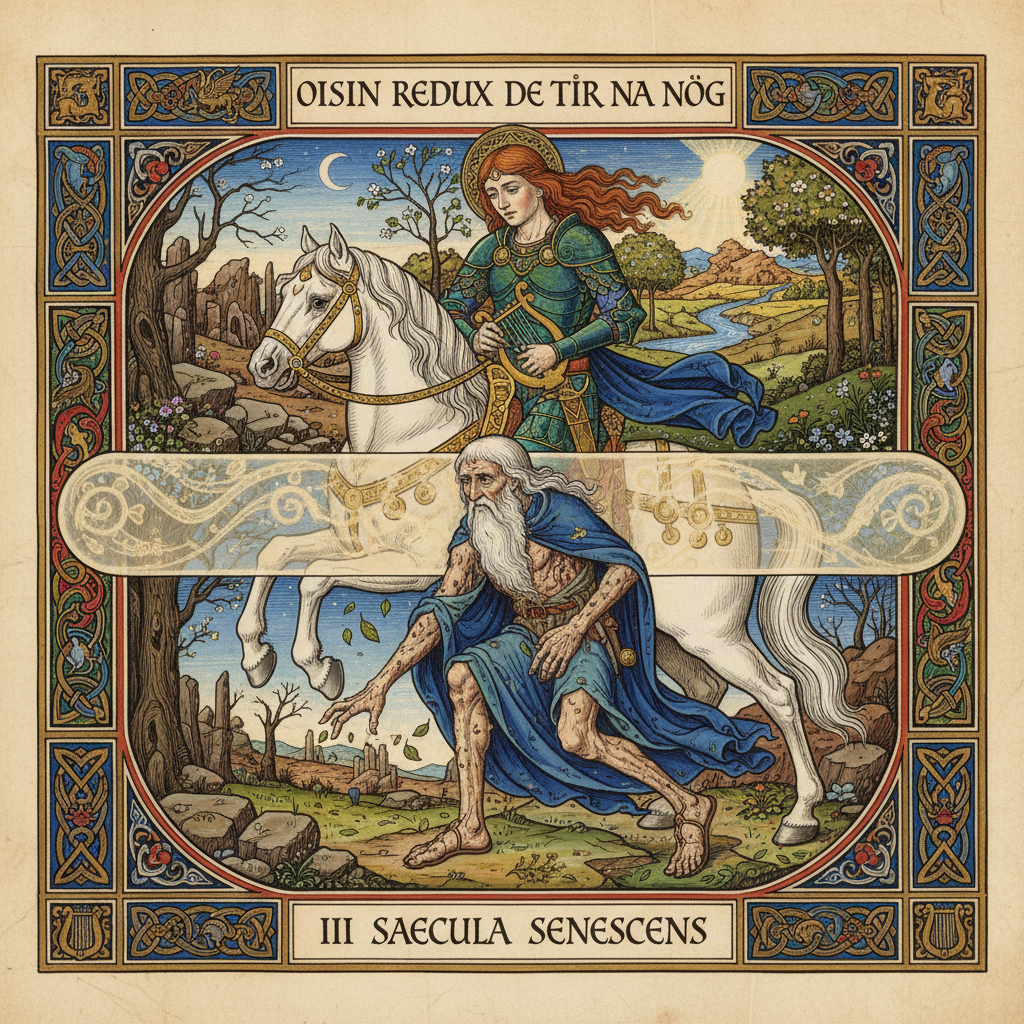
Cannot touch Irish soil after returning from Tir na nOg without aging 300 years instantly. He falls from his horse, touches the ground, and becomes ancient
“Where are the Fianna?” asked Oisin. And they told him: “The Fianna have been dead these three hundred years. There is a new God in Ireland now.”
Lore: Oisin (also spelled Ossian) is Fionn’s son and the greatest poet of the Fianna. His story is the most poignant in Celtic mythology and the one that most directly addresses the Celtic-Christian transition. Niamh of the Golden Hair, a woman of the Otherworld, rode a white horse to Fionn’s company and chose Oisin to return with her to Tir na nOg. He went. There, he experienced eternal youth, beauty, and joy. After what felt like three years, he grew homesick and asked to visit Ireland. Niamh gave him her white horse and warned him: do not dismount, do not touch Irish soil. He rode back to find Ireland transformed. The Fianna were gone. The great halls were ruins. Small men struggled to move a stone that a single Fianna warrior could have lifted. Oisin leaned from his saddle to help them, his girth snapped, and he fell to the ground. Instantly, three hundred years caught up with him, and he became a blind, withered old man. It was in this state that he met St. Patrick. Their dialogue — Oisin defending the old ways, the honor of the Fianna, the beauty of the pagan world; Patrick preaching salvation, the new God, the life to come — is one of the great literary encounters in Irish tradition.
Parallel: The time-dilation motif parallels Rip Van Winkle, the Japanese tale of Urashima Taro, and the broader folklore theme of fairy time versus mortal time. More profoundly, Oisin embodies the experience of anyone who has seen their world replaced: the returning soldier, the exile, the person who sleeps through a revolution. His dialogue with Patrick parallels the biblical tension between the old covenant and the new — and, remarkably, the Irish literary tradition treats both speakers with respect. Oisin is not a villain; Patrick is not a destroyer. They are two worlds meeting, neither entirely wrong.
2 min read
Time. He defeats every warrior but cannot defeat the passage of centuries
*Acallam na Senorach* (Tales of the Elders of Ireland, c. 12th century); *Oisin i dTir na nOg* (folk versions)