Combat Profile
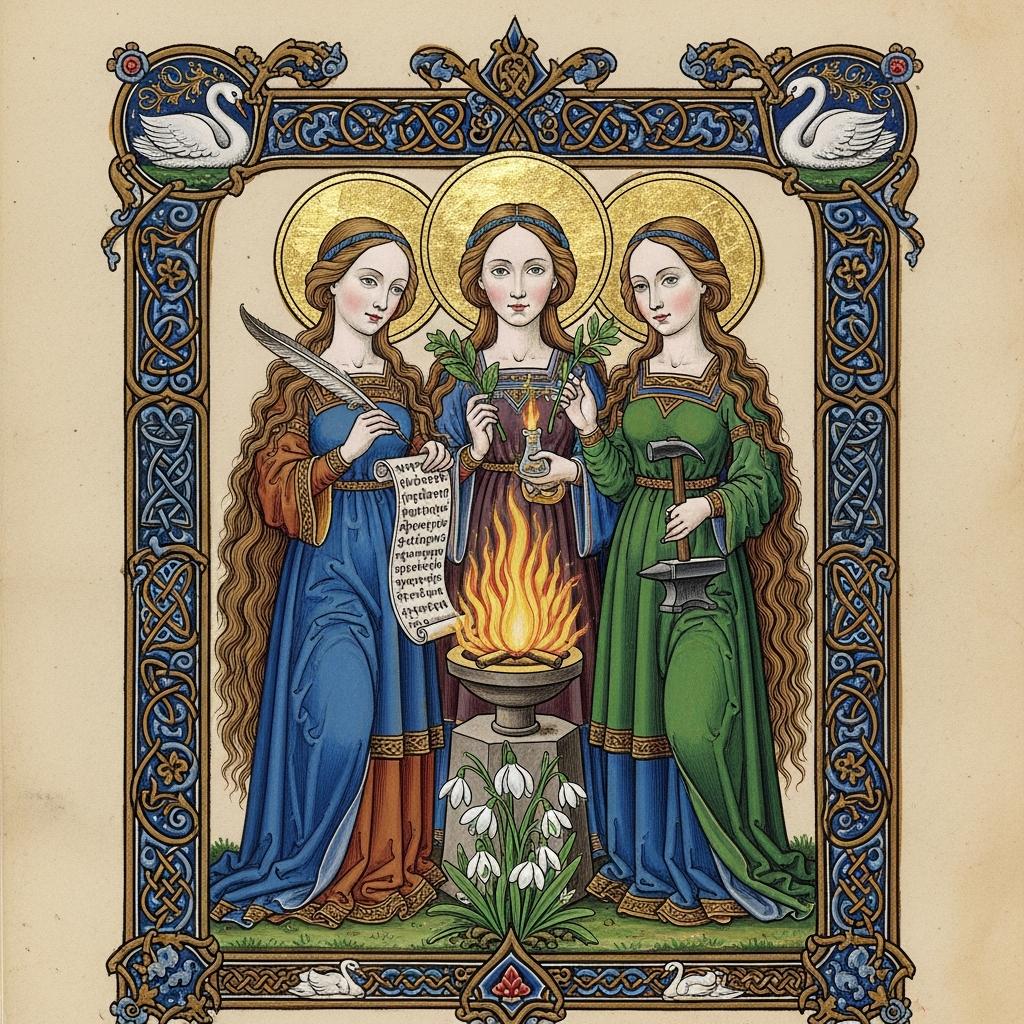
Threefold Flame
channels divine fire through poetry, healing, and craft simultaneously, amplifying all three aspects as one unified power
Triple Aspect
embodies poet, healer, and smith at once; gains bonuses to inspiration, restoration, and creation on every turn
Not a war goddess -- her power is creative, not destructive
“Brigid the poetess, daughter of the Dagda… Brigid the healer, Brigid the smith — three sisters, all called Brigid.” — Sanas Cormaic
Lore: Brigid is the most beloved figure in Celtic mythology, and her story is the centerpiece of the Celtic-Christian synthesis. As a goddess, she is a triple deity: Brigid of Poetry, Brigid of Healing, and Brigid of Smithcraft — three aspects or three sisters sharing one name. She is the daughter of the Dagda. Her sacred flame at Kildare was tended by nineteen priestesses (later nuns), each taking a night in turn; on the twentieth night, Brigid herself tended the flame. She invented keening — the ritual mourning cry — when her son Ruadan was killed fighting against the Tuatha De Danann at the Second Battle of Mag Tuired (he had sided with the Fomorians through his father’s lineage). Her cry was the first grief expressed aloud in Ireland. She presides over Imbolc (February 1), the festival marking the first stirrings of spring and the lactation of ewes.
The Transformation: At some point between the 5th and 8th centuries, Brigid the goddess became St. Brigid of Kildare (c. 451-525 AD). The feast day remained February 1. The sacred flame at Kildare continued to be tended — now by nuns rather than priestesses (it burned continuously until the 16th century and was relit in 1993). The healing wells sacred to the goddess became holy wells sacred to the saint. Brigid’s crosses, woven from rushes on her feast day, are still made in Ireland today. The hagiography of St. Brigid is saturated with miracles that echo the goddess’s domains: she heals the sick, she multiplies food (echoing the Dagda’s cauldron), she is associated with fire and light. Whether “St. Brigid” was a real woman onto whom the goddess’s attributes were projected, or the goddess directly Christianized, or some combination, is one of the great unresolved questions of Celtic studies.
Parallel: Brigid’s triple nature parallels the Christian Trinity — three persons, one essence. Her sacred flame parallels the eternal lamp in the Tabernacle (Leviticus 24:2). Her role as healer parallels Christ’s healing ministry. Her invention of keening — the expression of grief at the death of her child — parallels the Mater Dolorosa, Mary weeping at the cross. She is, more than any other figure in this compendium, a bridge between two worlds.
2 min read
Cannot be countered; she is too beloved and too essential
*Cath Maige Tuired*; *Lebor Gabala Erenn*; Sanas Cormaic (Cormac's Glossary, 9th century)