Contents
After Prometheus steals fire for humanity, Zeus commissions Hephaestus to fashion the first woman from clay — beautiful, cunning, and carrying a sealed jar. When Pandora opens it, every evil pours into the world. Only Hope remains, trapped at the bottom.
- When
- Mythic Time · Hesiod's Works and Days ~700 BCE
- Where
- Earth, after the gift of fire
Zeus does not rage the way mortals rage.
He does not shout. He does not break things. He sits on the throne of Olympus and looks down at the small bright smear of light spreading across the dark earth — campfire after campfire after campfire, humans who should be cold in the dark, now warm, now cooking, now smelting — and he calculates.
Prometheus has stolen fire. The theft cannot be undone. The flames are already in a thousand hands, and to snuff them now would be its own kind of defeat. Zeus understands something about power that lesser rulers do not: the visible punishment of a thief is less important than ensuring the thief’s gift becomes the world’s wound.
He summons Hephaestus.
The god of the forge does not work quickly. He works correctly. He takes clay — not river clay, not common earth, but the deep white clay from a riverbed that has never seen sunlight — and he shapes it with the patience of someone who has made real things before. Limbs, first. Then the torso. Then the face last, because the face is where the trap lives.
Each Olympian contributes. Aphrodite lays beauty over the clay like a glaze — not softly, but precisely, the way a weapon is finished. Athena gives cunning: not wisdom, not reason, but the sharper and more dangerous thing, the ability to read a room, to know what a person wants before they know it themselves. Hermes gives speech, and inside the speech he folds deceit the way a letter-writer folds a blade inside a sealed envelope. Charites dress her. The Horai crown her with flowers.
They name her Pandora. All-gifted. In the naming, the joke is already half-told.
Zeus gives her a jar.
It is sealed with wax. It is sealed with instruction: do not open it. He does not explain why. Explanations are for the innocent.
Prometheus has a brother. This is the detail Hesiod buries in the middle of the story, the detail that makes everything worse.
His name is Epimetheus — Afterthought, to Prometheus’s Forethought. Where his brother sees seven moves ahead, Epimetheus sees the last move, after it has already been made. Prometheus warns him: accept no gifts from Zeus. The god does not give without taking. Epimetheus nods. Prometheus goes back to his mountain, and Epimetheus — because he is Afterthought, because he cannot help it — looks at Pandora.
He accepts the gift.
She lives in Epimetheus’s house with the jar.
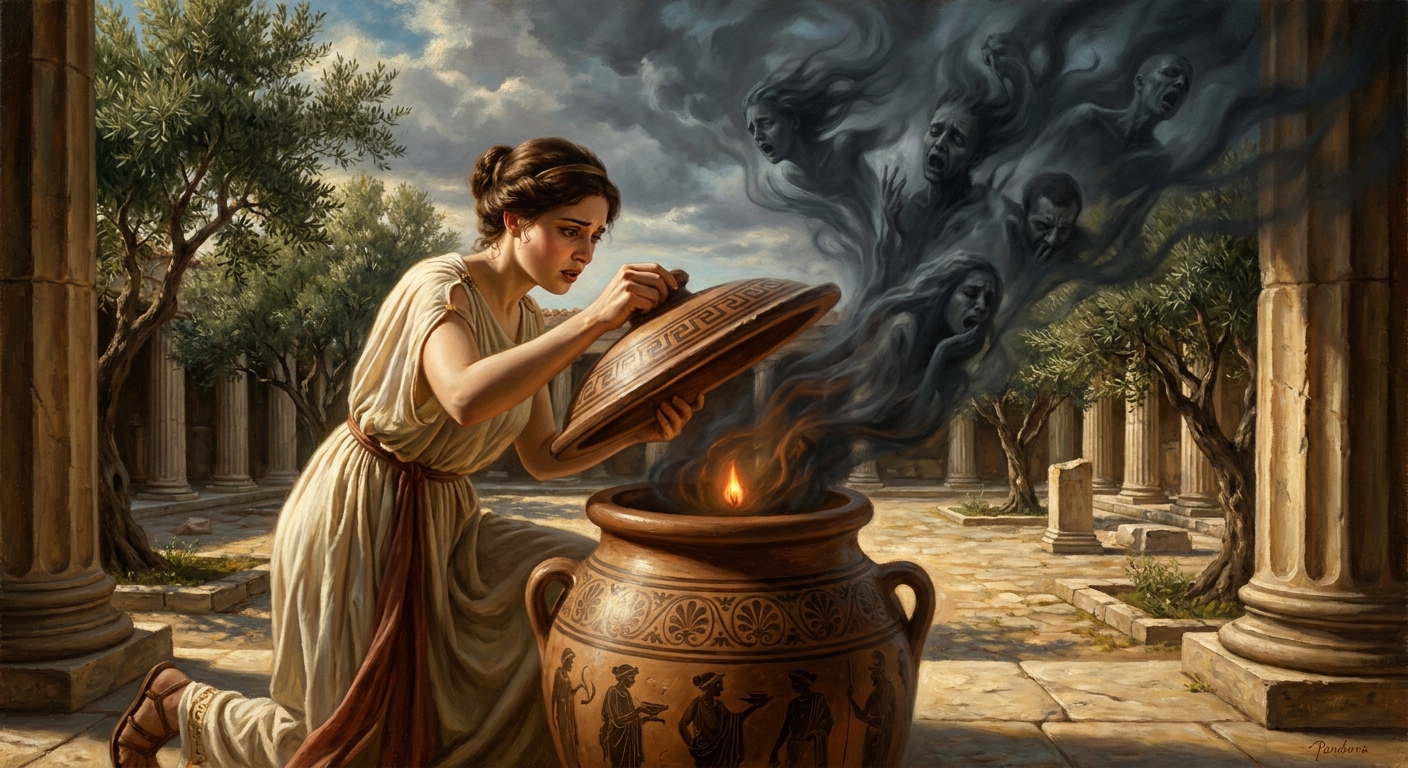
She does not open it immediately. This is the part the versions elide, because it is the part that makes her human rather than symbol. She lives with the sealed jar. She cooks near it. She sleeps near it. It sits in the corner and she does not look at it, and then she looks at it, and then she does not look at it again. This goes on.
Curiosity is not the right word. Curiosity implies lightness. What she feels is closer to the gravitational pull of an unanswered question — the same force that moves philosophers and prophets and every person who has ever stood at the edge of something and leaned forward slightly, just to see.
She opens it.
They come out in the order Zeus packed them.
Sickness first, the way a smell moves — everywhere at once, no edges, no warning. Then war, which does not roar but hisses, slipping between the fingers of men who thought they were making other choices. Hunger. Not the ordinary hunger of a skipped meal but the structural hunger that will be passed down, generation to generation, the hunger baked into the arrangement of the world. Jealousy. Every disease that has a name and every disease that does not. Grief. The particular grief of watching someone suffer and being unable to stop it. Old age, which is its own kind of violence. The absence of justice. The noise that replaces it.
They pour from the jar the way smoke pours from a fire that has been smothered with a lid — thick, relentless, climbing toward every available opening.
The earth receives them. From this point forward, the earth will be a different kind of place.
She seals the jar.
She is fast. Or the jar is fast. Or Zeus, who planned this, ensured that one thing would remain. At the bottom of the jar, beneath every evil he arranged, he placed one more thing: Elpis. Hope.
It stays inside. Sealed in. Not released into the world with the rest.
This is the ambiguity that has not been resolved in 2,700 years of argument: Is Hope trapped inside the jar as mercy — a comfort kept safe for humanity, immune to the corruption that escaped — or is Hope trapped inside the jar as cruelty — the one thing humans will always need and never be able to grasp directly, visible through the clay, almost in reach, forever interior?
Hesiod does not say. He records the myth and moves on. The scholars come later, the philosophers after them, the theologians after that, and none of them settle it.
The jar sits in Epimetheus’s house. It is sealed now. Every evil is already gone.
Prometheus watches from his mountain.
He will be chained there by Zeus — eagle, liver, regrowth, repetition — punishment for the fire. He knows this is coming. He is Forethought; he saw it before he carried the torch down from Olympus. He chose it anyway, which is either the definition of heroism or the definition of a particular kind of pride, depending on who is telling the story.
What he could not have seen — what even Forethought cannot see — is what the jar would mean. The fire he gave was clean. The jar is the reply. Every time a human lights a fire to cook or forge or warm themselves, somewhere a door opens on the world Pandora made: on the illness and the war and the hunger and the grief and the whole weight of being alive on an earth that is not arranged for comfort.
This is the Greek claim, and it is an honest one: the world is broken, and the breaking is bound up with every gift. The fire and the jar came together. You do not get one without the other.
At the bottom of the jar, Hope does not answer the question of whether this is survivable.
It simply stays.
The word “box” in the common version is Erasmus’s mistranslation. Hesiod writes pithos — a large storage jar, the kind used for grain or oil or wine, a thing of ordinary household life. The change from jar to box happened in 1508 in a Latin edition, and it stuck. The jar is the more interesting vessel: it is domestic, it is Mediterranean, it is the thing you keep your provisions in. Zeus did not hide the world’s evils in something exotic. He hid them in the pantry.
The word Elpis — Hope — can also mean Expectation, or Anticipation, or the forward-leaning attention of a mind that is not yet certain what comes next. Whether that is a mercy depends entirely on what comes next.
Echoes Across Traditions
Entities
- Pandora
- Epimetheus
- Prometheus
- Zeus
- Hephaestus
Sources
- Hesiod, *Works and Days* 60-105
- Hesiod, *Theogony* 570-612
- Erwin Panofsky & Dora Panofsky, *Pandora's Box: The Changing Aspects of a Mythical Symbol* (1956)
- Walter Burkert, *Greek Religion* (1985)