Persephone in the Pomegranate
Mythic Time · Homeric Hymn to Demeter ~7th century BCE · A meadow in Sicily, then the Underworld
Contents
Hades tears the earth open in a Sicilian meadow and carries Persephone into the dark. Demeter lets the world starve until the gods negotiate a return — but six pomegranate seeds already swallowed bind the goddess to the underworld half of every year. This is why winter exists.
- When
- Mythic Time · Homeric Hymn to Demeter ~7th century BCE
- Where
- A meadow in Sicily, then the Underworld
The narcissi are new. That is the first thing.
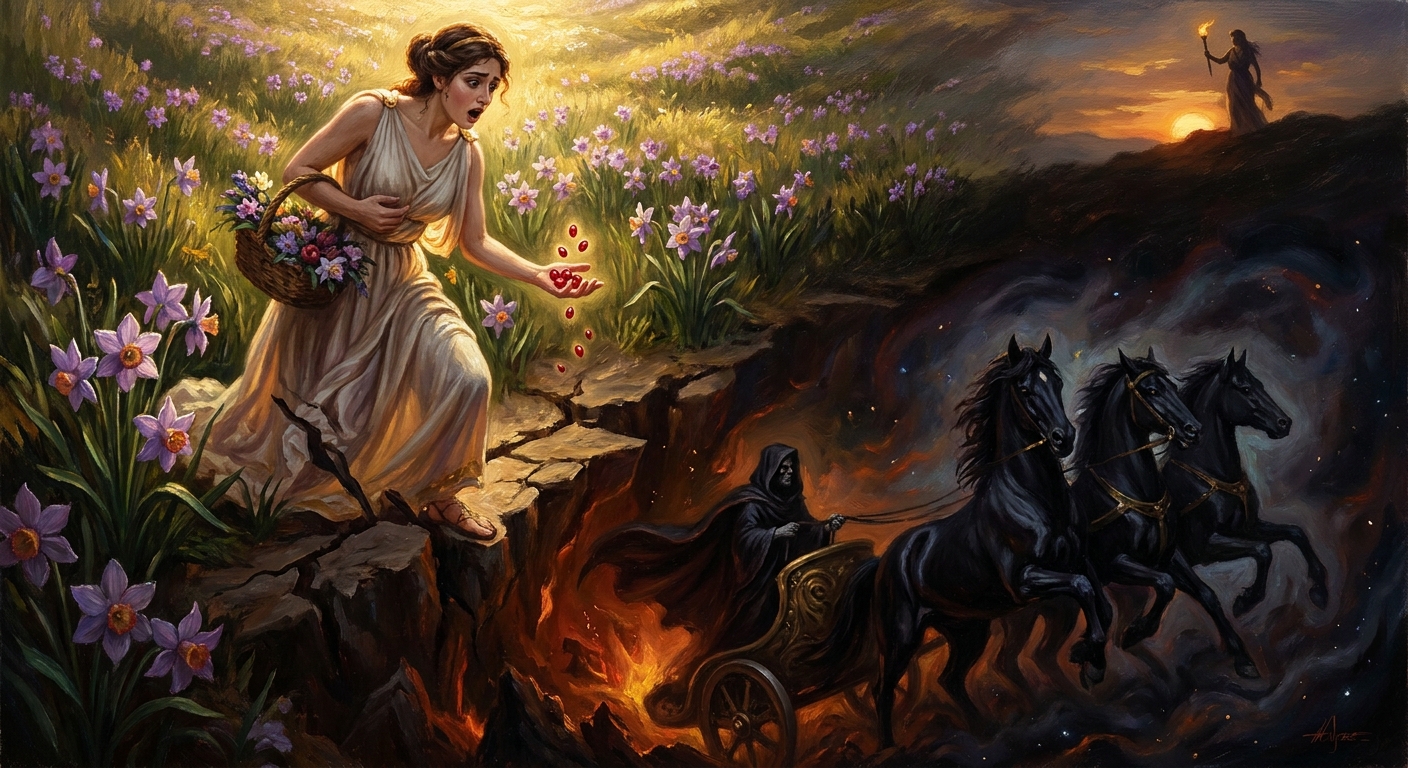
Persephone has gathered hyacinths and roses and crocuses, the ordinary flowers of a Sicilian afternoon, and now she bends toward a narcissus the earth has opened to offer her — one hundred blooms from a single root, scent so dense it stops the breath, so sweet it bends the knees of gods. The Homeric Hymn records it with the precision of a document: the earth made this flower for a trap, at Zeus’s instruction, to honor Hades who receives all things.
She reaches.
The ground does not tremble first. That is important. There is no warning. One moment the meadow is warm and ordinary; the next, a seam cracks open in the Nysian plain and Hades is there — chariot black, horses black, the god himself composed and purposeful, as if this has been decided for some time. He takes her with one arm, the way a man reaches for a fruit, and the earth seals behind them.
She screams. The scream travels everywhere and means nothing. Her father Zeus is absent, watching something else. Her companions scatter. The mountains hear her; the sea hears her; only Hecate in her cave and Helios in his chariot witness the act.
The chariot goes down.
Demeter hears it. Not the words — the grief, moving through the upper air like a change in pressure. She leaves whatever she was doing and runs. Shawl loose, torch unlit, she searches the whole surface of the earth for nine days and does not eat and does not bathe and does not rest. No god tells her anything. On the tenth day Hecate comes with a torch and says she heard screaming; she did not see who. Together they find Helios, who sees everything, and Helios — the one witness who does not flinch from telling the truth — tells it plainly: Zeus gave your daughter to his brother. This was arranged. Hades is not a thief. He is a groom.
Demeter sits down.
The earth notices.
The grain withdraws. Not dramatically — there is no proclamation, no curse spoken aloud. Demeter simply stops caring about the surface world, and the surface world goes grey. The seeds she spent centuries teaching to open themselves to warmth and water now lie in the soil and do nothing. The furrows are cut and nothing rises. Oxen pull plows across fields that give back only dust. The human race begins to starve; the smoke of sacrifice thins and then stops; the gods of Olympus go quiet from hunger, because gods eat what humans burn for them.
A famine is not an event. It is an argument. Demeter is making one.
She disguises herself as an old woman and sits down in Eleusis, near a well, and lets the grief have her. The daughters of the local king find her there and bring her home. She takes work as a nursemaid, cares for their infant brother Demophon with a tenderness that is also a wound, and begins, at night, to hold the child in fire — not to burn him but to burn away his mortality, to make of this one human child something that does not have to die. She is nearly finished when his mother sees it and screams, and Demeter drops the disguise and shows herself, towering, goddess-tall, unbearable to look at, and says: you have ruined him. He will die like the rest.
This is the moment that Eleusis remembers. Not the rape. The nursemaid holding a child in fire while the world starves outside.
Zeus blinks first. He sends one messenger and then another, each god returning from the underworld with Demeter’s answer unchanged: not until my daughter stands in this light. Finally he sends Hermes — wing-sandaled, caduceus in hand, the only god at home in every realm — down through the threshold that has no sun.
Hades receives him in the hall of the dead. He is not villainous about it. He is a god who received something that was given, and he will comply with Olympus’s instructions, and he will give the girl back. He tells Persephone this himself, adding, with the patience of a man who knows what he knows: you will be no lesser goddess here. You will be queen of all the dead. All who come to this place come to you.
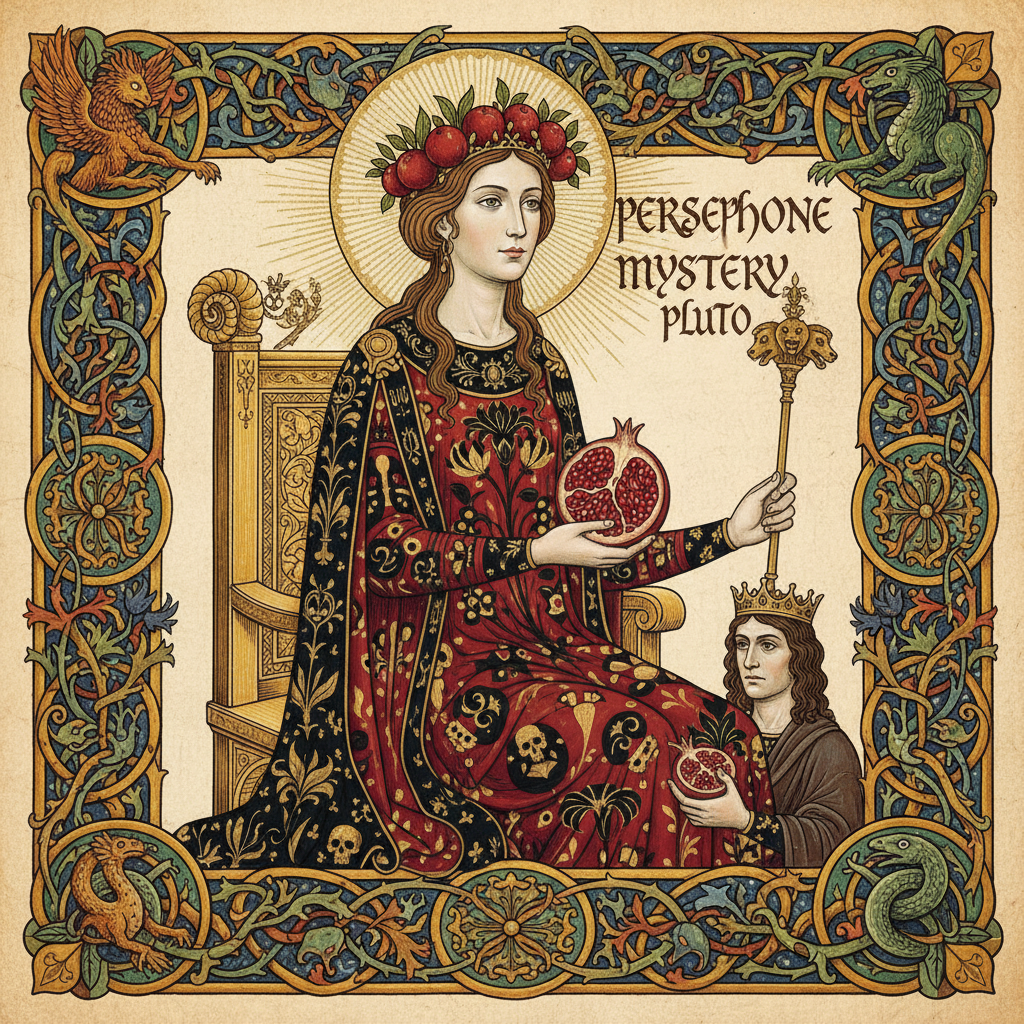
Then he gives her pomegranate seeds.
The Hymn is careful here: some versions say he gives them openly, some say he slips them to her as she mounts the chariot. What matters is that she eats them — six seeds, a small mouthful, a thing that could be called an accident. It is not an accident. The rule of the underworld is ancient and absolute: what is eaten here binds you here. Hermes already has the chariot ready. It makes no difference.
She rises into Sicily in autumn light and Demeter runs.
This is the reunion the Hymn dwells on — mother and daughter together on the Rharian plain, questions tumbling over each other. Did you eat anything below? The answer arrives the way bad news always arrives: sideways, surrounded by the rest of the story, late enough that there is nothing left to do. Six seeds. Six months.
The negotiation happens above their heads. Zeus sends Rhea, their own mother, grandmother of the cosmos, to soften Demeter, and Demeter agrees to let the earth live on one condition: the girl walks both roads. Six months above, where her mother is. Six months below, where her husband is. The world gets grain for half the year. For the other half it gets what Demeter’s grief produces, which is the bare trees and the locked ground and the sky that forgets how to warm things.
This is not presented as a tragedy. This is presented as the explanation.
What the initiates at Eleusis were taught — in the nine-day ritual that mirrored Demeter’s nine-day search, that ended in the darkened telesterion with something shown that could never be spoken — was not the myth. The myth was the preparation. The myth is the story of a world that lost its summer and got it back at a price, which is the story of every person who has gone somewhere they could not return from unchanged.
The thing shown in the dark was what you understood when you had followed Demeter long enough: that the descent is the initiation. That Persephone is not a victim who becomes a queen. She is a girl who reaches for a flower at the edge of the world and comes back knowing something about the dark that cannot be put into words, which is why they did not put it into words, which is why we are still talking about it.
Six seeds. That is what winter costs.
It is a small number, and it comes around every year, and every year the earth does exactly what Demeter does when her daughter goes back down: it pulls in, it goes cold, it lets things die. And every year, when Persephone’s chariot rises again, the narcissi come first — the same flower, the trap-flower, the one with a hundred blooms from a single root — and the earth remembers that the price of descent is also the price of return, and it opens.
The Eleusinian Mysteries ran for nearly two thousand years, from at least the 15th century BCE until the Roman Emperor Theodosius closed the sanctuary in 392 CE. In those two thousand years, initiates included Plato, Pindar, Cicero, Marcus Aurelius, and Hadrian. Cicero wrote that Athens gave many gifts to civilization, but none greater than the Mysteries — because they taught initiates not only how to live, but how to die with better hope. We do not know what was shown in the telesterion. We know it was worth walking nine days for.
Echoes Across Traditions
Entities
- Persephone
- Demeter
- Hades
- Hermes

Sources
- *Homeric Hymn to Demeter* (7th century BCE)
- Ovid, *Metamorphoses* 5.341-571
- Walter Burkert, *Greek Religion* (1985)
- Karoly Kerenyi, *Eleusis: Archetypal Image of Mother and Daughter* (1967)