Contents
Zeus swallows the goddess Metis whole to forestall a prophecy, then suffers the headache of the cosmos — until an axe-blow opens his skull and Athena erupts fully grown, fully armed, never a child, never born of a mother.
- When
- Mythic Time · Hesiod ~750 BCE
- Where
- Mount Olympus
Zeus swallows Metis on a Tuesday afternoon, as casually as a man swallows an olive.
The Fates have spoken — the children of Metis will surpass their father, the second child more powerful than the first. Zeus hears the prophecy the way rulers always hear bad news: as a logistics problem. Metis is wise, which makes the solution elegant and monstrous in equal measure. He waits until she is heavy with child, then opens his mouth and swallows her whole — wisdom, pregnancy, and all.
He is pleased with himself. He has beaten fate with his throat.
Time passes. Olympus continues. Zeus holds court, hurls lightning, fathers children by a rotating catalog of nymphs and goddesses. No one speaks of Metis. She is simply gone, absorbed, the most complete form of silencing one divinity can inflict on another.
Inside him, she keeps thinking.
She cannot stop. Metis is counsel — the Greek word means something closer to cunning wisdom, practical intelligence, the kind that solves a problem before the problem knows it has been named. Swallowed, she does what she has always done. She reasons. She plans. She works. The child is still coming, god or no god, digestion or no digestion. Metis begins to forge armor for the child who has nowhere yet to go.
The hammering is very small, but it is constant.
The headache starts slowly.
Zeus notices it the way he notices most inconveniences: with irritation, then dismissal, then mounting alarm. He has never had a headache. He is the lord of Olympus, the cloud-gatherer, the son who overthrew his father and divided the cosmos with his brothers. His skull has never once objected to anything.
It objects now.
The pain builds over days — or what gods experience as days, which may be centuries between meals. It spreads from the crown of his head to his temples, then behind his eyes, then into the bones of his jaw. He cannot think clearly, which is novel and terrible, because he has never had cause to doubt the instrument of his own thinking. He roars. The mountains on the Aegean coast slide six feet to the left.
Hera watches from across the hall. She says nothing. She has always known that a man who swallows wisdom will eventually develop the worst headache in history.
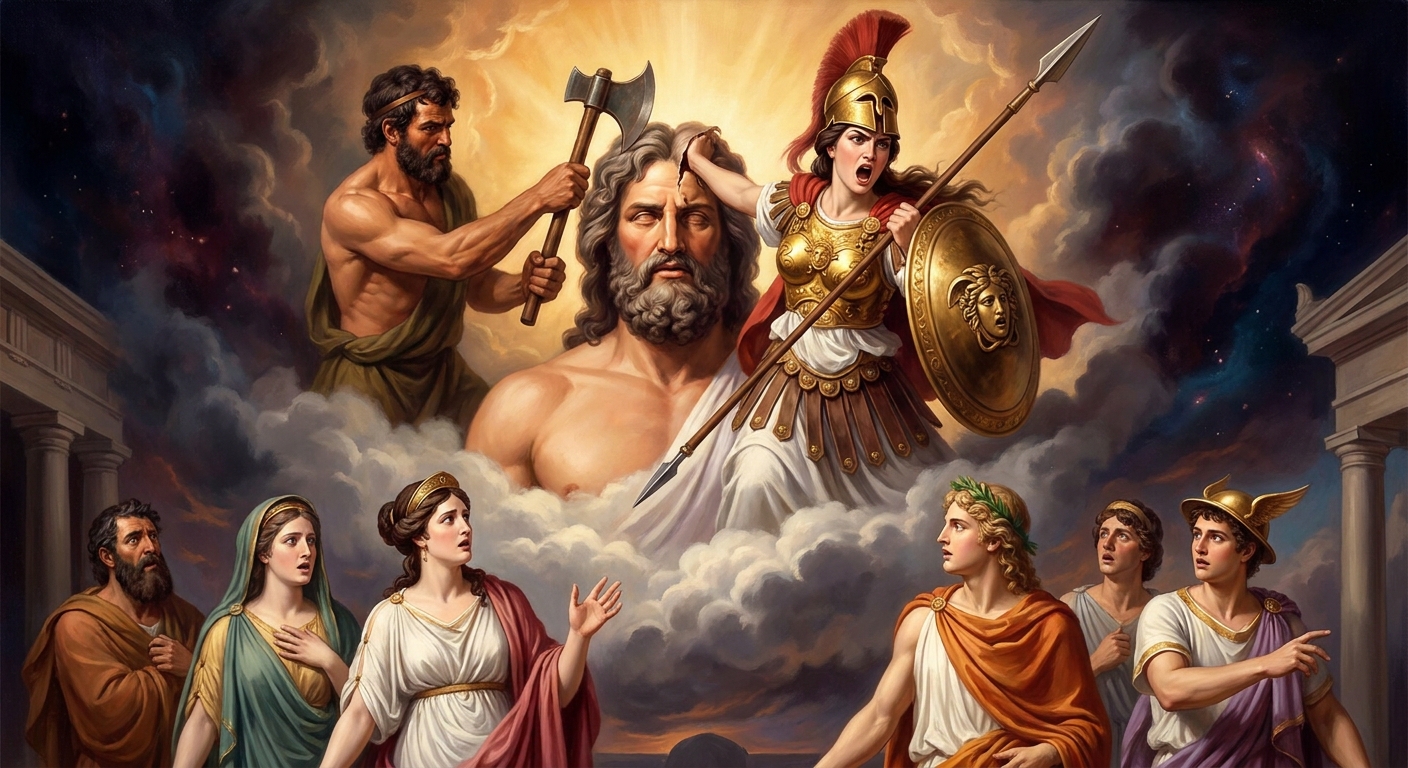
He summons Hephaestus — or in the older tellings, Prometheus; the versions do not agree on who holds the axe, only that it falls. It does not matter. What matters is that the king of the gods, the most powerful being in the cosmos, asks someone else to open his skull because he cannot do it himself.
Hephaestus is the craftsman, the god of fire and the forge, the one who was thrown from Olympus and landed so hard he walked with a limp ever after. He understands broken things. He understands building. He looks at Zeus with the particular expression of a man who knows this is going to cause a problem, lifts the axe, and brings it down.
The sound is not like metal on bone.
It is like a door being opened that has never been opened before.
She arrives at the speed of a war-cry.
Athena erupts from the wound in her father’s skull fully grown, fully armored, spear already raised. She does not emerge gently. She does not ease into existence the way a child unfolds. She arrives in the posture of someone who has been ready for a long time and is simply tired of waiting. The bronze of her armor catches the light of every torch on Olympus simultaneously. The owl that will follow her for eternity appears from nowhere and settles on her shoulder without being asked.
The war-cry shakes the foundation of the mountain. It is not a sound of anger. It is the sound of pure, cold, absolute intelligence announcing that it exists.
The sea stops. The rivers stop. The sun, Helios, pulls his horses up short. Everything pauses for a moment in the way that everything always pauses when something genuinely new arrives in the world — not just new like a new god, but new like a new category.
She has no mother. She has never been an infant. She will never be young.
This is the myth’s strangest insistence. Other gods are born, suckled, hidden, raised. Dionysus is sewn into Zeus’s thigh and carried to term. Apollo and Artemis are born on Delos, children who grow into power. Even Aphrodite, motherless as Athena, drifts on the sea before she walks. Athena arrives as she will always be: complete.
The Greeks understood what this meant. She is not wisdom achieved. She is wisdom given — but given in the most violent, most political way possible. Extracted by force from a father who tried to contain it. Born from the organ of thought itself. She carries no childhood to excuse her, no mother to soften her, no adolescence to make her relatable.
She is the patron of Athens, the city that will name itself for her and spend the next millennium arguing over what wisdom requires in practice. She is the strategist who prefers endings over beginnings, who trades in outcomes rather than passions. She invents the bridle that tames the horse. She teaches the loom, which is nothing but pattern applied to chaos, thread by thread. She picks up the spear, which is nothing but the same decision carried to its sharpest conclusion.
Metis is still inside Zeus.
This is what the myth never resolves, which is perhaps why it has lasted. The swallowing does not end. Metis continues to advise Zeus from within — the Hesiodic tradition says she remains inside him, counseling the son she never got to raise. Wisdom absorbed becomes wisdom that operates invisibly, from the interior, shaping the king’s decisions in ways he cannot fully account for.
He wanted to devour wisdom. He succeeded. But a thing you swallow becomes part of you, and you cannot tell anymore where your thoughts end and the swallowed mind begins.
Athena walks Olympus with her owl and her spear. She is her mother’s daughter and she is nobody’s daughter. She is the thought that could not be contained, the intelligence that a locked skull can slow but cannot stop.
The headache, presumably, does not entirely go away.
The myth is almost too legible. A male ruler swallows feminine wisdom to neutralize a prophecy. The result is not neutralization — it is a daughter more powerful than the plan to prevent her. Athena will never be subordinated; she cannot be, because she was never young enough to be shaped, never dependent enough to be controlled.
What Hesiod records in the Theogony is the paradox at the center of patriarchal power: to absorb wisdom is not to own it. You carry it. It thinks inside you. Eventually it comes out armed.
Echoes Across Traditions
Entities
- Athena
- Zeus
- Metis
- Hephaestus
Sources
- Hesiod, *Theogony* 886-900
- Pindar, *Olympian* 7
- Homeric Hymn to Athena (Hymn 28)
- Walter Burkert, *Greek Religion* (1985)