Romulus and the Furrow
April 21, 753 BCE · traditional date of Rome's founding · The Palatine Hill, central Italy
Contents
Twin sons of Mars, suckled by a wolf, argue over where to build a city. They read birds. Romulus sees twelve vultures, Remus sees six. Romulus ploughs the sacred boundary. Remus leaps over it. Romulus kills him. Rome begins.
- When
- April 21, 753 BCE · traditional date of Rome's founding
- Where
- The Palatine Hill, central Italy
The wolf does not choose them because they are gods’ sons.
She chooses them because they are there, cold in the sedge at the river’s edge, and she has milk. She does not know what she is feeding. Neither do they. That is the first lesson Rome will teach: the city does not care why you survive. It cares that you do.
Their mother is Rhea Silvia, vestal virgin, daughter of a deposed king, forced into sacred office by an uncle who wants no rival heirs. The god Mars visits her — visits is the word the sources use, as if a war-god dropping into a vestal’s bed is a social call. She bears twins. The uncle orders them drowned. The servant tasked with the drowning leaves them in a basket where the Tiber floods the bank, and walks away. The flood recedes. The basket grounds itself at the foot of a fig tree. A she-wolf comes to the crying.
This is the world the twins inherit: born of divine violence, abandoned by human cowardice, nursed by something that should have killed them. They grow up among herdsmen and hill-thieves. They are good at both.
When they are grown they kill the uncle. They restore their grandfather to his throne. They should stop there. They do not stop there.
The hills above the Tiber are wide enough for a city. The question is which hill, and that question is the question that kills one of them.
Romulus wants the Palatine. Remus wants the Aventine. They are a mile apart and both are right and neither will move. So they agree to let the gods decide. They go to their separate hills and they watch the sky.
This is augury: the reading of birds in flight. The Romans did not invent it, but they perfected it into bureaucracy — the right birds, in the right quadrant of sky, in the right numbers, interpreted by the right man. On the Aventine, Remus waits. Six vultures cross his section of heaven. Six is not nothing. Six is a sign.
On the Palatine, Romulus waits. Twelve vultures cross his sky.
Twice the number. The Palatine it is.
Except Remus disputes it. His birds came first, he says. Six early beats twelve late. The argument is real — the sources record it without resolution — because the argument is not about birds. The argument is about which brother gets to plough the line.
The pomerium is the sacred boundary of a Roman city, the furrow turned by a bronze-tipped plough, drawn by a white bull and a white cow yoked together, the farmer lifting the plough at each gateway so the entrances remain open to the living. Inside the furrow: the city, its gods, its law. Outside: everything else. To cross the pomerium armed is a capital offense even before the city exists. The line is the city. The city is the line.
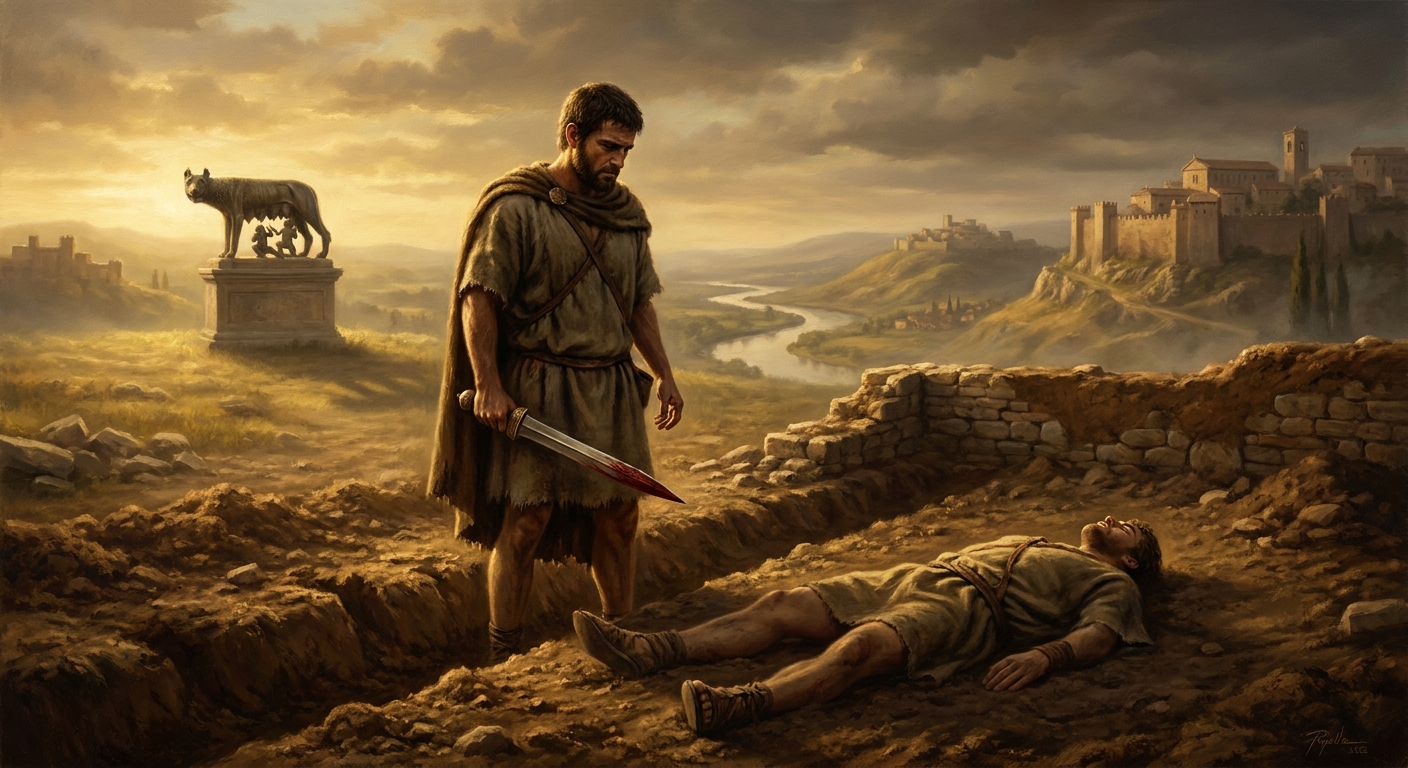
Romulus unyokes the animals, turns the first corner of the Palatine, and begins to plough.
Remus watches him. There is a version of this story where Remus is simply envious, a sore loser making mischief. That version is too small. The better reading is that Remus is making a political point — that a wall so shallow it can be stepped over is no wall, that his brother’s city is a joke, that twelve birds do not a sovereign make. He is testing the idea.
He leaps.
One step, both feet, over the unfinished furrow.
Romulus kills him.
The sources disagree on the instrument — a spear, a shovel, bare hands. They agree on the words that follow. Sic deinde quicumque alius transiliet moenia mea. So perish whoever else shall leap over my walls.
The wall is not finished. It will take centuries to finish. But the law is already in place: the line is absolute, and the penalty for crossing it is death, and the first man to die under that law is the founder’s twin.
Rome is consecrated in fratricide the same way a sword is tempered in water: something has to be killed to make the thing hard.
This is what the Romans never tried to hide. Other founding myths soften the violence — a divine gift, a heroic quest, a covenant made in good faith. The Romans kept the blood on the ground. They made Romulus weep for Remus in some tellings, and in others they made him feel nothing, and in all of them they kept the scene. It is the founding act. It happened. You are living inside the walls it built.
Plutarch will record, seven centuries later, that Romulus divided his citizens into tribes and his tribes into curiae and his curiae into families, that he built the Senate from the hundred wisest old men, that he organized the legions, opened the city to refugees and runaway slaves and anyone who needed a wall to stand behind. He was a brilliant administrator. He was also the man who killed his brother for jumping over a line in the dirt.
These two facts do not cancel each other. They explain each other.
The wolf knew what she was doing after all.
She nursed two boys, not one, because two boys would argue over the hill, and the argument would sharpen both of them, and one of them would plough the line, and the other would test it, and from that testing the line would become real. A law that has not been enforced is a preference. A law that has killed is a law.
The city that rises from the Palatine will conquer everything it can reach. It will absorb two hundred gods and a dozen legal systems and half the known world’s population into the thing Romulus started with a furrow and a sentence. It will fall, eventually, because everything falls. But for a thousand years it will be the world’s main idea of what a city is.
It begins here, in the spring of 753, with a man watching birds from a hill and another man deciding to jump.
The Romans knew the story made them look bad. They told it anyway. There is a kind of confidence in that — the confidence of a people who have decided that the truth of their origin is more useful than a prettier lie.
Every nation has its founding violence. Most nations bury it. Rome put Romulus on their coins.
Echoes Across Traditions
Entities
- Romulus
- Remus
- Mars
- Rhea Silvia
Sources
- Livy, *Ab Urbe Condita* 1.4-7
- Plutarch, *Romulus*
- Virgil, *Aeneid* 1
- T.P. Wiseman, *Remus: A Roman Myth* (1995)