Contents
Tarquinius Sextus, son of Rome's king, rapes Lucretia — the most virtuous woman in Rome. The next morning she summons her father and husband, forces them to swear revenge, and kills herself. Her body, carried through the streets, ignites the revolution that ends the Roman monarchy and founds the Republic. The paradox is absolute: the woman most completely stripped of agency produces the most consequential act of self-determination in Roman history.
- When
- 509 BCE
- Where
- Collatia and Rome
The contest begins as a joke among officers.
It is late in a siege, the army camped outside Ardea, and the generals are drinking and arguing in the way that officers drink and argue when a siege is going badly and there is nothing to do but wait. The question is whose wife, left at home in Rome, is most virtuous. Everyone claims his own. No one can prove it. So they ride — half-drunk, on horses, in the middle of the night — to find out.
At the house of Collatinus, they find Lucretia.
She is at her loom with her serving-women around her, working by lamplight long after midnight while the other wives they checked on were at dinner parties, at the theater, alive in the world in the way women of rank are permitted to be alive. She sees her husband and she does not flinch, because she is Lucretia and she does not flinch at anything. She receives the officers. She orders food and wine brought. She is, by every measure the Romans have for measuring such things, exactly what her husband claimed.
Tarquinius Sextus, son of the king, looks at her across the lamplight and feels the thing that powerful men feel when they encounter the one thing they cannot have by simply taking it. What Lucretia has is not a possession. You cannot seize virtue. You can only destroy it. He files this thought away and rides back to the siege.
He returns alone, a few days later, presenting himself as a traveler and a kinsman and a guest. Lucretia receives him as all of these things, because she is Lucretia and her household is properly managed, because he is related by blood to her husband, because hospitality is the foundation of Roman civilization and she does not yet know what she is extending it to.
He waits until the house is asleep.
He enters her room with a sword.
Livy gives us the threat in its exact, terrible logic: he will kill her and kill a slave and put their bodies together, and he will say he caught her in adultery and executed them. She will die disgraced. Her family will carry the shame. Her children will live under it. There is no defense she can mount, no witness she can call, no version of this night in which her testimony is worth more than a prince’s. The only variable she controls is whether she dies with her name intact or with it ruined.
She chooses to survive the night.
At dawn she sends for her father and her husband.
Come at once. Something terrible has happened. They come, each with a friend — Spurius Lucretius with Publius Valerius; Collatinus with Lucius Junius Brutus, the man who has spent years playing the fool to survive the court of a paranoid king. They find Lucretia sitting, not collapsed. Sitting, dressed, composed in the way that a person composes themselves when they have already done the hardest thinking and what remains is action.
She tells them what happened. She does not use evasion. She names the man. She describes the threat. She does not perform distress because distress is not what she needs from them. She needs what she says she needs next.
Swear vengeance.
They swear, each of them. They try also to give her absolution — the mind sins, not the body; you have not done wrong — and she accepts this with the same composure with which she accepts everything, which is to say she hears it and she disregards it completely.
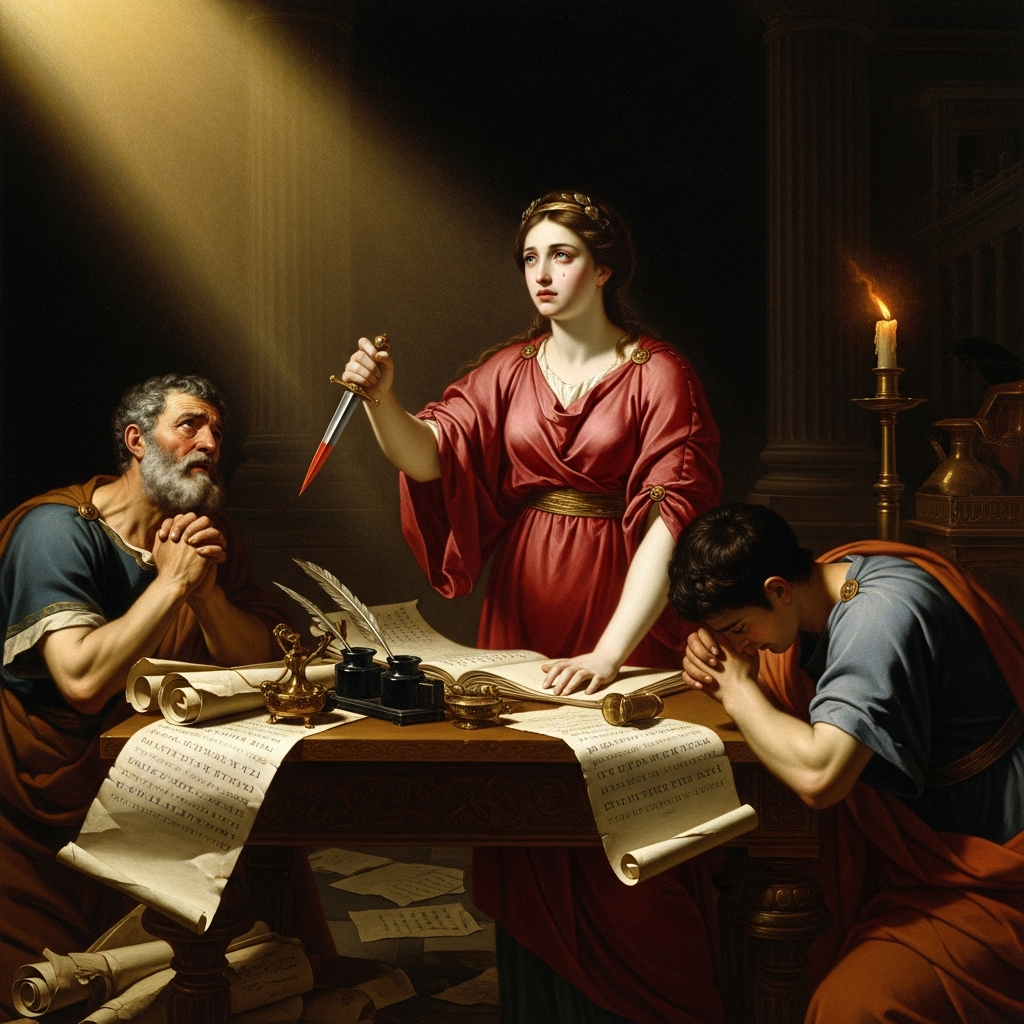
She puts her hand in the fold of her robe and removes a knife.
She says: I acquit myself of the sin, but I do not release myself from the punishment. No unchaste woman shall ever cite Lucretia as her precedent.
Then she drives the knife into her heart.
Livy writes this with a precision that suggests he understood what he was recording was not merely a scene of tragedy but a theological statement about the nature of female virtue in Roman civilization and the price that civilization charged for it. Lucretia is not confused. She is not despairing. She does not believe she has sinned. She kills herself because she has decided — and this is the word the sources keep returning to, the word that will haunt two thousand years of commentary — that a woman who survived what she survived cannot be cited as a precedent. She is writing the law of Roman womanhood in her own blood, and she is doing it as a voluntary act, and she is doing it in front of witnesses she has carefully selected, and she has extracted the promise she needed before she did it.
This is not victimhood. This is sovereignty, performed under the only conditions available to her.
Her father catches her body as it falls. He does not let her touch the floor.
Brutus pulls the knife from the wound.
He holds it up — bloodied, still warm — and he makes a speech over the body. This is the moment Brutus has apparently been preparing for since he decided, years ago, to survive Tarquin’s court by pretending to be an idiot. The speech is about tyranny, about the king who sanctioned a son capable of this, about a Roman people who have endured enough. He is not performing. Or he is performing, but the performance is real, because the body of Lucretia is real, and the blood on the knife he is holding is real, and Rome is outside the door.
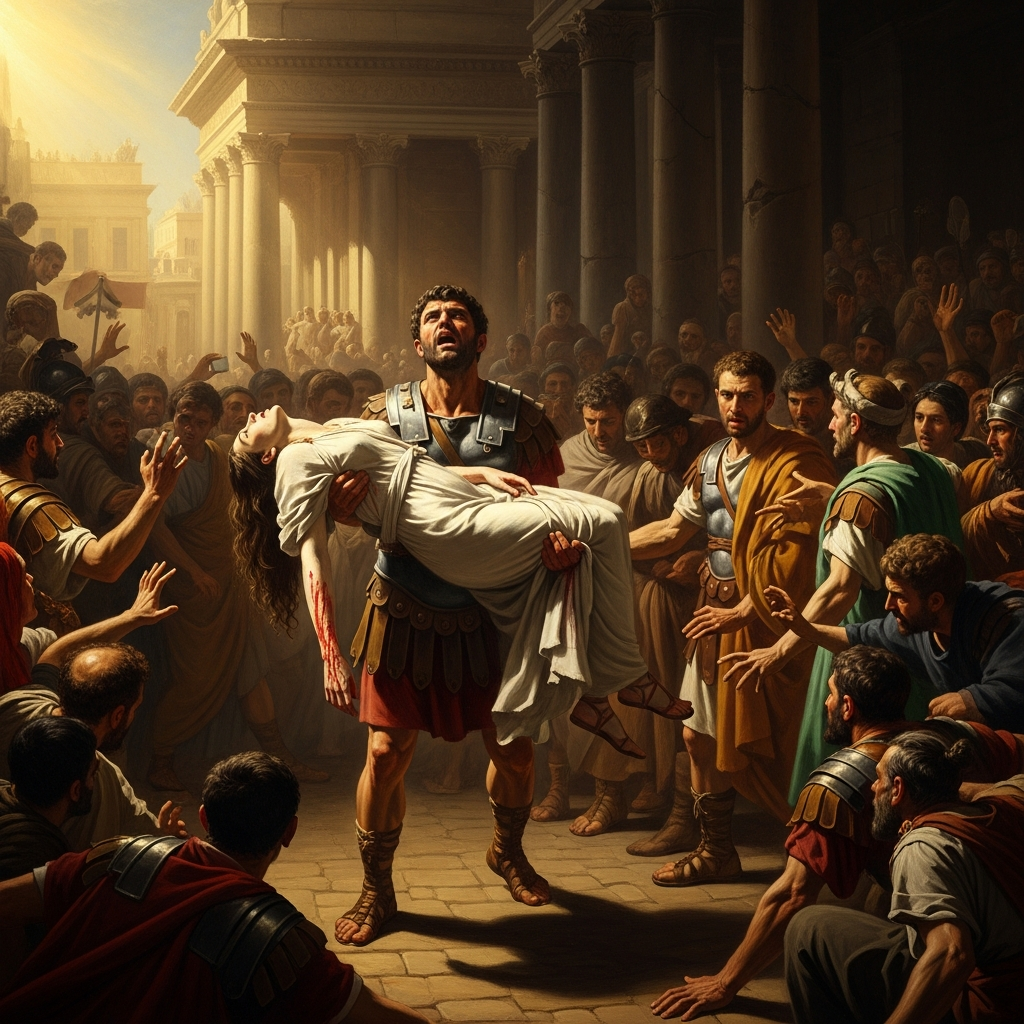
He carries her into the Forum.
The sight of her works exactly the way he knew it would. The Roman crowd is not abstract. It responds to the visible, the physical, the undeniable evidence before it. A woman who was alive yesterday is dead on the stones of the Forum with a knife wound in her chest and a story that admits no other explanation. Tarquinius Sextus did this. His father’s court enabled it. The king who rules by terror has raised a son who does what he wants to women in the houses of his officers and believes the sword in his hand is sufficient argument.
The crowd decides it is not.
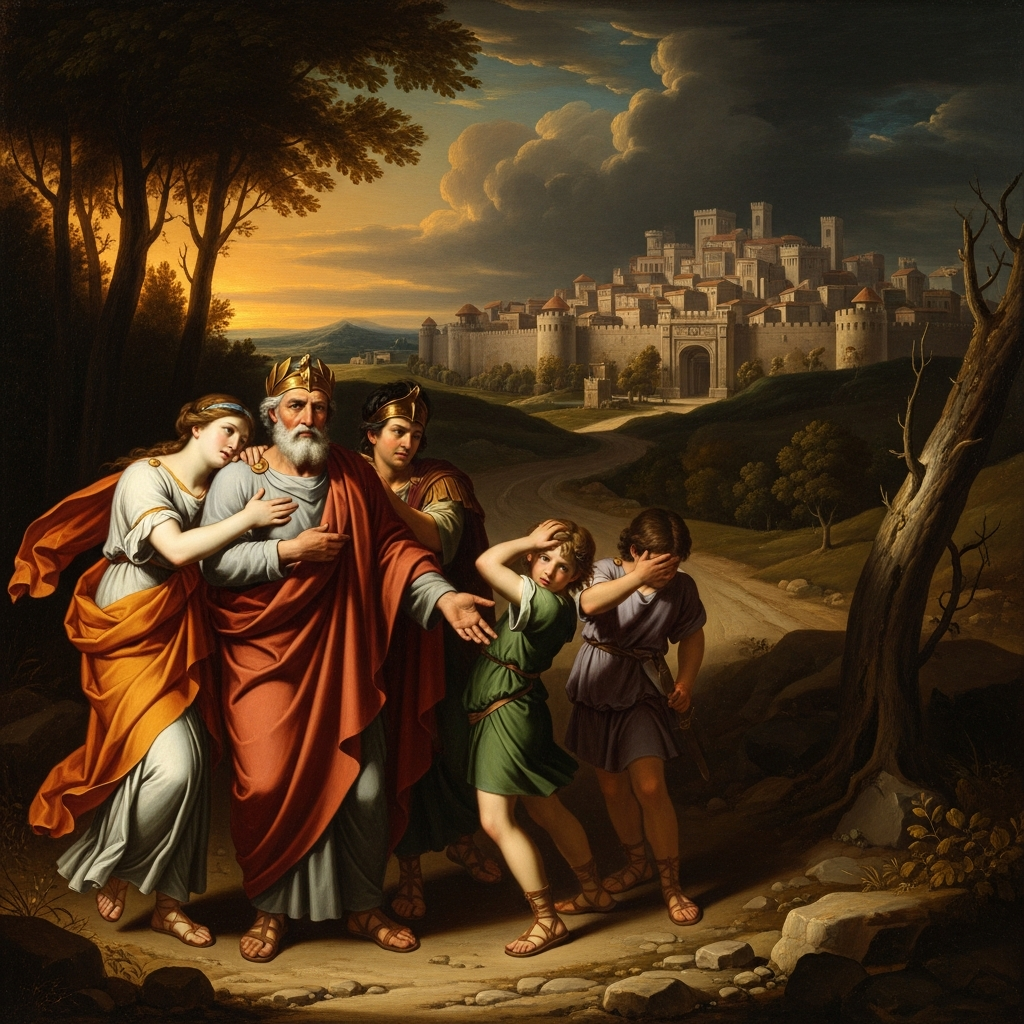
Tarquinius Superbus is expelled with his entire family before the day ends.
He goes to the Etruscan king Lars Porsena and tries to get his kingdom back by force, and this works partially and then not at all, and the bridge over the Tiber is held by Horatius and the Tiber itself is swum by Mucius Scaevola who burns off his own right hand in Porsena’s fire to prove that Romans do not break under pressure, and all of these stories are also about the founding of the Republic and all of them are downstream of the knife and the Forum and the body of Lucretia.
Two consuls replace the king. One of them is Collatinus, her husband. The other is Brutus, the man she made swear vengeance on that last morning.
The Republic will last five hundred years.
It is a system built specifically to prevent what happened — to prevent any one family, any one man, any one prince with a sword and an entitlement and a bedchamber visit in mind from concentrating enough power to do what Tarquinius Sextus did and walk away from it. The Romans were clear on this. They said so. Annual consuls, divided authority, the Senate as check, the tribunes as further check — the entire constitutional architecture of the Republic is an answer to the question posed by one night in one bedroom.
Augustine cannot figure out what to do with her.
He argues about her in City of God for two full chapters, trying to find the Christian framework that can hold her, and he cannot. If she was innocent, why did she die? If she was guilty of some internal assent — some failure of perfect chastity of mind — then she committed a sin she could have confessed. Either way, the suicide was wrong by his lights. He calls her admirable and cannot quite call her virtuous. He is bothered by her for reasons that go past theology into the fact that Lucretia refuses to fit into any category his framework provides for women. She is not saint, not martyr, not sinner as he understands sin. She is something the Roman world produced that the Christian world does not have a box for: a woman who judges herself by her own law, executes the sentence herself, and founds a civilization in the act.
Livy is writing the history of Rome during the reign of Augustus. He knows what he is doing when he makes the founding of the Republic turn on a woman’s body and a woman’s last autonomous act. He is writing for a Rome that is in the process of burying the Republic — that is, right now, in the time of his writing, watching one man gather to himself the power the Republic was built to prevent any one man from holding.
He does not editorialize. He records. He lets the scene do what scenes do.
No unchaste woman shall ever cite Lucretia as her precedent. The woman who said this was not speaking to Collatinus or to Brutus or to Rome. She was speaking to every woman who would come after her, in every age that would read Livy, in every civilization that would use her name. She was speaking to the future. She had thought this out. She knew what she was making.
Scenes
Lucretia at her writing table, the knife in her hand, her father and husband on their knees before her
 Generating art…
 Brutus carries Lucretia's body into the Roman Forum, her blood still visible on his arms
 Generating art…
 The Tarquin family in exile on the Etruscan road, looking back at a city that has sealed its gates
 Generating art…
 Echoes Across Traditions
Entities
- Lucretia
- Tarquinius Sextus
- Lucius Tarquinius Superbus
- Lucius Junius Brutus
- Collatinus
Sources
- Livy, *Ab Urbe Condita* 1.57-60
- Ovid, *Fasti* 2.685-852
- Dionysius of Halicarnassus, *Roman Antiquities* 4.64-85
- Augustine, *City of God* 1.19
- Stephanie Jed, *Chaste Thinking: The Rape of Lucretia and the Birth of Humanism* (1989)