Confucius Meets Lao Tzu
c. 518 BCE — late Spring and Autumn period · Luoyang, capital of the declining Zhou dynasty — the royal archive where the old keeper of the books receives a young scholar from Lu
Contents
The young ritual-master travels to the Zhou capital to ask the old archivist about the proper forms — and is told, in a single quiet sentence, that he has been carrying his own corpse around for years.
- When
- c. 518 BCE — late Spring and Autumn period
- Where
- Luoyang, capital of the declining Zhou dynasty — the royal archive where the old keeper of the books receives a young scholar from Lu
He travels for weeks.
Confucius is young — thirty-four, by some counts; old enough to have students, young enough to still believe the answer is in someone else’s mouth. He has heard of the keeper of the royal archive at Luoyang, an old man named Lao Dan, who has read every ritual text the Zhou dynasty has ever recorded. The Zhou is decaying. The dukes squabble. The proper forms are forgotten. If anyone alive remembers how the rites were truly performed in the high days, it is the archivist.
Confucius packs his books. He bows to his mother’s tomb. He sets out west with one disciple and a borrowed cart. He intends to ask, with the deference of a younger scholar to an elder, about ritual.
He does not know he is walking into the other half of his civilization.
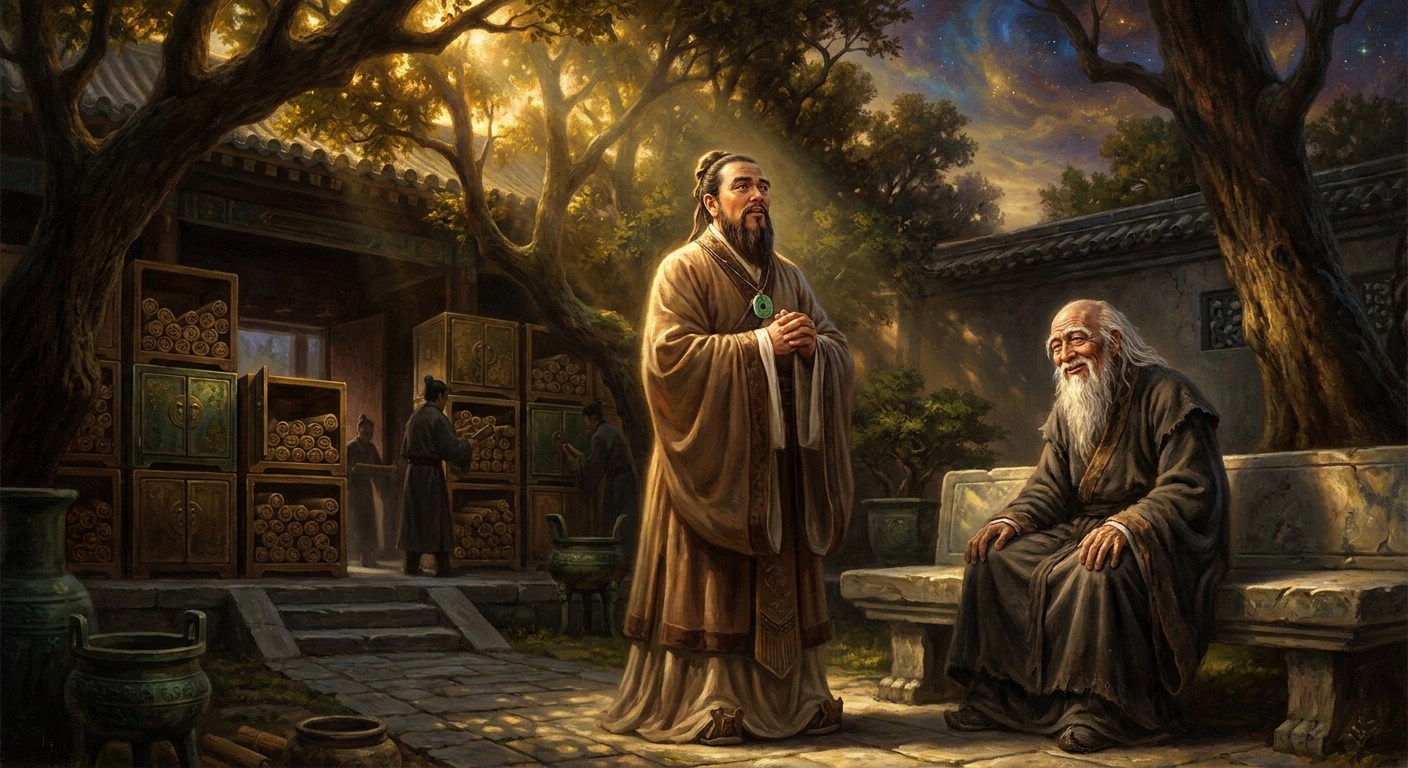
The archive is dim.
Bamboo slips stacked to the rafters, brittle silk scrolls in lacquer boxes, the smell of mouse and old ink. Lao Tzu sits at a low desk near the only window. He does not stand when the visitor is announced. He looks up — old, thin, eyes the color of river-stone — and waits.
Confucius bows the deep formal bow, the bai, the one he has been teaching his students since he opened his school. He recites his lineage. He names his teachers. He explains, with the careful syntax of a man who has rehearsed the sentence on the road, that he has come to ask about the rituals of the ancient kings, the proper forms, the correct music, the precise measurements of the sacrificial vessel.
Lao Tzu listens. The light through the window slats shifts. A fly lands on a scroll and is ignored.
When Confucius finishes, the old man does not answer the question.
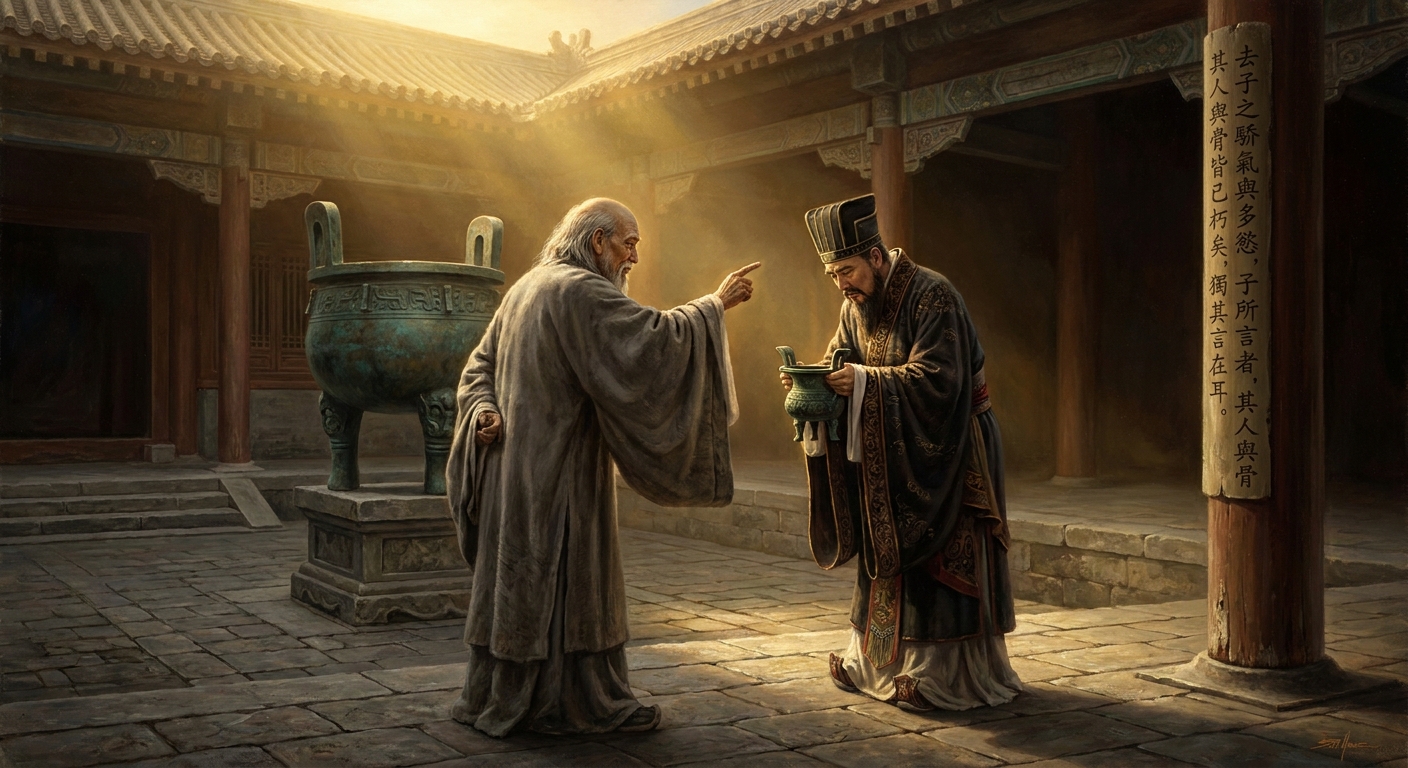
“The men you speak of,” Lao Tzu says, “and their bones, are long since rotted. Only their words remain.”
The sentence lands like a slap that does not move the air.
“A gentleman whose time has come rides in a carriage. A gentleman whose time has not come walks with the wind on his face. I have heard that the best merchant hides his treasures so deeply he seems to have nothing. The man of true virtue carries himself like a fool.”
He looks at Confucius, kindly, the way a doctor looks at a patient who does not yet know he is sick.
“You — you have a great deal of pride in your bearing. You have many desires. You have a manner that is too pleased with itself, and ambitions that reach further than you do. None of this is of any use. This is what I have to tell you. That is all.”
He returns to the scroll on his desk. The audience is over.
Confucius walks out into the Luoyang afternoon.
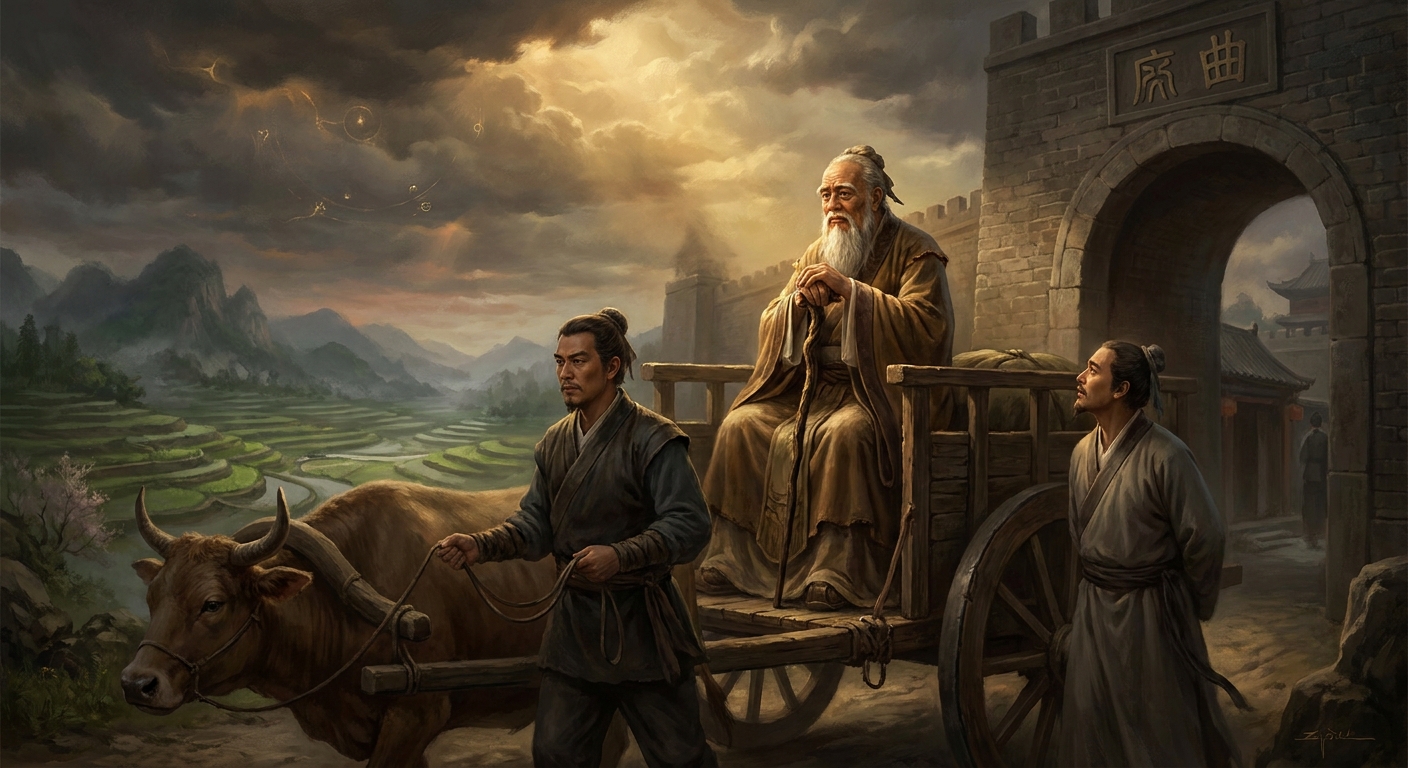
He does not speak. The disciple who has come with him asks, three times, what the old man said; three times Confucius does not answer. They mount the cart. They ride east. The cart wheels squeak in the way cart wheels squeak. The road dust rises. Confucius sits with his hands on his knees and stares at the horizon.
For three days he says nothing.
He has been spoken to as no teacher has ever spoken to him. He has had his ambition named in front of him as if his ambition were a smell on his clothes. The proper response, by every ritual he has ever taught, would be offense — to the offense of an elder calling a younger man proud, the younger man owes a defense of his honor, a quiet withdrawal, a letter later in the year explaining that one’s intentions had been misread.
He drafts none of these letters. He composes no defense. The old man’s sentence is doing something inside him that ritual cannot reach.
On the fourth day, he speaks.
The disciples have gathered at his return — the senior ones, the ones who will, decades later, edit his sayings into the Analects and decide for two thousand years what ren and li will mean. They expect a report. They expect Confucius to describe the archive, the protocols, the technical answer to the technical question.
He does not.
“Of birds,” he says, “I know that they fly. Of fish, I know that they swim. Of beasts, I know that they run. For the running creature, a snare. For the swimming creature, a net. For the flying creature, an arrow.”
The disciples wait.
“But the dragon — the dragon I cannot know. The dragon rises on the wind and the cloud and ascends to heaven. Today I have met Lao Tzu, and he is like the dragon.”
The senior disciple writes the sentence down. He does not entirely understand it. He suspects, correctly, that his teacher has been changed.
Confucius will live another forty-six years.
He will teach, he will travel, he will fail spectacularly to find a state that will employ him. He will compile the odes, edit the rites, refuse to discuss the supernatural, and be remembered by China as the man who held a falling civilization together with the bare strength of li — proper form, proper relationship, proper word. He will become, within three centuries of his death, the official sage of the empire.
He will not become a Daoist.
But the meeting at Luoyang will not leave him. He will warn his students, in unguarded moments, against the very ambitions he once preached. He will say, near the end of his life, that at seventy I followed what my heart desired without overstepping the bounds — a sentence that sounds Confucian on its surface and Daoist underneath. The dragon does not leave the man it has spoken to.
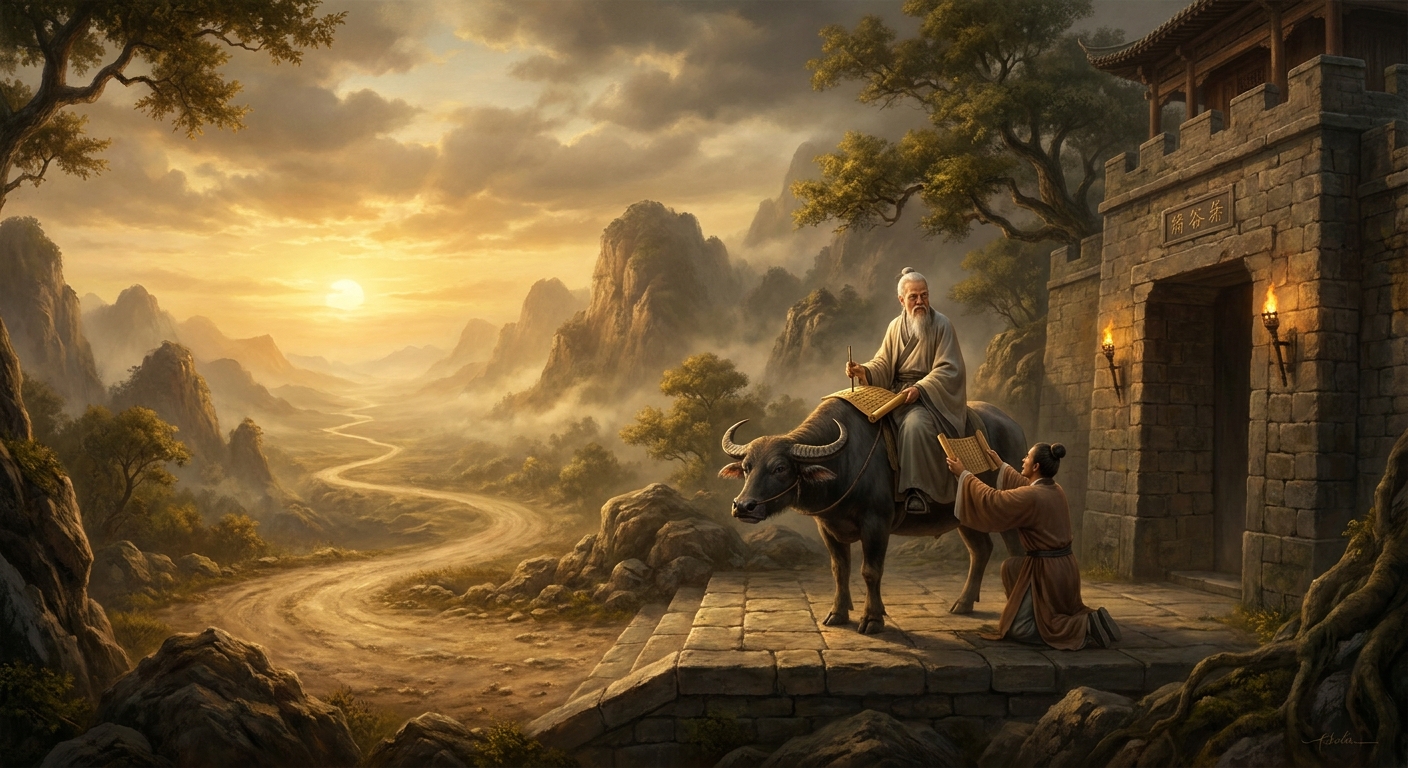
Lao Tzu, for his part, will close the archive not long after. He will saddle a black ox and ride west toward the Hangu Pass, and at the pass the gatekeeper Yinxi will refuse to let him leave the empire without writing down what he knows. Lao Tzu will sit for a night and dictate five thousand characters — the Daodejing — and then ride out into the Gobi, and history will not record where he went.
The two traditions begin in this room.
Confucianism will teach China how to be a society. Daoism will teach China how to not be one. The empire will need both — the ritual that holds the funeral together, and the wine the mourners drink afterward to remember that the funeral is not the world.
No civilization has been honest enough to canonize both of its founders as right. China is. The dragon and the gentleman ride together for two thousand years. They do not reconcile. They do not have to.
‘I have seen the dragon,’ Confucius said. He was telling the truth. So was Lao Tzu when he said the dragon-watcher was a proud young man with too many desires. Both sentences have been true for twenty-five centuries, and the river between them is the Dao.
Scenes
The young scholar bows in the archive doorway
Generating art… *'Drop the proud bearing,'* the old man says
 Generating art…
 Three days of silence on the road home
 Generating art…
 Echoes Across Traditions
Entities
- Confucius
- Lao Tzu
- the Dao
Sources
- Sima Qian, *Records of the Grand Historian* (Shiji), ch. 63 (*Biography of Lao Tzu and Han Fei*), ~94 BCE
- Burton Watson (trans.), *Records of the Grand Historian: Han Dynasty* (1993)
- *Zhuangzi*, ch. 14 (*Tian Yun*) — variant accounts of the meeting, ~3rd c. BCE
- *Liji* (Book of Rites), references to Confucius's study under Lao Dan
- A.C. Graham, *Disputers of the Tao* (1989)