The First Sermon at Deer Park
~528 BCE · weeks after enlightenment · Sarnath — the Deer Park, near Varanasi
Contents
Weeks after his enlightenment, the Buddha walks to Sarnath and finds the five ascetics who abandoned him. He turns the Wheel of Dharma for the first time — teaching the Four Noble Truths and the Eightfold Path — and a private awakening becomes a path others can walk.
- When
- ~528 BCE · weeks after enlightenment
- Where
- Sarnath — the Deer Park, near Varanasi
He does not know if they will listen.
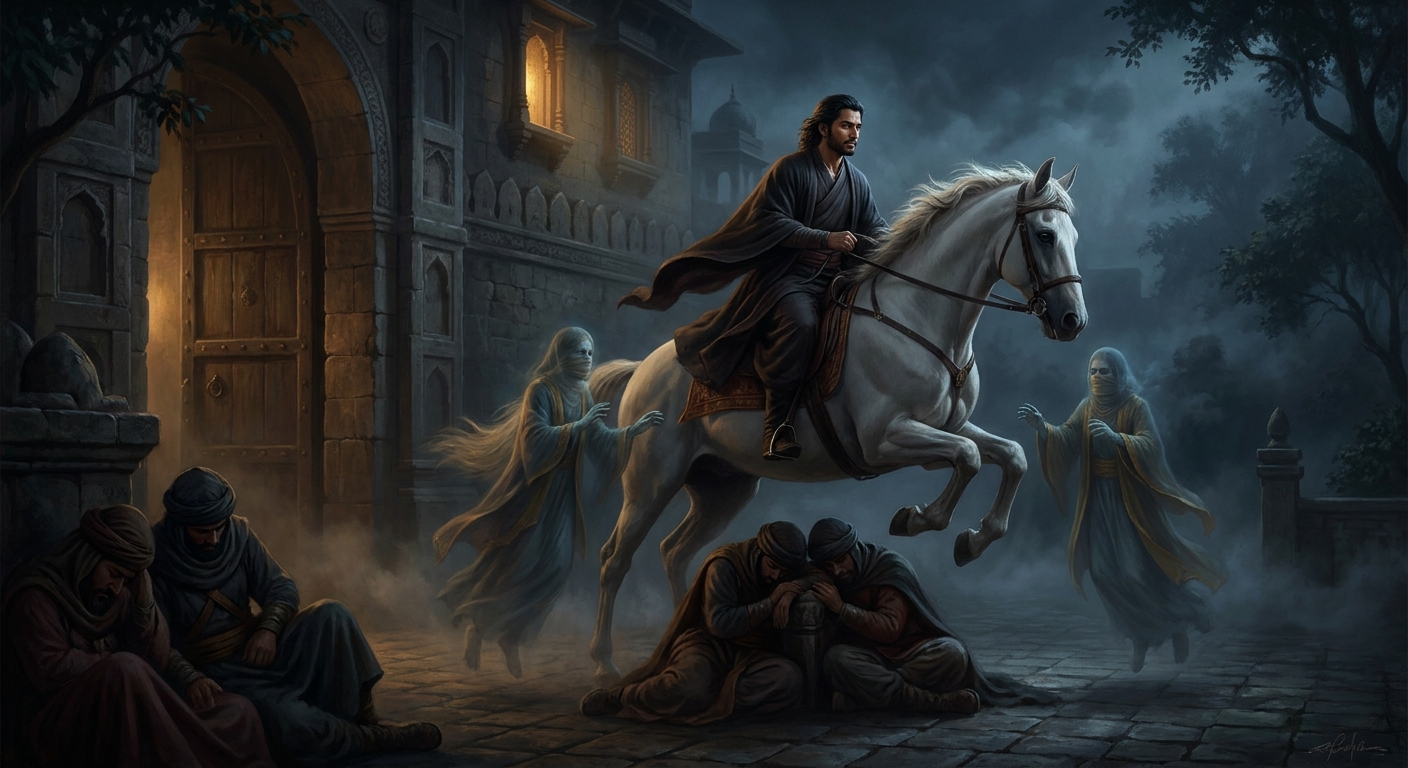
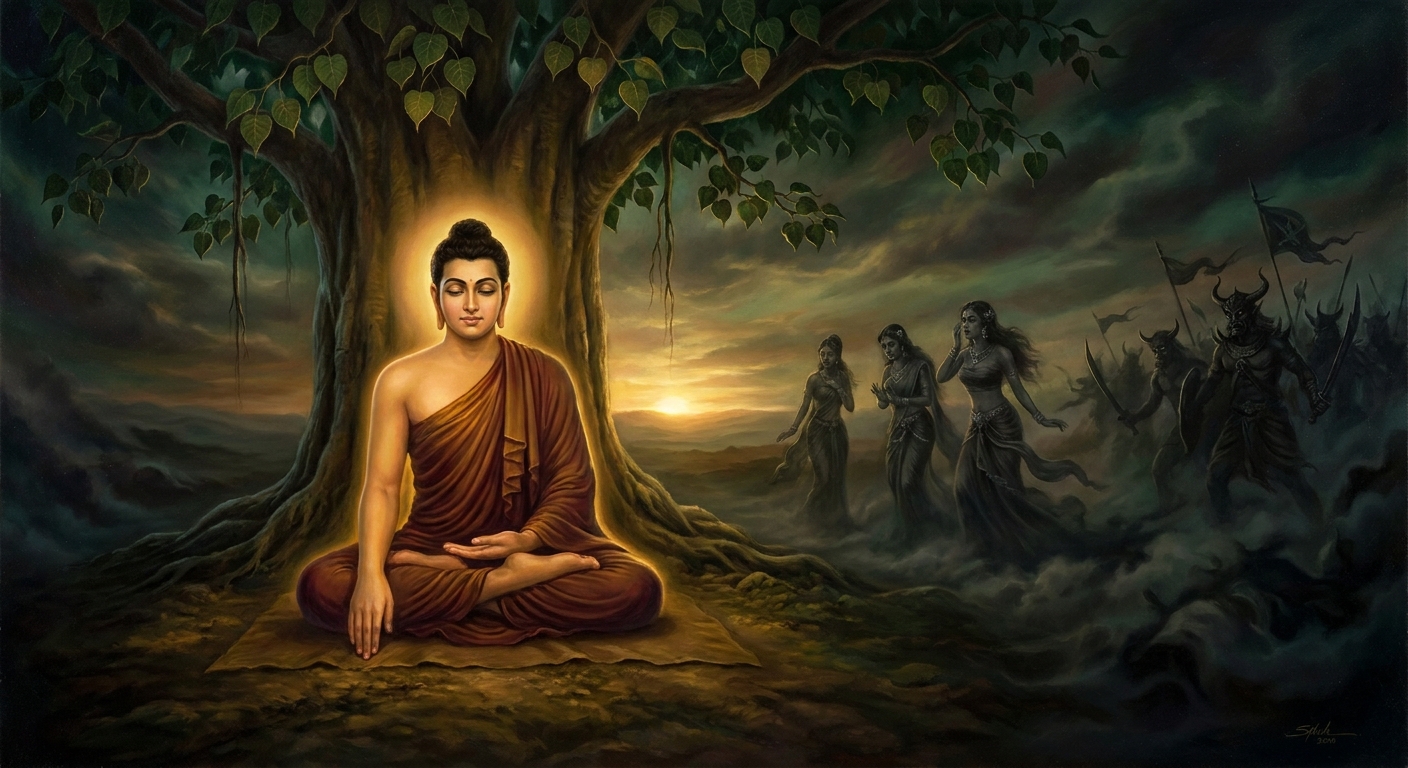
This is the thought that walks with him on the road from Bodh Gaya to Sarnath — five days, give or take, along the dusty road northeast, through the plains of the Ganges basin, past the city of Varanasi where the river turns and the cremation fires burn without ceasing. He is, by any measure, already awake. He has sat under the pipal tree and watched the architecture of suffering reveal itself from root to crown. He has seen his past lives arranged before him like rings in wood. He has understood.
And now he is walking to find five men who left him in contempt.
The five ascetics — Kondanna, Bhaddiya, Vappa, Mahanama, Assaji — had been his companions in the forest years. They had watched him fast until his spine pressed against his belly, held breath until his ears rang, endure cold that would have killed a man with any fat left to lose. They believed he was the most rigorous seeker alive. Then the village girl Sujata brought the bowl of milk-rice, and he drank.
They saw it from across the clearing. They drew their own conclusion: he had broken. Abandoned the path. Returned to comfort. They gathered their robes and their contempt and walked away without a word.
Now he is coming to find them.
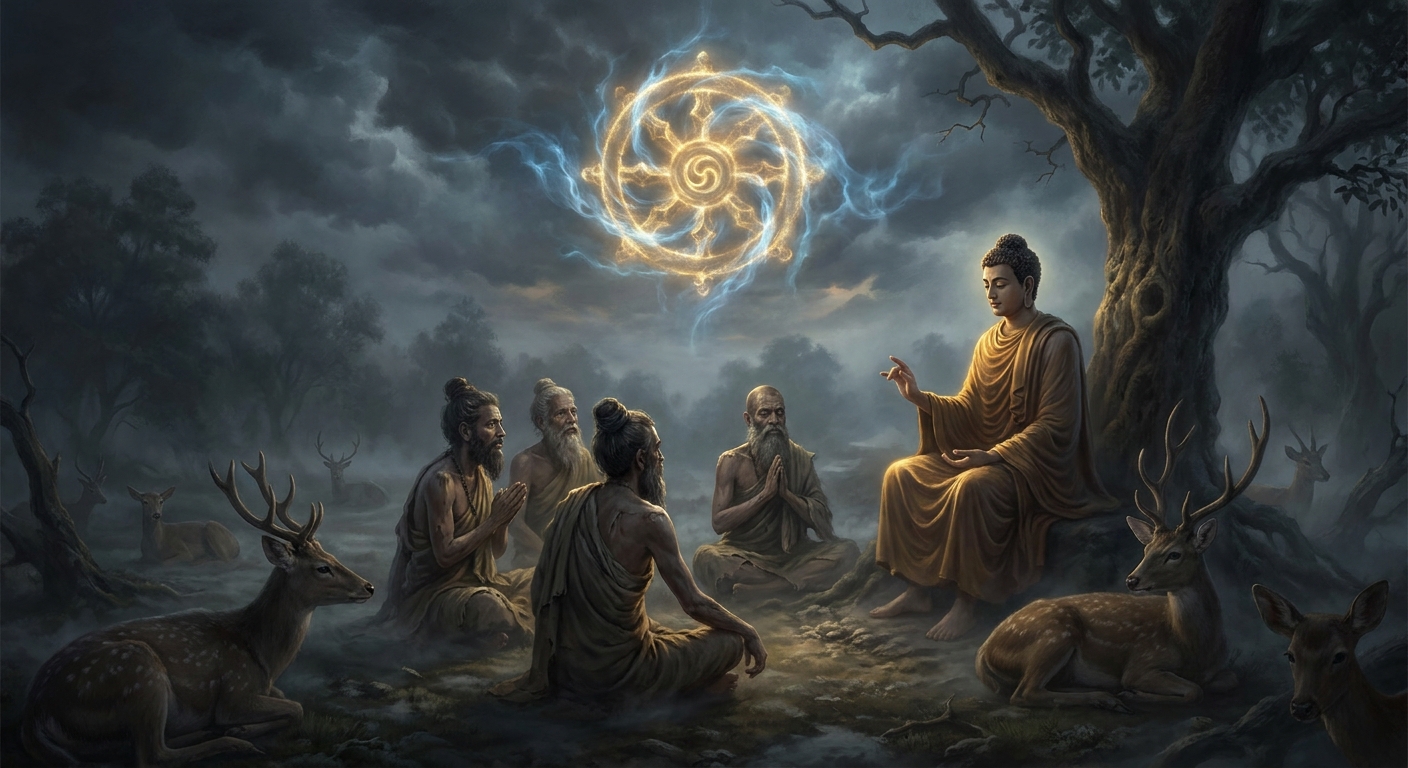
He arrives at the Deer Park in the late afternoon. The light is long and golden across the grass. Deer move at the edges. The five ascetics sit in their accustomed positions — the cross-legged discipline they have maintained through every heat and cold and hunger. One of them sees him coming and says something to the others. The agreement is immediate: We will not rise. We will not honor him. He is a man who quit.
But when he is close enough that they can see his face, the agreement dissolves.
They rise. They take his bowl. They bring water for his feet. They call him Venerable One — the honorific they had promised themselves they would withhold. Later the texts will record this without explanation, as if it needs none. Perhaps it does not. Perhaps there is a quality that enlightenment wears on the body, visible before the mouth opens, that commands its own recognition.
He sits with them as the light changes.
Then he speaks.
“There are two extremes, monks, that one who has gone forth should not practice. Which two? That which is devoted to indulgence in sensual pleasure — low, vulgar, the way of the worldling, ignoble, leading to no good. And that which is devoted to self-mortification — painful, ignoble, leading to no good. Without veering toward either of these extremes, the Tathagata has awakened to the Middle Way, which gives rise to vision, which gives rise to knowledge, and which leads to calm, to direct knowledge, to enlightenment, to Nibbana.”
The five ascetics are still. The deer do not run.
He teaches them the Four Noble Truths — not as comfort, but as diagnosis. A physician does not comfort a patient by pretending the wound is not there. He names the wound. Dukkha: suffering, dissatisfaction, the basic unsatisfactoriness of conditioned existence. He names its cause: craving — for pleasure, for existence, for non-existence. He names its cure: the cessation of craving is possible. And he names the medicine: the Eightfold Path.
It is, structurally, a doctor’s chart. Problem. Etiology. Prognosis. Treatment.
The Eightfold Path unfolds like a map drawn by someone who has already walked the territory.
Right View — see clearly what is. Not what you want, not what you fear, but what is actually there. Right Intention — let the will be pointed toward renunciation, toward non-harm, toward non-cruelty. Right Speech, Right Action, Right Livelihood — live in the world without compounding the suffering already in it. Right Effort, Right Mindfulness, Right Concentration — tend the mind the way you tend a field, clearing, attending, deepening.
Eight spokes. One wheel. He turns it now, here, in this deer park, at dusk.
It does not thunder. No mountain opens. The five men listen, and one of them — Kondanna, the eldest — begins to understand while the teaching is still in the air. The texts say the Buddha looks at him and says, quietly: “Kondanna knows. Kondanna knows.” And from that moment, Kondanna’s name becomes Anna-Kondanna — Kondanna-who-understands.
One man. One moment. A wheel set turning.
Within days, all five understand.
They ask to be received. They take the refuge — I take refuge in the Buddha, I take refuge in the Dhamma, I take refuge in the Sangha — though the Sangha is, at this exact moment, the six of them sitting in a field with deer at the edges. The Sangha is being constituted by the act of constituting it. Community as its own founding document.
This is what the Bodhi Tree could not do. The Bodhi Tree gave him the awakening, but awakening is not transferable. Understanding is. Method is. The path, precisely because it is a path and not an experience, can be handed to someone else. It can be walked by feet that have never been to Bodh Gaya, by minds that have never sat under a pipal tree, by people not yet born in kingdoms not yet imagined, by five hundred million people twenty-six centuries later who have no particular interest in the cosmology and simply find that sitting quietly with the breath for twenty minutes makes them less cruel.
He has not given them his enlightenment. He cannot. He has given them something harder and more durable: a sequence of steps.
Later — centuries later, in paintings across Asia — this scene will be rendered with lotus blossoms, golden auras, a dharma wheel floating in fire above the teacher’s head. The iconography is not wrong, exactly. It is trying to say the same thing the simpler telling says.
Something turned here that has not stopped.
A man who achieved the most private thing imaginable — the cessation of his own suffering — looked at five other people who were suffering and decided that the path could be described. That description could be transmitted. That transmission could become a community. That the community was not a concession to the social, not a compromise with the worldly, but the entire point.
Buddhism does not begin under the Bodhi Tree. It begins here, in this deer park, at dusk, when the first student understands.
The Dhammacakkappavattana Sutta — “Setting the Wheel of the Dhamma in Motion” — is the oldest complete sermon in the Buddhist canon. Kondanna’s immediate understanding is recorded matter-of-factly, as if the text knows that the miracle is not the understanding but the teaching: that there is a path, that the path can be described, and that description can cross the space between one mind and another. It has been crossing that space, in one form or another, ever since.
Echoes Across Traditions
Entities
- Siddhartha
- the Five Ascetics
Sources
- *Dhammacakkappavattana Sutta* (Samyutta Nikaya 56:11), Pali Canon
- *Mahavagga* I, Pali Canon (Vinaya Pitaka)
- Bhikkhu Bodhi (trans.), *The Connected Discourses of the Buddha* (2000)
- Walpola Rahula, *What the Buddha Taught* (1959)