Buddha's Parinirvana
~483 BCE · Kushinagar, India · Kushinagar — the grove of sal trees
Contents
At eighty, after forty-five years of wandering and teaching, the Buddha accepts a final meal, lies down between two sal trees in Kushinagar, and enters the last nirvana — leaving behind only a method and the instruction to use it.
- When
- ~483 BCE · Kushinagar, India
- Where
- Kushinagar — the grove of sal trees
He is eighty years old, and he has been walking for forty-five years.
The roads of northern India know his feet. Rajagaha, Vesali, Savatthi, Kosambi — the cities of the Ganges plain have all heard him speak in their market squares and parks and mango groves, have all seen the orange robe pass through. Thousands of monks follow the tradition now. Kings have fed him. Merchants have built him halls. He has not slept in the same place twice if he could help it, because the teaching requires a living body in motion, not a shrine.
His body is ending that arrangement.
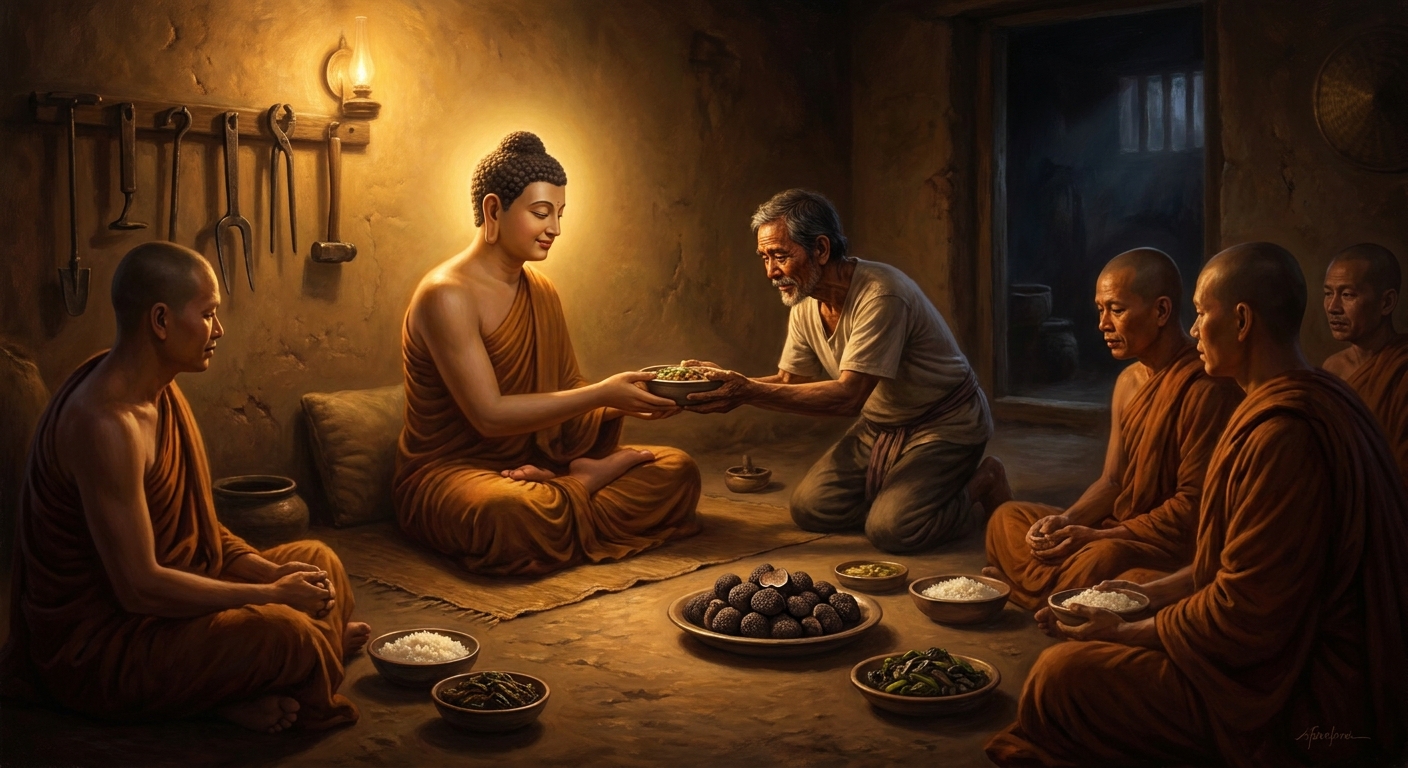
The meal comes from Cunda.
Cunda is a smith in Pava, not a king or a brahmin, just a craftsman who has found the dharma and wants to do something with it. He invites the Buddha and the sangha to eat. He prepares sukara-maddava — the texts are careful here, the word is ambiguous, it may be pork, it may be a certain kind of mushroom, it may be something that cannot be translated cleanly — and the Buddha takes it. He takes it deliberately. He tells Cunda to offer the rest to the other monks and not to serve it to them; he will eat this portion himself.
What follows is a hemorrhage that the texts describe plainly: severe, bloody, acute. The kind of pain that makes the road stop existing.
He walks toward Kushinagar anyway.
He stops at a river. He asks Ananda for water. He lies down and rests and then stands and walks again, because the teaching is that you do not stop before the stopping place, and his stopping place is not a riverbank in Pava. He rests twenty-five times on the road. Each time he rises. He sends Ananda ahead to tell the Mallas of Kushinagar that the Tathagata will attain his final nirvana in their town tonight, in their grove, under their trees, and they should come.
He does not want them to regret missing it.
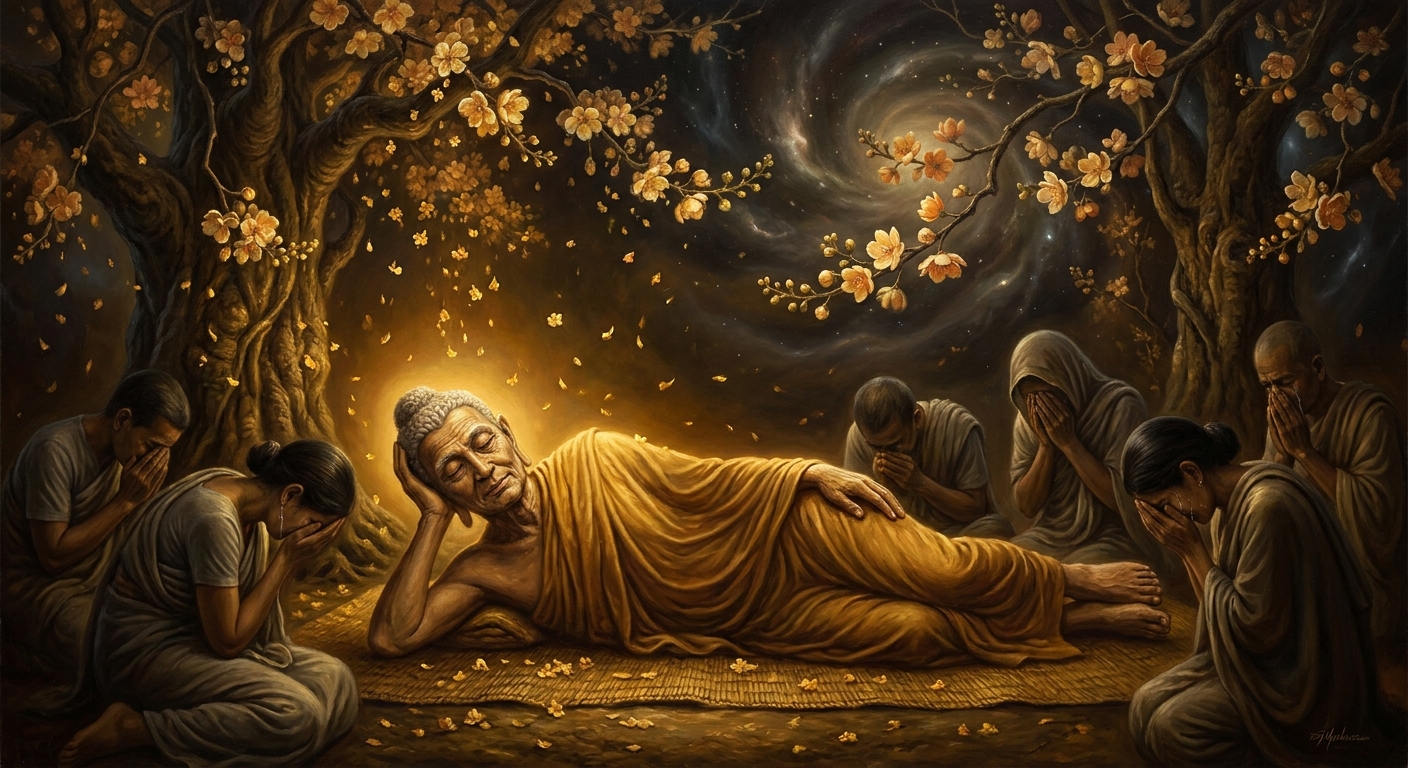
The sal trees are flowering.
This is not the season for sal trees to flower. The Mallas know this, and the monks know this, and the texts record it with the same flat precision they use for everything: the trees bloom, petals fall on the Buddha’s body and on the ground around him, a rain of flowers that no one has asked for. The trees are doing what trees near the dying sometimes do in these accounts — they become participants. They make an occasion of it.
He lies on his right side, facing west. The lion posture. This is the posture in which all Buddhas pass, and he is one who has remembered that. His head points north.
Ananda goes behind a wall and weeps.
The Buddha notices.
He calls Ananda back. Ananda, his cousin, his closest attendant, the one who memorized everything and forgot nothing and will later recite the entire suttas to the council at Rajagaha so the teaching can be written down — Ananda who has walked beside him for twenty-five years and still has not attained what the Buddha has attained — Ananda is weeping behind a wall, and the Buddha calls him by name.
“Do not weep, Ananda. Have I not taught you that all things dear and pleasant are subject to change, to separation, to becoming otherwise? How could it be otherwise, Ananda? That which is born, that which has come into existence — how could it not be subject to dissolution?”
Ananda asks the question that will outlast both of them: what should we do without you?
The answer has been asked ten thousand times since, in temples and hospices and burning-ground meditations and monastic training halls, and the answer is always the same because the Buddha gave it once and it has never needed revision: “Be a lamp unto yourselves. Be a refuge unto yourselves. Take the dharma as your lamp. Take the dharma as your refuge. Look not for refuge to anyone beside yourselves.”
He is not appointing a successor. He is declining to be a door.
A wanderer named Subhadda comes to the grove to ask a final question — whether the other teachers, the Jains and the materialists and the skeptics, have also attained the truth. The monks try to send him away. The Buddha has only hours; this is not the moment for philosophical debate.
The Buddha calls Subhadda forward.
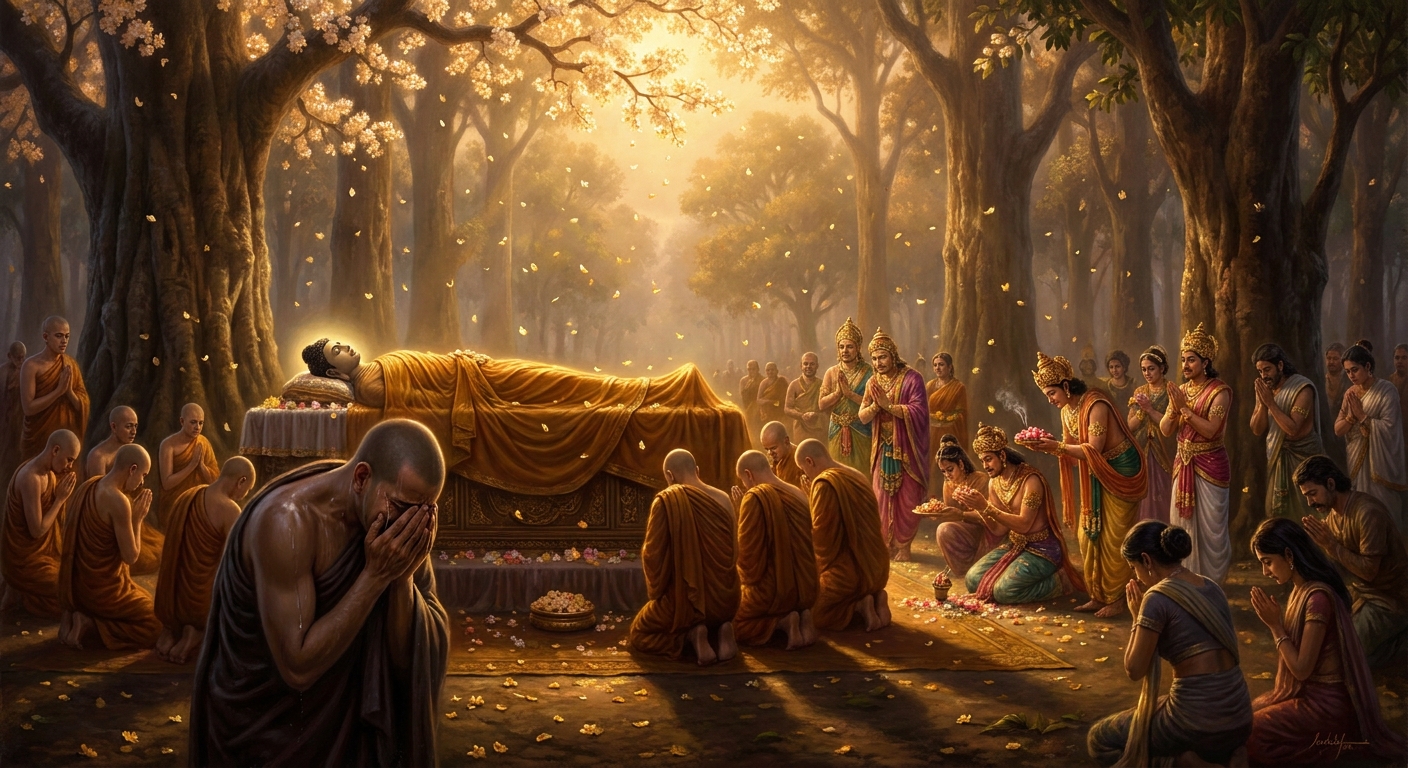
He answers the question briefly, and Subhadda becomes the last disciple ordained before the parinirvana, and then the Buddha speaks to all of them, the full sangha gathered in the sala grove under the out-of-season flowers, and what he says is not a revelation or a miracle or a promise of a god who will receive them.
He says: “All conditioned things are impermanent. Strive on with diligence.”
That is the last sentence. The texts are explicit that nothing comes after it.
Then he enters the jhanas.
The first. The second. The third. The fourth. Then beyond — the formless absorptions, the sphere of infinite space, the sphere of infinite consciousness, the sphere of nothingness, the sphere of neither-perception-nor-non-perception. He has walked through all of these before, in every retreat, every long meditation, every rainy season spent in stillness. The mind knows the route.
He returns to the fourth jhana.
This is the one the texts specify: equanimity, neither pleasure nor pain, pure clarity, full breath. He rests there. And from the fourth jhana he passes into final nirvana.
The sal trees shed their flowers. The earth trembles — just slightly, just enough for the monks present to notice, just enough for the tradition to record. Some of the monks wail aloud. Some sit very still. The ones who have attained liberation sit still with the full knowledge of what has ended. The ones who have not sit still with grief, because grief is honest and he never said grief was wrong, only that grief is also impermanent.
Ananda does not weep this time. He had his moment behind the wall. Now he is remembering, because that is what Ananda does — he is the one who will carry the teaching out of this grove and into the council hall and into the texts that will go to every country that touches the Indian Ocean and beyond. The words are already inside him. He has only to carry them.
Cunda the smith, back in Pava, will learn what happened and will suffer for it.
The Buddha anticipated this. Before leaving the river, he gave Ananda a specific instruction: find Cunda, and tell him that the meal he offered was not the cause of harm but the occasion for the greatest merit any person can accumulate — to feed the Tathagata at the moment of final enlightenment. Two donors stand above all others in the record: the woman Sujata who fed him rice milk before he sat beneath the Bodhi tree, and Cunda who fed him his last meal. Cunda is in the better company he could possibly be in.
This is a teaching in itself. The Buddha’s last administrative act is to protect a craftsman’s reputation. The final nirvana can wait while he does that.
They cremate the body. The Mallas take the relics. Eight kings divide them among eight kingdoms, and the relics go into stupas, and the stupas become the first Buddhist sacred sites, and eventually the whole question of the relics and the sites and the councils and the lineages and the schools will become enormously complicated in ways the man under the sal trees did not ask for and probably expected.
He told them not to make him a door. They made him a door anyway.
But the words survived the door. All conditioned things are impermanent. Strive on with diligence. The method survived the shrine. That is what he left: a method tested to its final limit, in a grove in Kushinagar, on a night when the trees flowered out of season and the earth moved once and then was still.
You do not need him to do the method.
That was always the point.
Scenes
The Buddha on his right side between the twin sal trees at Kushinagar
Generating art… Cunda the smith serves the Buddha his final meal — sukara-maddava, 'pig's delight,' perhaps mushrooms, perhaps something else
 Generating art…
 The sangha gathers around the sala grove
 Generating art…
 Echoes Across Traditions
Entities
- Buddha
- Ananda
- Cunda
- Subhadda
Sources
- *Mahaparinibbana Sutta* (Digha Nikaya 16), Bhikkhu Sujato translation
- Donald Mitchell, *Buddhism: Introducing the Buddhist Experience*
- Andre Bareau, *La composition et les étapes de la formation progressive du Mahaparinirvanasutra ancien*