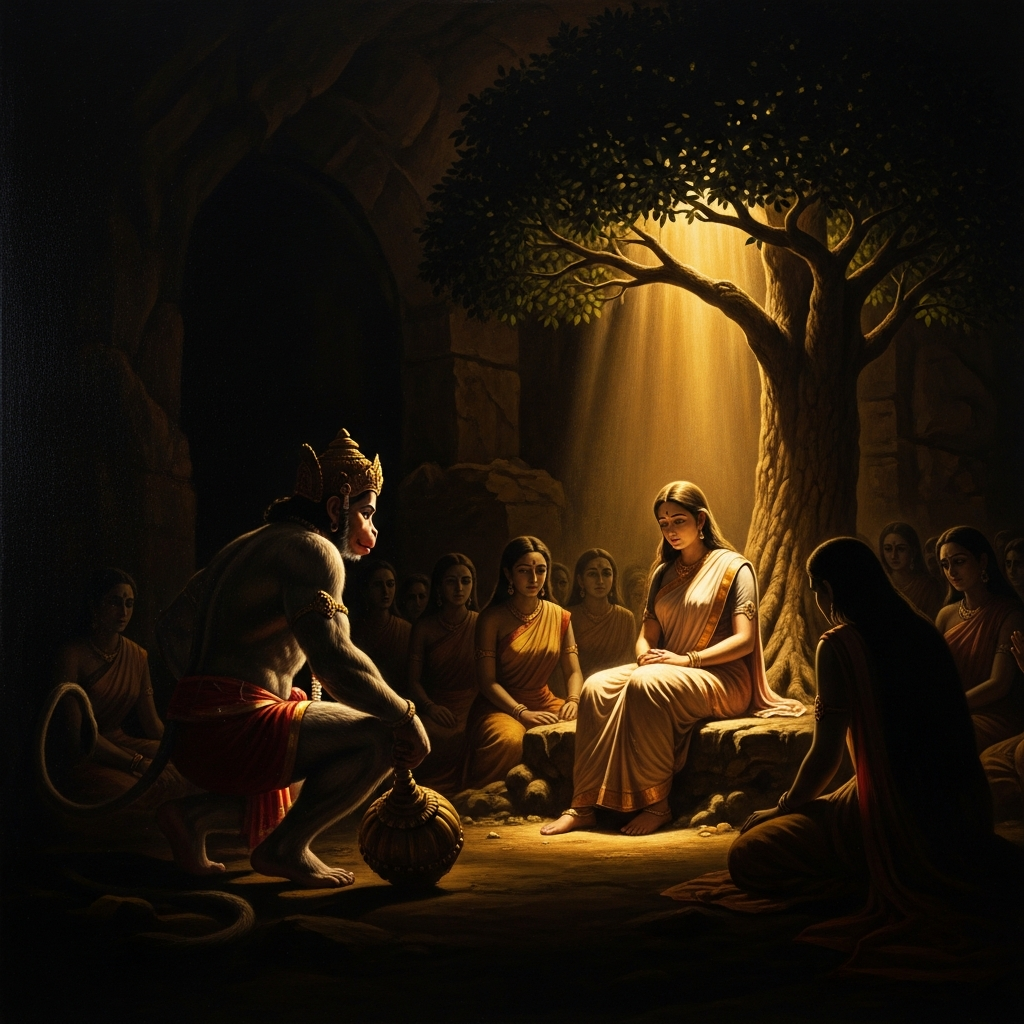
Hanuman Finds Sita in the Ashoka Grove
Mythic Time · Valmiki Ramayana ~5th century BCE · The Ashoka grove inside Ravana's palace, Lanka
Contents
The monkey-god leaps an ocean to find a grieving queen beneath a shimshapa tree. He shrinks to the size of a cat, sings Rama's story softly in the branches above her head, and presses a signet ring into her palm. She refuses his offer to carry her home.
- When
- Mythic Time · Valmiki Ramayana ~5th century BCE
- Where
- The Ashoka grove inside Ravana's palace, Lanka
He lands on Lanka at dusk.
The leap across one hundred yojanas of ocean has cost him nothing — he is the son of Vayu, and the wind does not tire — but he stands now on a coastline that is not his and considers what shape he should take. He is enormous. He has been enormous all morning. The walls of Ravana’s golden city were built to keep large things out.
He shrinks.
It is not a humble act. It is a tactical one. A monkey the size of a house cannot enter a palace; a monkey the size of a cat can slip through a drainage grate. He becomes small. He becomes smaller. By the time he reaches the outer wall he is no larger than a fruit, and he climbs the gold-leafed stones the way a squirrel climbs a tree.
Inside, the city is impossible. He looks for Sita anyway.
He searches all night.
He moves through Ravana’s harem and does not find her. He moves through the kitchens, the treasuries, the war-rooms hung with weapons whose names he does not know. He sees rakshasis sleeping in piles of silk, rakshasas drunk on stolen wine, dancing girls collapsed across each other in the long exhalation of a city that knows it is winning.
She is not in any of these rooms.
He begins to despair. He has been told she is here — Sampati the vulture saw her with his old eyes from the southern cliff — but the city is vast and the night is short and a small monkey can only search so much before dawn shows him what he is. He sits on a parapet and considers turning back. He thinks: what message do I bring Rama if she is not here, or worse, no longer alive?
Then he remembers that grief sits under trees.
He goes to the gardens.
She is in the Ashoka grove.
She sits beneath a shimshapa tree at the center of a walled garden built for one woman. Around her, ten or twelve rakshasis squat in a ring — ugly, watchful, cruel in the small bored way of jailers who have been at it long enough to invent new humiliations. They take turns describing what Ravana will do to her if she does not yield. She does not look at them. She has been not-looking-at-them for so many months that her not-looking has become a kind of armor.
She is thin. Her hair is matted. Her sari is the same one she was wearing when Ravana lifted her out of the forest, and the gold border has gone gray with dust. She is pressing her cheek against the bark of the shimshapa tree the way a child presses against a parent who has died.
Hanuman climbs into the branches above her head.
He does not announce himself. He cannot. If he speaks too loudly the rakshasis will see him; if he speaks too softly she will not hear; if he frightens her and she cries out, the entire mission ends in this garden tonight.
He thinks about it for a long time. Then he begins to sing.
He sings the story of Rama.
Not loudly. The way you might hum an old song to a child who cannot sleep. He starts at the beginning — King Dasaratha of Ayodhya, the four sons, the elder Rama beloved of all, the marriage to Sita won by bending the unbendable bow of Shiva. He sings the exile. He sings the years in the forest. He sings the golden deer that was not a deer, the abduction by the rakshasa king, the broken arrow of the dying Jatayu. He sings carefully, every detail correct, the way you sing to prove you are who you say you are.
Sita lifts her head.
Her eyes search the leaves. She has been suffering long enough that her first thought is that she is hallucinating — the shimshapa is full of birds, and grief makes any voice sound like a remembered voice. But the song continues. The song knows things she has not told anyone in this city, things only Rama would know, things only someone Rama trusted would know.
She whispers: Who is there?
Hanuman comes down.
He shows himself in the smallest form he can hold — a monkey no bigger than her hand, sitting on the branch above her with his palms folded.
She is afraid for a moment. Ravana has shape-shifters. Rakshasas put on softer skins than their own to torment her. She has learned not to trust comfort.
Hanuman does not push. He says: I am Hanuman, the son of Vayu. I serve Rama. He is alive. He is searching for you. He has crossed the south with an army of monkeys and bears, and he sent me ahead because I could leap the ocean.
He puts his hand inside his fur and brings out the ring.
She knows it. She knew it before he showed it to her — the moment he said Rama’s name in a voice that loved Rama, she knew — but the ring is something her hands can hold. She takes it. She presses it against her forehead. She presses it against her chest where the breath has been shallow for months. She begins to weep, not the way she has wept here every day, but the other way: the way of someone who has just been told the door is not, after all, locked from the outside forever.
The rakshasis do not see. They are arguing among themselves at the edge of the grove. The shimshapa tree holds its silence the way trees hold the secrets of those who lean against them.
He offers to take her back.
It is the obvious offer. He is enormous when he wants to be — he could lift her in one hand, leap the ocean before the rakshasis finish their next sentence, set her down on the southern shore of Bharata before dawn. The war could end tonight. Rama could embrace her by sunrise. The whole machinery of armies and bridges and slaughter that is grinding toward Lanka could simply stop, because a small monkey carried a queen home through the air.
She looks at him for a long time.
She says: No.
She says it gently. She is grateful. She presses his small paw between her palms. But she says: Rama must come for me himself. If I am carried out of Lanka by another, even one who serves him, the world will say he could not rescue his own wife. Dharma will be dishonored. Ravana must be defeated, not eluded. The cosmic order requires that the one who broke it be the one to confront its restoration. I will wait.
Hanuman bows. He is the wind’s son, and he understands when to push and when to let a thing be.
He says: Then give me a token, so he knows I found you.
She unties a single jewel from her hair — the chudamani, the crest-jewel of Mithila, the only object on her body that is still hers — and presses it into his hand.
She says: Tell him I will hold for one month. After that I will not be alive to hold.
He folds the words into his chest. He folds the jewel beside them.
He climbs back up into the shimshapa tree and turns once before he goes — to memorize her face, the exact angle of her cheek against the bark, the shape of the rakshasi ring around her, the dimensions of the garden so that Rama’s army knows exactly where to come.
He grows. He fills the sky above the grove. The rakshasis look up and begin to scream. Hanuman is no longer a small monkey. He is the wind’s son in his full form, and he is leaving Lanka the way he came — but he has work to do first, on this side of the ocean, in the towers and gardens of the city that thought a queen could be locked in a garden and not be found.
That is the next chapter.
This chapter ends here, in the grove, with a woman holding a ring against her chest and a small monkey disappearing into the leaves and the cosmic war about to turn because one messenger crossed a sea and sang the right song softly enough.
The Sundara Kanda — the “Beautiful Chapter” — takes its name partly from this scene. Sundara means beautiful, auspicious, gracious. The book is recited for protection and for finding what has been lost. Pilgrims carry the chudamani jewel-image into shrines as a token of the moment when the divine found the suffering soul in its private garden.
Sita’s refusal is the theological hinge. She will not be rescued by a substitute, no matter how capable. The dharma requires that the one who violated the order be the one to confront its restoration. Hanuman’s role is messenger, not rescuer. The distinction matters in every devotional theology that has followed: the divine envoy carries assurance, but the soul still walks back through its own door.
A monkey the size of a cat. A queen under a tree. A ring pressed into a palm. The whole Ramayana balances on this single private exchange, and the public war that follows is, in the deepest reading, the working-out of what was already settled in the grove.
Echoes Across Traditions
Entities


Sources
- Valmiki, *Ramayana*, Sundara Kanda 13-38
- Robert P. Goldman and Sally J. Sutherland Goldman (trans.), *The Ramayana of Valmiki, Volume V: Sundarakanda* (Princeton, 1996)
- Camille Bulcke, *Ramakatha: Utpatti aur Vikas* (1950)
- Tulsidas, *Ramcharitmanas*, Sundara Kanda
- Philip Lutgendorf, *Hanuman's Tale: The Messages of a Divine Monkey* (2007)