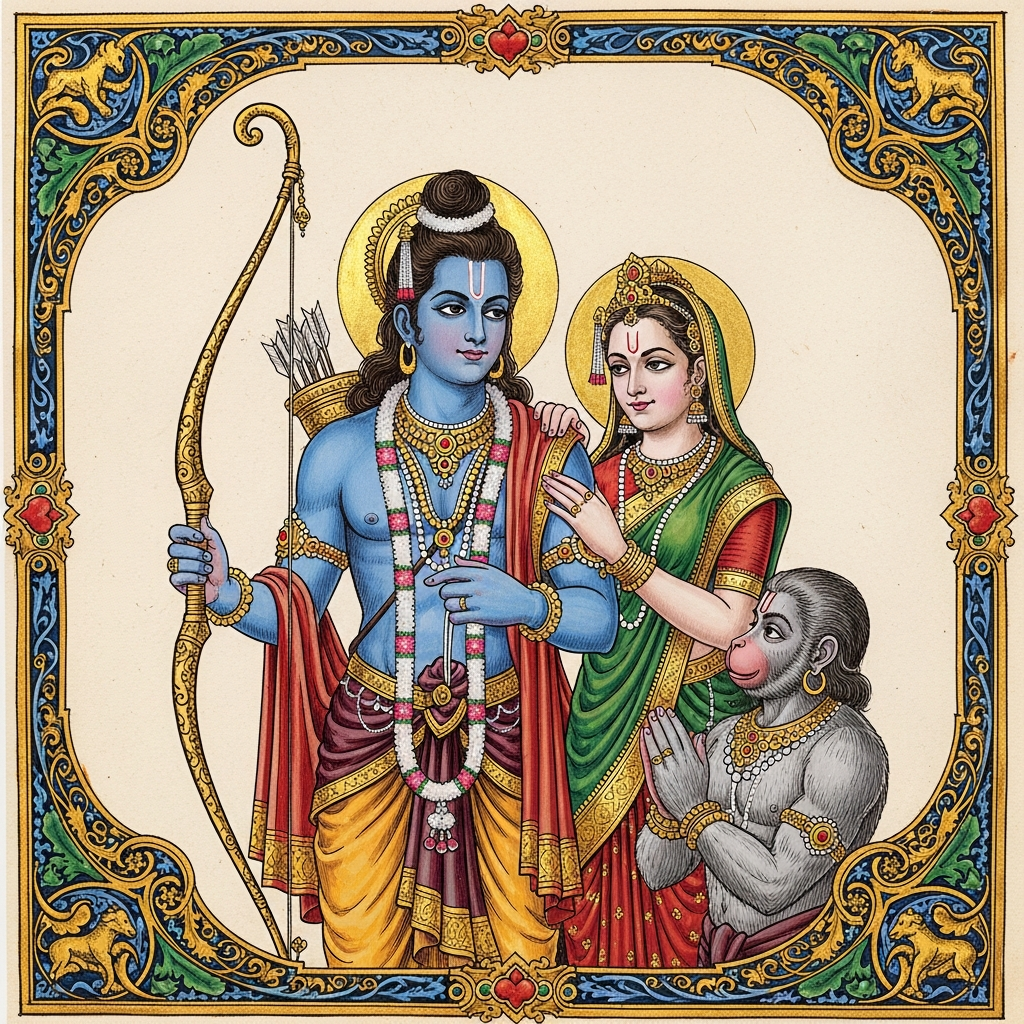
Combat Profile
Maryada Purushottama
Rama embodies perfect dharma, granting allies unwavering resolve and purifying corruption from the battlefield.
Avatar of Vishnu
Rama's presence maintains cosmic order, gradually healing allies and weakening those who violate dharma.
Rama is the prince of Ayodhya, eldest son of King Dasharatha, and the embodiment of dharma (righteous duty) (Ramayana, Balkanda). When his stepmother Kaikeyi demands that her own son be crowned king instead, Rama accepts exile without bitterness — duty to his father’s word outweighs his own rights. He spends 14 years in the forest with his wife Sita and brother Lakshmana. During the exile, the ten-headed demon king Ravana kidnaps Sita and takes her to his island kingdom of Lanka.
Rama raises an army of monkeys and bears led by the devoted Hanuman, builds a bridge across the ocean to Lanka (Ram Setu, an actual geological formation), and wages war against Ravana’s vastly superior forces. After an epic battle, Rama kills Ravana with a divine arrow and rescues Sita (Ramayana, Lanka Kanda). He returns to Ayodhya and is crowned king, inaugurating an era of perfect justice — “Rama Rajya.”
The structural parallels to Christ are extensive: exile from his rightful kingdom, a period of wandering and testing, a cosmic battle against the lord of evil, the rescue of the beloved (the Church as “bride of Christ”), and a triumphant return to reign in perfect justice. Rama is the king who SHOULD rule but is rejected and exiled; Christ is the king who SHOULD rule but is crucified. Both return to claim their kingdom.
“He who knows the truth of my divine birth and activities is not born again after leaving this body, but comes to me.” (Bhagavad Gita 4.9, Krishna speaking of the avatar principle that Rama embodies)
1 min read
Ramayana (Valmiki, c. 5th-4th century BCE), Ramcharitmanas (Tulsidas, 16th century)