Combat Profile
Pushpaka Mastery
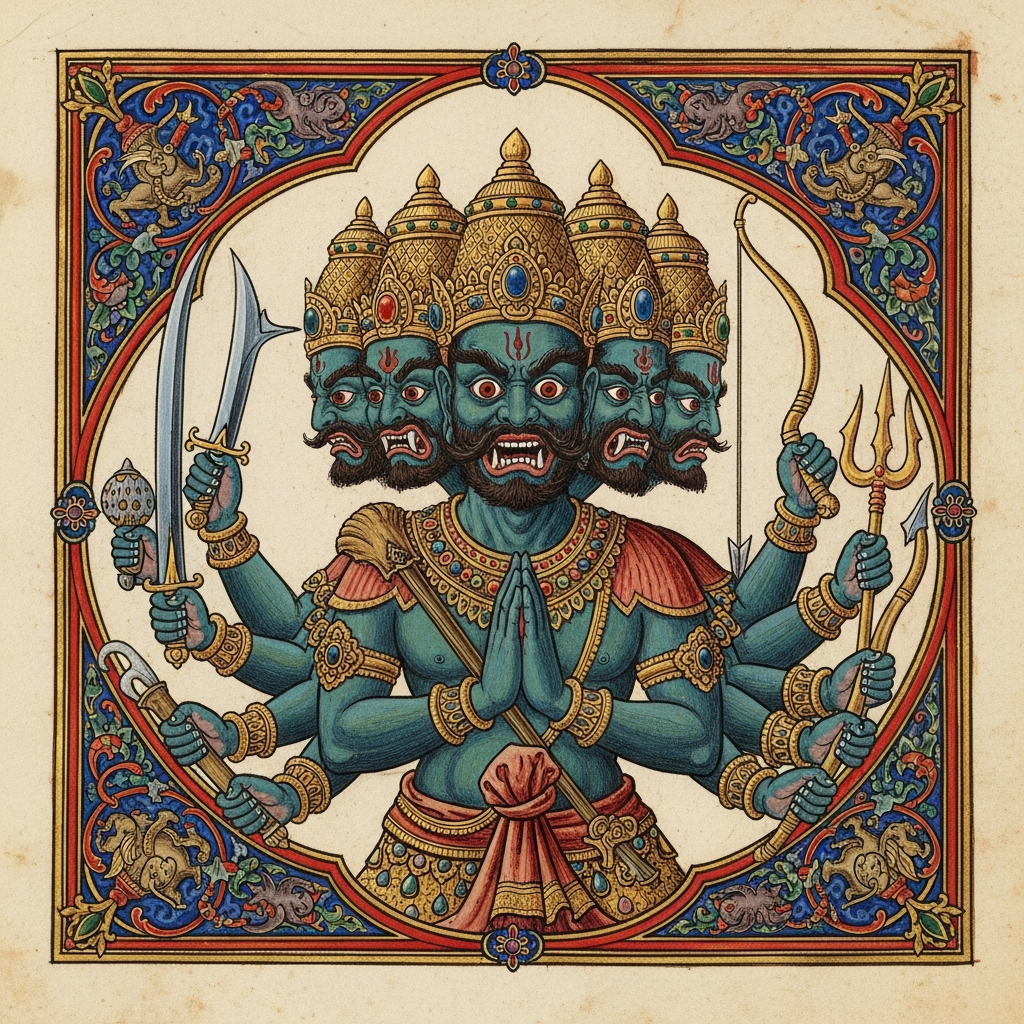
Ravana commands the celestial flying palace Pushpaka, granting him dominion over vast territories and the ability to project his will across realms.
Ten-Headed Omniscience
Ravana's ten heads grant him simultaneous perception of all directions and mastery of all Vedas, making him immune to surprise and deception.
Ravana is not a simple villain. He has ten heads (representing mastery of the four Vedas and six Shastras — ten fields of knowledge) (Ramayana, Lanka Kanda), twenty arms, and is one of the greatest devotees of Shiva who ever lived. He composed the Shiva Tandava Stotram — one of the most beautiful hymns to Shiva in all of Hindu literature — while Shiva was crushing him under Mount Kailash (Ramayana, Uttara Kanda). He was a Brahmin of extraordinary learning and piety. His downfall was entirely ego: granted near-invincibility by Brahma’s boon, he thought himself beyond consequences and kidnapped Sita (Ramayana, Aranya Kanda).
The parallel to Satan as brilliant but fallen is precise: Ravana, like Lucifer, is the most gifted being who was undone by pride. His ten heads parallel the Dragon’s seven heads in Revelation 12 — multiple heads representing multiplied power and knowledge that has become monstrous through corruption. And like Satan’s defeat by Christ, Ravana’s defeat by Rama is the narrative pivot of the entire epic (Ramayana): the righteous king destroys the arrogant tyrant and restores cosmic order.
The burning of Ravana’s effigy during Dussehra (Vijayadashami) is celebrated by hundreds of millions of Hindus annually as the triumph of good over evil.
1 min read
Ramayana (Valmiki), Lanka Kanda