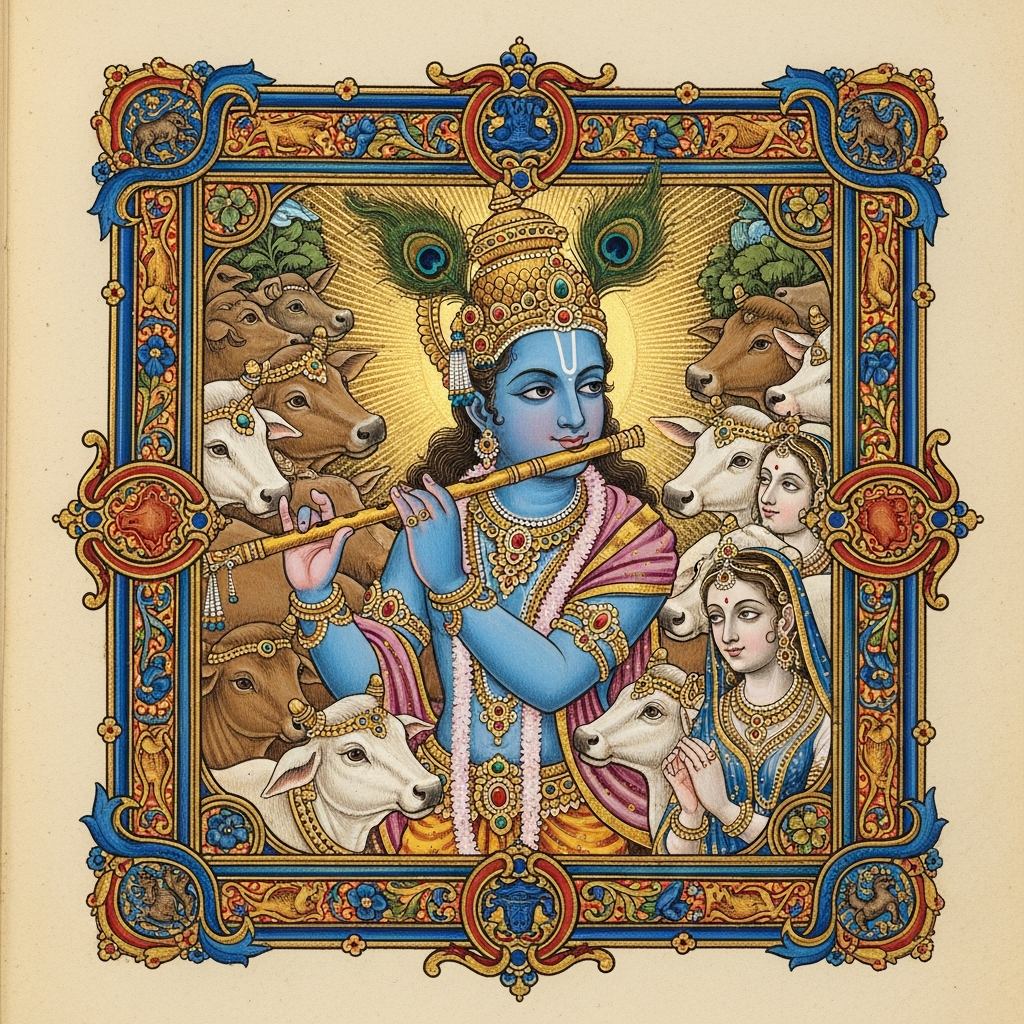
Abhimanyu in the Wheel
Mythic Time · Mahabharata, Drona Parva ~400 BCE-400 CE · Kurukshetra — the thirteenth day of the eighteen-day war
Contents
Abhimanyu, sixteen-year-old son of Arjuna, learned how to enter the Chakravyuha — the lethal spinning wheel formation — while still in his mother's womb. His father explained the exit while she slept. On day thirteen of the war at Kurukshetra, he enters the formation alone. He knows how to get in. He does not know how to get out.
- When
- Mythic Time · Mahabharata, Drona Parva ~400 BCE-400 CE
- Where
- Kurukshetra — the thirteenth day of the eighteen-day war
He learned the entry before he was born.
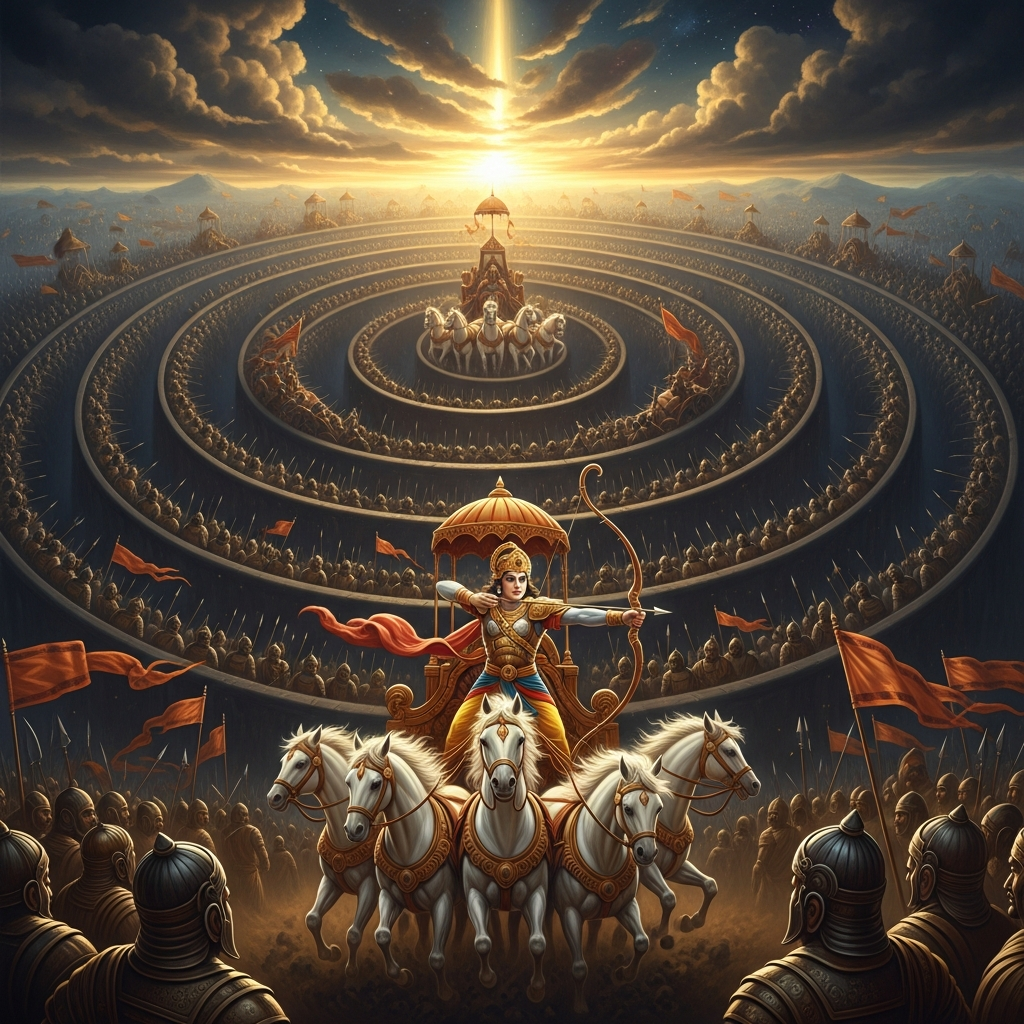
Arjuna, in the months before his son arrived, was explaining the Chakravyuha to his wife Subhadra. The Chakravyuha is the wheel formation — seven concentric rings of warriors rotating in opposite directions, the innermost fastest, each ring interlocked with the next so that what appears to be a gap closes before you reach it. Breaking into it requires knowing the sequence of the rotations, the specific approach angle, the timing of each threshold. Breaking out of it requires knowing the corresponding sequence in reverse, and the reversal is different from the entry in ways that require their own explanation.
Arjuna was explaining all of it.
Subhadra listened through the entry — the approach, the first ring, the second, the timing of the wheel, the gap that opens when the third and fourth rings synchronize for a moment at the eastern facing. She was listening, attentive, her hand on her belly where the child was turning in the fluid dark. The child was listening in whatever way children in the womb listen to the world — which is to say: completely, without filtering, absorbing the vibration and rhythm and structure of a language it did not yet know it was learning.
Then Subhadra fell asleep.
She was exhausted. She was very pregnant. The formation’s exit strategy began — the reversal, the sequence of egress, the way to unspool the wheel from the inside out — and she was asleep, and Arjuna noticed, and stopped talking, because talking to sleeping people is something even the greatest archer of his age does not do.
The child was still listening. There was nothing left to hear.
Abhimanyu grows up knowing half a secret.
He does not think of it this way — children do not audit their knowledge for gaps. He knows he can break the Chakravyuha. He has known it the way he knows to breathe, the way he knows to draw a bow: not as a learned thing but as a constitutive thing, built into the architecture of his awareness before he had awareness. He trains in his father’s methods, studies under Krishna and Pradyumna, earns a reputation on the practice fields that makes the Kuru court elders watch him with the specific attention that extraordinary youth generates in people who recognize it.
He is everything his father is at sixteen. Some texts suggest he is more.
He is sixteen years old on the thirteenth day of the war at Kurukshetra.
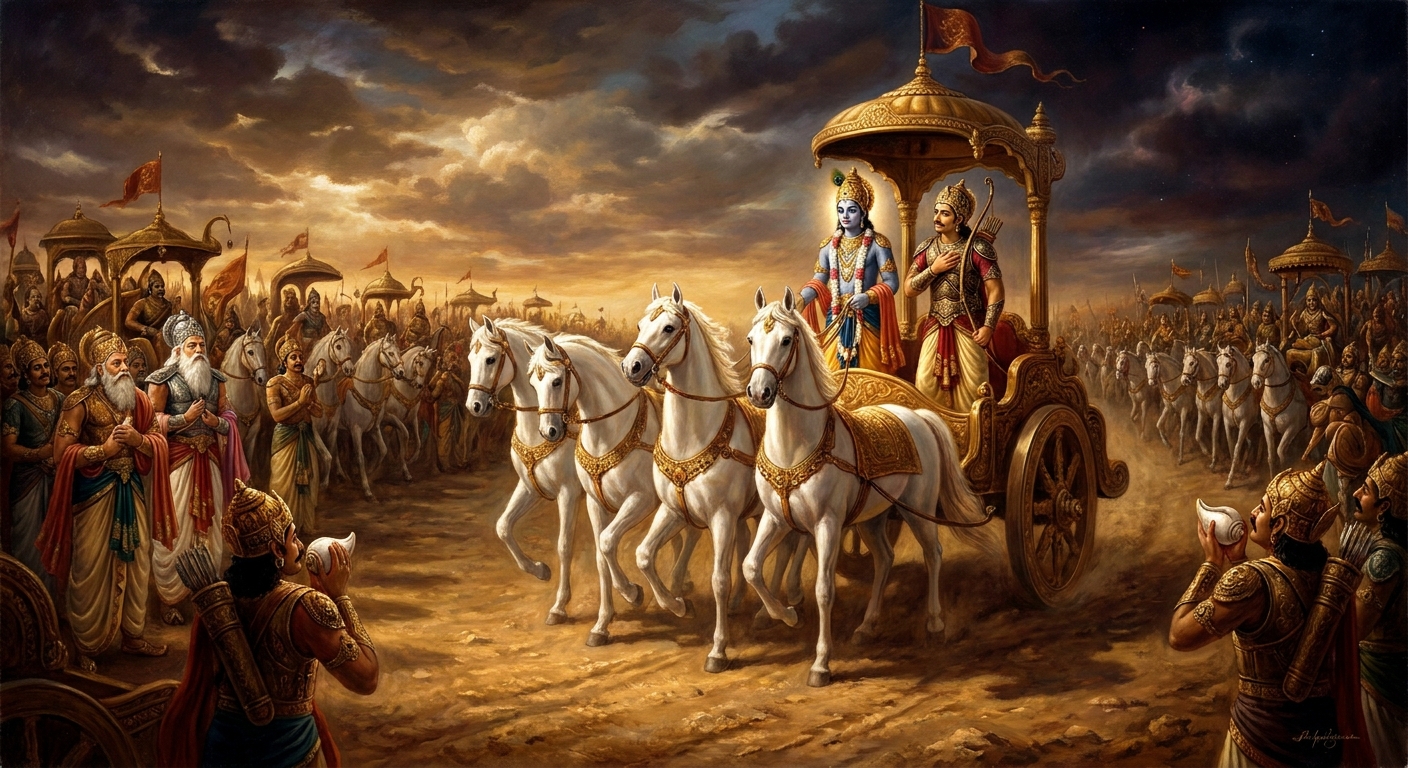
Drona is the commander of the Kaurava forces on day thirteen. Drona is the greatest military strategist alive, the teacher of every major warrior on both sides of the field. He has arranged the Kaurava forces in the Chakravyuha formation because he knows exactly one thing about the Pandava army: only three warriors alive can break it. Arjuna can break it. Krishna can break it. Krishna is Arjuna’s charioteer and does not fight personally. Arjuna is not on this part of the field — Drona has arranged for Arjuna to be drawn away to fight the Samsaptakas on the southern end of the battlefield, a separate army pledged to kill him or die trying.
He has removed the two men who can break the wheel. He knows that no one else on the Pandava side possesses the knowledge.
Yudhishthira is standing in front of the formation with his commanders when Abhimanyu says: I know how to enter it.
He tells them honestly — completely honestly, the way young men of genuine character tell the truth even when the truth is dangerous — that he knows the entry but not the exit. He can get in. He cannot guarantee he can get out.
Yudhishthira and the commanders look at the formation and look at the boy and look at the formation. The army needs to move. The Chakravyuha is holding them. The day is burning. They make the plan that desperate men with limited options make: Abhimanyu will breach the wheel, and the other Pandava warriors will follow him in through the gap before the formation closes, and together they will fight their way through from the inside.
It is not a good plan. They know it is not a good plan.
They send him in anyway.
He enters the wheel and it is everything he knew it would be and has never seen.
The first ring parts for him — he has the timing exactly right, the approach angle, the moment when the rotation opens the threshold — and he goes through and the ring closes behind him before Bhima, following, can enter. Jayadratha is at the gate. Jayadratha, who received a boon from Shiva after a humiliation at the hands of the Pandavas: for one day he can hold back all the Pandavas except Arjuna himself. He uses the boon today. The Pandava army hammers against the closed ring and cannot enter.
Abhimanyu is alone inside the wheel of the Kaurava army.
He fights.
He fights the way the texts describe only a handful of warriors fighting in the whole of the Mahabharata — with the specific, luminous, slightly inhuman efficiency of someone who has passed beyond fear into pure function. He kills Drona’s son Lakshmana with an arrow through the throat. He kills generals whose names the text catalogs as carefully as it catalogs the great warriors of the war. He kills thousands — the number is given, and the number is enormous. He moves through the rotating rings of the formation like something that cannot be stopped, because inside the knowledge he was born with he is exactly where he was always going to be, doing exactly what the knowledge was for.
The Kaurava commanders watch him from their positions in the rings. They are the greatest warriors alive. He is sixteen. He is killing them.
Drona calls a council.
The decision made in that council is the Mahabharata’s clearest indictment of war.
The rules of dharmic combat, announced at the war’s opening and observed imperfectly throughout, prohibit: attacking a single warrior with multiple warriors simultaneously, attacking an unarmed man, attacking from behind, attacking a man whose wheel is stuck. The rules are clear. Drona is the teacher of the rules.
Drona says: attack him from all sides simultaneously. Strip his weapons. Kill his horses. Destroy his chariot.
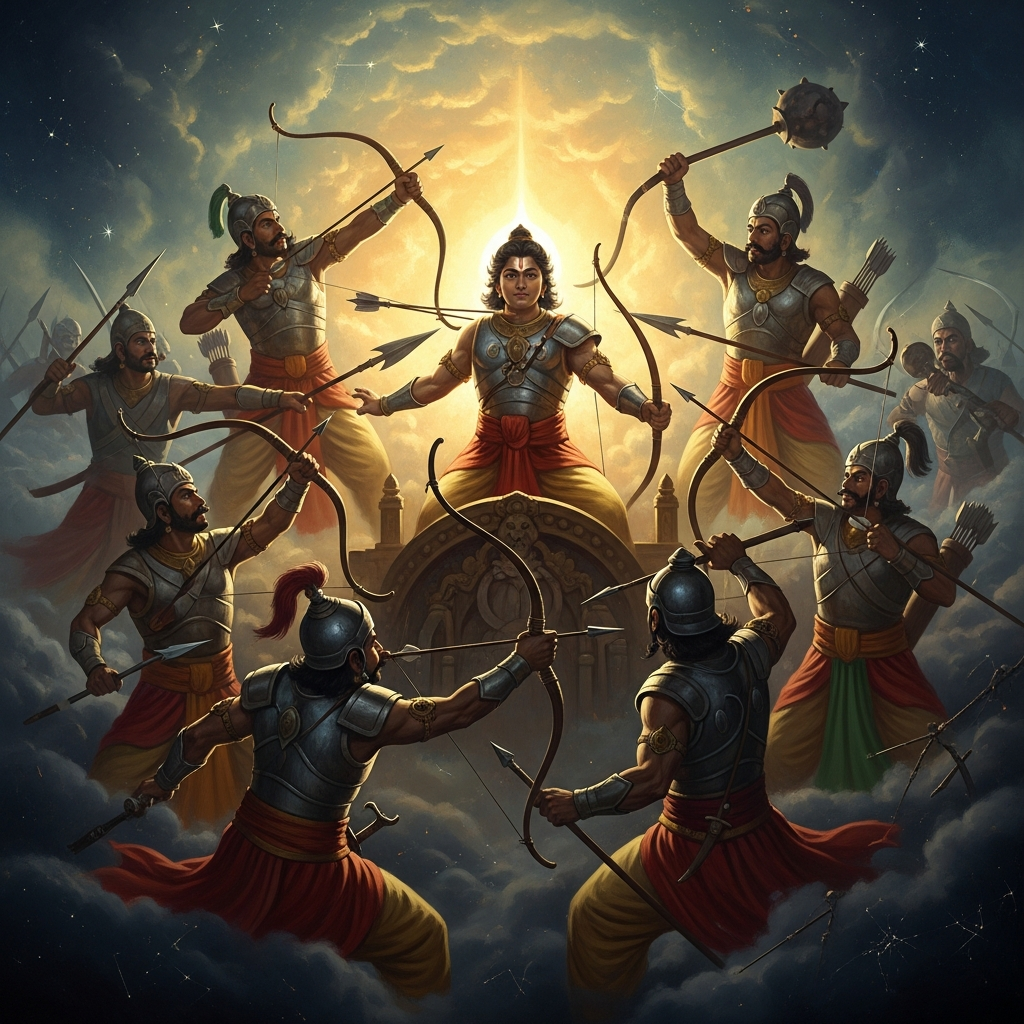
Six of the greatest warriors in the war act on this instruction at once: Karna destroys his bow from behind. Kripa kills his horses. Ashvatthama destroys his chariot. Shalya kills his driver. The other two close the circle. They are breaking every rule of war that was announced before the war began, and they are breaking them all at once against a sixteen-year-old because it is the only way to stop him.
He is unarmed and on foot in the wreckage of his chariot.
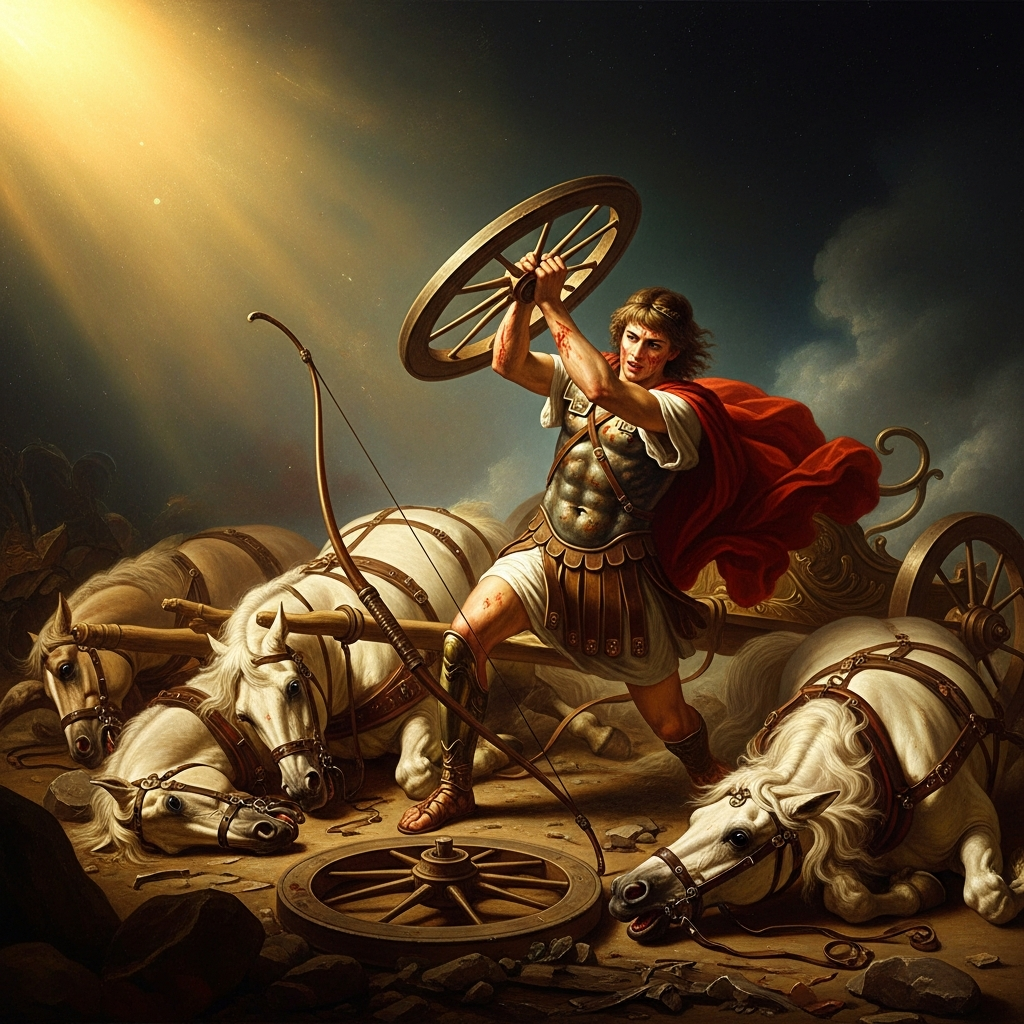
He picks up the chariot wheel.
He fights with the chariot wheel.
The texts spend time on this — the boy standing in the wreckage of his vehicle, using the wheel of the smashed chariot as a weapon, still fighting, still killing, still moving against the six greatest warriors alive. He is not performing heroism. He does not have the option to leave. The exit strategy was never taught to him. He is inside the formation with no weapon except what the formation itself broke around him, and he uses it.
The wheel finally breaks. He has no weapon.
He stands without a weapon in the center of the Chakravyuha that he entered because no one else could, and he looks at the circle of men around him, and none of them will say the thing that would require stopping. His body has been receiving arrows since the moment his bow was taken. He is bleeding from a number of wounds that the text does not enumerate because the enumeration would stop the reader completely.
He falls.
The Kaurava army gives a cry of victory that the Pandava army, outside the formation, can hear.
Arjuna comes back from the southern field in the afternoon.
He asks where his son is. No one will answer him directly. He finds the answer in the slowness of the commanders’ responses, the way Yudhishthira will not meet his eye. He goes to the body. He stays there for a long time. The other warriors give him distance, which is what warriors give each other around grief of this type.
Then he stands.
He makes the oath that the Drona Parva turns on for the next several days: Before tomorrow’s sunset I will kill Jayadratha, the man who sealed the gate and held back the Pandava army while my son was surrounded inside. If I do not, I will walk into fire myself.
Krishna, standing next to him, says nothing. He will make Arjuna’s oath possible — this is a promise he makes silently, to himself, in the way that gods make promises that require the management of events across an entire afternoon and evening. He will move the sun. He will create false darkness. He will do what the management of dharma requires.
He will kill Jayadratha. Arjuna’s arrow will fly. The head will fall.
But that is tomorrow’s story. Tonight there is only Arjuna at the body of his son, and the moon coming up over Kurukshetra, and the boy who knew half a secret lying in the mud of the formation he entered without a way out.
The Abhimanyu story is told by the Mahabharata as a pure tragedy, which is unusual for a text that generally maintains that the deaths of the righteous are victories of a larger kind. Abhimanyu’s death is different. The text does not comfort the reader with the information that he died in a good cause or that his spirit ascends to the appropriate realm — though both are mentioned, briefly, as afterthoughts. The text’s emotional weight stays on the image: the boy with the chariot wheel, surrounded by six.
The question the story asks without answering: whose responsibility is the half-knowledge? Arjuna noticed Subhadra sleeping and stopped talking. He stopped at the right moment — the moment when continuing would be pointless. The gap is structural, not negligent. The knowledge Abhimanyu has is complete and correct as far as it goes. He enters the wheel flawlessly. The exit was never available to him.
He went in anyway. This is both the story’s heroism and its horror: the boy who assessed the situation honestly, declared the limits of his knowledge clearly, and entered the formation that would kill him because the army needed someone to enter it and he was the only one who could.
The Mahabharata keeps asking: what does dharma require? In the Chakravyuha chapter, the answer is: sometimes, everything. And sometimes everything is a sixteen-year-old with a chariot wheel.
Scenes
The Chakravyuha spins before him like a living wall — seven layers of warriors rotating in opposite directions, the outer ring facing outward, each inner ring a tighter death
 Generating art…
 Inside the wheel, he is surrounded on all sides
 Generating art…
 His chariot is destroyed
 Generating art…
 Echoes Across Traditions
Entities
- Abhimanyu
- Arjuna
- Subhadra
- Drona
- Jayadratha
- Karna
Sources
- *Mahabharata*, Drona Parva 30-47 (Abhimanyu Vadha, BORI critical edition)
- Iravati Karve, *Yuganta: The End of an Epoch* (1969)
- Wendy Doniger, *The Hindus: An Alternative History* (2009)
- Alf Hiltebeitel, *The Ritual of Battle: Krishna in the Mahabharata* (1976)
- R.K. Narayan, *The Mahabharata: A Shortened Modern Prose Version* (1978)