Itzamna Begins the Count
August 11, 3114 BCE — Long Count zero date · Before the current world, Mesoamerica
Contents
On August 11, 3114 BCE — the zero date of the Maya Long Count — Itzamna, Lord of the Heavens and inventor of writing, creates time itself. Not the physical world, but the count of days, the measure that makes history possible. What does a god experience at the moment he begins to number what was previously numberless?
- When
- August 11, 3114 BCE — Long Count zero date
- Where
- Before the current world, Mesoamerica
Before this moment, there is no before.
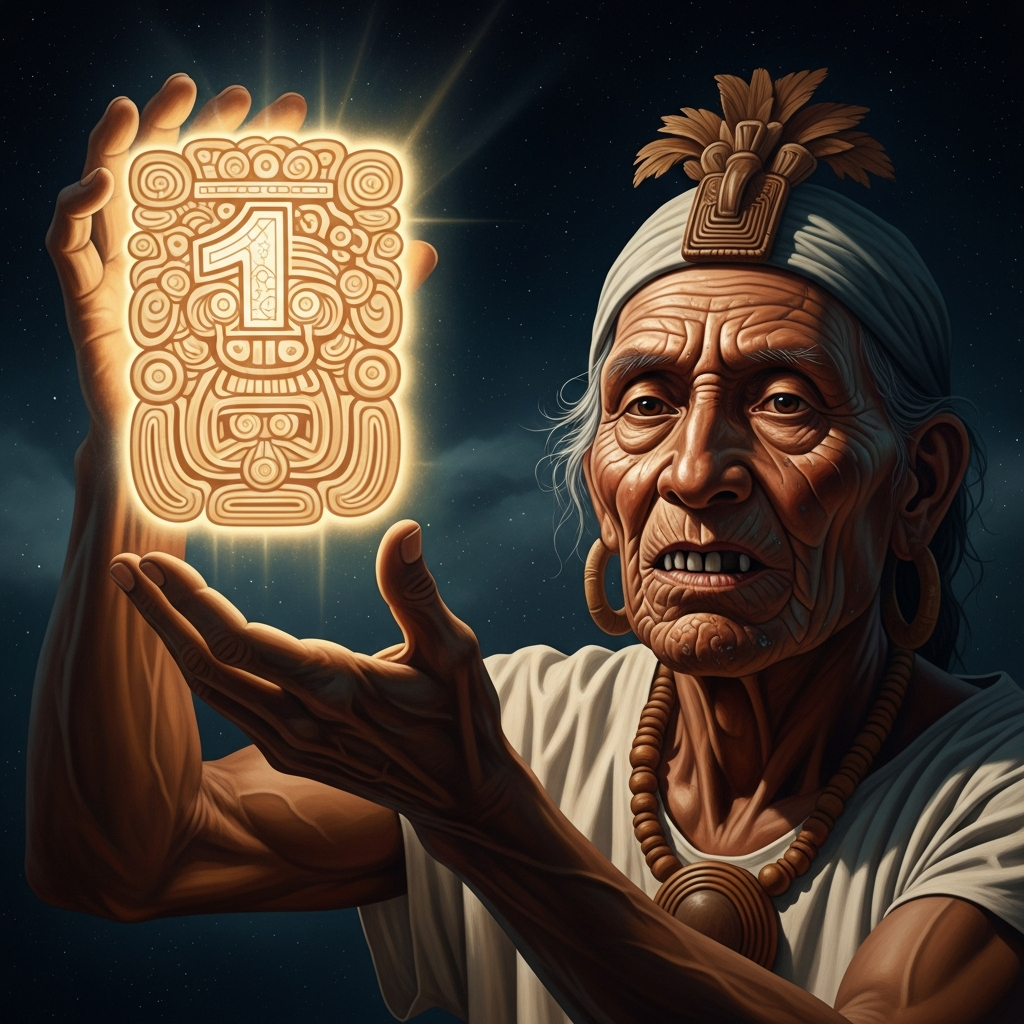
This is not a paradox Itzamna has been asked to resolve. This is simply the condition he inhabits at the edge of what has not yet been counted. He is old — in every depiction that survives him he is the oldest thing visible, a toothless man with a heavy jaw and deep-set eyes in a face that time has had more time on than anything else — and his age is the proof that there was a before before the before he is about to create. The gods existed before the calendar. They existed in an interval that the calendar will make legible, the way a lamp makes a room legible without creating the room.
But the calendar will also, in a sense, create time. Because time that is not counted is not time in any functional sense. It is duration without landmark. It is the dark that does not know it is dark because there is nothing to compare it to. Itzamna is about to give the darkness a count, and once you count something it is never quite the same thing again.
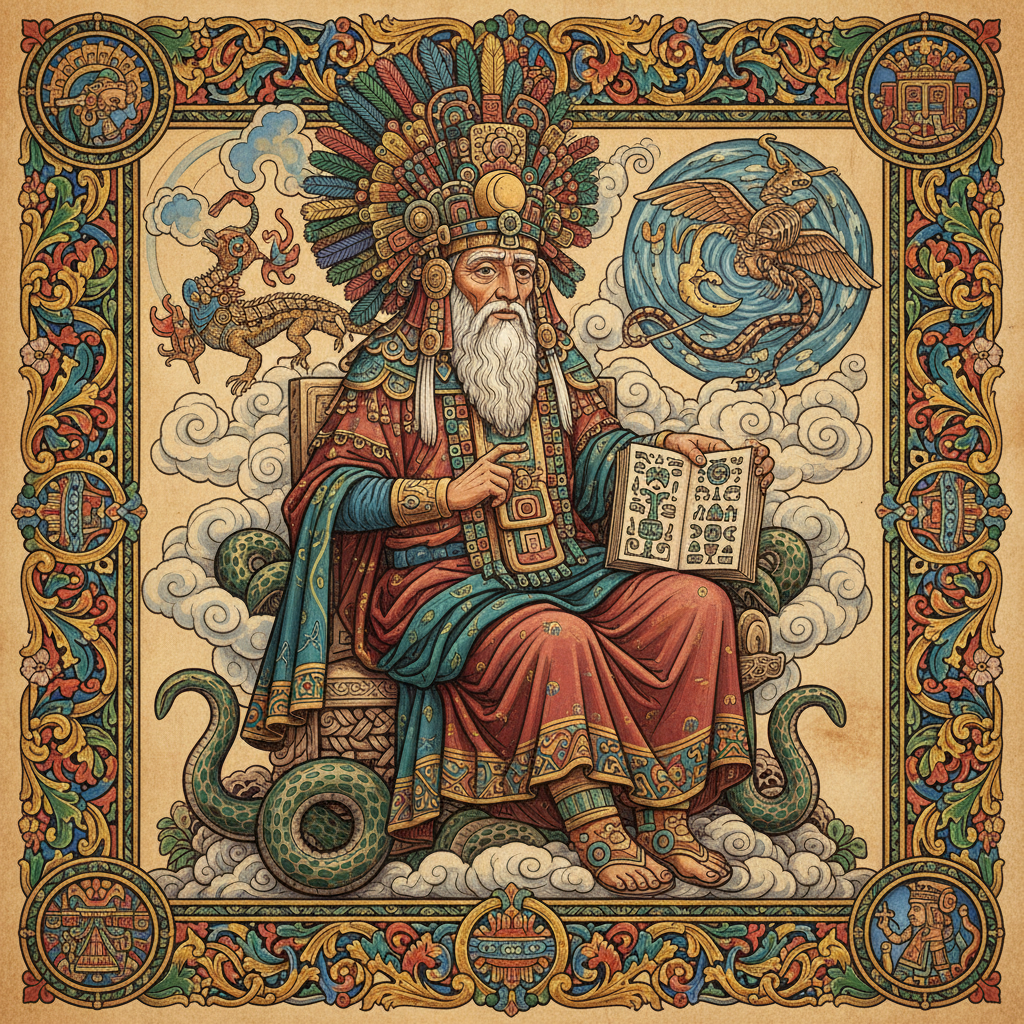
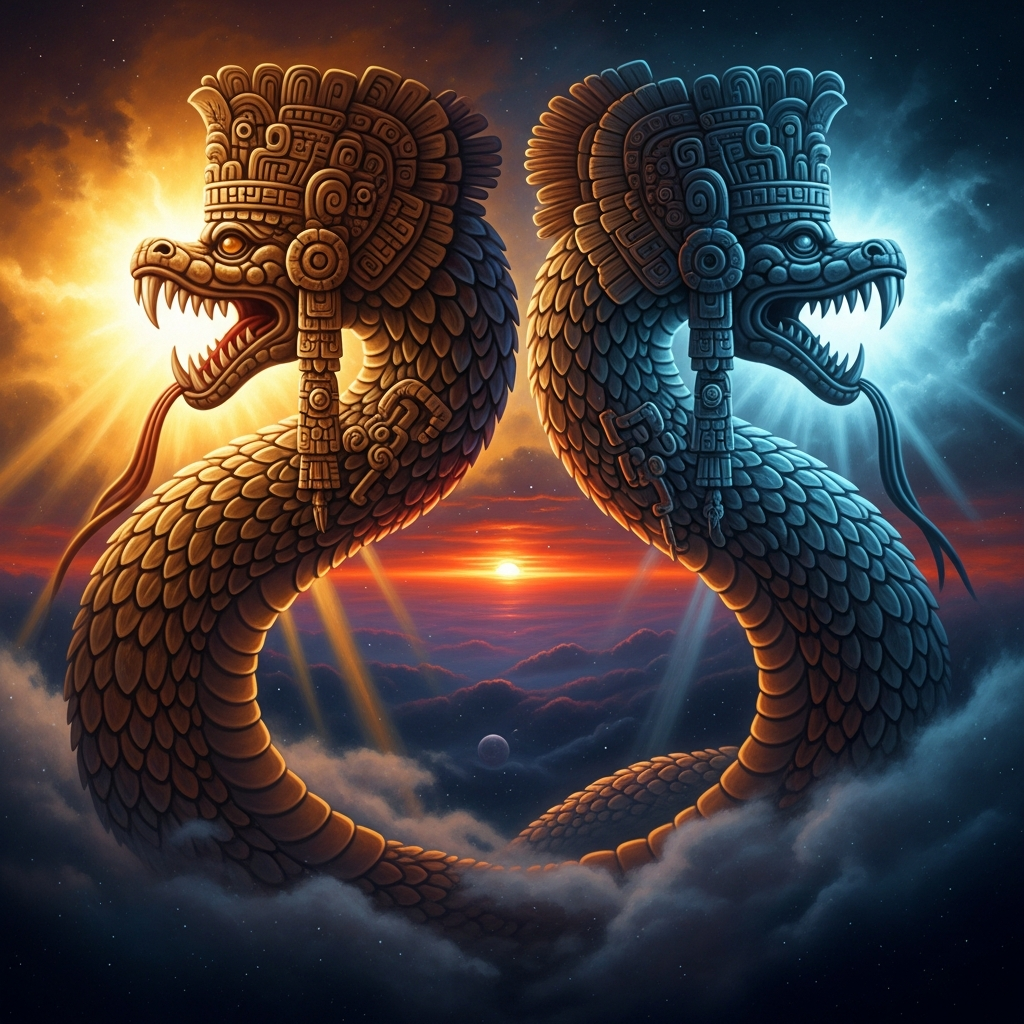
He is the Lord of the Heavens. He is also the Lord of the Nights. He is both, because the heavens include the absence of the sun, and the nights include the presence of stars, and stars are the record of previous time, light that left its source before the count began. His body in its most expansive form is the two-headed celestial serpent — a creature the length of the sky, one head at the eastern horizon where the sun rises and one head at the western horizon where it sets, and through its body the day passes. He is the interval. He is the distance between the last dark and the next dark.
His sons are Kinich Ahau, the sun, and Ix Chel, the moon. He invented writing — this is not a poetic attribution, it is the direct claim of the tradition: Itzamna taught writing to the first priests and the first priests taught it to the scribes and the scribes have been copying it onto bark-paper books ever since, every codex in the Maya world a descendant of the first lesson. He invented medicine. He named the plants and their uses. He established the first calendar — the 260-day tzolk’in, the sacred round, which the farmers use to time their planting and the priests use to time their ceremonies and the diviners use to read the character of every day into the character of every person born on it.
But the tzolk’in is not linear. The tzolk’in has no zero date. It is a wheel, and wheels have no beginning.
The Long Count is different.
The Long Count is a linear calendar — the first linear calendar the Americas produced, a count of days from a fixed origin point, accumulating without cycling back, measuring the current world-age from its first day to whatever day you are on now. The math is exact. Twenty kins make a uinal. Eighteen uinals make a tun. Twenty tuns make a katun. Twenty katuns make a baktun. One baktun is approximately 394 years. Thirteen baktuns bring you to 5,125 years, one full cycle of the current world-age.
The zero date — the first day of the count, the moment from which all subsequent Long Count dates are measured — is 13.0.0.0.0, which corresponds in the proleptic Gregorian calendar to August 11, 3114 BCE. Modern archaeologists have confirmed this correlation by cross-referencing Maya dates with datable astronomical events: solar eclipses, Venus apparitions, conjunctions whose timing can be calculated backward. The correlation holds to within a day across three millennia of records. It is the most precise calendrical data from the ancient Americas.
Someone had to establish the zero date.
The tradition says it was Itzamna. The specifics of how he did it are not preserved in any surviving text — the Spanish burned most of the Maya codices in 1562, and what remains is four books of later date and many stone inscriptions that reference the creation date without describing its moment. But the tradition is clear: the calendar was not found. It was made. The zero point was not discovered by observation. It was set by decision.
What does Itzamna decide?
He is standing at the edge of the unnarrated interval — the previous world-ages that the Maya tradition counts as three failed experiments in creation before this one — and he is about to establish a zero from which all subsequent days will be numbered. The previous worlds ended. Their endings are recorded in the current creation’s mythology as lessons. The first people were made of mud and dissolved. The second were made of wood and could not speak properly. The third — the Popol Vuh is specific about this — were destroyed by a flood.
This world begins with the decision to count it.
The first day is not the first day of anything in particular. The world existed before the count. The gods existed. The sky existed. The count is a frame imposed on what was already there, an act of epistemological violence not unlike writing itself — which also imposes a frame, a sequence, a fixity on what speech leaves fluid. Itzamna invented writing too. He understands this violence. He has chosen it as the cost of knowledge.
Before he begins the count, everything is simultaneous. The first maize field and the last baktun of the current age exist in the same undifferentiated duration. Nothing is early or late. Nothing is old or young. Nothing can be early or late or old or young without a scale, and the scale requires a zero, and the zero requires a decision.
One, he says, or the thing that precedes saying and produces the same result. One.
The first day is a day like any other day except that it is the first. The sun rises through Itzamna’s body from east to west. The crops are not planted yet — the people who will plant them are not made yet, that event belonging to a later date in the count now beginning — but the field is already the kind of place where crops will be planted. The world has its geometry. It has its directions: east, west, north, south, the zenith, the nadir, the center where the world tree grows. It has its colors assigned to each direction. It has its lords assigned to each direction. All of this predates the count.
What the count gives it is: sequence. After the first day comes the second day. After the second, the third. After 5,125 years, the baktun cycle completes, and the current world-age reaches its own zero — not destruction, the Maya scholars insist, contra every sensationalist account of the 2012 date, but transformation, the same relationship to the count’s end that the seed has to the harvest.
Itzamna knows this too. He is inventing a calendar that will eventually reach its own conclusion, because that is the nature of countable things. A count that never ends is not a count. A calendar with no last day is not a calendar. He is building a finite instrument in the full knowledge that its finitude is a feature rather than a flaw.
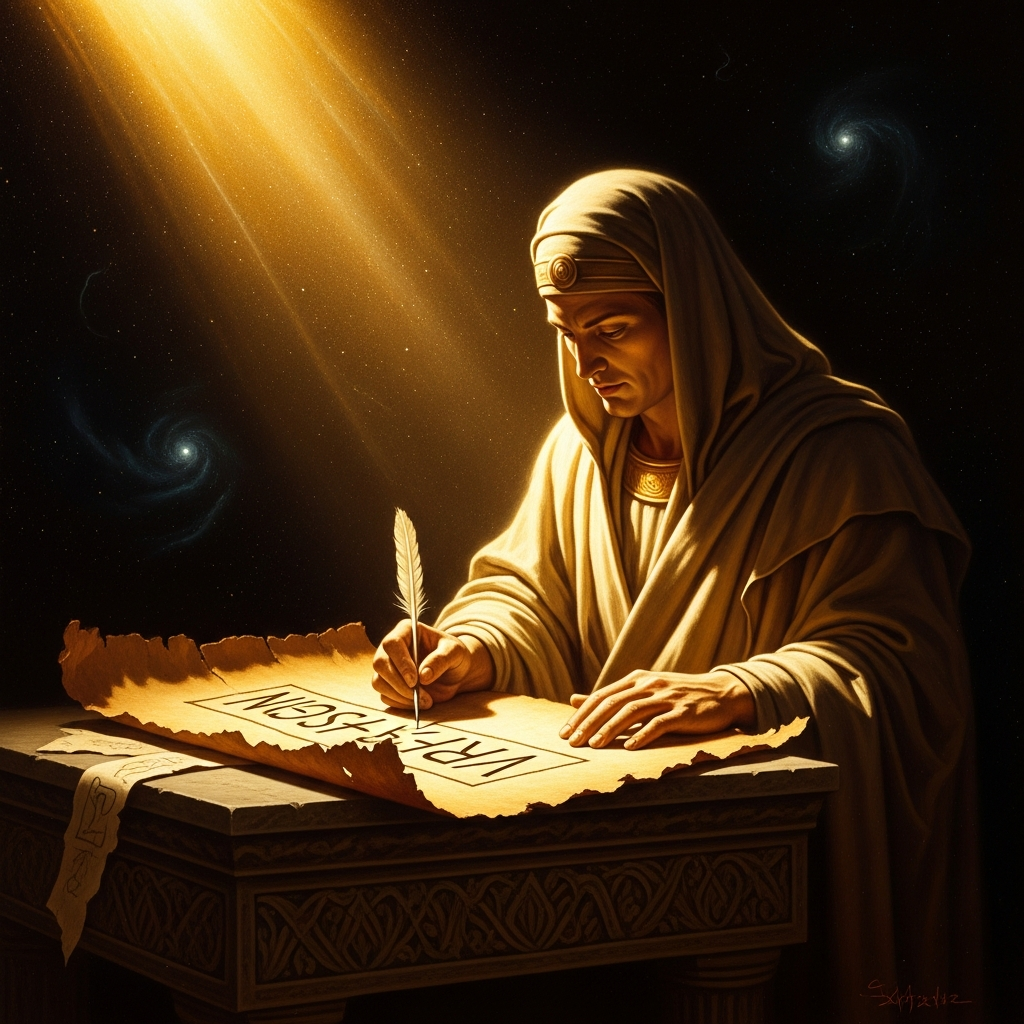
He writes the first glyph.
This is the moment the tradition fixes on, because the calendar and writing are the same invention expressed in two forms. The glyph is scratched into bark paper with a fine brush of split reed and black pigment made from carbon and resin. It is tiny — smaller than a thumbnail — and it contains an enormous amount of information, the way the first cell of anything contains the plan for what follows. The glyph for the first day is also the glyph for the creator who records it, which is also the glyph for the sun rising through the serpent’s body, which is also the glyph for Itzamna himself — because the god of writing and the act of writing and the thing written are not, in the Maya system, separable categories. The scribe is always present in the text.
He sets the glyph down. He looks at it. He looks at the cosmos arranged before him, which now has a before that it did not have a moment ago.
The second day begins.
The count will run for 5,125 years. The farmers will plant the corn and speak to the seed on days whose names are already present in the count. The kings will celebrate the katun endings and the baktun endings in ceremonies of extravagant labor — massive stone monuments, blood offerings, feasts that last for weeks — because the calendar requires the world to notice it at its turning points, to acknowledge that it has been fifty-two years, that it has been four hundred, that the count is still running and the world is still here to run it.
The scribes will copy the codices by lamplight in the cool of the dry season, recording dates that reach back before memory and forward beyond any single human lifetime, in a system so exact that when the Spanish arrive in 1519 and the Maya calendar meets the European calendar for the first time, the conversion will be possible, and the past will be recoverable, and Itzamna’s first glyph will turn out to have been the first sentence of everything that follows.
Time is not discovered. It is made. The universe does not hand us its structure — we impose a structure and then live inside it, and after long enough the structure feels like the universe itself. Itzamna invented a calendar because he understood that the gods, like the people they would eventually shape from corn dough, need to know what day it is. He is an old man, toothless, holding the first glyph. It is August 11, 3114 BCE. Tomorrow is the second day. The count is now running and will not stop.
Scenes
Itzamna, depicted as an old man with a toothless jaw and great age in his face, holds the first glyph of the Long Count above a dark and undivided cosmos
 Generating art…
 The Lord of the Heavens inscribes the first day-sign on bark paper — the world made legible, time made countable, history made possible
 Generating art…
 Itzamna as the two-headed celestial serpent through whose body the sun rises and sets — the cosmic interval that measures the first day from the last night
 Generating art…
 Echoes Across Traditions
Entities


Sources
- Anthony Aveni, *Skywatchers of Ancient Mexico* (1980)
- David Freidel, Linda Schele, and Joy Parker, *Maya Cosmos: Three Thousand Years on the Shaman's Path* (1993)
- Karl Taube, *The Major Gods of Ancient Yucatan* (1992)
- Michael D. Coe and Stephen Houston, *The Maya* (9th ed., 2015)
- John Justeson, *The Origin of Writing Systems: Preclassic Mesoamerica* (1986)