Combat Profile
Codex Celestial
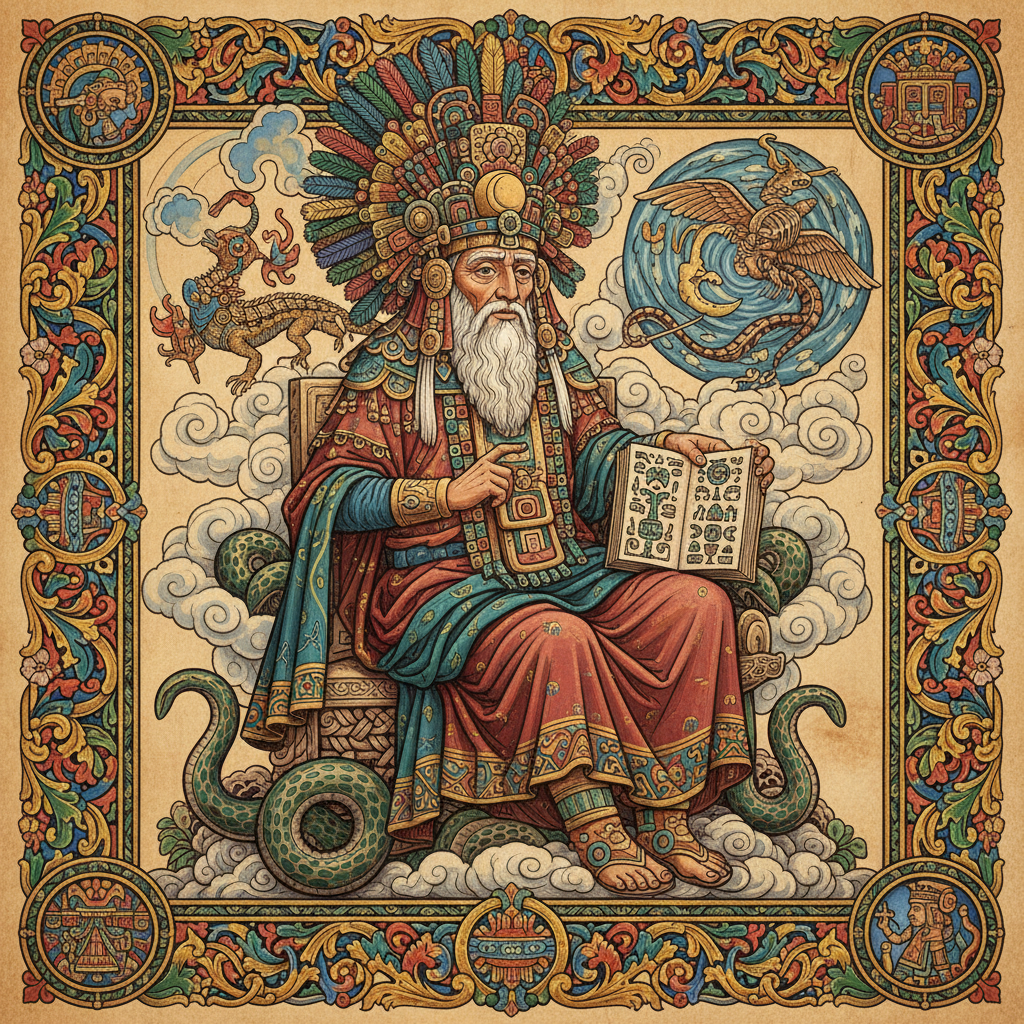
Itzamna rewrites fate itself, reshaping the fundamental laws of creation and time to achieve his divine will.
Supreme Architect
All healing, divination, and calendar-based effects under Itzamna's influence are doubled in potency and cannot be negated by mortal magic.
Ancient and distant -- he created the world but increasingly withdrew, leaving its management to younger gods
“He gave us the glyphs so that time could be recorded. He gave us the calendar so that the gods could be tracked. He gave us cacao so that the sacred drink could open the way between worlds.”
Lore: Itzamna (possibly “Iguana House” or “Itzam Deity”) is the supreme creator god of the Yucatec Maya — the lord of heaven, the inventor of writing and the calendar, the first priest, and the source of all knowledge. He is typically depicted as a benevolent, cross-eyed old man (cross-eyes were considered beautiful among the Maya) with a large Roman nose and toothless jaw. He is the husband or counterpart of Ix Chel (the moon goddess) and the father of the Bacabs, the four gods who hold up the sky at the cardinal points.
Itzamna’s invention of writing is theologically significant. The Maya developed the most sophisticated writing system in the pre-Columbian Americas — a full logosyllabic script capable of expressing any thought in the language. For the Maya, writing was not a secular technology but a divine gift from Itzamna himself, and scribes (ah tz’ib) were a revered class of artist-priests whose work was understood as sacred. The Maya codices (only four survive the Spanish book-burnings) were not mere records but sacred objects imbued with divine power. (Schele & Freidel, A Forest of Kings) When Bishop Diego de Landa burned thousands of Maya manuscripts at Mani in 1562, he described the Maya weeping and said it “caused them great pain.” (Landa, Relacion) He was not destroying books. He was destroying the physical medium of a god’s gift to humanity.
Parallel: Gods who invent writing appear across the ancient world: Thoth (Egyptian), Nabu (Mesopotamian), Odin (Norse, who sacrificed himself to gain the runes). The parallel with Odin is particularly rich: both are old, wise, supreme gods associated with writing, knowledge, and sacrifice. Odin hung on Yggdrasil for nine days to gain the runes; Itzamna gave the glyphs from his throne in heaven. The theological assumption is the same: writing is too powerful to be a human invention. It must come from the gods. And in each tradition, the destruction of sacred texts is understood not as the loss of information but as the killing of something alive.
2 min read
None -- he is above the conflicts of the other deities
*Popol Vuh*; *Chilam Balam*; Taube, *The Major Gods of Ancient Yucatan*; Coe, *The Maya*