Combat Profile
Divine Synthesis
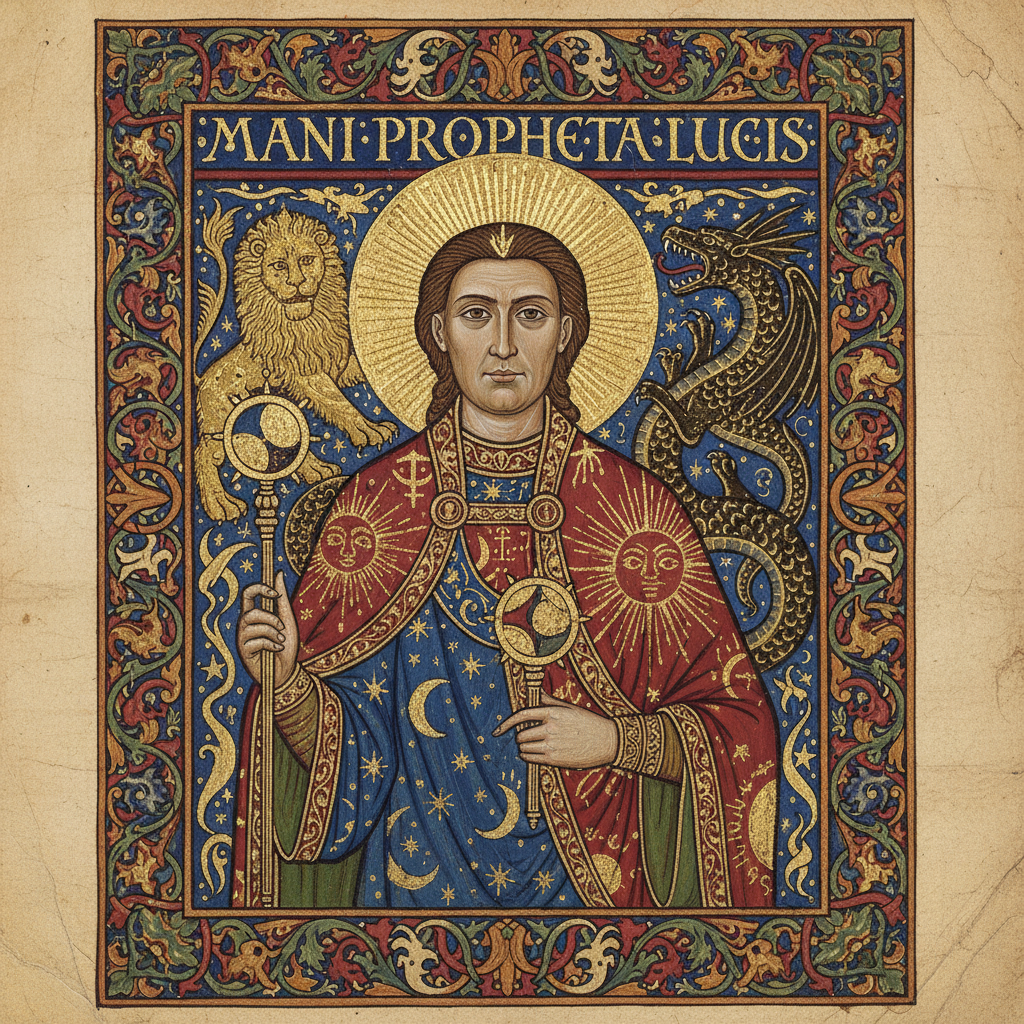
Mani temporarily unifies all contradictory faiths and philosophies into a single coherent truth, granting all allies perfect clarity and understanding of their enemies' nature.
The Seal of Prophets
Mani's presence radiates absolute certainty and revelation; all illusions and deceptions within his domain are dispelled, and he cannot be misled by false information.
Mortal; dependent on political patronage that ultimately turned against him
“Zoroaster came to Persia and taught. The Buddha came to India and taught. Jesus came to the West and taught. After them, this revelation has come down and this prophecy has appeared in this last age through me, Mani, the Apostle of the God of Truth.”
Lore: Mani was born in 216 AD in Mesopotamia (modern Iraq) into a Jewish-Christian baptistal sect, the Elchasaites (Cologne Mani Codex). At ages 12 and 24, visions came — from his “heavenly twin” (al-Tawm), a divine spiritual counterpart — revealing the true nature of the cosmos: a war between Light and Darkness with the material world as temporary battlefield (BeDuhn, The Manichaean Body). Mani concluded that Zoroaster, the Buddha, and Jesus had received genuine revelations but their teachings had been corrupted by their followers. He would be the final prophet, the Seal. He would write his own scriptures and paint his own illustrations to prevent distortion (Living Gospel).
This was audacious beyond measure. Mani did not emerge from one tradition and critique the others. He claimed to complete all of them. He traveled to India, studied Buddhism firsthand, and incorporated its non-violence and vegetarianism. He grew up Christian and absorbed Gnostic cosmology. He lived in the heart of the Zoroastrian world and adopted its radical dualism. Then he fused everything into a single universal religion with himself as the final authority.
For a time, it worked. Mani won the patronage of Sasanian King Shapur I (Shabuhragan), who let him preach throughout the Persian Empire. Manichaean missionaries spread east along the Silk Road and west into the Roman Empire (Lieu, Manichaeism in the Later Roman Empire and Medieval China). When Shapur I died, the Zoroastrian high priest Kartir turned King Bahram I against Mani (Cologne Mani Codex). In 274 AD, Mani was arrested and executed — accounts vary (flayed alive, crucified, or left in chains until he died). His skin was reportedly stuffed with straw and hung at the city gate as a warning.
It didn’t work. The religion exploded after his death.
Parallel: Mani maps onto Jesus, Muhammad, and the Buddha — but with a critical difference. All four founded world religions. All four claimed divine revelation. But Mani’s religion died. Jesus’s survived persecution and became the state religion of Rome. Muhammad’s survived opposition and conquered the Middle East. The Buddha’s survived and spread across Asia. Mani’s was destroyed by all three. He is the prophet whose revelation was consumed by the very traditions he claimed to fulfill.
2 min read
The Sasanian priesthood (Kartir), who convinced King Bahram I to have him executed
BeDuhn, *The Manichaean Body*; Lieu, *Manichaeism in the Later Roman Empire and Medieval China*; Gardner & Lieu, *Manichaean Texts from the Roman Empire*; the Cologne Mani Codex